Golden Opportunity: A Young Eagle’s Second Chance

10 minute read. Updated June 2026.

On November 5, 2025, the Yukon Wildlife Preserve’s Rehabilitation Centre admitted a new patient — a juvenile Golden Eagle, estimated to be about two years old, found in the Burwash Landing area.
One-eyed great horned owl in care at the Yukon Wildlife Preserve Wildlife Rehabilitation Centre. photo credit Lindsay Caskenette

The eagle’s story began when a member of the public noticed something unusual — a large bird appearing to be stuck on a chimney. Concerned, they called Yukon Conservation Officers (COs) for help. Responding quickly, the officers discovered the eagle was indeed stuck, possibly frozen to the chimney. They carefully freed the bird and provided a safe, warm place for the night in a crate before contacting the Preserve the next morning
Vet assessment of the one-eyed great horned owl by Yukon Wildlife Preserve Animal Care team. Photo Credit: L.Caskenette

When the eagle arrived at the Preserve, the Animal Care team and veterinarian, Dr. Cori, began a full assessment. The eagle was notably calm — a good sign, given the stressful ordeal it had endured. Weighing in at 2.90 kg, the bird showed no palpable signs of fractures or dislocations. Neurological and sensory tests all appeared normal. However, the team did notice a few bent feathers on the left wing, a slight postural abnormality (the wing was being carried lower than normal), and a small ulcer on the right foot pad.

Encouragingly, the eagle ate with enthusiasm — and by the next day had already gained weight, tipping the scale at 3.2 kg! (We weren’t exaggerating when we said “enthusiastic eater.”)

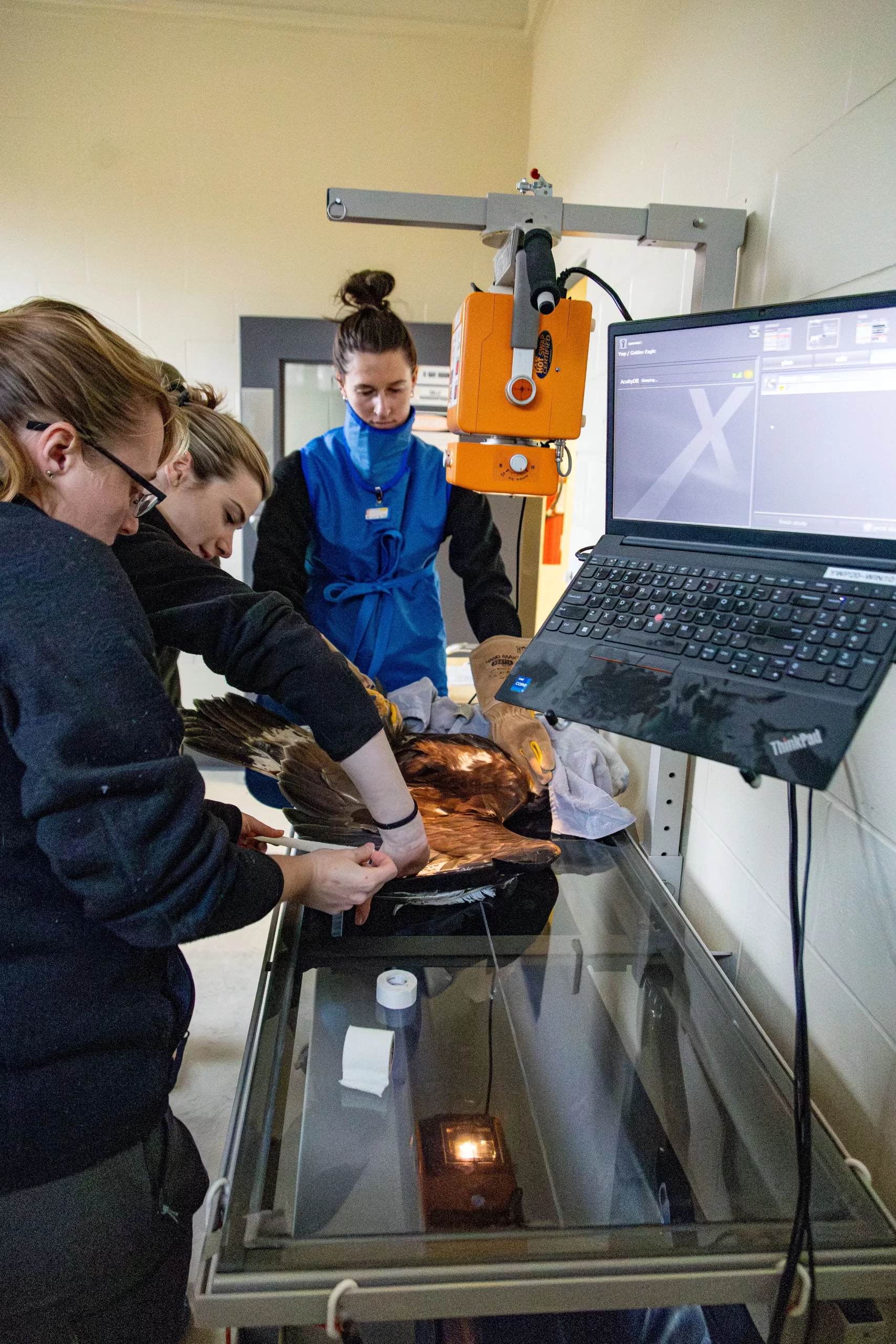
Golden eagle left wing injury - Widllife rehabilitation at the Yukon Wildlife Preserve. Photo credit Lindsay Caskenette. The animal care team xray the animal to further assess injury where no palpable fracture of dislocations were noted.

On November 6, x-rays revealed trauma to the left wing, explaining the low carriage and bent feathers. The team applied a figure-eight bandage to help stabilize the wing. Over the coming weeks, the eagle will remain under close observation, with routine checks and follow-up x-rays to monitor healing.
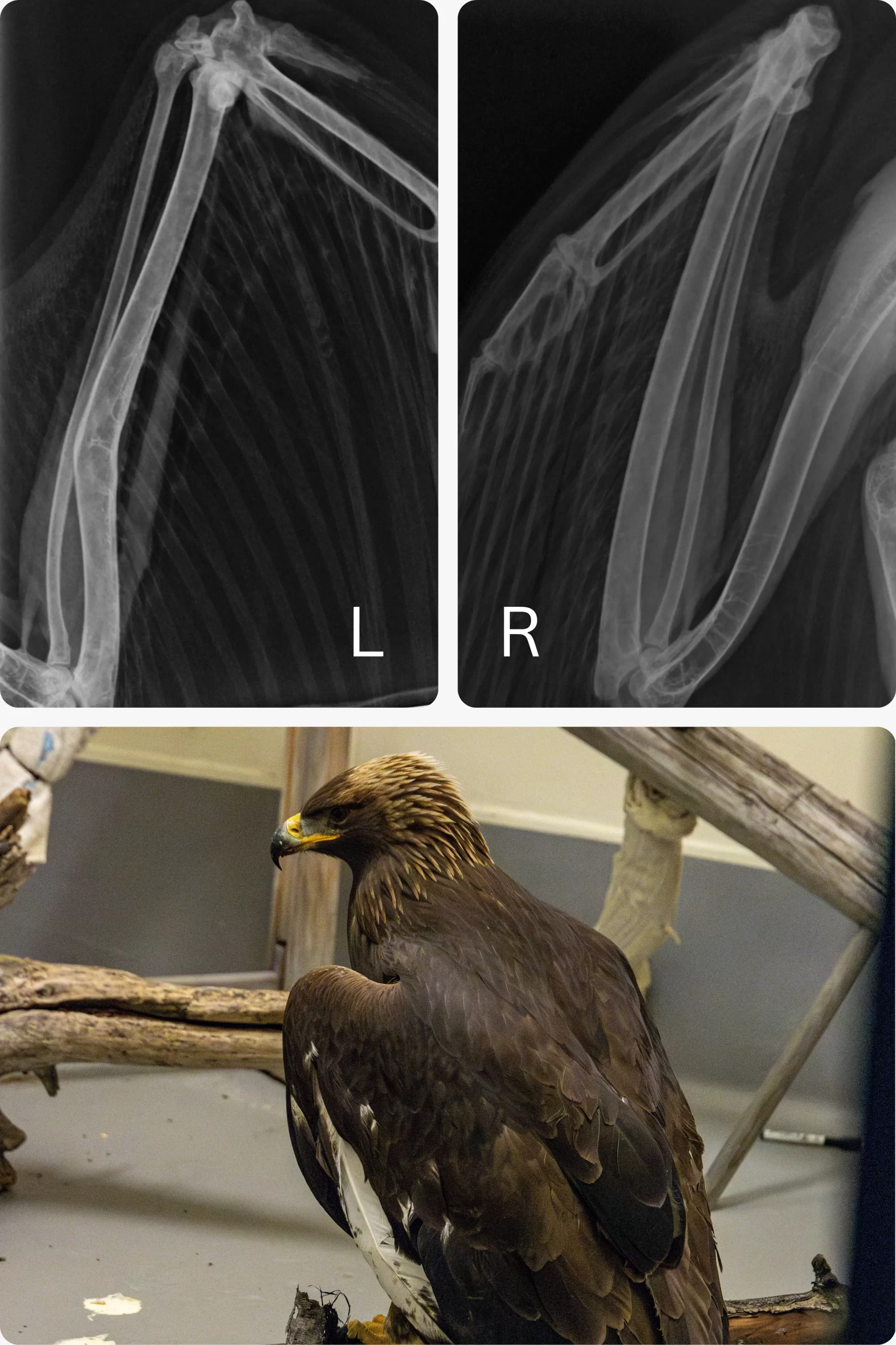
Golden eagle left wing injury - Widllife rehabilitation at the Yukon Wildlife Preserve. Campring the left and right xray of the eagle wings. Can you notice the difference?

Golden eagle wing injury - Widllife rehabilitation at the Yukon Wildlife Preserve. Comparing the left and right xray of the eagles' wings. Can you notice the difference?

This young eagle was found within the Traditional Territory of the Kluane First Nation, and its recovery journey is another reminder of how collective care — from the public, Conservation Officers, and the Wildlife Preserve team — can make a real difference for Yukon’s wildlife.

We extend our thanks to the member of the public who made the call, and to the Conservation Officer Services for their swift and compassionate response. Because of your actions, this eagle now has a fighting chance to heal, regain strength, and, hopefully, take to the skies once more.

If you’d like to support the care of this eagle and other wild patients, please consider donating to the Yukon Wildlife Preserve’s Wildlife Rehabilitation Program. Your contributions help provide the medical care, food, and facilities needed to give injured wildlife a second chance at life in the wild.

June 2026 Update: 

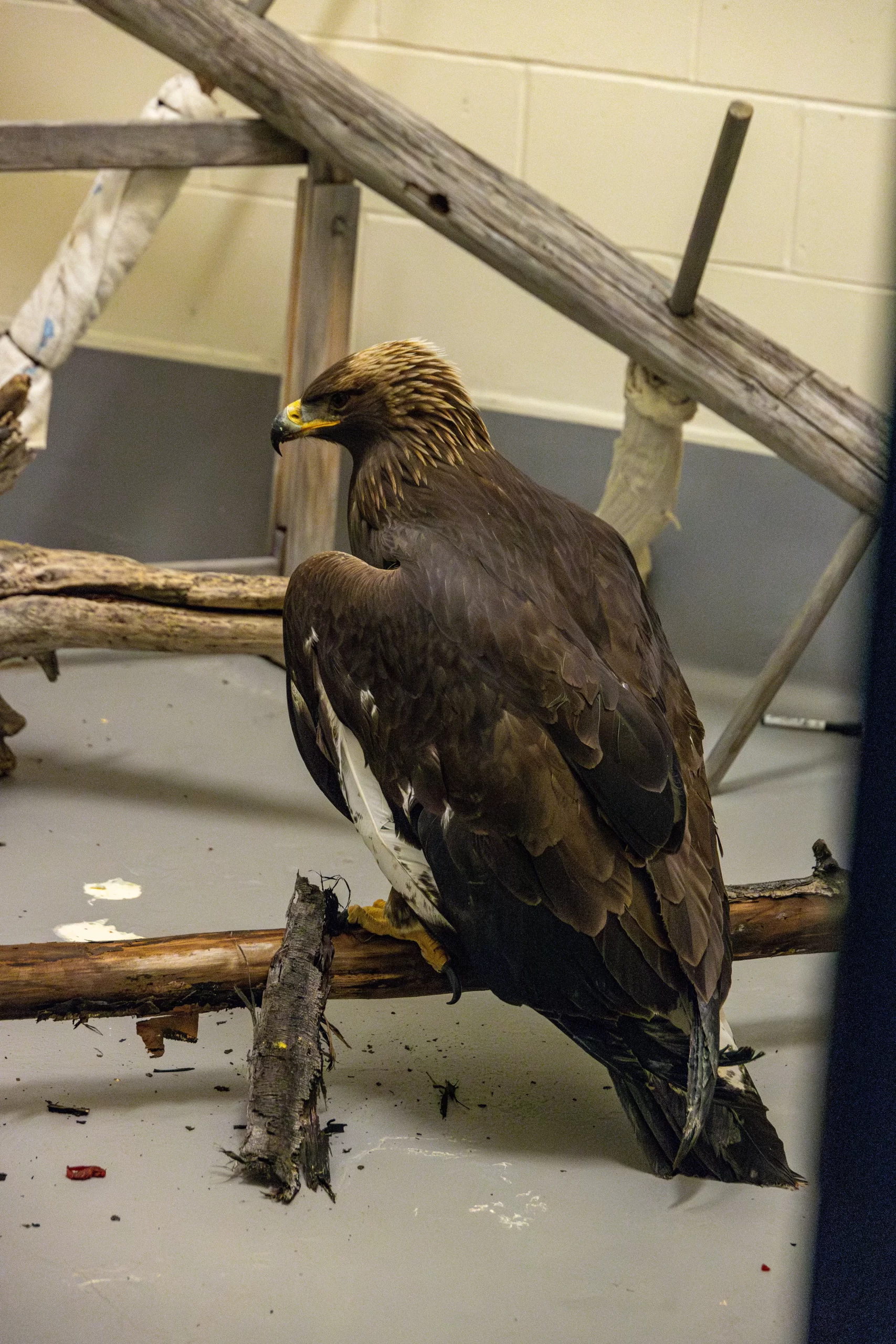
This golden eagle originated from Burwash in Nov.2025. It was brought in by COs after a member of the public called because the bird had been sitting on their chimney and seemed unable to leave. At the time the weather was in the -40s, but its unclear whether the bird was actually stuck to/in the chimney or just unable to fly and not able to leave.
When we received the bird, it was in normal body condition (weight) and it's feather colours indicate it was ~2 years old. However, it had a palpable bend in the ulnar bone of its left wing. On xray you could see the abnormality (see our blog). The bones were already stabilized, but it was unclear whether the bend developed due to a fracture that was healing, or from nutritional deficiencies during bone growth that caused it to grow that way. We leaned towards a fracture, because the bird was already 2 years old and in good body condition so it must have been able to fly well until recently. 
During the first month of care we were unsure whether the bird would regain full flight ability despite the bend in the wing bone. We tried daily flight training that increased in intensity. However, after 4 weeks the xrays still looked the same and the bird had made very little improvement in its ability to fly. This made the bird non-releasable, since it wouldn't be able to hunt or avoid predation. It is calm in the aviary, responds relatively well to the presence of people, and co-existed really nicely with other rehab eagles when they passed through. This makes the bird an excellent candidate for remaining with us on display. It is a native species that few people get to see and is very majestic. 
Normal Husbandry Routine:
The eagle gets fed ~400g of a variety of meats (bison, mice, fish, quail, etc.) split into two meals every day. We adjust the quantity of food depending on the birds body condition, weight, and food interest. It generally does not like fish, but prefers mice and bison. 
Raptors meet most of their hydration needs through the fluids present in whole prey. You will rarely see any raptor drinking unless it is very hot out. We never give water bowls to birds in the winter because they can get water on their feathers or feet that then freezes and permanently damages them. In the summer, its recommended to provide water mostly for bathing, even then raptors rarely drink. 
Every day the animal care team encourages the eagle to fly to reach it's food on various perches twice a day. This helps keep the bird healthy, active, and mentally engaged. During the winter, we have tried to shovel off the platform and various perches as often as possible, but sometimes the snow gets away from us. 
When this eagle flies, it can make good distance from perch to ground, but has a very difficult time getting lift to return by flight to the perch. You will often see it walk or flap through the snow to use the steps back up to the platform. This does not seem to negatively impact its feathers or comfort. Sometimes, it flies so well that it decides to grab the netting and stop up high on the net-wall. It will only hold on for a second, then drop to the ground. Sometimes this looks uncoordinated and can surprise people who do not expect it, but its completely normal and safe. 
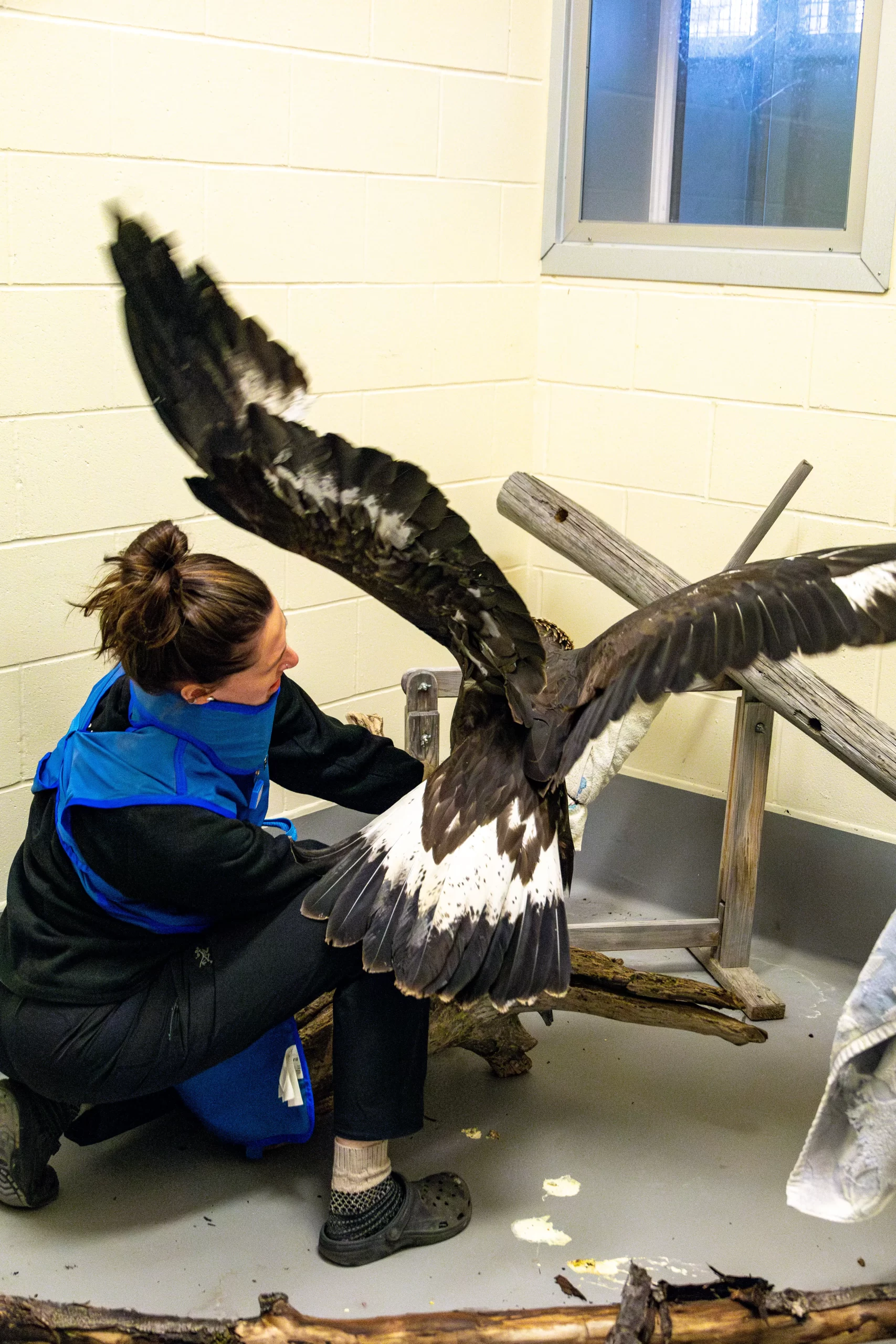
Approximately every two weeks, animal care team members catch the eagle with a net and restrain it in hand for an exam. This is important because perching on similar shaped perches for long periods of time can easily cause pressure sores on bird feet. Pressure sores that are inflamed and can be infected are often referred to as "bumblefoot". During the exam we check the condition of the tips of the feathers on the tail and bottom of the wings. If the perches are not positioned correctly, the feathers drag on the ground and damage begins on the tips. We check the eagle's body condition by feeling the keel (bone along the chest), weigh it on a scale, and examine its eyes, beak, bent wing bone, and overall reactions. Birds can lose or gain body weight very quickly, so it's important to weigh them much more often than mammals. 
Raptors are most comfortable up high, and generally do not like their vision blocked by shelters or walls. Not being able to see their surroundings makes them anxious, which is why you often see them in treetops in the wild. Our eagle has the option to go under the platform and stand on a couple of different perches, but much prefers the exposed top of the platform. Since this bird cannot get a lot of lift during flight, it needs low perches or steps to reach higher ones. Hopefully during the summer we can make a similar set of steps to a high perch on the opposite side of the enclosure for it to alternate and fly back and forth. 
Lastly, the Preserve will repair the current aviary into its original larger L-shape during summer 2026! We might make some small adjustments as well, to create a better space for this eagle to be if it stays in that enclosure long term. We have also discussed more formal training that might allow less handling for weights and health checks moving forward. 
Lindsay Caskenette

Lindsay Caskenette

Manager Visitor Services

Lindsay joined the Wildlife Preserve team March 2014. Originally from Ontario, she came to the Yukon in search of new adventures and new career challenges. Lindsay holds a degree in Environmental Studies with honours from Wilfrid Laurier University and brings with her a strong passion for sharing what nature, animals, and the environment can teach us.

867-456-7400
Lindsay@yukonwildlife.ca

Explore by Category

Explore by Author

0 Comments

Submit a Comment

Your email address will not be published. Required fields are marked *