
I Have to Sell!
adventure
 This article was made possible thanks to support from the Yukon 125 Fund. Learn the incredible history of the Yukon Wildlife Preserve, and Yukon Game Farm from the people of the past through this series of articles.
Danny Nowlan is one of Yukon’s colourful, and at times, notorious characters. He was a polarizing figure who cared deeply for animals and connecting them to kids. He was also the subject of one of Yukon’s most expensive trials ever. His work on the Yukon Game Farm would eventually result in the creation of the Yukon Wildlife Preserve. That is a legacy that is still experienced by many Yukoners – although many of the stories are not known or well understood.
The stories of Danny Nowlan are important threads that are woven through the tapestry of Yukon’s recent history. This project gives us the opportunity to capture and share this history before its lost. This includes the opportunity to celebrate the positive lasting legacy and to learn about and grapple with the challenging aspects of this legacy.
In 2023 historian Sally Robertson collected oral histories from more than a dozen people who knew Danny. Out of this work, Sally wrote a series of stories about Danny and his adventures.
(9 minute read)
Danny and Erika Nowlan had a dream, and the Yukon Game Farm was established in the mid-1960s. Danny had to struggle several times over the years to keep the Yukon Game Farm operating. It was never profitable until the falcon breeding program was in place. Until 1990, the Nowlans were in business to raise breeding stock and sell young animals to international zoos and wildlife farms. In the case of birds of prey, their market was falconers wherever they happened to live. A Dall’s sheep ram might occasionally bring $2,000 and a trained gyrfalcon might be sold for $13,000, but there were many animals on the Farm, and they all needed care and a constant supply of huge quantities of food.
Danny considered selling the Yukon Game Farm in the 1970s, when it seemed there would be never-ending bank loans. This was a time when Danny had close friendships with Yukon Game Branch employees, both guardians (Conservation Officers) and biologists. Government biologist Dave Mossop came to Danny with a plan to replenish Yukon’s wild stock of peregrine falcons. This was successful and, building on that, the Yukon Game Farm purchased gyrfalcons from the government and embarked on a successful breeding program.

Danny with Gyrfalcon
Danny needed even more money to establish the infrastructure and so, instead of selling the whole property he tried to subdivide and sell some lots along the Hot Springs Road. The government prohibited the sale and Danny’s attitude toward bureaucracy started changing towards antipathy. In the end, the approach of a government official elicited a yell of ‘cops’ from Danny and furious barking from his well-trained dogs. Followed by Danny’s famous laugh.
Prohibited from selling titled property, Danny instead sold 999-year leases. The government challenged this sale, and Danny won in court, so the parcels became titled land. Selling the road frontage kept him in business for a while, and also had the advantage of providing some protection for the animals. Before they were moved away from the road, there were incidents of animals being injured and one ram sheep with trophy-sized horns was killed.
In the mid-1980s, Danny, his second wife Uli, and well-respected biologist Dave Mossop were arrested and dragged into court on charges associated with the capture and illegally selling of endangered falcons to wealthy Saudi Arabians. Operation Falcon was an undercover operation that started in the United States and reached into the Yukon. The Yukoners were judged not guilty of all charges, but the trial affected reputations and bank accounts. After the trial, the Game Farm’s elaborate infrastructure for breeding, raising, and replenishing wild stocks was in shambles, and Danny and Uli were no longer able to realize a profit from selling the birds they were so successful at raising.
In the 1980s, elk farming became a profitable business in Canada and Danny was quick to acquire a herd of about 300 animals. He and a number of other Yukoners became successful elk farmers before the Korean market for Canadian elk antlers and velvet collapsed. Some elk farmers in the United States changed their operations to hunt farms, places where hunters could pay to shoot animals. The only legal option in the Yukon was the sale of elk meat, and that was not part of Danny’s vision of an educational preserve to showcase Yukon wildlife. He told a friend that the day he had to sell a pound of elk meat was the day he was out of business.

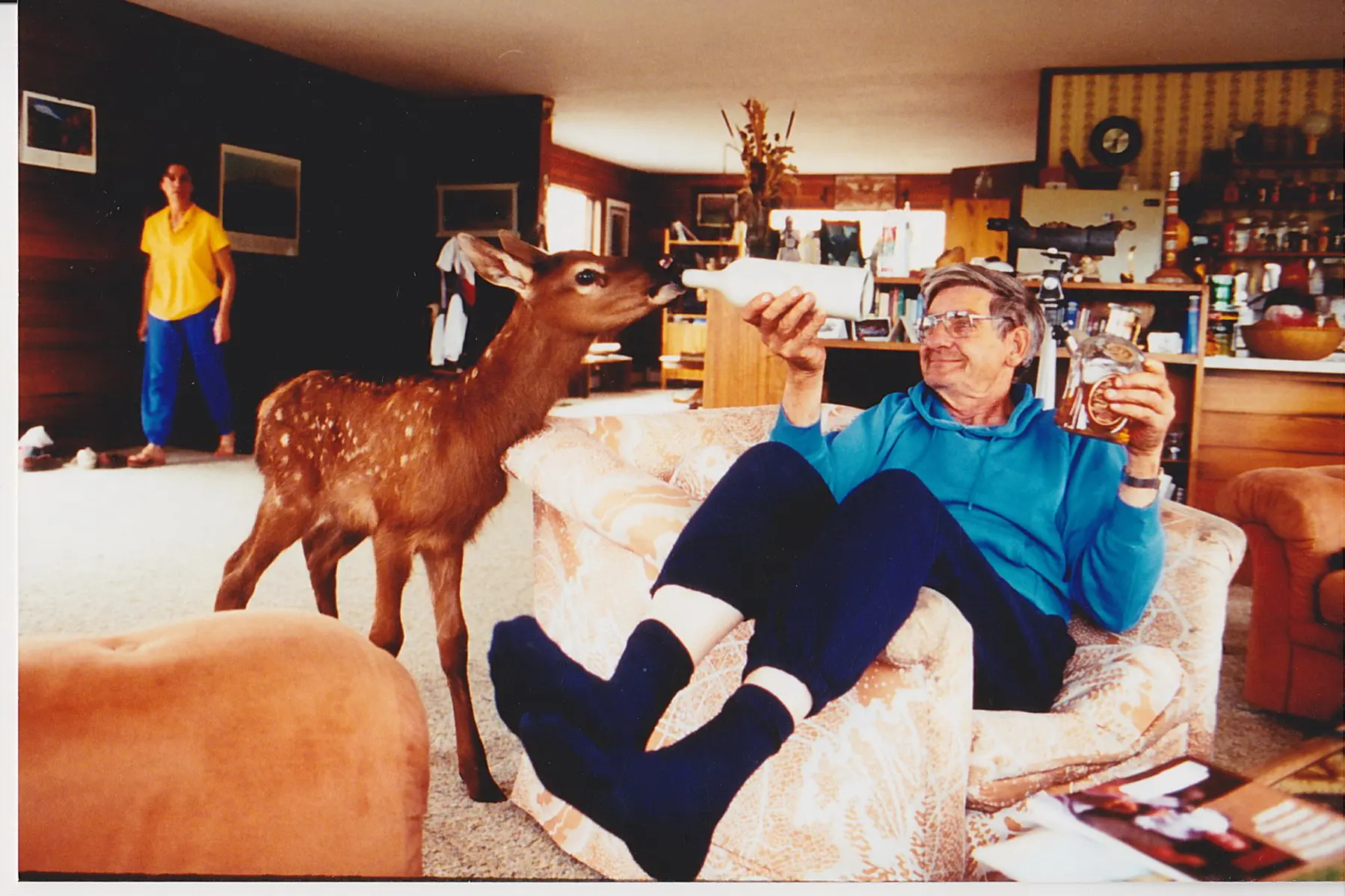
Elmer-1st and Danny especially favorite elk bull came from Chuck and Clara from California 1983 visit.
Fortunately, just at this time the Nowlans were approached by Holland America to provide a tourist attraction for the company’s bus tours. This was in line with Danny’s vision. He needed to upgrade the roads and fences, and acquire more northern species, but the Nowlans were still able to sell animals and care for the injured and abandoned ones that were constantly being dropped off at their door. This change in direction was formalized by a change in name; the Yukon Game Farm became the Yukon Wildlife Preserve in 1989.

Original logo created by Peregrine Nowlan in 1989 when the name change occured from Yukon Game Farm. Later when the facility was sold and run as a non-profit the name remained and the logo updated to its current version.
Around 2000, Danny was once again faced with the serious problem of keeping the operation in business. Animal sales were still an option, but there was a dawning awareness in Canada of spreading diseases affecting wildlife. Danny needed permits to move animals across borders, and these became increasingly difficult to obtain. The matter came to a head for the Yukon Wildlife Branch when public attention was drawn to one of Danny’s mountain goats that appeared on a steep hill across the North Klondike Highway from the sod farm. Government officials were worried about the transmission of disease from domestic animals to wildlife, and two escaped mountain goats could have travelled past agricultural farms containing domestic goats.
Danny was unable to recapture his animals, and the Yukon government’s Philip Merchant came to the rescue with a helicopter and a tranquilizer gun. The story of the capture is a harrowing tale for another time, but no animal (human or goat) was terribly injured, and Danny was presented with the bill.
Danny said, “I want to go fishing” and he started looking for buyers. He could have made a lot of money by letting a developer divide the Game Farm into acreages. Many Yukoners were reluctant to see this happen, and the Friends of the Yukon Wildlife Preserve was established in 2002. The Board of Directors included successful businesspeople, educators, and wildlife biologists who recognized the Preserve’s potential economic, preservation, and educational worth to the Yukon. The society tried to raise funds to buy and operate the facility as a business, and they received support from individuals and potential partners.
2002 CBC Interview with Danny Nowlan
In July 2003, the Yukon Fish and Wildlife Management Board wrote a letter to support a proposal where a not-for-profit society would run the facility with assistance from the Yukon Government, as long as the facility obtained accreditation from the Canadian Association of Zoos and Aquariums. The government, for many reasons, was reluctant to commit to any involvement at that time, and the Board of Directors dissolved the Friends of the Yukon Wildlife Preserve association in August 2003.

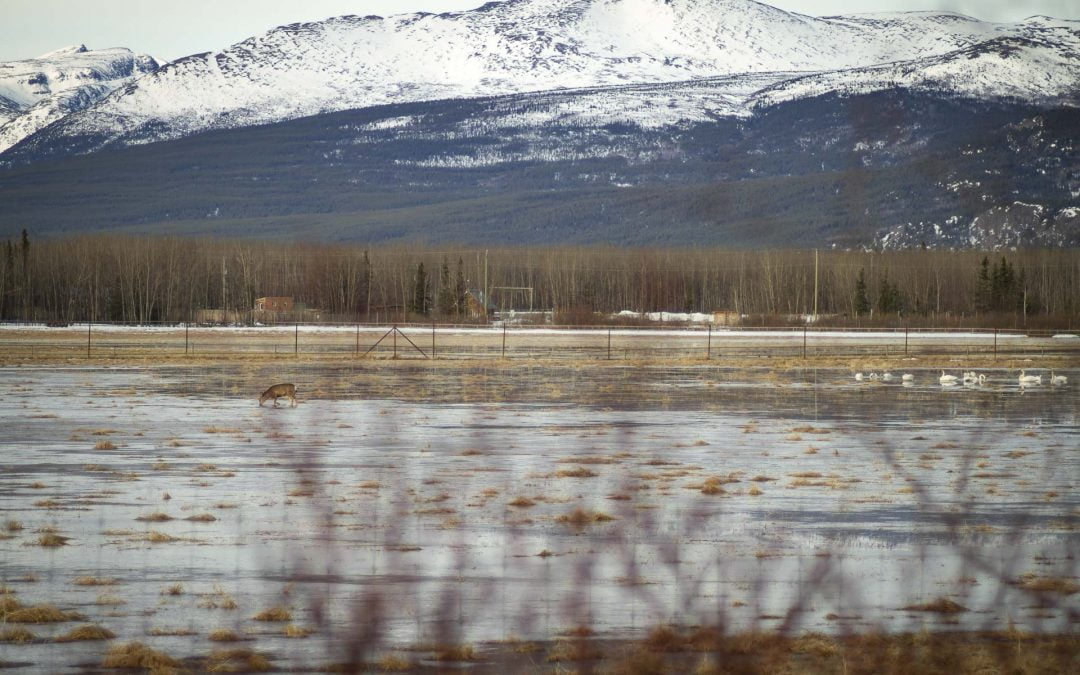
The public facing entrance to the Yukon Wildlife Preserve. Photo Rebecca August 2004.
There are many opinions about why the government persuaded a number of the original Friends and others to form an operating society, and then purchased the Yukon Game Farm in April 2004. Danny talked to the media and there was considerable public pressure in support of the sale. It was, and remains, a controversial decision especially for those opposed to seeing wildlife in pens. However, the Yukon Wildlife Preserve is a delight for children of all ages, and the expansive habitats created by Danny Nowlan make the residents very happy.
About his ability to get things done, Wendy Brassard says Danny would get these ideas and he wouldn't abandon them. He wouldn't just let them die or turn away from them. He'd think about it, he'd read because there was no Internet back then, he'd make phone calls, and the next thing you know, everything's changed. And he just kept evolving. He was such a good example of ingenuity and resourcefulness, and never say die. Just if you think it's right and it's going to work and it's a good thing? Do it.” David Smiley says Danny was an amazing character; that guy was different. Both good and bad. He had a rough side and he had a Grade 3 education. But he could develop a plan that somebody from a university would have trouble figuring out the nuances. He was a good planner. Randy Hallock concluded that Danny was interesting and always full of ideas. He just built the place and not much could stop him. He had ideas, and he made them work. People telling him ‘no’ just made him that much more driven.

Minister Dixon, Department of Environment, Yukon Government and YWPOS board member Bill Klasson.
Photo taken 2013 on the signing of a 5 year agreement.
David Mossop is involved with the Game Farm in its current form as the Yukon Wildlife Preserve. He says it's interesting that all these years later, they haven't changed anything. It's basically exactly as Danny and Erika envisioned it – except brought to fruition a lot more. Their idea was to create something where the children of the Yukon could come and see the creatures that live here. And that's basically what happened.
The memories that were collected during this oral history project speak to the impact that Danny had on so many friends, kids, and animals - and the Nowlans’ legacy remains intact for Yukoners and Yukon visitors. We think Erika would be proud to see a fully realized wildlife preserve with its visitation of wide-eyed children. Uli Nowlan often visits the facility and keeps a watchful eye on the operation. Danny didn’t become an avid fisherman, but he did relax knowing his animals, and his legacy, were in good hands.
• • •
On June 12, 2004, was the Grand Opening of the Preserve!
Danny Nowlan Life and Death - June 4th, 1929 - October 23rd, 2011.
Photos gratefully provided by Uli Nowlan.
Sally Robinson, October 2023
with words from interviews with Uli Nowlan, David Mossop, Philip Merchant, Wendy Brassard, Randy & Maria Hallock, David Ford.

Sally Robinson
Vintage Ventures - Researcher & Writer

Lindsay Caskenette
Manager Visitor Services
Lindsay joined the Wildlife Preserve team March 2014. Originally from Ontario, she came to the Yukon in search of new adventures and new career challenges. Lindsay holds a degree in Environmental Studies with honours from Wilfrid Laurier University and brings with her a strong passion for sharing what nature, animals, and the environment can teach us.


Recent Comments