Look Twice: How to Tell Juvenile Bald and Golden Eagles Apart

Look Twice: How to Tell Juvenile Bald and Golden Eagles Apart

Look Twice: How to Tell Juvenile Bald and Golden Eagles Apart

5 minute read –

These young raptors may look alike at first glance, but their feathers, legs, and eyes tell a story.

At First Glance, They Can Totally Trick You

If you’ve ever looked up and spotted a massive dark eagle soaring overhead and thought, “Is that a Golden? No, wait. Juvenile Baldie?”  you are absolutely not alone.

These birds can look incredibly similar when you’re only seeing silhouettes or quick flyovers. Even at the Yukon Wildlife Preserve, where we see eagles regularly, we still have moments where a distant speck in the sky sparks that tiny flicker of curiosity.

If you slow down and look closely, the differences are actually quite striking.

Left: A juvenile Bald Eagle with its yellow feet and part of its legs exposed.      Right: A Juvenile Golden Eagle with fully feathered legs, all the way to it’s feet.

Right now, our Animal Care Team is caring for a juvenile golden eagle, but in the past,  we’ve admitted several juvenile bald eagles for care. Seeing these two species up close, sometimes side by side, makes it incredibly fun to compare them. You start noticing details you might not notice from a quick glance.

If you are able to clearly see their legs you’ll note that Juvenile Bald Eagles have more of their yellow feet and legs exposed – compared to the Golden Eagle that appears to be wearing some fancy feathered pants.

In the slides above, you can clearly see Bald eagles have a chunkier head and heavy, hooked bill even as juveniles.

The Golden eagles have a slimmer, more streamlined head. They also rock the tell tale golden tips on their head feathers.

While both young Bald and Golden eagles have dark brown eyes, as they age they do change. Bald eagle eyes, lighten to a yellow whereas the Golden eagles eyes turn a more amber hue.

Now here’s where people most often get tripped up – plumage patterns!

Juvenile Golden eagles:

Juvenile golden eagles are mostly a rich, dark brown overall, giving them a uniform appearance compared to young bald eagles. They also have warm golden feathers on the back of the head and neck, which is where their name comes from, even in youth. One of the most reliable features of a juvenile golden eagle is the bold white band across the tail feathers and the clean white patches at the base of the wings. These white areas are crisp and well-defined, and they gradually disappear as the bird matures, fading into the darker brown of adulthood.

Juvenile Bald eagles:

Juvenile bald eagles look much more irregular. Instead of clean patterns, they show patchy white and brown mottling across the body, wings and tail. No two young bald eagles look exactly alike, and they won’t develop the iconic white head and tail until they are four or five years old. As they age, the white feathers on the head and tail slowly increase, becoming more noticeable each year. This gradual shift in plumage is one of the major differences between the two species when they’re young, helping distinguish juvenile bald eagles from juvenile golden eagles.
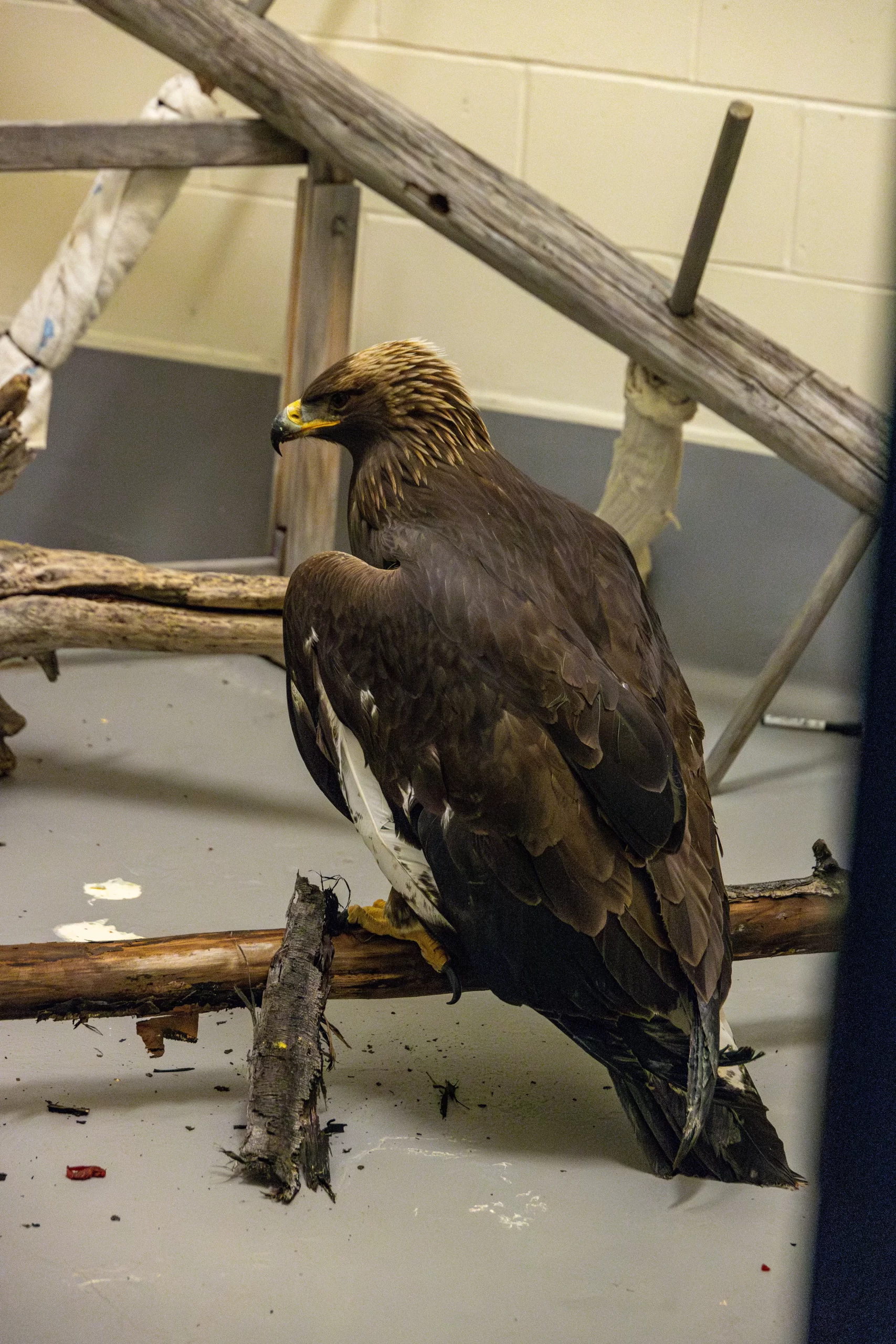
Up close its both easy to see how you could get them mixed up and easy to see their differences. This sequence of photos offers side by side comparisons. Can you tell which is which?

Juvenile eagles can look deceptively similar at first glance, but a closer look at legs, wing and tail pattern and head shape — plus tracking how their eyes and plumage change over time — reveals the differences. These traits make each species unique and fascinating to observe.

Every eagle that comes through our rehab program relies on specialized care, safe housing and dedicated staff — all powered by the generosity of people who care about Yukon wildlife.

If you enjoyed learning about these incredible birds and want to help us continue rescuing, rehabilitating and releasing wildlife, please consider making a donation today.

Your gift directly supports animals in our care — including the eagles featured in this story.
❤️ Thank you for helping Yukon’s wild lives take flight again.
Brittney Forsythe

Brittney Forsythe

She/Her - Visitor Services Coordinator

Brittney joined the Wildlife preserve in the summer of 2023. Growing up on Northern Vancouver Island, surrounded by the temperate rainforest, nature and animals have always been a part of her life. It exploded into a passion, when she started her dog walking business in 2017 and she began spending 6-7 days a week in the forest, rain or shine! This sparked an even deeper appreciation for the cyclical nature of the land and how all of the plants & animals work together symbiotically. She is forever ‘that girl’ on the hike, pointing out different rocks and plants, explaining their origin or what they could be used for medicinally. Brittney and her dog Cedar relocated to the Yukon to help care for 31 sled dogs. She is so excited to expand her local knowledge as a part of the Preserve team.

867-456-7400
 Brittney@yukonwildlife.ca

Explore by Category

Explore by Author

One-Eyed Owl Care Continues

One-Eyed Owl Care Continues

One-Eyed Owl Care Continues

6 – 8 minute read

Care for the one-eyed Great Horned Owl continues here at the Yukon Wildlife Preserve Wildlife Rehabilitation and Research Centre.

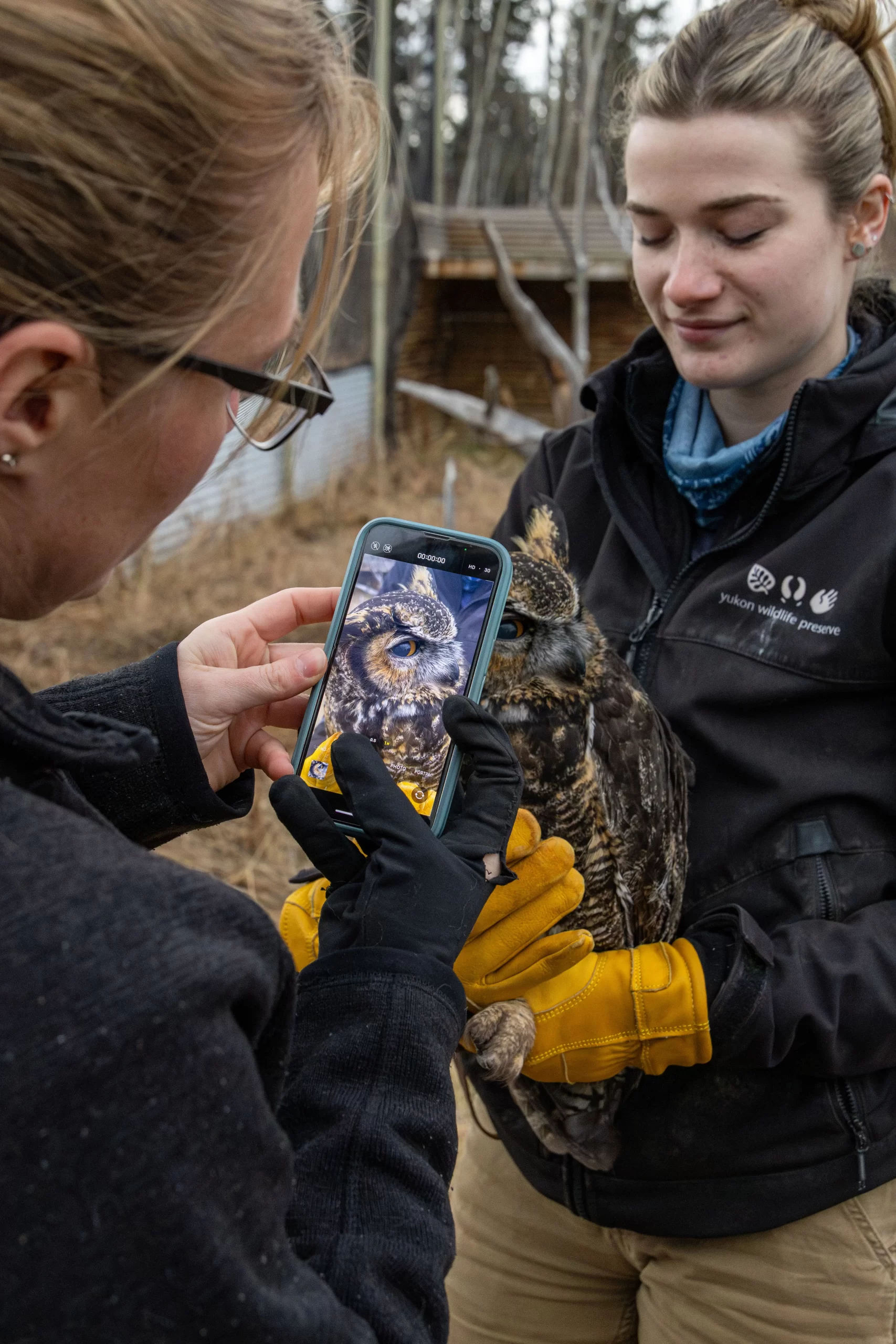
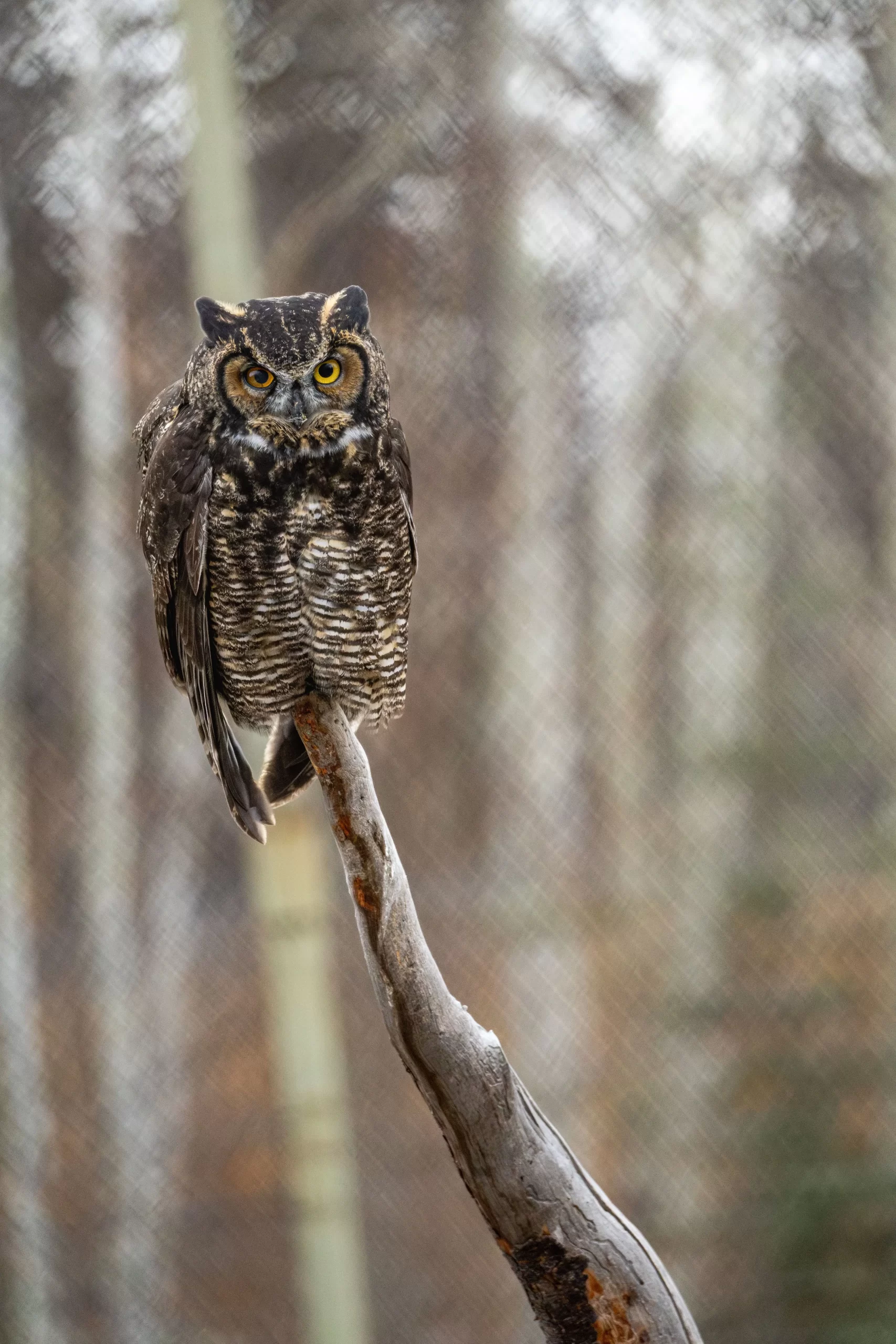
One-eyed great horned owl in care at the Yukon Wildlife Preserve Wildlife Rehabilitation Centre. photo credit Lindsay Caskenette

Since the owl’s story introduction by Connor, this resilient owl has made steady progress under the attentive care of the Preserve’s veterinarian, Dr. Cori. During a recent checkup, the owl weighed at 990 grams (on November 5th) — slightly below the average Great Horned Owl weight of around 1.2 kilograms. However, it’s important to note that this individual is of smaller stature, so this weight is healthy and appropriate for their build.

Vet assessment of the one-eyed great horned owl by Yukon Wildlife Preserve Animal Care team.  Photo Credit: L.Caskenette

As part of the ongoing assessment, the team also conducted several diagnostic tests, including what’s known as a menace test — similar to how doctors might assess human vision — by observing the owl’s eye response to motion and changes in light to evaluate pupil constriction and visual awareness.

Talking with Preserve Veterinarian, Dr. C about the owl's eye assessment

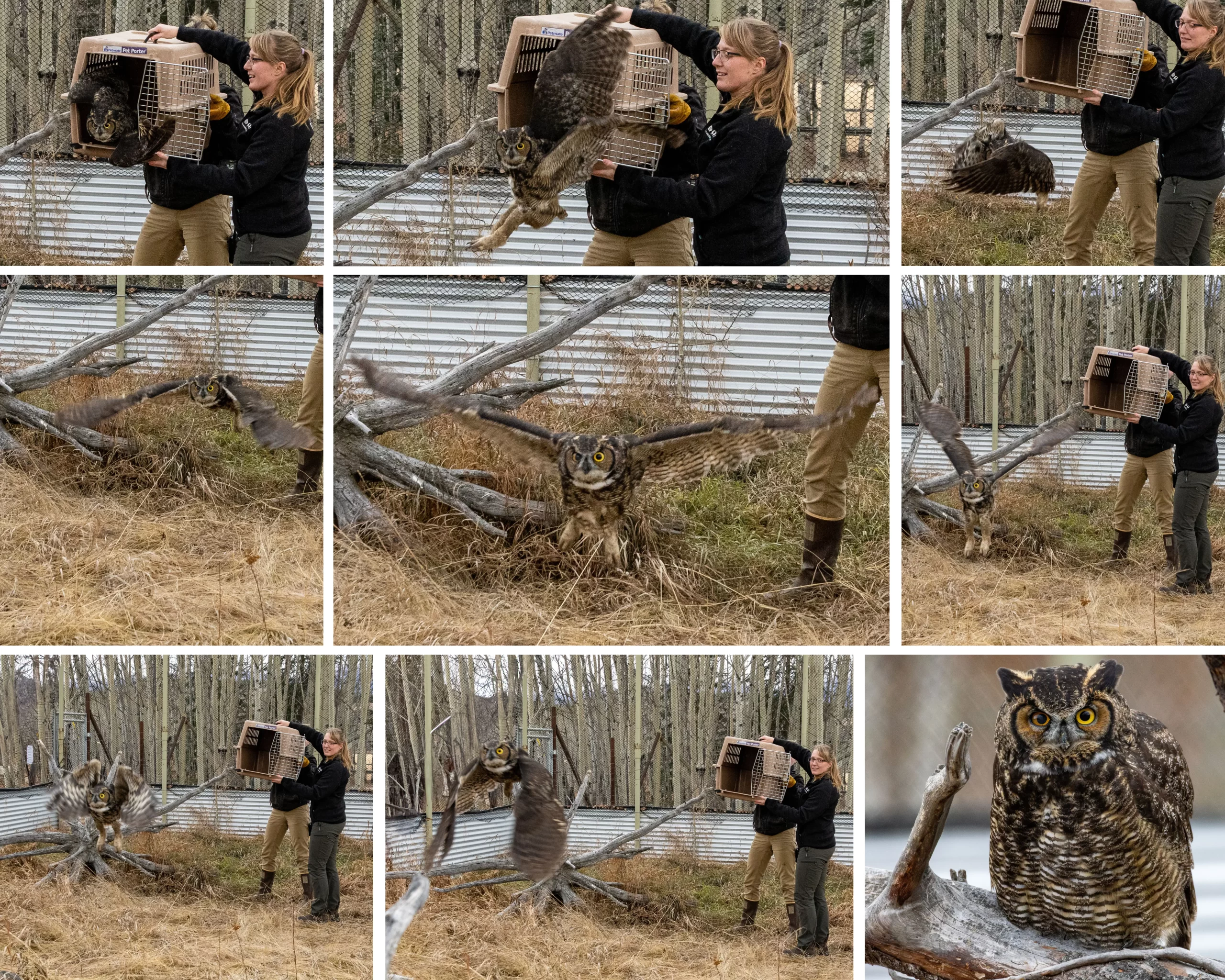
Over the past month, the owl has been living in the large outdoor aviary, where they’ve been working hard to rebuild flight strength and coordination. Encouragingly, the owl has demonstrated natural hunting instincts by successfully capturing live prey during both daylight and low-light conditions — critical for crepuscular and nocturnal animals living in the Yukon where winter is long and the days are short.

The owl will continue to receive care through the winter as we consults with other wildlife care experts and facilities to determine the best long-term outcome — whether that may mean continued care here at the Preserve or, potentially, a return to life in the wild. For now, time (and a little more information) will guide those next steps.

One-eyed great horned owl in care at the Yukon Wildlife Preserve Wildlife Rehabilitation Centre. photo credit Lindsay Caskenette

One-eyed great horned owl in care at the Yukon Wildlife Preserve Wildlife Rehabilitation Centre is seen in several frames flying, gaining lift and perched on a tree. Photo credit L.Caskenette

Each animal’s recovery journey is unique, and this owl’s story continues to highlight the skill, patience, and compassion that go into every case at the Yukon Wildlife Preserve.

Stay tuned for future updates on this remarkable bird — and thank you to everyone whose support helps make this vital rehabilitation work possible.

Story Update: November 20th, 2025:

We’re saddened to share an update about our one-eyed Great Horned Owl, who was found deceased early Wednesday morning, November 12th. There were no visible signs of struggle and no obvious cause at the time.

A post-mortem necropsy has since revealed a necrotic (decaying) lesion on the front left lobe of his brain — a likely consequence of his previous head trauma from a vehicle strike. This condition was not something we could have predicted or prevented. Aside from this lesion, the owl was sexed a male, in good body condition, with no other abnormal findings.

His passing is a difficult loss for our team and for many of you who followed his journey. We’re grateful for the time he spent in our care and for the chance to witness — and share — his resilience and beauty. Our thanks extend to everyone who supported him, especially Sonya, who first found him flightless along the roadside.
Lindsay Caskenette

Lindsay Caskenette

Manager Visitor Services

Lindsay joined the Wildlife Preserve team March 2014. Originally from Ontario, she came to the Yukon in search of new adventures and new career challenges. Lindsay holds a degree in Environmental Studies with honours from Wilfrid Laurier University and brings with her a strong passion for sharing what nature, animals, and the environment can teach us.

867-456-7400
Lindsay@yukonwildlife.ca

Explore by Category

Explore by Author

Golden Opportunity: A Young Eagle’s Second Chance

Golden Opportunity: A Young Eagle’s Second Chance

Golden Opportunity: A Young Eagle’s Second Chance

6 – 8 minute read

On November 5, 2025, the Yukon Wildlife Preserve’s Rehabilitation Centre admitted a new patient — a juvenile Golden Eagle, estimated to be about two years old, found in the Burwash Landing area.

One-eyed great horned owl in care at the Yukon Wildlife Preserve Wildlife Rehabilitation Centre. photo credit Lindsay Caskenette

The eagle’s story began when a member of the public noticed something unusual — a large bird appearing to be stuck on a chimney. Concerned, they called Yukon Conservation Officers (COs) for help. Responding quickly, the officers discovered the eagle was indeed stuck, possibly frozen to the chimney. They carefully freed the bird and provided a safe, warm place for the night in a crate before contacting the Preserve the next morning

Vet assessment of the one-eyed great horned owl by Yukon Wildlife Preserve Animal Care team.  Photo Credit: L.Caskenette

When the eagle arrived at the Preserve, the Animal Care team and veterinarian, Dr. Cori, began a full assessment. The eagle was notably calm — a good sign, given the stressful ordeal it had endured. Weighing in at 2.90 kg, the bird showed no palpable signs of fractures or dislocations. Neurological and sensory tests all appeared normal. However, the team did notice a few bent feathers on the left wing, a slight postural abnormality (the wing was being carried lower than normal), and a small ulcer on the right foot pad.

Encouragingly, the eagle ate with enthusiasm — and by the next day had already gained weight, tipping the scale at 3.2 kg! (We weren’t exaggerating when we said “enthusiastic eater.”)

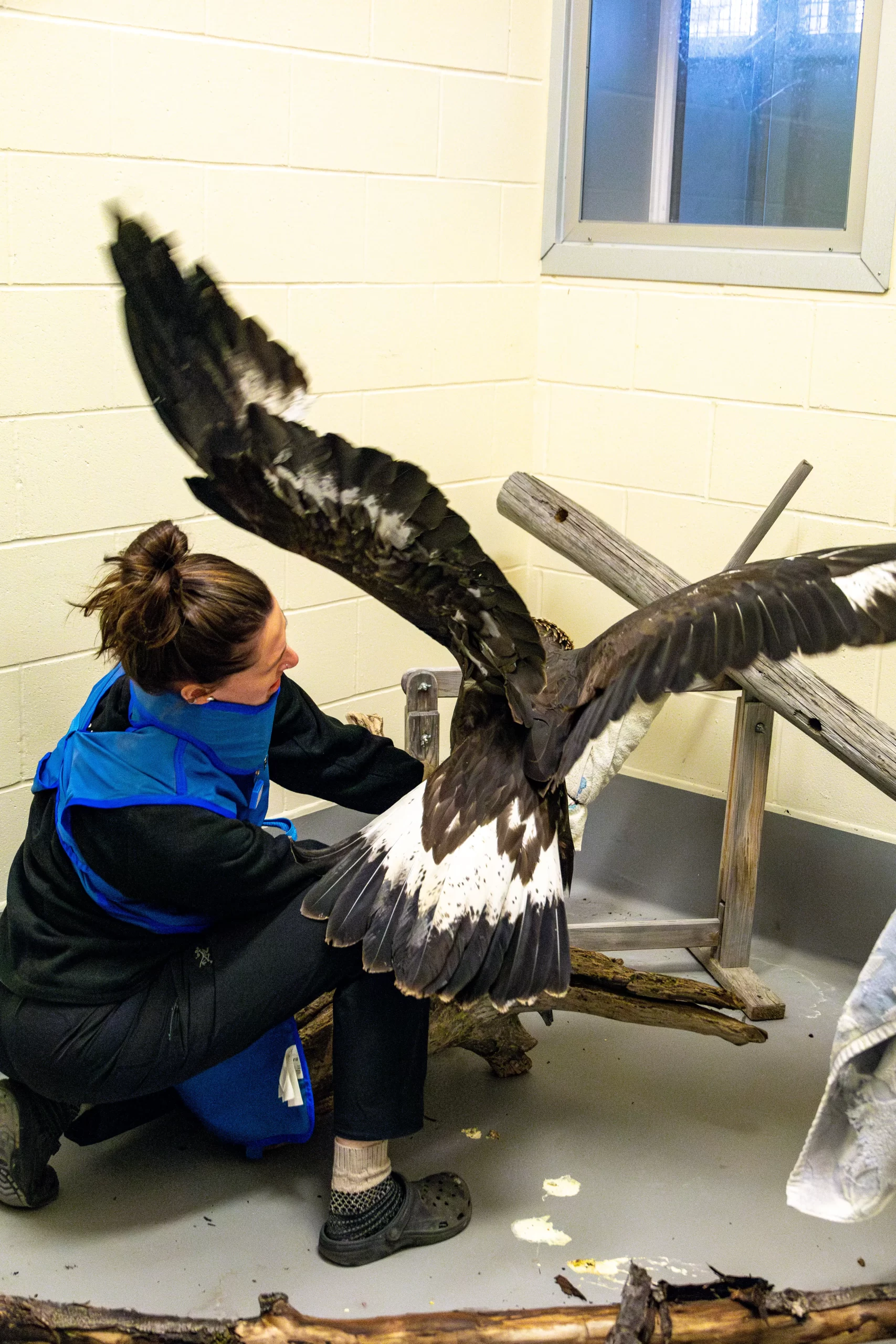
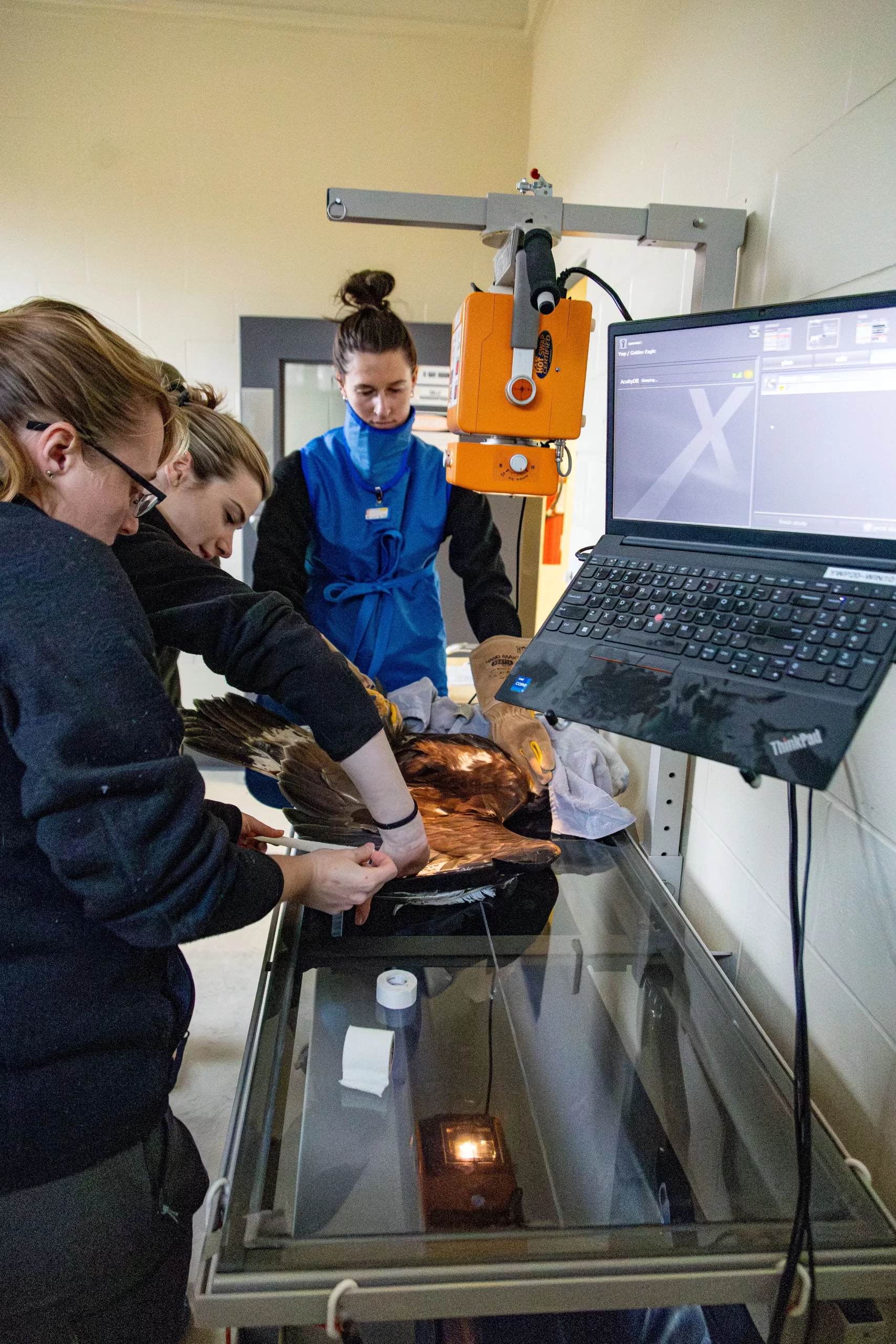
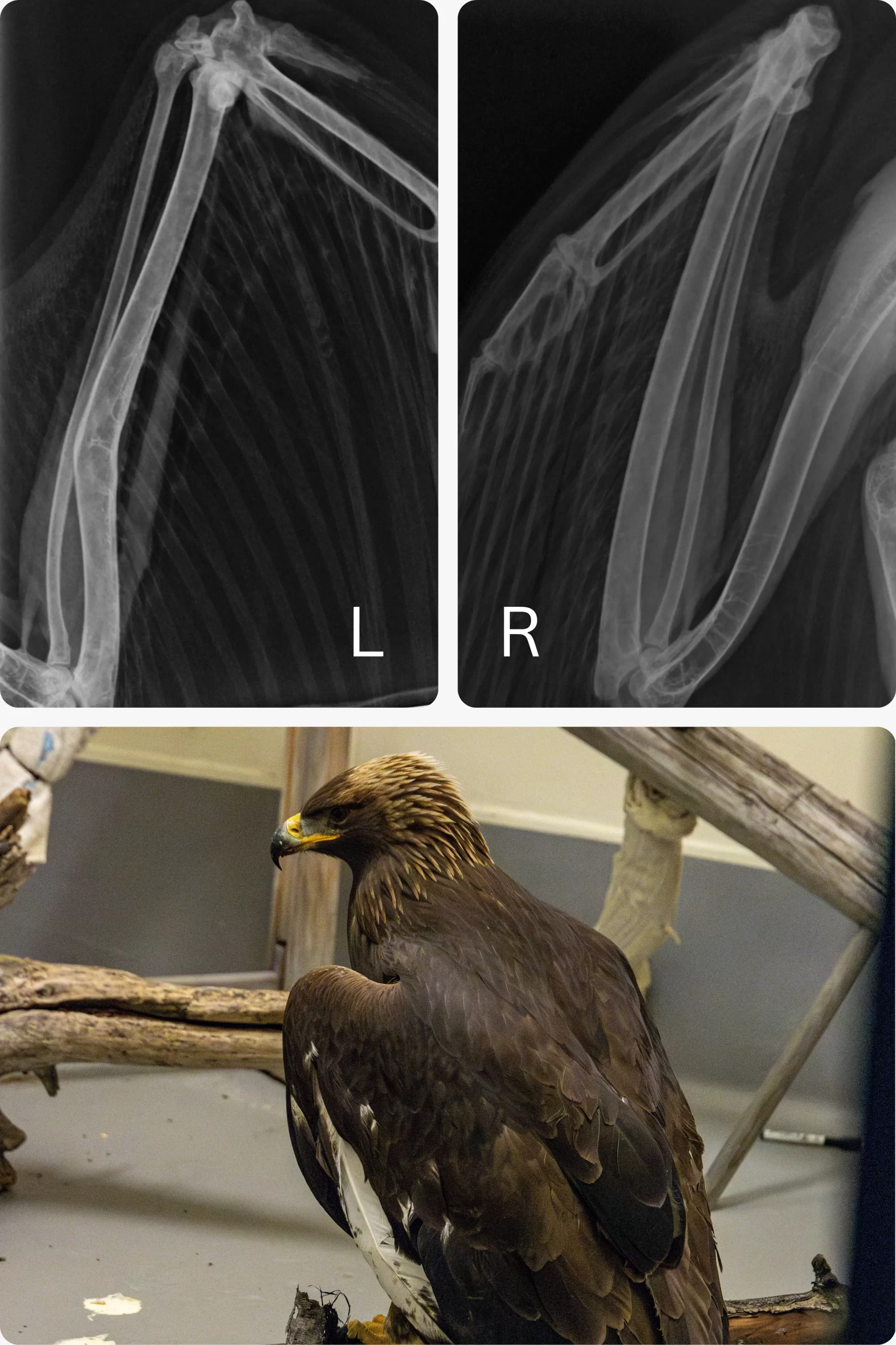
Golden eagle left wing injury - Widllife rehabilitation at the Yukon Wildlife Preserve. Photo credit Lindsay Caskenette. The animal care team xray the animal to further assess injury where no palpable fracture of dislocations were noted.

On November 6, x-rays revealed trauma to the left wing, explaining the low carriage and bent feathers. The team applied a figure-eight bandage to help stabilize the wing. Over the coming weeks, the eagle will remain under close observation, with routine checks and follow-up x-rays to monitor healing.

Golden eagle  left wing injury - Widllife rehabilitation at the Yukon Wildlife Preserve.  Campring the left and right xray of the eagle wings. Can you notice the difference?

Golden eagle wing injury – Widllife rehabilitation at the Yukon Wildlife Preserve. Comparing the left and right xray of the eagles’ wings. Can you notice the difference?

This young eagle was found within the Traditional Territory of the Kluane First Nation, and its recovery journey is another reminder of how collective care — from the public, Conservation Officers, and the Wildlife Preserve team — can make a real difference for Yukon’s wildlife.

We extend our thanks to the member of the public who made the call, and to the Conservation Officer Services for their swift and compassionate response. Because of your actions, this eagle now has a fighting chance to heal, regain strength, and, hopefully, take to the skies once more.

If you’d like to support the care of this eagle and other wild patients, please consider donating to the Yukon Wildlife Preserve’s Wildlife Rehabilitation Program. Your contributions help provide the medical care, food, and facilities needed to give injured wildlife a second chance at life in the wild.

Lindsay Caskenette

Lindsay Caskenette

Manager Visitor Services

Lindsay joined the Wildlife Preserve team March 2014. Originally from Ontario, she came to the Yukon in search of new adventures and new career challenges. Lindsay holds a degree in Environmental Studies with honours from Wilfrid Laurier University and brings with her a strong passion for sharing what nature, animals, and the environment can teach us.

867-456-7400
Lindsay@yukonwildlife.ca

Explore by Category

Explore by Author