I Have to Sell!

I Have to Sell!

I Have to Sell!

This article was made possible thanks to support from the Yukon 125 Fund. Learn the incredible history of the Yukon Wildlife Preserve, and Yukon Game Farm from the people of the past through this series of articles.

Danny Nowlan is one of Yukon’s colourful, and at times, notorious characters. He was a polarizing figure who cared deeply for animals and connecting them to kids. He was also the subject of one of Yukon’s most expensive trials ever. His work on the Yukon Game Farm would eventually result in the creation of the Yukon Wildlife Preserve. That is a legacy that is still experienced by many Yukoners – although many of the stories are not known or well understood. 

The stories of Danny Nowlan are important threads that are woven through the tapestry of Yukon’s recent history. This project gives us the opportunity to capture and share this history before its lost. This includes the opportunity to celebrate the positive lasting legacy and to learn about and grapple with the challenging aspects of this legacy. 

In 2023 historian Sally Robertson collected oral histories from more than a dozen people who knew Danny. Out of this work, Sally wrote a series of stories about Danny and his adventures.

(9 minute read)

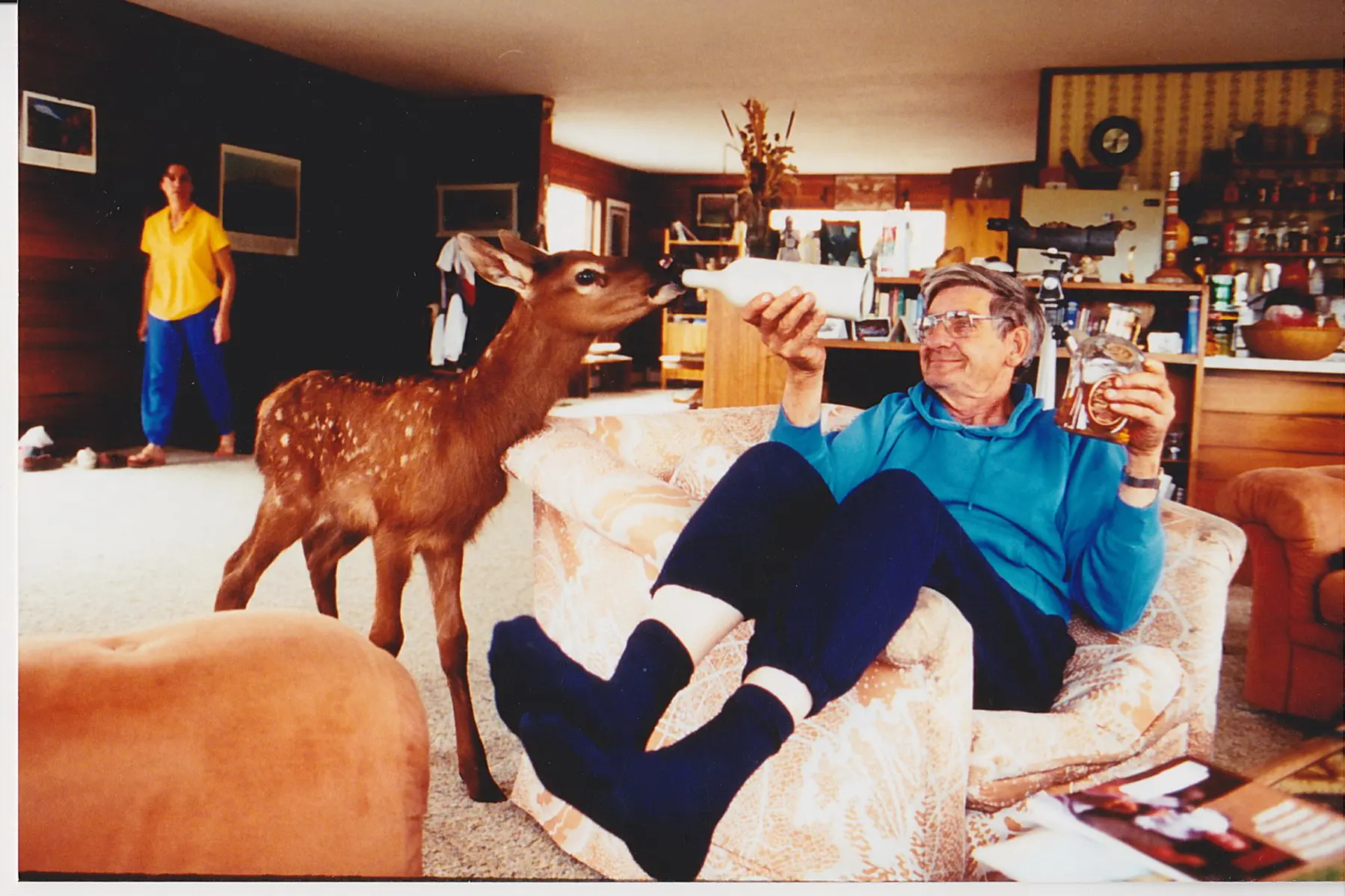
Danny and Erika Nowlan had a dream, and the Yukon Game Farm was established in the mid-1960s. Danny had to struggle several times over the years to keep the Yukon Game Farm operating. It was never profitable until the falcon breeding program was in place. Until 1990, the Nowlans were in business to raise breeding stock and sell young animals to international zoos and wildlife farms. In the case of birds of prey, their market was falconers wherever they happened to live. A Dall’s sheep ram might occasionally bring $2,000 and a trained gyrfalcon might be sold for $13,000, but there were many animals on the Farm, and they all needed care and a constant supply of huge quantities of food.  

Danny considered selling the Yukon Game Farm in the 1970s, when it seemed there would be never-ending bank loans. This was a time when Danny had close friendships with Yukon Game Branch employees, both guardians (Conservation Officers) and biologists. Government biologist Dave Mossop came to Danny with a plan to replenish Yukon’s wild stock of peregrine falcons. This was successful and, building on that, the Yukon Game Farm purchased gyrfalcons from the government and embarked on a successful breeding program.

Danny with Gyrfalcon


Danny needed even more money to establish the infrastructure and so, instead of selling the whole property he tried to subdivide and sell some lots along the Hot Springs Road. The government prohibited the sale and Danny’s attitude toward bureaucracy started changing towards antipathy. In the end, the approach of a government official elicited a yell of ‘cops’ from Danny and furious barking from his well-trained dogs. Followed by Danny’s famous laugh.

Prohibited from selling titled property, Danny instead sold 999-year leases. The government challenged this sale, and Danny won in court, so the parcels became titled land. Selling the road frontage kept him in business for a while, and also had the advantage of providing some protection for the animals. Before they were moved away from the road, there were incidents of animals being injured and one ram sheep with trophy-sized horns was killed.

In the mid-1980s, Danny, his second wife Uli, and well-respected biologist Dave Mossop were arrested and dragged into court on charges associated with the capture and illegally selling of endangered falcons to wealthy Saudi Arabians.  Operation Falcon was an undercover operation that started in the United States and reached into the Yukon. The Yukoners were judged not guilty of all charges, but the trial affected reputations and bank accounts. After the trial, the Game Farm’s elaborate infrastructure for breeding, raising, and replenishing wild stocks was in shambles, and Danny and Uli were no longer able to realize a profit from selling the birds they were so successful at raising.

In the 1980s, elk farming became a profitable business in Canada and Danny was quick to acquire a herd of about 300 animals. He and a number of other Yukoners became successful elk farmers before the Korean market for Canadian elk antlers and velvet collapsed. Some elk farmers in the United States changed their operations to hunt farms, places where hunters could pay to shoot animals. The only legal option in the Yukon was the sale of elk meat, and that was not part of Danny’s vision of an educational preserve to showcase Yukon wildlife. He told a friend that the day he had to sell a pound of elk meat was the day he was out of business.

Elmer-1st and Danny especially favorite elk bull came from Chuck and Clara from California 1983 visit.


Fortunately, just at this time the Nowlans were approached by Holland America to provide a tourist attraction for the company’s bus tours. This was in line with Danny’s vision. He needed to upgrade the roads and fences, and acquire more northern species, but the Nowlans were still able to sell animals and care for the injured and abandoned ones that were constantly being dropped off at their door.  This change in direction was formalized by a change in name; the Yukon Game Farm became the Yukon Wildlife Preserve in 1989.

Original logo created by Peregrine Nowlan in 1989 when the name change occured from Yukon Game Farm. Later when the facility was sold and run as a non-profit the name remained and the logo updated to its current version.

Around 2000, Danny was once again faced with the serious problem of keeping the operation in business. Animal sales were still an option, but there was a dawning awareness in Canada of spreading diseases affecting wildlife. Danny needed permits to move animals across borders, and these became increasingly difficult to obtain. The matter came to a head for the Yukon Wildlife Branch when public attention was drawn to one of Danny’s mountain goats that appeared on a steep hill across the North Klondike Highway from the sod farm. Government officials were worried about the transmission of disease from domestic animals to wildlife, and two escaped mountain goats could have travelled past agricultural farms containing domestic goats.

Danny was unable to recapture his animals, and the Yukon government’s Philip Merchant came to the rescue with a helicopter and a tranquilizer gun. The story of the capture is a harrowing tale for another time, but no animal (human or goat) was terribly injured, and Danny was presented with the bill. 

Danny said, “I want to go fishing” and he started looking for buyers. He could have made a lot of money by letting a developer divide the Game Farm into acreages. Many Yukoners were reluctant to see this happen, and the Friends of the Yukon Wildlife Preserve was established in 2002. The Board of Directors included successful businesspeople, educators, and wildlife biologists who recognized the Preserve’s potential economic, preservation, and educational worth to the Yukon. The society tried to raise funds to buy and operate the facility as a business, and they received support from individuals and potential partners.
In July 2003, the Yukon Fish and Wildlife Management Board wrote a letter to support a proposal where a not-for-profit society would run the facility with assistance from the Yukon Government, as long as the facility obtained accreditation from the Canadian Association of Zoos and Aquariums. The government, for many reasons, was reluctant to commit to any involvement at that time, and the Board of Directors dissolved the Friends of the Yukon Wildlife Preserve association in August 2003.

The public facing entrance to the Yukon Wildlife Preserve. Photo Rebecca August 2004.

There are many opinions about why the government persuaded a number of the original Friends and others to form an operating society, and then purchased the Yukon Game Farm in April 2004. Danny talked to the media and there was considerable public pressure in support of the sale. It was, and remains, a controversial decision especially for those opposed to seeing wildlife in pens. However, the Yukon Wildlife Preserve is a delight for children of all ages, and the expansive habitats created by Danny Nowlan make the residents very happy.

About his ability to get things done, Wendy Brassard says Danny would get these ideas and he wouldn’t abandon them. He wouldn’t just let them die or turn away from them. He’d think about it, he’d read because there was no Internet back then, he’d make phone calls, and the next thing you know, everything’s changed. And he just kept evolving. He was such a good example of ingenuity and resourcefulness, and never say die. Just if you think it’s right and it’s going to work and it’s a good thing? Do it.” David Smiley says Danny was an amazing character; that guy was different. Both good and bad. He had a rough side and he had a Grade 3 education. But he could develop a plan that somebody from a university would have trouble figuring out the nuances. He was a good planner. Randy Hallock concluded that Danny was interesting and always full of ideas. He just built the place and not much could stop him. He had ideas, and he made them work. People telling him ‘no’ just made him that much more driven. 

Minister Dixon, Department of Environment, Yukon Government and YWPOS board member Bill Klasson.
Photo taken 2013 on the signing of a 5 year agreement.

David Mossop is involved with the Game Farm in its current form as the Yukon Wildlife Preserve. He says it’s interesting that all these years later, they haven’t changed anything. It’s basically exactly as Danny and Erika envisioned it – except brought to fruition a lot more. Their idea was to create something where the children of the Yukon could come and see the creatures that live here. And that’s basically what happened.

The memories that were collected during this oral history project speak to the impact that Danny had on so many friends, kids, and animals – and the Nowlans’ legacy remains intact for Yukoners and Yukon visitors. We think Erika would be proud to see a fully realized wildlife preserve with its visitation of wide-eyed children. Uli Nowlan often visits the facility and keeps a watchful eye on the operation. Danny didn’t become an avid fisherman, but he did relax knowing his animals, and his legacy, were in good hands. 

• • •

On June 12, 2004, was the Grand Opening of the Preserve!

Danny Nowlan Life and Death – June 4th, 1929 – October 23rd, 2011.

Photos gratefully provided by Uli Nowlan.

Sally Robinson, October 2023
with words from interviews with Uli Nowlan, David Mossop, Philip Merchant, Wendy Brassard, Randy & Maria Hallock, David Ford. 

Sally Robinson

Sally Robinson

Vintage Ventures - Researcher & Writer

Sally is currently an independent consultant in the heritage field. Throughout her career, after working 20 years with Yukon museums as a researcher, curator and exhibit designer/producer, she joined the Yukon Government to work for 16 years as the Historic Sites Interpretive Planner.

Lindsay Caskenette

Lindsay Caskenette

Manager Visitor Services

Lindsay joined the Wildlife Preserve team March 2014. Originally from Ontario, she came to the Yukon in search of new adventures and new career challenges. Lindsay holds a degree in Environmental Studies with honours from Wilfrid Laurier University and brings with her a strong passion for sharing what nature, animals, and the environment can teach us.
867-456-7400
Lindsay@yukonwildlife.ca

Explore by Category

Explore by Author

Bonaparte’s Gull Release

Bonaparte’s Gull Release

Bonaparte’s Gull Release

4 minute read – 

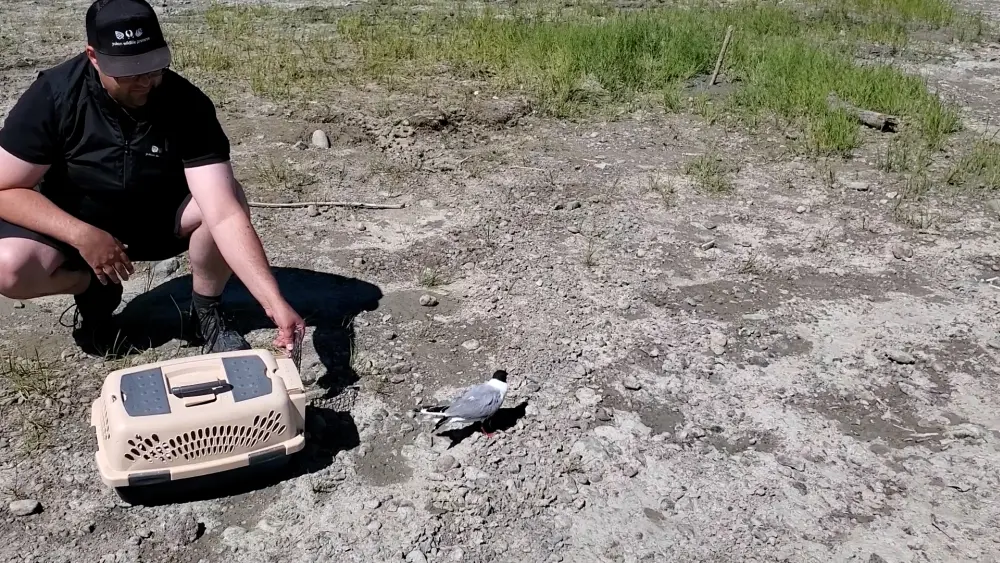
A Bonaparte’s gull was brought into the Wildlife Rehabilitation Centre at the Yukon Wildlife Preserve after it was found flightless on the side of the road. The bird has no significant injuries, some feather damage and was likely concussed. A short time in the centre to recover, eat fish and get strong meant a successful release of the animal to Tàa’an Män — Lake Laberge on the traditional territory of the Ta’an Kwach’an Council.

Lindsay Caskenette

Lindsay Caskenette

Manager Visitor Services

Lindsay joined the Wildlife Preserve team March 2014. Originally from Ontario, she came to the Yukon in search of new adventures and new career challenges. Lindsay holds a degree in Environmental Studies with honours from Wilfrid Laurier University and brings with her a strong passion for sharing what nature, animals, and the environment can teach us.
867-456-7400
Lindsay@yukonwildlife.ca

Explore by Category

Explore by Author

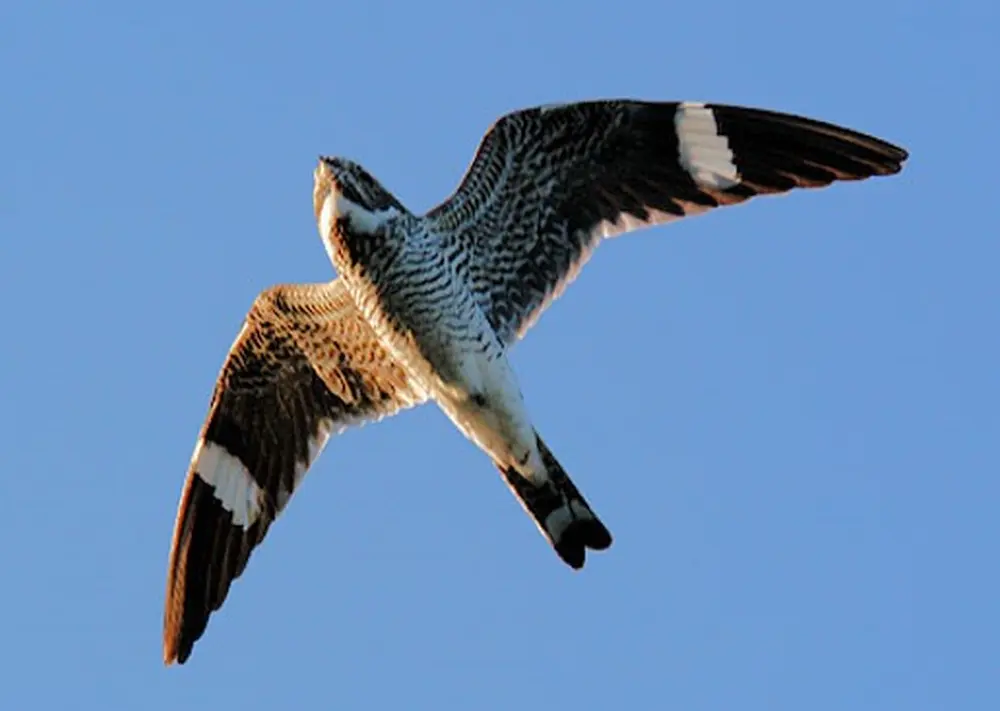
Your Yukon NightHawks

Your Yukon NightHawks

Your Yukon NightHawks

This article was originally published in The Preserve Post newsletter in Spring 2016. More current information and contact for the regional project can be doing on WildResearch.

2 minute read – 

Is it true, that the early bird gets the worm? Not always!

COIN male. 
Credit: Anne Brigham

A group of highly camouflaged birds, called nightjars, spend their days resting, waking  up just in time for sunset. These birds are most active during twilight – not actually early birds!

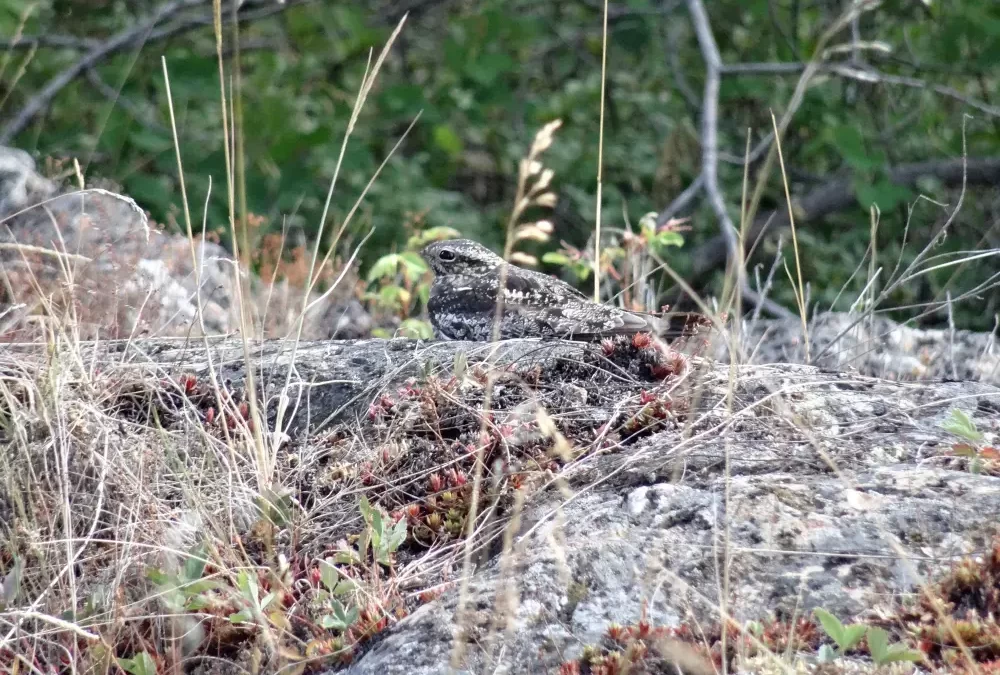
The Common Nighthawk, the Yukon’s only nightjar, can often be found feasting on insects above the YWP wetlands during those twilight hours.


offspring nightjars nighthawk, wildlife research blog.

Common nighthawk chicks July 7.
Credit: Andrea Sidler

You’ve likely heard the electric peent calls of nighthawks filling the air, or maybe observed their silhouettes circling high above. Perhaps you’ve witnessed the males’ aerial maneuvers as he protects a territory. He shows off his white wing-bars to potential mates while performing spectacular dives toward the ground, pulling up at the last minute, and creating a  mechanical “booming” sound with his wings.

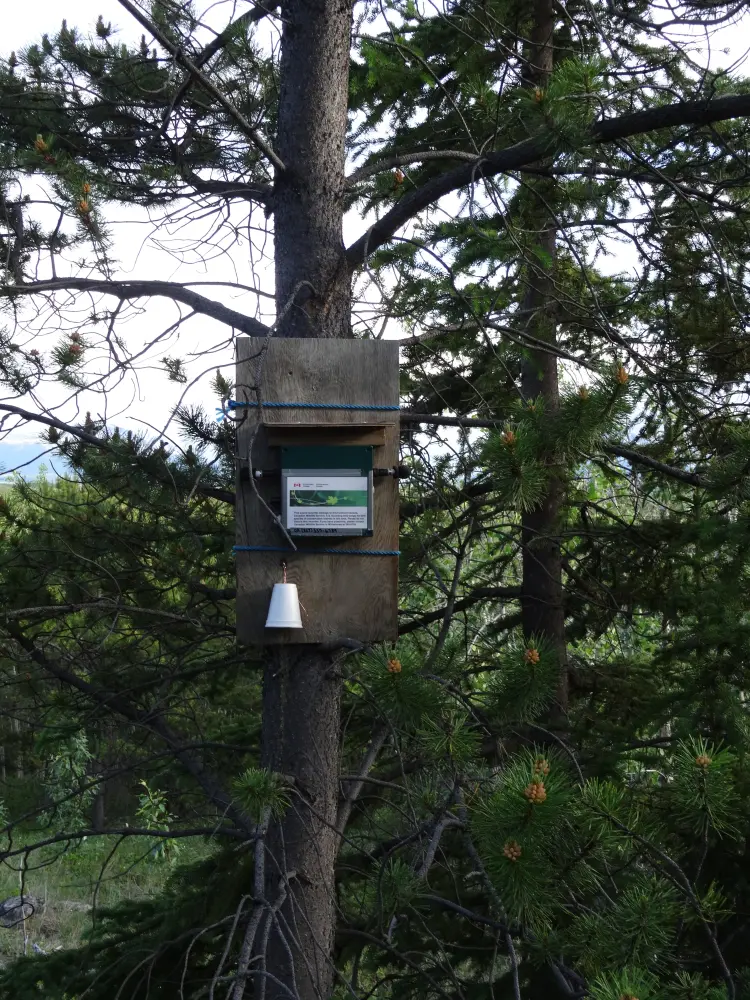
Nighthawk sound recorder. Audio wildlife research.

A sound recorder mounted to a tree with some information for a, human passerby. Credit: Andrea Sidler

In the Yukon, we are lucky we get to experience these unique birds. It is not like this everywhere. In fact, Canadian populations have declined by over 50% in just 30 years (status: Threatened). As a species, nighthawks are poorly understood, particularly here, on their boreal forest breeding grounds.

By using remotely recording sound meters, Canadian Wildlife Service investigated how the Norths’ perpetual daylight influenced the timing of nighthawk activity. For two summers, the YWP was home to recorders which, each night, recorded the calls of resident populations. During June, nighthawks were most active around 2:00 am. However, by the end of July, as true night returned to the YT, this changed.

female nighthawk, nightjars. wildlife research blog

A well camoflauged female.
Credit: Andrea Sidler

There were two activity peaks, one at dawn (4:00 am) and one at dusk (11:30 pm) –similar to southern populations – demonstrating that nighthawks are indeed affected by the changing day-length!

We are trying to learn more about what landscapes our nighthawks use. To help address this, WildResearch is expanding their nighthawk surveying program to the Yukon this summer. WildResearch relies on the collective power of volunteer citizen scientists to conduct surveys (2-3 hrs), which contribute data to conservation efforts. If you’re interested in getting involved contact your regional coordinator. Find out who that is by visiting the WildResaearch site.

Andrea Sidler

Andrea Sidler

Guest Researcher / Author

Explore by Category

Explore by Author

Vernal Species Migration

Vernal Species Migration

Vernal Species Migration

11 min read –

Part of Nature’s plan involves animals moving to new locations for two primary reasons:.  One is seasonal migration when animals move to a summer location principally to give birth and raise offspring, and the other is permanent migration or colonized range expansion when animals or plants colonize a new range where the critical resources for their continued survival exist in sufficient quantity. Here they will call home and make themselves a part of the local flora and fauna populations.

Migration is a tool used by Nature and benefits many species of animals and the areas where they live. From Monarch Butterflies to Blue Whales, animals migrate back and forth between two primary ranges that support the animal at important stages of every given year. Species temporary absence also provides the area where they live with a break from grazing or predation on a single source of food.  Also, physical disturbances and predation is reduced so that grasses and other vegetation can grow back and prey species can rebuild their populations while the predatory species are away on their seasonal migration. Think of it as shift work, there is a split between where creatures work for almost half the year and where they make their home for the other half.

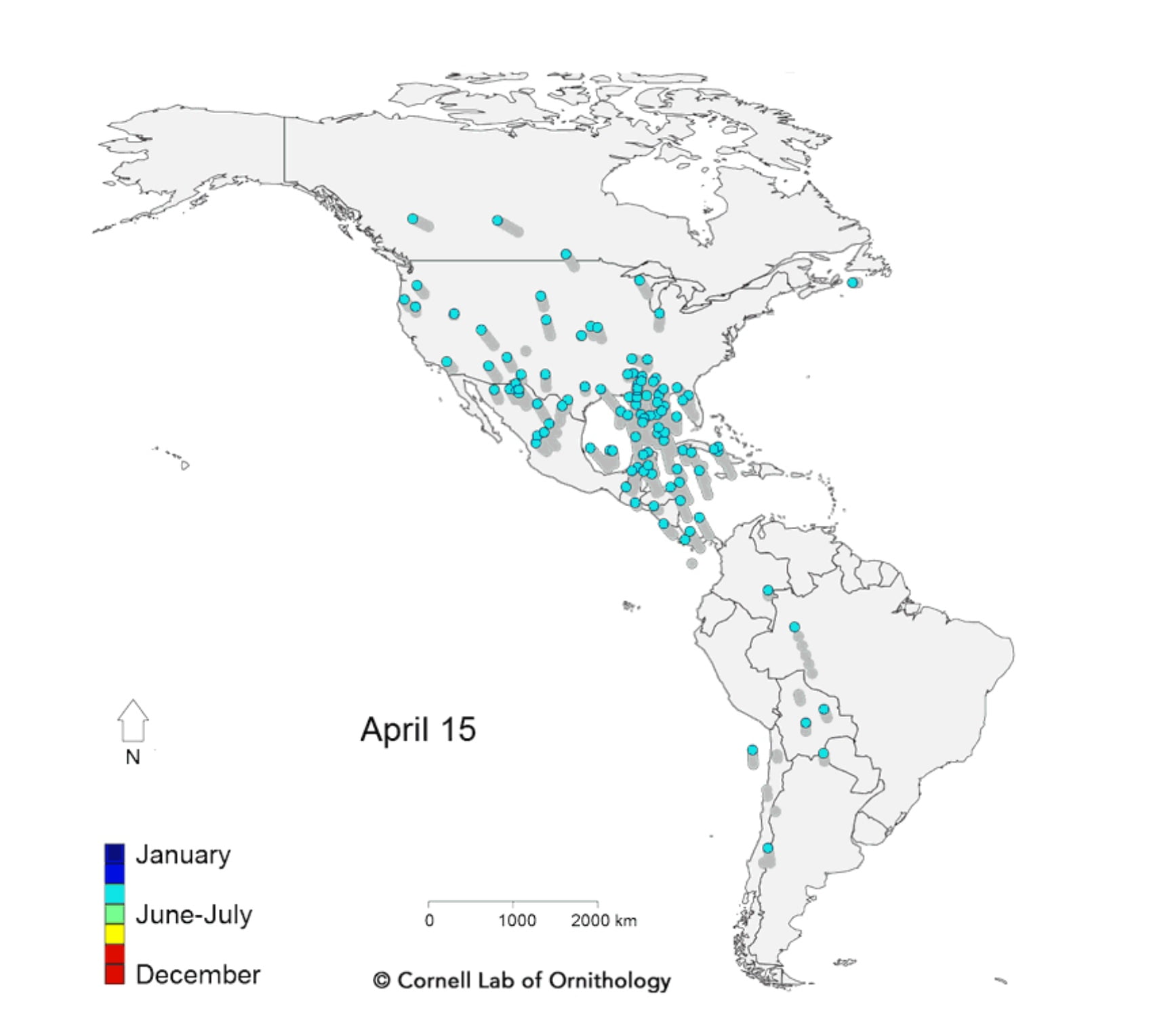
Let’s begin with spring seasonal migration, more properly called the Vernal (Latin for spring) migration when animals move to alternate locations typically in the north with the changing of the seasons only to return later in the year to the area or range they occupied before they migrated. These are often called winter and summer ranges and in many cases involve moving to a place to birth and raise offspring and when these offspring have adequately grown and become a bit more self-sufficient, they return to the other range with mom and dad to spend the rest of their year.

Click here to watch the seasonal movement of birds in North America.
Source Credit: All About Birds

The selection of the spring or winter ranges goes back many hundreds or thousands of generations by species. Some seasonal ranges evolved over time as animals sought out locations that provided the essential basics for them to thrive. Some species migrations have evolved over a tremendous period of time as far back as the Ice Ages, as migration routes are a complex undertaking involving weather conditions and distance to travel while ensuring there is adequate food resources with the right temperatures, humidity and water supply for those species to live comfortably and have the required foods to sustain them on their migration journey. Time is also a very important factor of migration as many other requirements must occur at critical times to ensure the continued health of the animals through all stages of their migrations.

For example, ice in the north must be sufficiently melted to permit arriving waterfowl to eat and remain secure from some predators, similarly, the plants and other vegetation migratory animals depend on should either be grown or growing well enough to sustain the creatures that depend on it when they arrive. These requirements are not just at the destination ranges, but also along the route the animals travel as some migrations may take weeks to complete.

Some species must also learn to endure through varied and sometimes lethal obstacles either created by natural events like landslides, earthquakes and floods, but also by human-made challenges like dams, habitat reduction and new developments and their supportive infrastructure where vital resources needed by the migratory animals have been removed or altered in some way. Ducks and geese must seek out new safe places to stop and reenergize when wetlands they have depended on in previous migrations have been turned into shopping malls and parking lots.

Migratory birds like swans and geese are probably the most visible migratory species as they fly overhead in great flocks honking as they go. Beneath the water’s surface, fish of all kinds like salmon migrate back to their natal streams to lay and fertilize the eggs that will produce their next generation- often within a couple meters of where they were born. Yukon’s rivers connect lakes where our common species of pike, grayling, whitefish and lake trout choose to spend their summers and winters, which may be greatly influenced by the insect hatches and changing water depths resulting from spring melt and freshet flooding. These short seasonal relocations are also considered to be migrations, but are not of the same scope other species like salmon or geese perform.

Photo credit: From Left, Lindsay Caskenette &  Jake Paleczny

Barren ground caribou like the Porcupine herd travel vast distances each year enroute to their calving grounds near the north coast. Their migration helps to distribute the impacts of their grazing so that they do not over-consume the vegetation causing harm to the landscape in any given location. Many thousands of caribou can eat a lot and their migration not only ensures more widespread grazing, but also their waste products (poop) are deposited over a greater area, thereby helping to fertilize more of the tundra they depend on each year.

Woodland Caribou at the Preserve.
While all caribou herd migrate the Barren Ground is know for more expansive journeys, particularly the Porcupine Barren Ground Caribou herd.  
Photo credit: Jake Paleczny

Insects also migrate usually in search of warmer temperatures and liquid water to lay their eggs and ensure there is an adequate food supply for the young to eat and grow healthy on. A queen honey bee will trigger a brief hive migration when she leaves the hive in search of a new location with better food resources nearby.

Migration is closely tied to a number of annual behavior traits as well. Some bird species may molt (shed their feathers) soon after arriving at their spring destination. Energetically expensive as migration itself molting and replacing feathers after a long journey north is important for the return trip. Also, the cast-off feathers can be used to line their nests against the cool winds of the tundra. However, while molting their ability to fly may be diminished which will put them at greater risk from predators. Just like migration and breeding, molting is ones of the vital parts of a bird’s life. 

Video explores molt in the migratory species, the Rusty Blackbird in Southern Yukon.
Source Credit: International Rusty Blackbird Working Group.

Predator birds, raptors like falcons, owls, eagles and various hawks also migrate to these ranges to raise their families and they depend on the ducks, hares, lemmings and other ground-nesting birds as a resource for them and their offspring until it’s time to migrate south again.

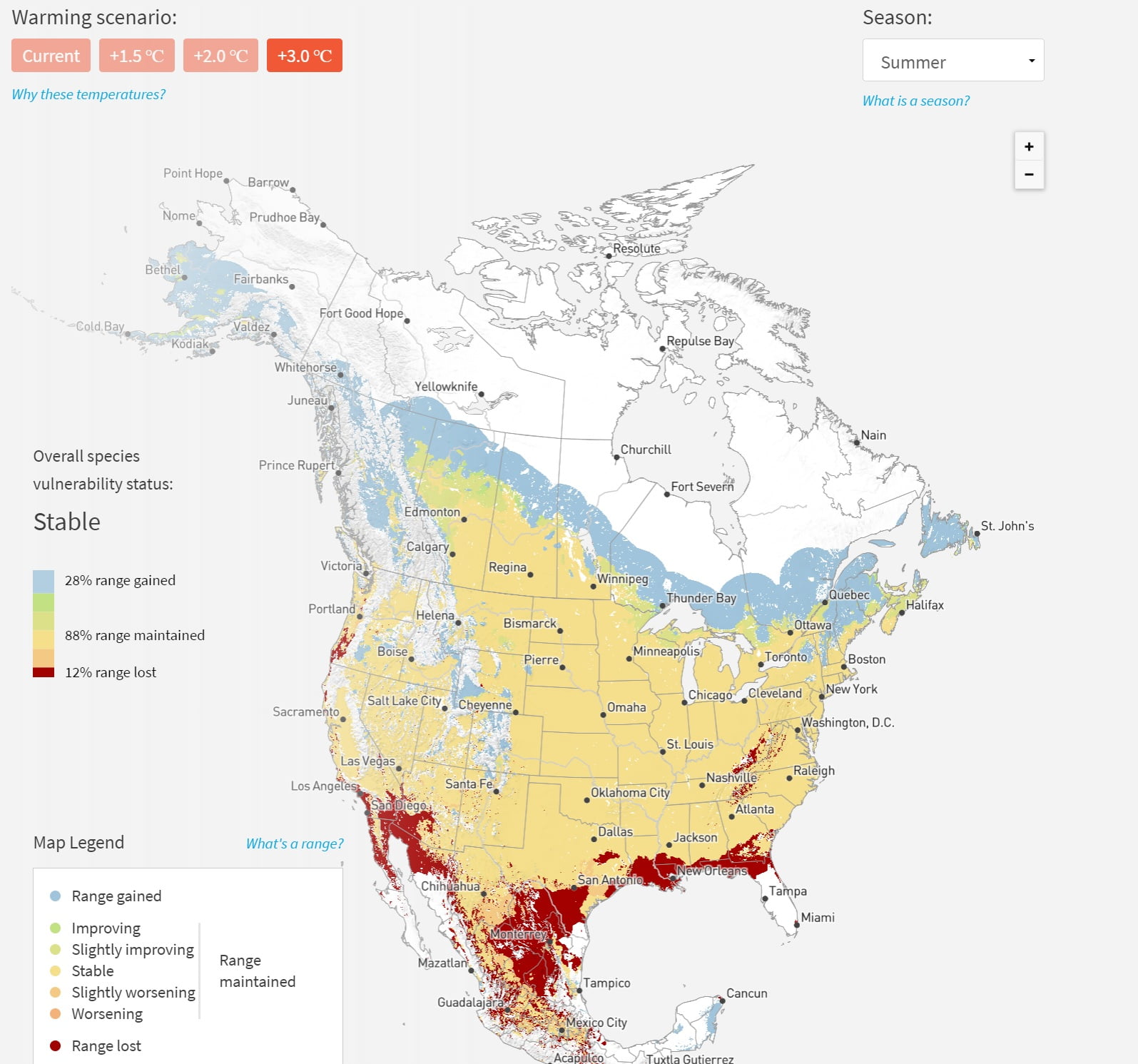
Climate change is modifying many of the important conditions some species require to live in a region, the timing of the spring melt is one of the major ones. As warmer spring conditions arrive earlier in the year, some species may need to begin their migration northward sooner to ensure they arrive in time to get a good nesting location, or time their arrival to an important food resource like a caddisfly hatch where millions of little flying insects hatch from a river over a few hours. Both fish and birds gather for these short-lived but important high-protein energy feasts.

Visit Audonbon.org to learn more about shifting and actaully expanding range for the Barn Swallow in climate change warming scnarios.  Source credit: Audubon

Again time is a critical element that can determine success or failure especially when other elements are out of sync. Like a delayed arrival of the warmer spring weather will slow the growth of some vegetation or delay thawing of the ice from waterways which can also create problems if the spring melt happens too early or too dramatically where it may cause rapid snow melt and flood rivers and creeks along migratory routes and nesting locations that create new hazards for the animals. A long lasting winter will also influence how arriving animals settle into their summer homes and make their arrangements for the warmer days to come. Nesting locations and preferred hunting and fishing and grazing spots may be at a premium and first come-first gets is the rule if they are willing to defend their locations.

Migration can be a life or death test for some animals depending on the conditions of the travel route and their intended destinations. Some destinations may be unusable due to new predators making a home there, physical damages caused by floods, fires and the landslides which may cause the animals to seek a new location that meets their needs. They may have to fight to keep their new location as other groups or another species may compete for the same resources they need to survive.

Bird migration and cities

There are many ways human activity interferes with animal migrations in the Detours and Distractions: How Humans Impact Migration Patterns. Explore the educational PDF by National Geographic.

Some predators take advantage of the migratory creatures when they arrive in great numbers. Bears demonstrate this very well as they gather on the streams and rivers to capture migrating salmon returning to spawn.  Bears also follow the caribou herds in pursuit of newly born calves trying to keep up with the rest of the herd. Fledgling birds are common prey for Sharp-Shinned Hawks, Shrikes and other small raptors that also may have hungry hatchlings in their nests.  Foxes and weasels also prey heavily on eggs and young hatchlings of geese, ducks and other ground-nesting birds.

This photo slide from Yukon photographer, Peter Mather at Ni’iinlii Njik (Fishing Branch) Territorial Park shows the close relationship of predator and prey. Bears will remain active in this region as winter approaches to benefit from the abundance of food in the form of migrating salmon. 
Source Credit: Peter Mather Photography

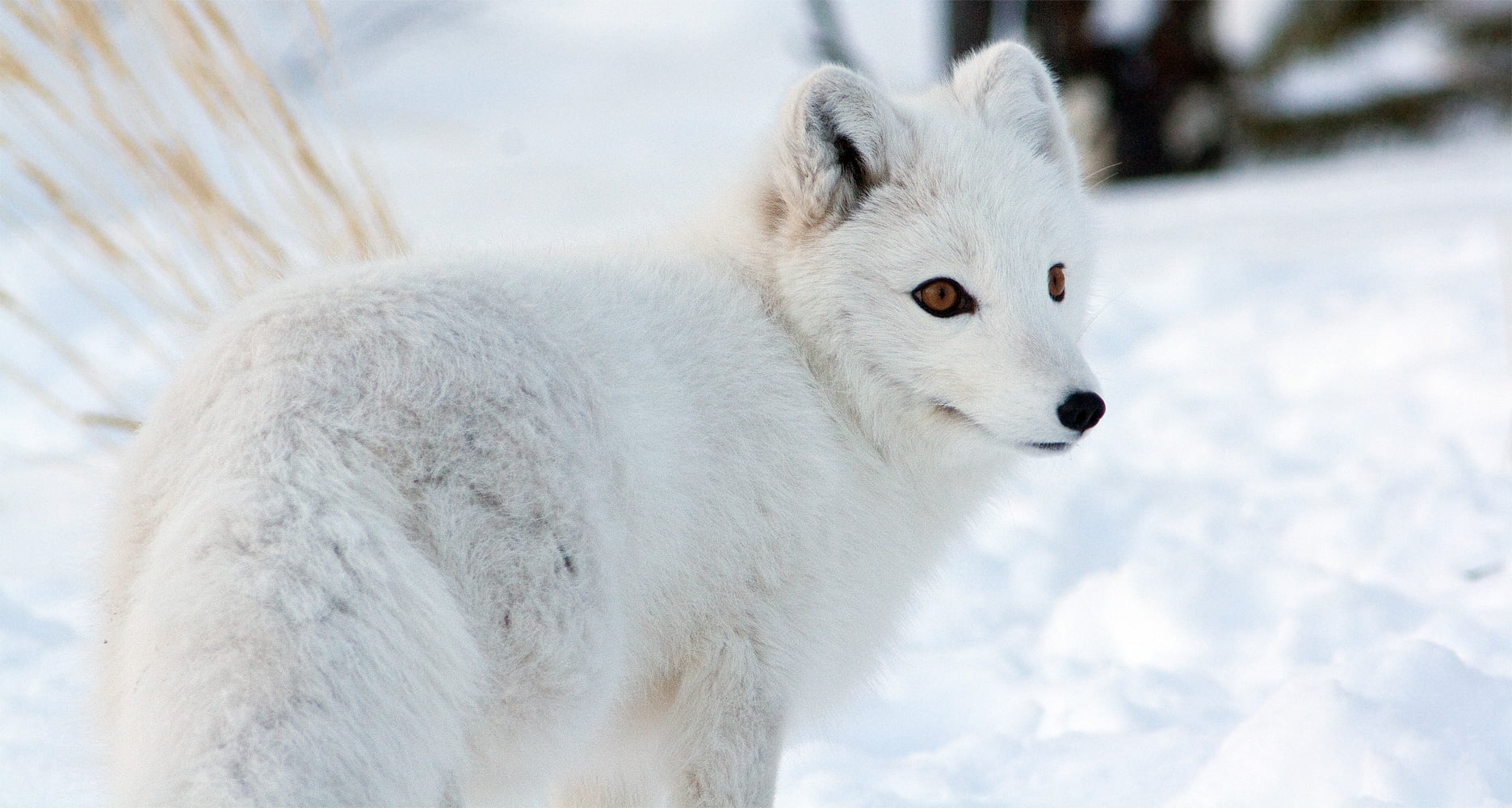
It works the opposite way as well as migratory animals depend on other species to sustain them and in some cases, their choice of destination may depend on resident species and the birthing of their offspring. An example can be found with Peregrine Falcons and other raptors who hunt the lemmings, hares and other rodents born in large numbers on the tundra each spring. Lemmings mature at 5 – 6 weeks of age. They are prolific breeders and may produce 8 litters of up to 6 young each throughout the summer. The gestation period of the female Lemming is 20 days making them one of the primary food resources for carnivorous species, like the Arctic Fox, spending their summer on the tundra.

Arctic Fox at the Yukon Wildlife Preserve.
Photo Credit: J.Paleczny.

Some species like Canada Geese and Tundra Swans mate for life so when they arrive at their springtime destination they can get right to work raising a family, However other species and those just reaching reproductive maturity will need to find a mate, build a nest, breed and raise their new offspring. All of this takes time and each animal is racing the clock and calendar to complete these basic requirements before they have babies which will demand a larger portion of their available time keeping them fed and protected as they grow to adolescence to commence preparations for the migratory trip back to their winter ranges before the winter season arrives, and some years it can come early or later as the present weather trends indicate.

Swan parents and their offspring at the Yukon Wildlife Preserve. In Spring, 2015 a pair built a nest in the moose habitat and had 5 cygnets.
Photo Credit: L.Caskenette

Waterfowl and other creatures that depend on water for their nutrition and safety pay close attention to falling temperatures and the return of ice on the surfaces of ponds and lakes. Other indicators warn of the returning winter conditions, insect populations fall dramatically; leaves change colour and other vegetation stops growing and goes to seed signalling it is time to move south once again.

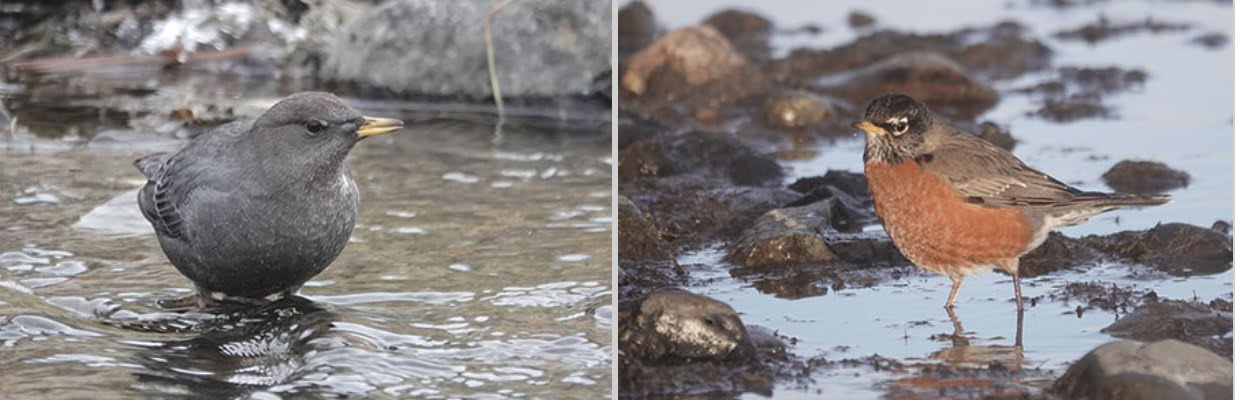
Some years snow may fall early and in sufficient quantities to make searching for food a greater challenge. Often robins will be seen digging in the snow for insects and berries as they gather together in preparation for their journey south.

Left Photo: American dippers are a delightful winter sight, swimming and singing from icy or rocky perches in fast-flowing waters, such as the Yukon River below the Whitehorse dam.

Right Photo: Winter wannabes like this American robin find small bugs and animals to eat along the muddy shoreline of the Yukon River below the Rotary Centennial Bridge.

Photo Credit and Caption: Jenny Trapnell
Read more from Jenny – A Chance on Winter in What’s Up Yukon.


Migration is an effective tool to ensure the seasonal health of many animal species, but also migration provides habitats some time to regrow while the species are away in their other ranges. Nature’s clock is the movement of the planets and the tilting of the Earth which determine the seasons as winter gives way to spring and new generations are being born. Climate change is also influencing animal species that are well-tuned into these seasonal changes which can be very subtle but are important signs for creatures that need to pay attention to subtle weather changes and the potential impacts on their migration requirements.

Doug Caldwell

Doug Caldwell

Wildlife Interpreter

Doug is one of the Interpretive Wildlife Guides here at the Preserve. An avid angler and hunter he has a broad knowledge of Yukon’s wilderness and the creatures that live here. With a focus on the young visitors to the Preserve, Doug takes the extra time to help our guests to better appreciate the many wonders of the animal kingdom here in the Yukon.

Explore by Category

Explore by Author

I Wish I Was as Tough as a Chickadee!

I Wish I Was as Tough as a Chickadee!

I Wish I Was as Tough as a Chickadee!

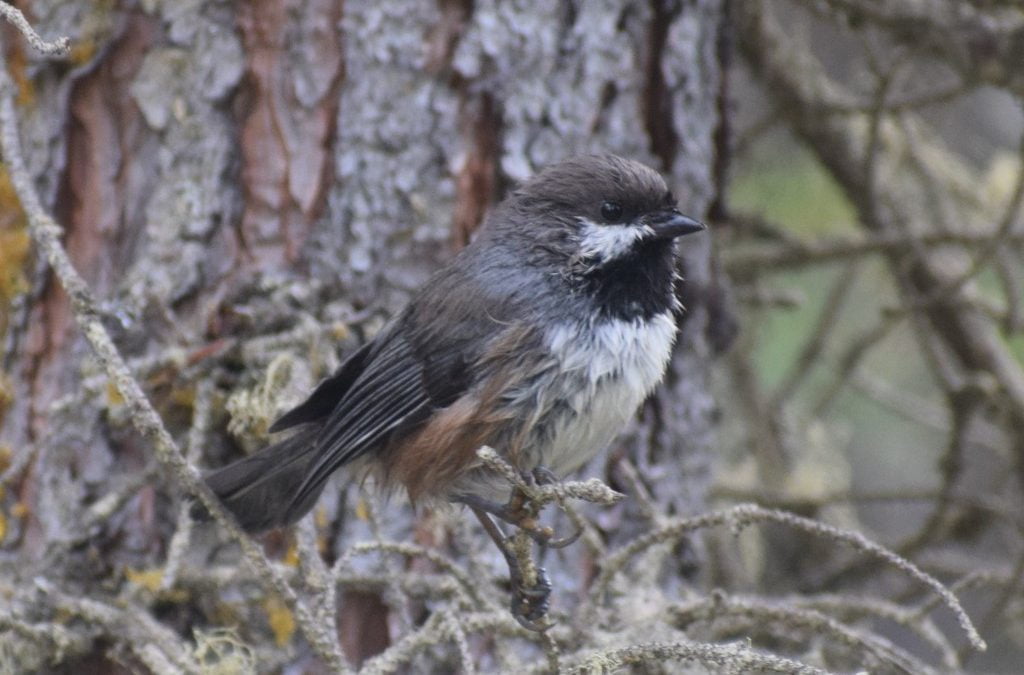
6 minute read – Banner image photo credit: Syd Cannings, iNaturalist

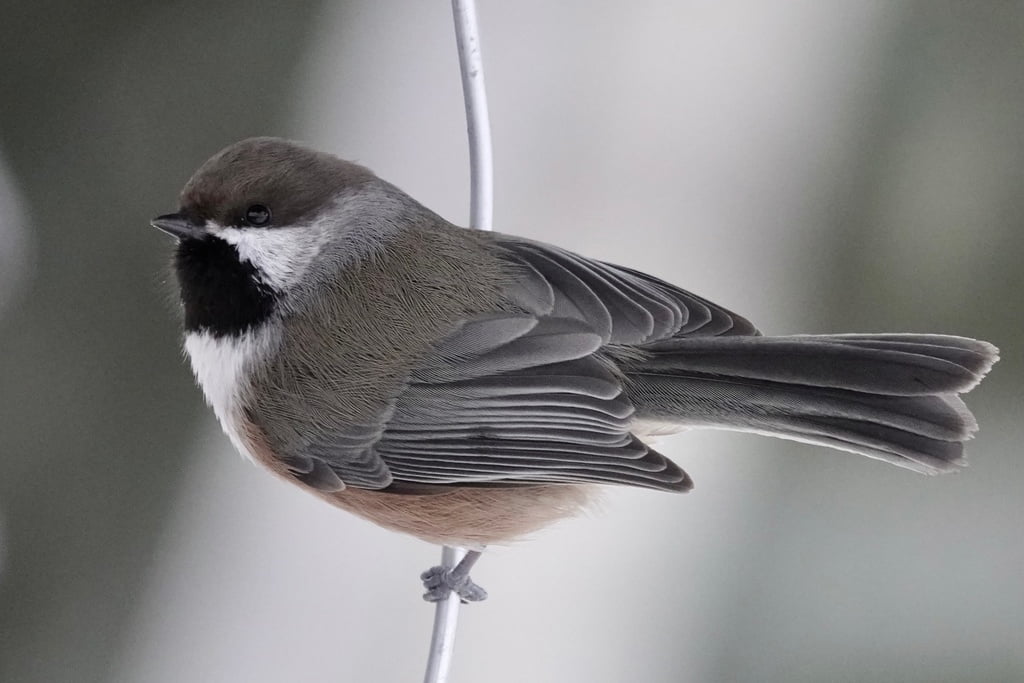
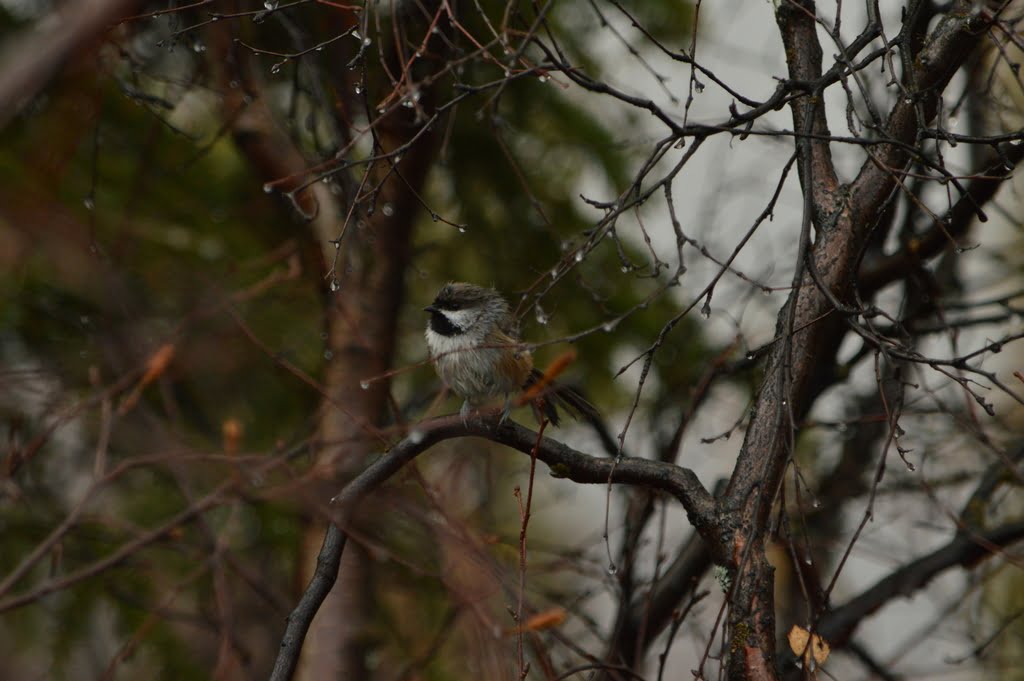
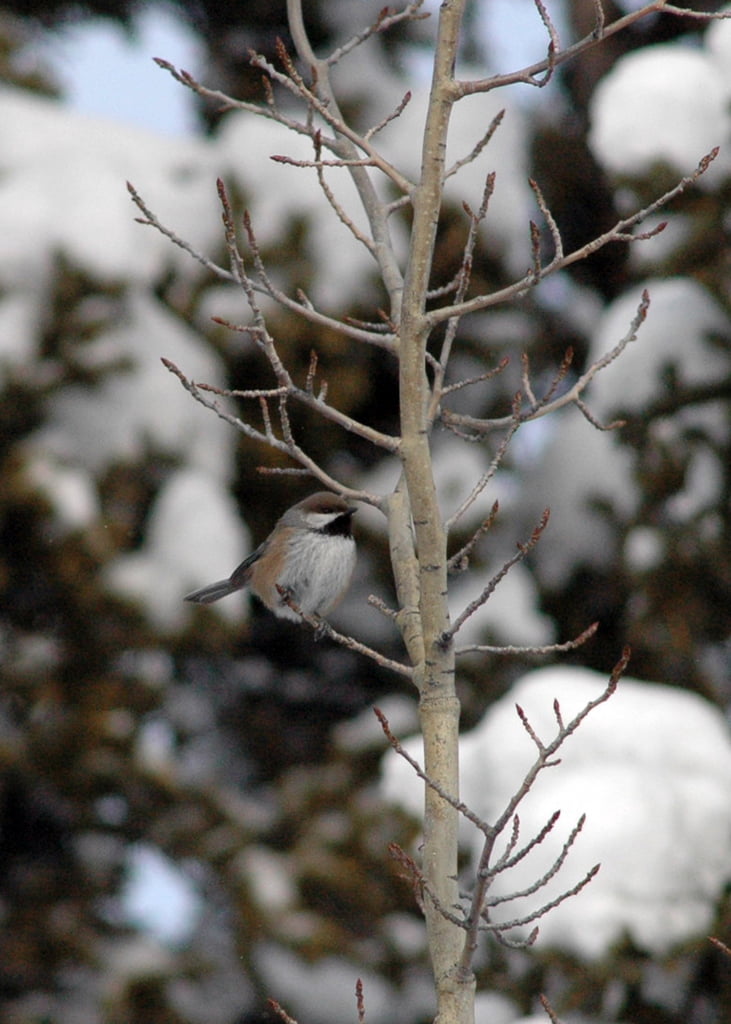
Gram for gram, there are few creatures in the North that have the endurance, temerity and constitution equal to a Boreal Chickadee. An iconic small bird of the north, this species lives its entire life in the Boreal forest and does not migrate to warmer southern climates in the winter months. Chickadees have adapted to not only survive, but to thrive in harsh winter conditions known across this northern biome.

For hundreds of thousands of years Boreal Chickadees, a cousin of the Black-capped varieties, has called the upper lands of North America home. It is believed to have crossed the Bering land bridge from present-day Russia into North America, very much like the first humans and many animal species to arrive in the Americas.

A secret to the Chickadee’s success is its work ethic where much of the summer is spent gathering and storing food, in the form of insects and their larva; seeds of many varieties and fat often gathered from animal carcases killed by much larger predators. Chickadees are frequent participants in cleaning up the remains of other animals as they can eat and digest just about anything organic.

They cache their winter larder in the bark and crevasses of trees, in tree cavities and roots, rock faces and structures. They demonstrate a very reliable memory for where they hid these morsels as some weeks later they return and consume them, often retrieved from beneath snow cover.1https://www.hww.ca/en/wildlife/birds/chickadee.html

A very social bird, the Boreal Chickadee is often found in the company of its cousins the Black-capped variety, Nuthatches, Pine Siskins, Red Polls, Kinglets and other regular visitors to bird feeders in the back yard. Their cheerful call is very recognizable and can often be heard following an insect hatch when their food gathering activities stimulate greater activity.

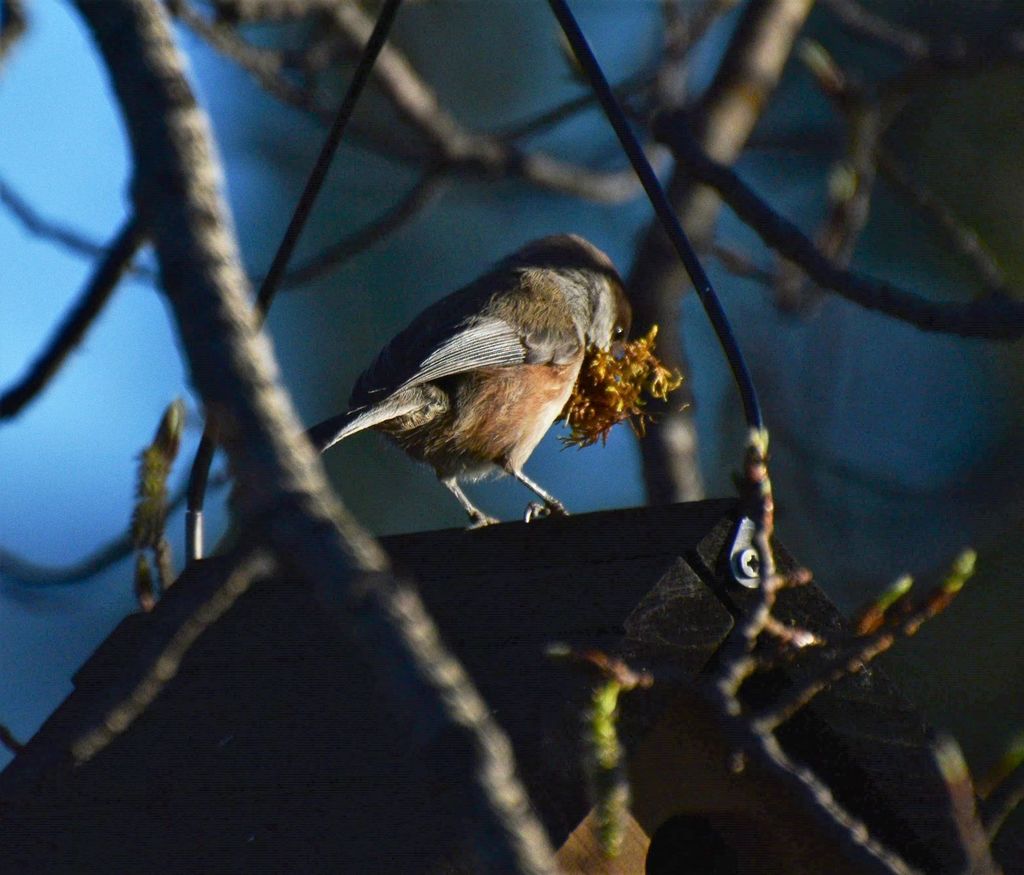
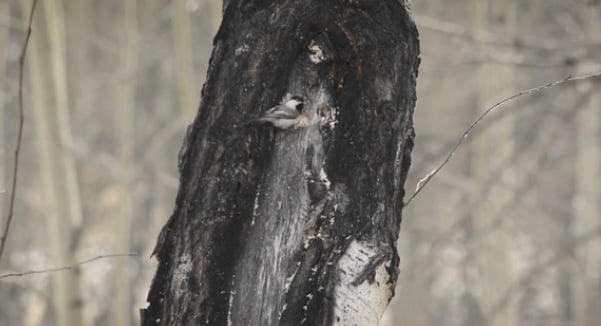
It is believed that Boreal Chickadees mate for life with the pair remaining together all year. The nest site is often a hole in a tree, either a natural cavity or old woodpecker hole; chickadees may also excavate their own site or enlarge an existing hole. The nest site is usually low, within twelve feet above the ground. Both male and female help with excavation, but only the female builds the nest inside. Nest has a foundation of moss, bark strips, lichens, topped with: feathers, plant seed fluff and the fur and hair shed by local animals. In human occupied locations, nests have been found to contain clothes dryer lint, threads and strings and similar items useful for the purpose.

This is a Boreal Chickadee’s cousin, the Blackcapped Chickadee making a nest in the spring of 2020. Watch the Wild Spring Adventures video for the action of this busy bird and other spring happenings at the Preserve. 

After breeding, the hen will lay up to nine eggs in a single clutch. These are white, with fine reddish brown dots often concentrated at the egg’s larger end. Only the female sits to incubate the eggs which take between ten and fifteen days to hatch. The male captures food and brings it to the brooding female during incubation. The female stays with the young and broods them much of the time at first, while the male continues to bring food. Growing quickly and developing flight feathers within a week of hatching, the young leave nest at about 20 days.

As summer concludes and the fall winds blow through the trees, Chickadees put on fresh, heavier plumage. And their feathers are more dense than most birds’, creating a comfy down parka for the chickadee. And most impressive, the chickadees adapt to deep cold by lowering their body temperature at night from 42 degrees Celsius to just 29.5 degrees. In this way, the birds conserve their stores of insulating fat as their metabolism slows. They fluff their feathers up so they truly look like little balls of fluff capturing more body heat within the airspace created within their feathery parka.

An average Boreal Chickadee weighs only a third of an ounce and its body size – without all the fluffy feathers – is about as big as an adult human’s thumb. It truly is remarkable how a creature this small and delicate can endure the harsh frigid cold of a six-month Yukon winter.

Each year the local Yukon Bird Club does several outtings and observations including a the winter seasonal Christmas Bird Count across the Territory – several variety of chickadee are noted to withstand Yukon winters! It’s an excellent citizen science engagement that contributes to a North American wide bird monitoring and conservation program. The Preserve boasts an array of species for bird lovers year-round but especially in Spring migration and throughout summer.

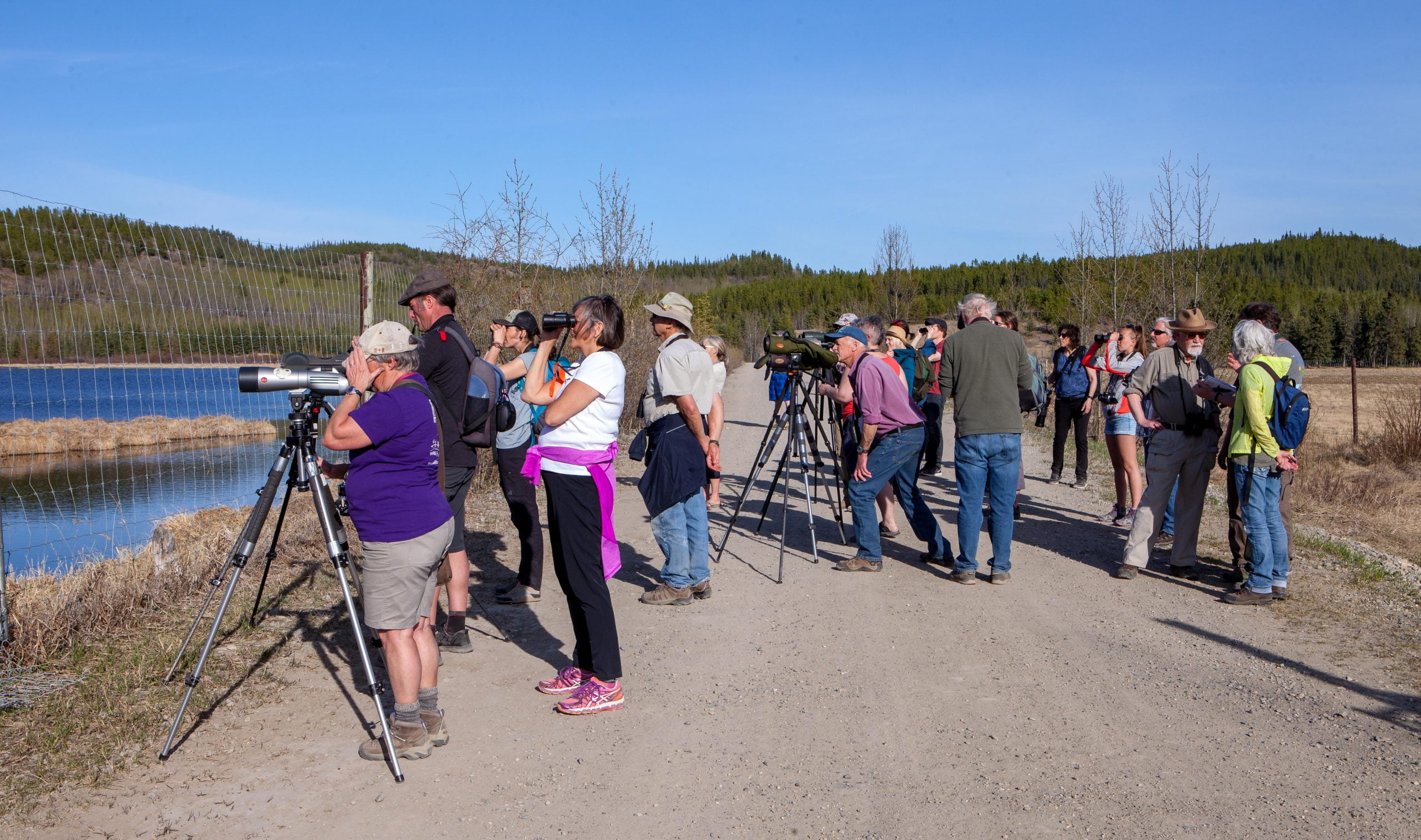
Annual Spring bird walk at the Yukon Wildlife Preserve.
Photo Credit: Jake Paleczny. 

Doug Caldwell

Doug Caldwell

Wildlife Interpreter

Doug is one of the Interpretive Wildlife Guides here at the Preserve. An avid angler and hunter he has a broad knowledge of Yukon’s wilderness and the creatures that live here. With a focus on the young visitors to the Preserve, Doug takes the extra time to help our guests to better appreciate the many wonders of the animal kingdom here in the Yukon.

Explore by Category

Explore by Author