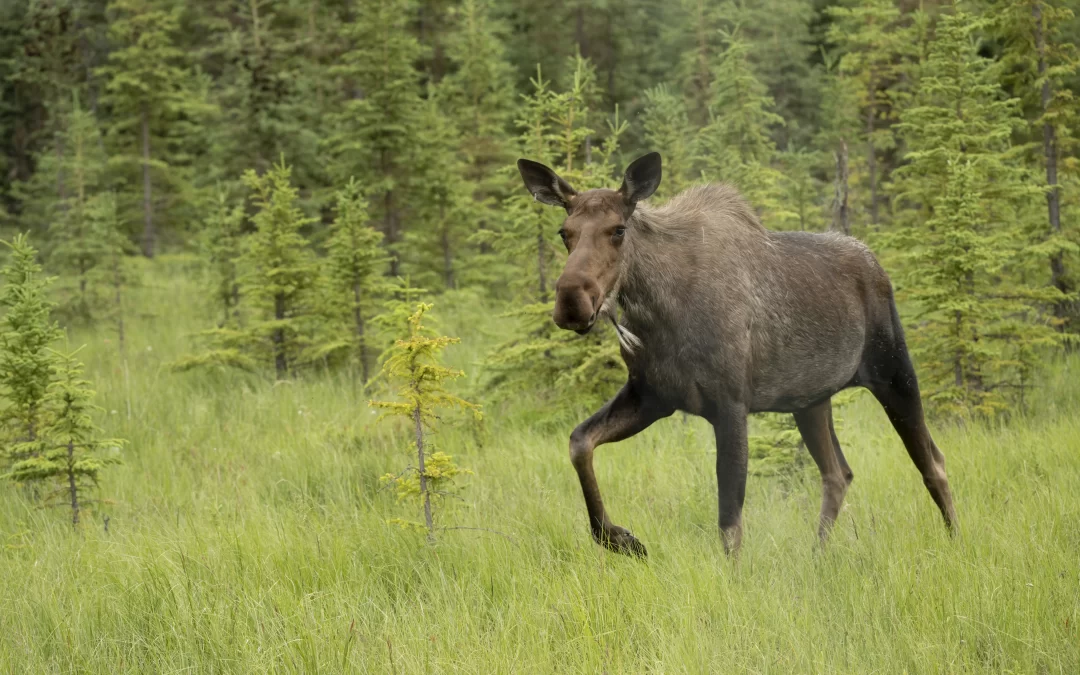
Jesse the Moose

Jesse the Moose

nature preserve

by Jake Paleczny | Jun 19, 2025

2 minute read -

It was with profound sadness that the Yukon Wildlife Preserve (YWP) shared the death of Jesse, a cherished and iconic moose who had resided at the Preserve since 2016. The YWP’s Animal Care team made the difficult decision to euthanize Jesse on June 19, 2025 due to complications following a medical procedure.

An Old Injury

The YWP Animal Care team had been monitoring Jesse’s old hoof injury, which had become arthritic, causing her increasing discomfort and pain. The team had diligently monitored her condition, exploring options to alleviate her suffering and improve her quality of life. On Monday, June 17th, Veterinarian Dr. Cassandra Andrew and the YWP Animal Care team immobilized (anesthetized) Jesse to provide a targeted treatment for the affected hoof joint. While under anesthesia Jesse regurgitated contents from one of her stomachs - one of the risks of anesthesia in ruminants like moose. Recognizing the immediate risk, the team promptly cut the hoof treatment short, administered broad-spectrum antibiotics, and reversed the anesthesia.
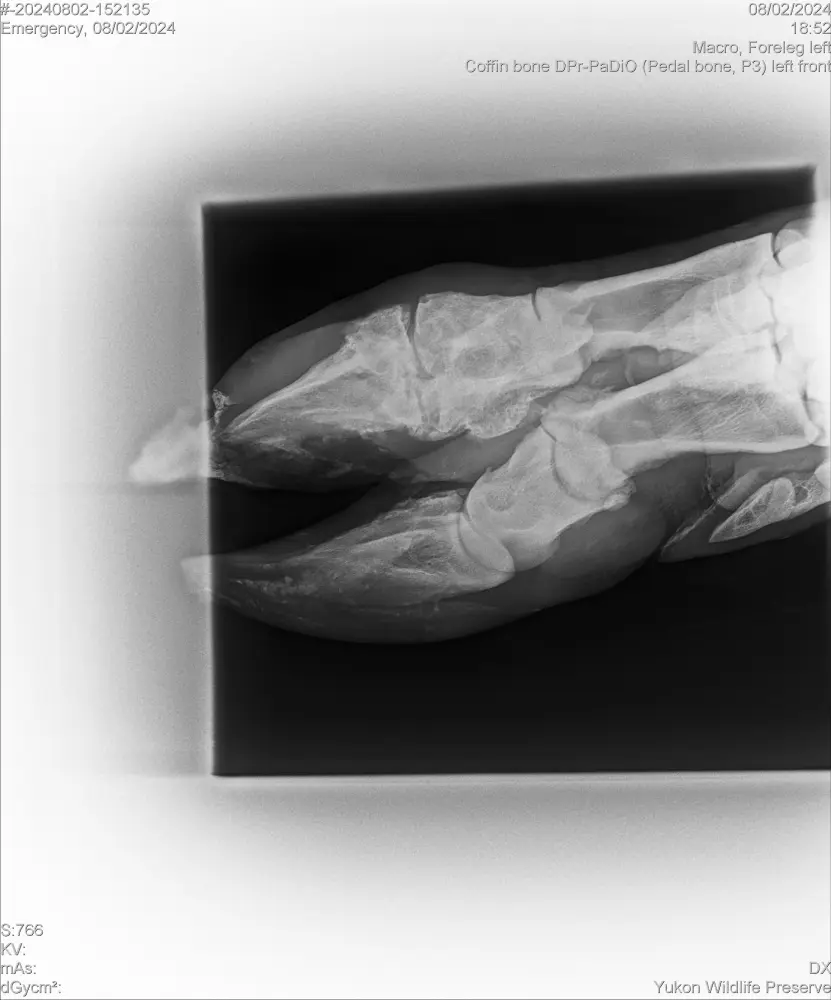
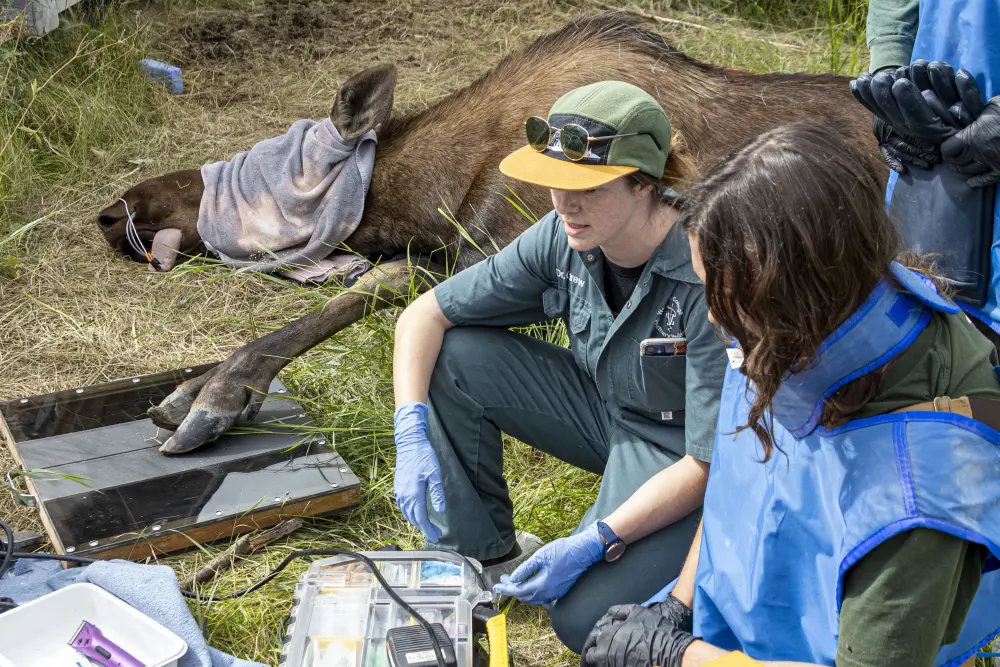
Dr. Cassandra Andrew and the Animal Care Team check on Jesse's hoof during in summer 2024.

Complications and Consequences

Upon waking, Jesse exhibited signs of respiratory distress, including coughing and more rapid breathing than normal, indicating that she had inhaled some of the regurgitated material. Later that day, the team provided additional medication to help reduce fever and inflammation. By Tuesday, June 18th, Jesse appeared to be more relaxed and showed initial signs of improvement as the team continued to monitor her closely.

However, during the morning check-in on Wednesday, June 19th, it was clear that Jesse's condition had declined significantly overnight. She was suffering from what was suspected to be severe aspiration pneumonia (inhalation of foreign/food material into the lungs) and was struggling to breathe. Unfortunately treating such a severe condition can be quite invasive and would only be feasible with a domesticated animal in a clinical setting. The team made the difficult decision to euthanize Jesse without delay.

Dr. Andrew performed a gross necropsy, which confirmed extensive damage to her lungs and the severe pneumonia. The team is conducting additional tests to better understand Jesse's overall health and to reveal potential future treatments for similar hoof injuries in other animals.
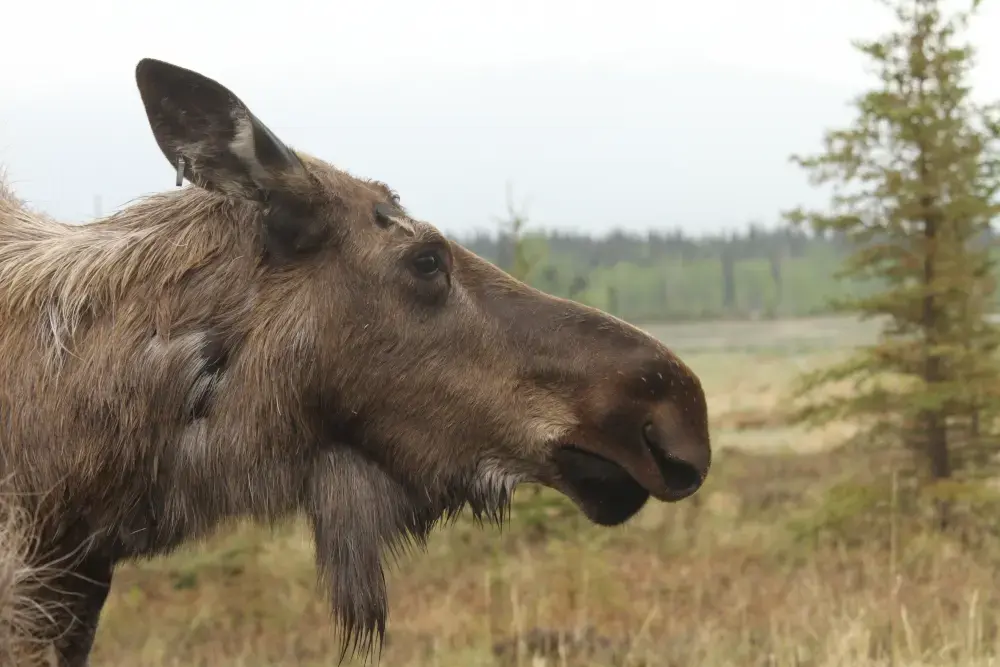
Jesse in June 2024

Jesse's Story

“Jesse was a really special animal with a remarkable story who touched the hearts of many, both our staff and visitors alike,” said Jake Paleczny, Executive Director, Yukon Wildlife Preserve. “Her death is a big loss for our team and so many of our visitors who got to know her so well over her 9 years here. Our team made every possible effort to provide her with the best care, and we will honour her legacy by learning what we can to inform what we do for our moose in the future.”

Jesse's remarkable journey at the Yukon Wildlife Preserve began in May 2016. At only a few weeks old and weighing just 47 pounds, dogs attacked her in the bush near Whitehorse, separating her from her mother. A quick-thinking teenager (named Jesse) carried the injured moose out and with some help, brought her to the Preserve. The dogs had gone after her neck, causing swelling that made it difficult for her to swallow and breathe. YWP staff provided 24-hour care, and for the first couple of nights, they were unsure if she would survive. For the first four days at the Preserve, Jesse couldn’t get up, and the team fed her via IV, offering small amounts of formula when she could manage it. With her injuries, it’s unlikely Jesse would have survived in the wild. Her comfort around humans meant she would reside at the Preserve permanently.

Jesse's Impact

If you have a story or memory you'd like to share about Jesse, send it to jake@yukonwildlife.ca  and lindsay@yukonwildlife.ca. We'd like to share and celebrate the impactful experiences and relationships she was a part of.

The crazy snow winter which had packed snow so high people's heads (and moose heads) were much closer to the top of the fence than normal and Jesse started stealing people's touques right off their heads. She especially loved to target hat wearers' taking selfies.
Pete, Wildlife Interpreter

We said our goodbye!
She knows and she listens—
She cried, I cried.
Michael, Senior Wildlife and Rehabilitation Technician
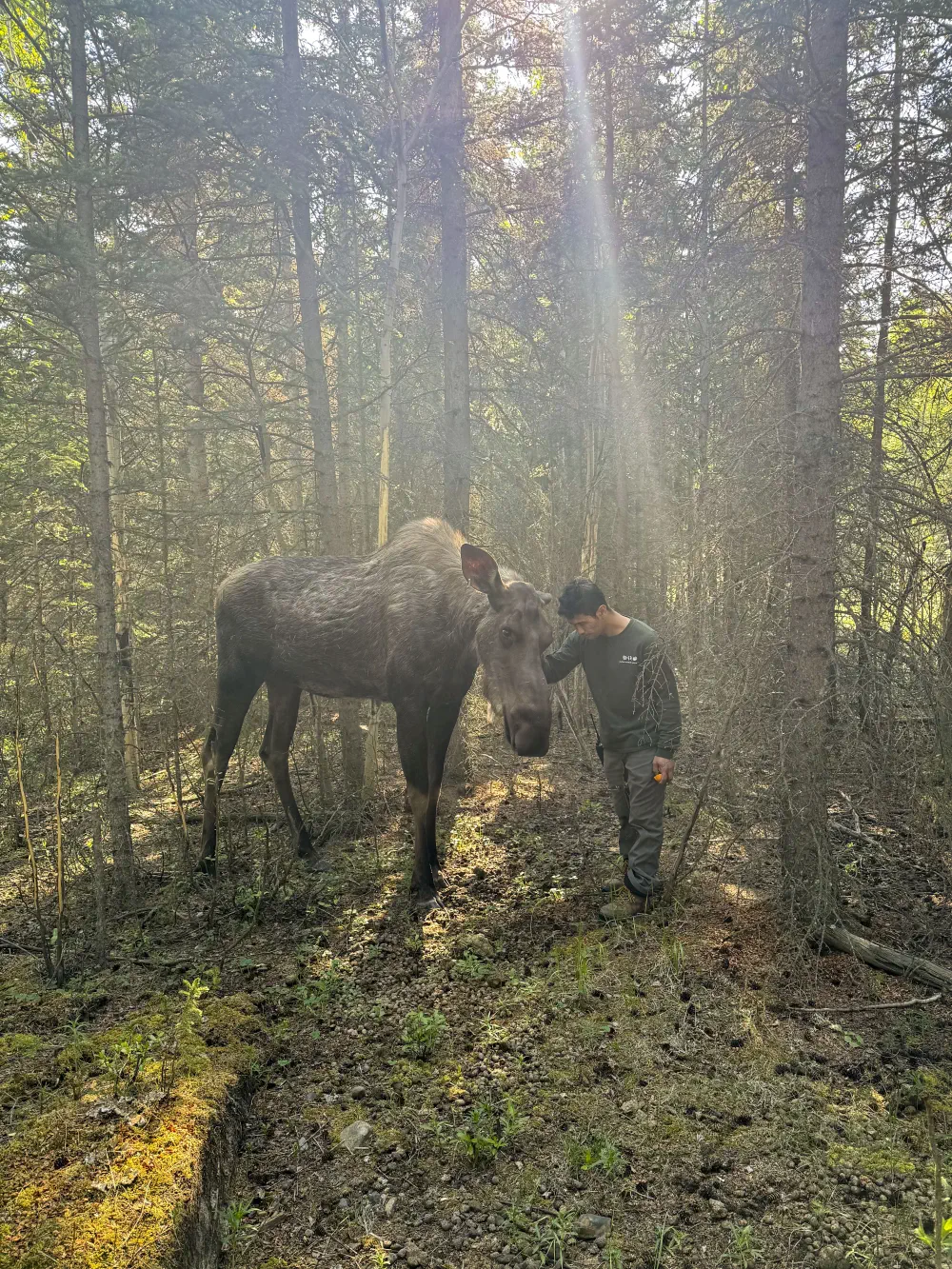
Above: Michael and Jesse on the morning of June 19.

Jake Paleczny

Jake Paleczny

He/Him - Executive Director/ CEO

Jake Paleczny is passionate about interpretation and education. He gained his interpretative expertise from a decade of work in Ontario’s provincial parks in addition to a Masters in Museum Studies from the University of Toronto. His interests also extend into the artistic realm, with a Bachelor of Music from the University of Western Ontario and extensive experience in galleries and museums.

867-456-7313
jake@yukonwildlife.ca

Explore by Category

Explore by Author

I Have to Sell!

I Have to Sell!

nature preserve

This article was made possible thanks to support from the Yukon 125 Fund. Learn the incredible history of the Yukon Wildlife Preserve, and Yukon Game Farm from the people of the past through this series of articles.

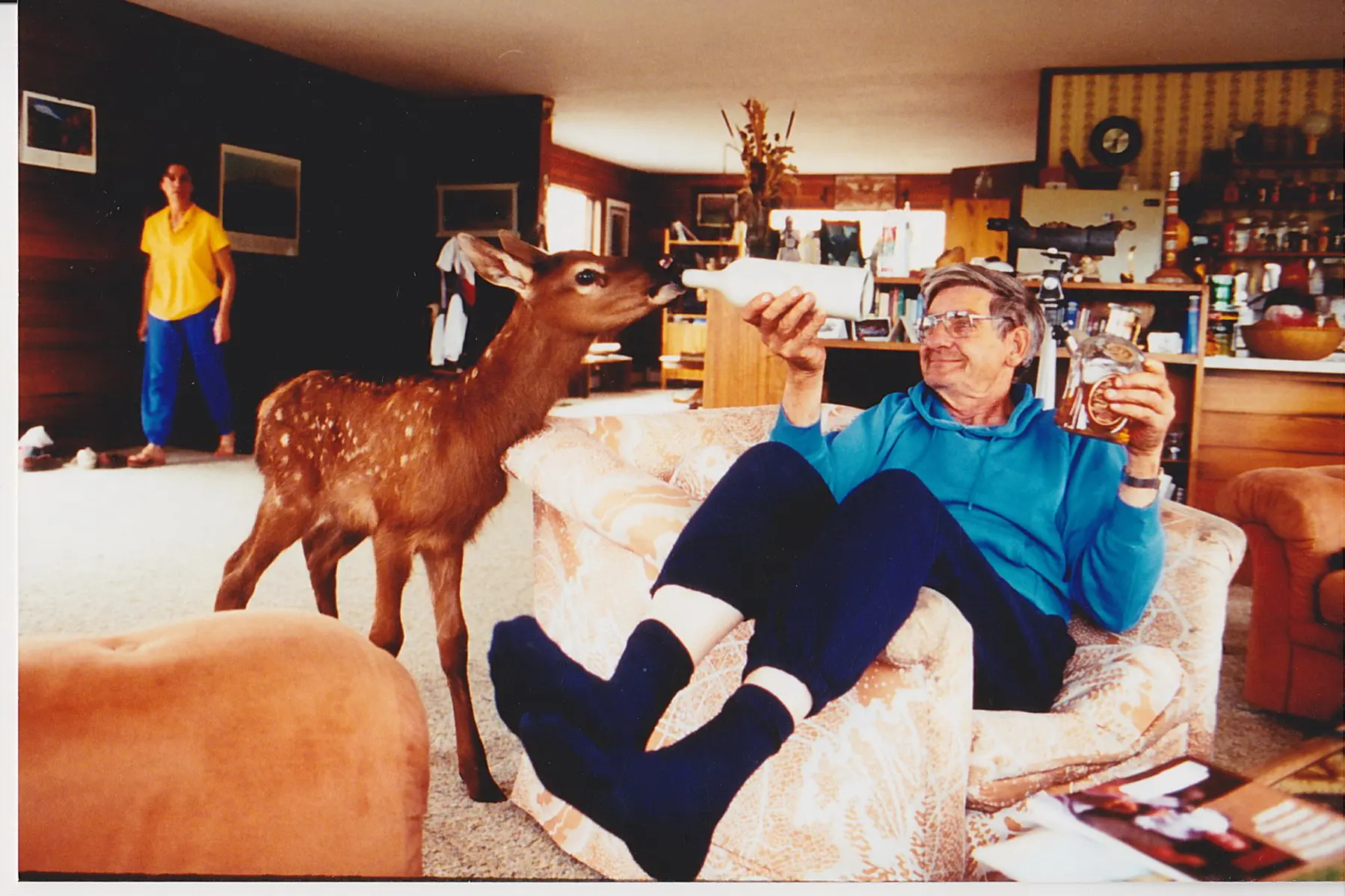
Danny Nowlan is one of Yukon’s colourful, and at times, notorious characters. He was a polarizing figure who cared deeply for animals and connecting them to kids. He was also the subject of one of Yukon’s most expensive trials ever. His work on the Yukon Game Farm would eventually result in the creation of the Yukon Wildlife Preserve. That is a legacy that is still experienced by many Yukoners – although many of the stories are not known or well understood. 

The stories of Danny Nowlan are important threads that are woven through the tapestry of Yukon’s recent history. This project gives us the opportunity to capture and share this history before its lost. This includes the opportunity to celebrate the positive lasting legacy and to learn about and grapple with the challenging aspects of this legacy. 

In 2023 historian Sally Robertson collected oral histories from more than a dozen people who knew Danny. Out of this work, Sally wrote a series of stories about Danny and his adventures.

(9 minute read)

Danny and Erika Nowlan had a dream, and the Yukon Game Farm was established in the mid-1960s. Danny had to struggle several times over the years to keep the Yukon Game Farm operating. It was never profitable until the falcon breeding program was in place. Until 1990, the Nowlans were in business to raise breeding stock and sell young animals to international zoos and wildlife farms. In the case of birds of prey, their market was falconers wherever they happened to live. A Dall’s sheep ram might occasionally bring $2,000 and a trained gyrfalcon might be sold for $13,000, but there were many animals on the Farm, and they all needed care and a constant supply of huge quantities of food.  

Danny considered selling the Yukon Game Farm in the 1970s, when it seemed there would be never-ending bank loans. This was a time when Danny had close friendships with Yukon Game Branch employees, both guardians (Conservation Officers) and biologists. Government biologist Dave Mossop came to Danny with a plan to replenish Yukon’s wild stock of peregrine falcons. This was successful and, building on that, the Yukon Game Farm purchased gyrfalcons from the government and embarked on a successful breeding program.

Danny with Gyrfalcon


Danny needed even more money to establish the infrastructure and so, instead of selling the whole property he tried to subdivide and sell some lots along the Hot Springs Road. The government prohibited the sale and Danny’s attitude toward bureaucracy started changing towards antipathy. In the end, the approach of a government official elicited a yell of ‘cops’ from Danny and furious barking from his well-trained dogs. Followed by Danny’s famous laugh.

Prohibited from selling titled property, Danny instead sold 999-year leases. The government challenged this sale, and Danny won in court, so the parcels became titled land. Selling the road frontage kept him in business for a while, and also had the advantage of providing some protection for the animals. Before they were moved away from the road, there were incidents of animals being injured and one ram sheep with trophy-sized horns was killed.

In the mid-1980s, Danny, his second wife Uli, and well-respected biologist Dave Mossop were arrested and dragged into court on charges associated with the capture and illegally selling of endangered falcons to wealthy Saudi Arabians.  Operation Falcon was an undercover operation that started in the United States and reached into the Yukon. The Yukoners were judged not guilty of all charges, but the trial affected reputations and bank accounts. After the trial, the Game Farm’s elaborate infrastructure for breeding, raising, and replenishing wild stocks was in shambles, and Danny and Uli were no longer able to realize a profit from selling the birds they were so successful at raising.

In the 1980s, elk farming became a profitable business in Canada and Danny was quick to acquire a herd of about 300 animals. He and a number of other Yukoners became successful elk farmers before the Korean market for Canadian elk antlers and velvet collapsed. Some elk farmers in the United States changed their operations to hunt farms, places where hunters could pay to shoot animals. The only legal option in the Yukon was the sale of elk meat, and that was not part of Danny’s vision of an educational preserve to showcase Yukon wildlife. He told a friend that the day he had to sell a pound of elk meat was the day he was out of business.

Elmer-1st and Danny especially favorite elk bull came from Chuck and Clara from California 1983 visit.


Fortunately, just at this time the Nowlans were approached by Holland America to provide a tourist attraction for the company’s bus tours. This was in line with Danny’s vision. He needed to upgrade the roads and fences, and acquire more northern species, but the Nowlans were still able to sell animals and care for the injured and abandoned ones that were constantly being dropped off at their door.  This change in direction was formalized by a change in name; the Yukon Game Farm became the Yukon Wildlife Preserve in 1989.

Original logo created by Peregrine Nowlan in 1989 when the name change occured from Yukon Game Farm. Later when the facility was sold and run as a non-profit the name remained and the logo updated to its current version.

Around 2000, Danny was once again faced with the serious problem of keeping the operation in business. Animal sales were still an option, but there was a dawning awareness in Canada of spreading diseases affecting wildlife. Danny needed permits to move animals across borders, and these became increasingly difficult to obtain. The matter came to a head for the Yukon Wildlife Branch when public attention was drawn to one of Danny’s mountain goats that appeared on a steep hill across the North Klondike Highway from the sod farm. Government officials were worried about the transmission of disease from domestic animals to wildlife, and two escaped mountain goats could have travelled past agricultural farms containing domestic goats.

Danny was unable to recapture his animals, and the Yukon government’s Philip Merchant came to the rescue with a helicopter and a tranquilizer gun. The story of the capture is a harrowing tale for another time, but no animal (human or goat) was terribly injured, and Danny was presented with the bill. 

Danny said, “I want to go fishing” and he started looking for buyers. He could have made a lot of money by letting a developer divide the Game Farm into acreages. Many Yukoners were reluctant to see this happen, and the Friends of the Yukon Wildlife Preserve was established in 2002. The Board of Directors included successful businesspeople, educators, and wildlife biologists who recognized the Preserve’s potential economic, preservation, and educational worth to the Yukon. The society tried to raise funds to buy and operate the facility as a business, and they received support from individuals and potential partners.

In July 2003, the Yukon Fish and Wildlife Management Board wrote a letter to support a proposal where a not-for-profit society would run the facility with assistance from the Yukon Government, as long as the facility obtained accreditation from the Canadian Association of Zoos and Aquariums. The government, for many reasons, was reluctant to commit to any involvement at that time, and the Board of Directors dissolved the Friends of the Yukon Wildlife Preserve association in August 2003.

The public facing entrance to the Yukon Wildlife Preserve. Photo Rebecca August 2004.

There are many opinions about why the government persuaded a number of the original Friends and others to form an operating society, and then purchased the Yukon Game Farm in April 2004. Danny talked to the media and there was considerable public pressure in support of the sale. It was, and remains, a controversial decision especially for those opposed to seeing wildlife in pens. However, the Yukon Wildlife Preserve is a delight for children of all ages, and the expansive habitats created by Danny Nowlan make the residents very happy.

About his ability to get things done, Wendy Brassard says Danny would get these ideas and he wouldn't abandon them. He wouldn't just let them die or turn away from them. He'd think about it, he'd read because there was no Internet back then, he'd make phone calls, and the next thing you know, everything's changed. And he just kept evolving. He was such a good example of ingenuity and resourcefulness, and never say die. Just if you think it's right and it's going to work and it's a good thing? Do it.” David Smiley says Danny was an amazing character; that guy was different. Both good and bad. He had a rough side and he had a Grade 3 education. But he could develop a plan that somebody from a university would have trouble figuring out the nuances. He was a good planner. Randy Hallock concluded that Danny was interesting and always full of ideas. He just built the place and not much could stop him. He had ideas, and he made them work. People telling him ‘no’ just made him that much more driven. 

Minister Dixon, Department of Environment, Yukon Government and YWPOS board member Bill Klasson.
Photo taken 2013 on the signing of a 5 year agreement.

David Mossop is involved with the Game Farm in its current form as the Yukon Wildlife Preserve. He says it's interesting that all these years later, they haven't changed anything. It's basically exactly as Danny and Erika envisioned it – except brought to fruition a lot more. Their idea was to create something where the children of the Yukon could come and see the creatures that live here. And that's basically what happened.

The memories that were collected during this oral history project speak to the impact that Danny had on so many friends, kids, and animals - and the Nowlans’ legacy remains intact for Yukoners and Yukon visitors. We think Erika would be proud to see a fully realized wildlife preserve with its visitation of wide-eyed children. Uli Nowlan often visits the facility and keeps a watchful eye on the operation. Danny didn’t become an avid fisherman, but he did relax knowing his animals, and his legacy, were in good hands. 

• • •

On June 12, 2004, was the Grand Opening of the Preserve!

Danny Nowlan Life and Death - June 4th, 1929 - October 23rd, 2011.

Photos gratefully provided by Uli Nowlan.

Sally Robinson, October 2023
with words from interviews with Uli Nowlan, David Mossop, Philip Merchant, Wendy Brassard, Randy & Maria Hallock, David Ford. 

Sally Robinson

Sally Robinson

Vintage Ventures - Researcher & Writer

Sally is currently an independent consultant in the heritage field. Throughout her career, after working 20 years with Yukon museums as a researcher, curator and exhibit designer/producer, she joined the Yukon Government to work for 16 years as the Historic Sites Interpretive Planner.

Lindsay Caskenette

Lindsay Caskenette

Manager Visitor Services

Lindsay joined the Wildlife Preserve team March 2014. Originally from Ontario, she came to the Yukon in search of new adventures and new career challenges. Lindsay holds a degree in Environmental Studies with honours from Wilfrid Laurier University and brings with her a strong passion for sharing what nature, animals, and the environment can teach us.

867-456-7400
Lindsay@yukonwildlife.ca

Explore by Category

Explore by Author

The Early Years

The Early Years

nature preserve

by Sally Robinson | May 30, 2025

This article was made possible thanks to support from the Yukon 125 Fund. Learn the incredible history of the Yukon Wildlife Preserve, and Yukon Game Farm from the people of the past through this series of articles.

Danny Nowlan is one of Yukon’s colourful, and at times, notorious characters. He was a polarizing figure who cared deeply for animals and connecting them to kids. He was also the subject of one of Yukon’s most expensive trials ever. His work on the Yukon Game Farm would eventually result in the creation of the Yukon Wildlife Preserve. That is a legacy that is still experienced by many Yukoners – although many of the stories are not known or well understood. 

The stories of Danny Nowlan are important threads that are woven through the tapestry of Yukon’s recent history. This project gives us the opportunity to capture and share this history before its lost. This includes the opportunity to celebrate the positive lasting legacy and to learn about and grapple with the challenging aspects of this legacy. 

In 2023 historian Sally Robertson collected oral histories from more than a dozen people who knew Danny. Out of this work, Sally wrote a series of stories about Danny and his adventures.

(6 minute read)

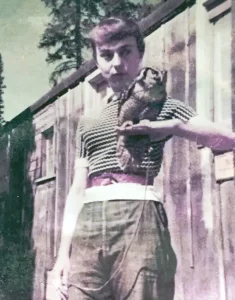
Erika Nowlan. Photo gratefully provided by Sabrina Nowlan.

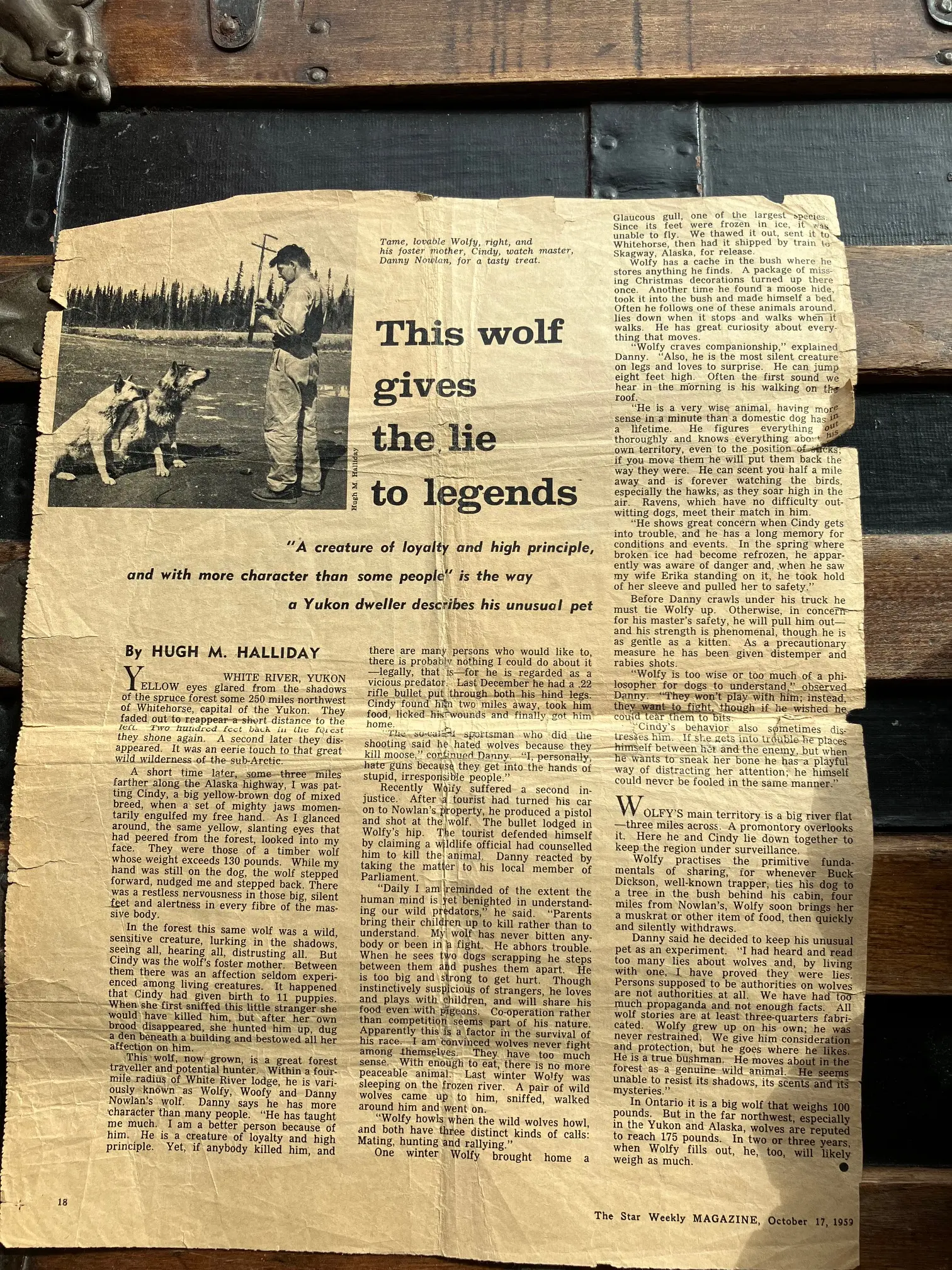
Danny and Erika dreamed of developing a place where northern animals were shown in a home-like environment for educational and conservation purposes. Danny had a way of understanding wildlife that astounded those who knew him. He had a reputation as an expert in training eagles and falcons, and the wolf he raised at White River was the topic of a magazine article. 

Wolfy Article - The Star Weekly Magazine, October 17, 1959
This wolf gives the lie to legends by Hugh M. Halliday.

He thought that keeping wildlife breeding stock and selling animals to southern zoos and game farms would allow him to have enough money to run the Game Farm activities, feed the animals, and provide him and his wife and children with at least three good meals a day. He had no idea what obstacles lay ahead of him – but even knowing them would not have slowed him down or discouraged him. Danny was full speed ahead, full time.

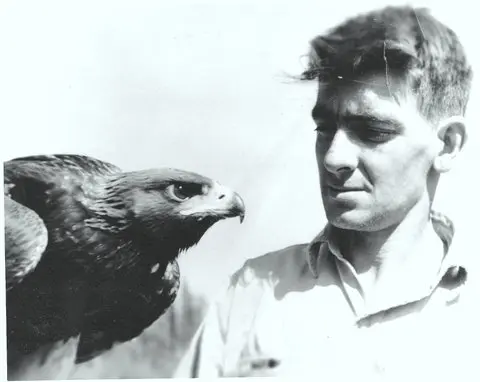
Danny Nowlan with a golden eagle.

Like the time he brought a little Porter locomotive from an abandoned railway near Dawson. He thought a little steam train could carry people around the property, and the kids would love it. He took his 5-ton vehicle up to Dawson to pick up the more than 10-ton locomotive. It was a wild ride to Whitehorse, with Danny running the truck into snowbanks along the road to slow the vehicle. The truck’s brakes were not up to the job and by the time they reached Whitehorse they were burned out. Danny always had big ideas, and he usually backed them up with detailed and practical plans. The little railway did not pan out.

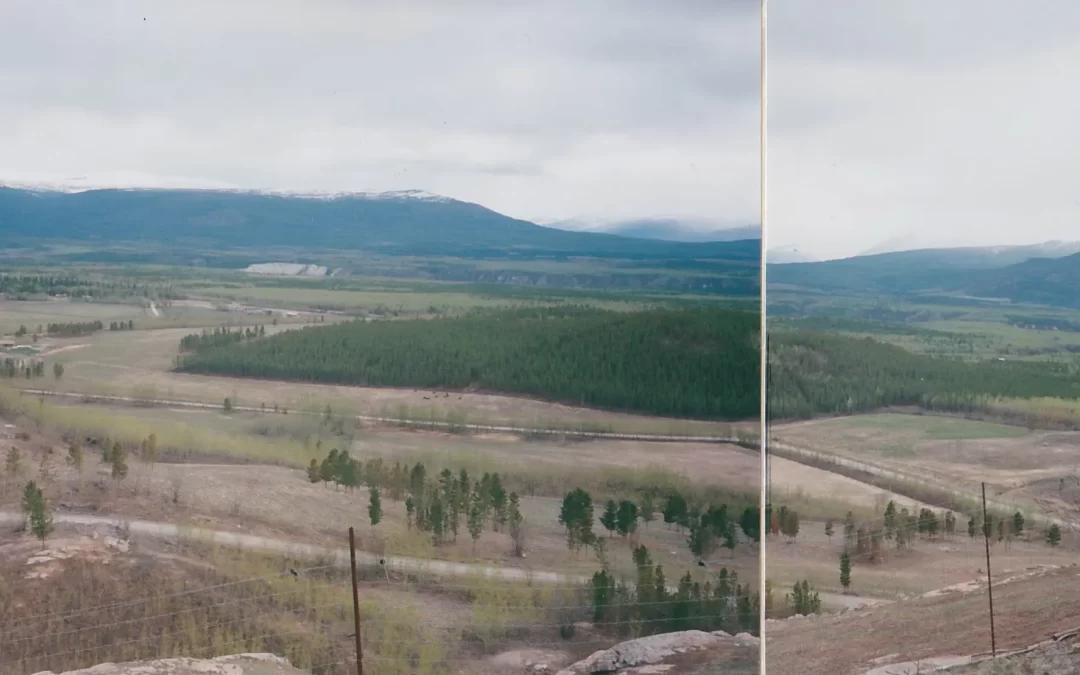
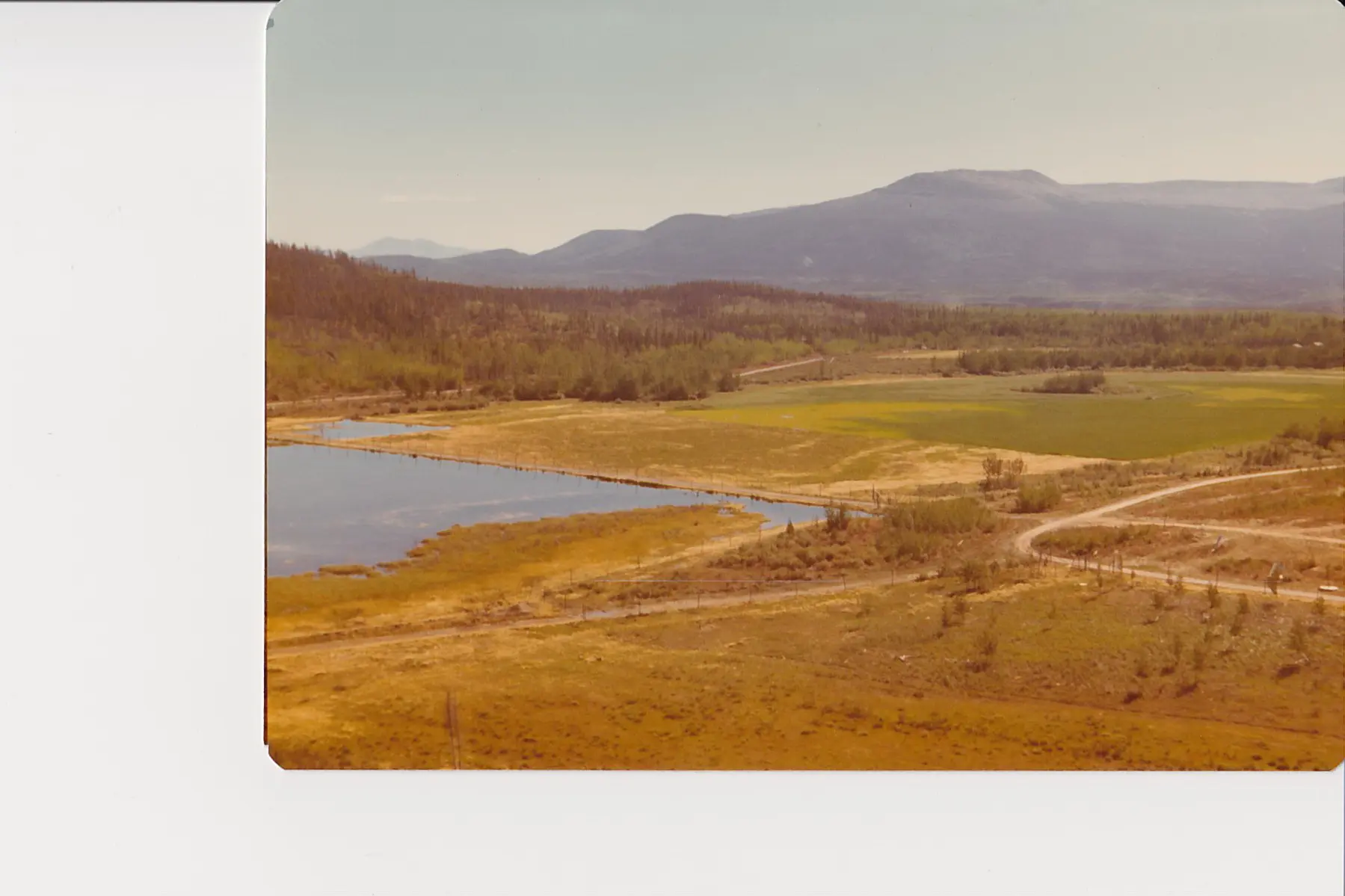
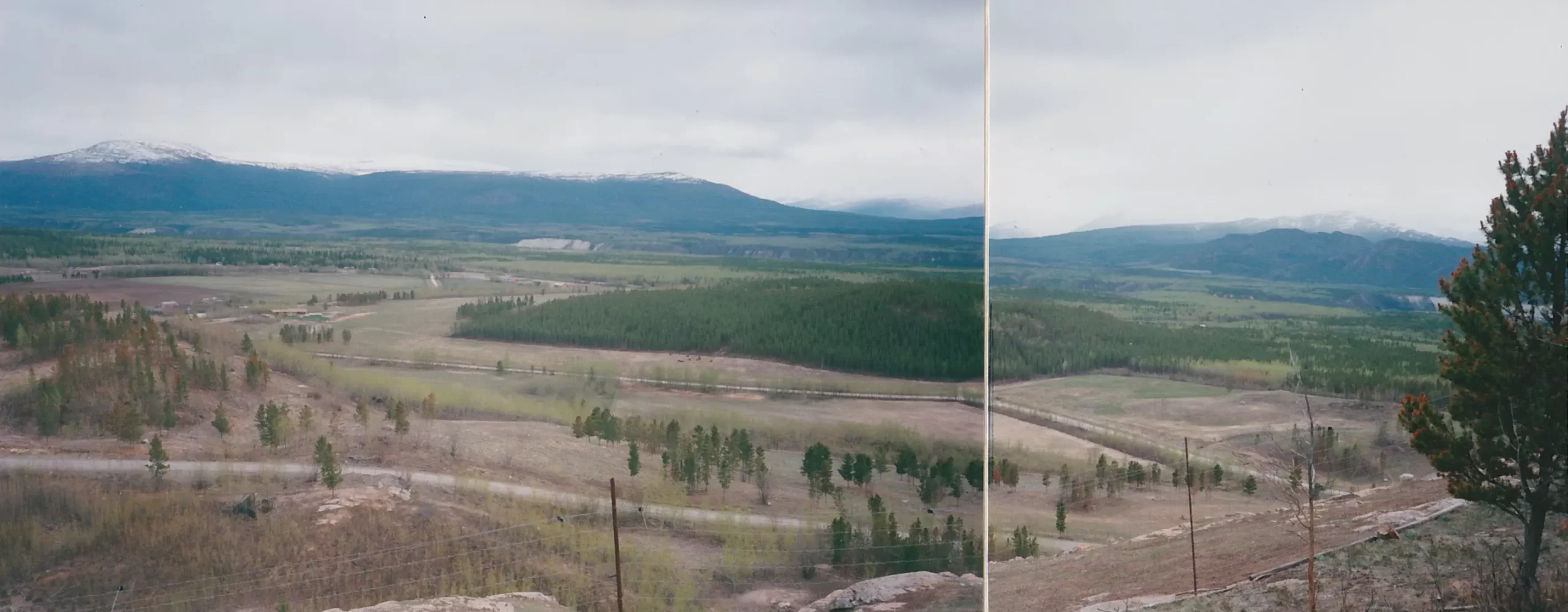
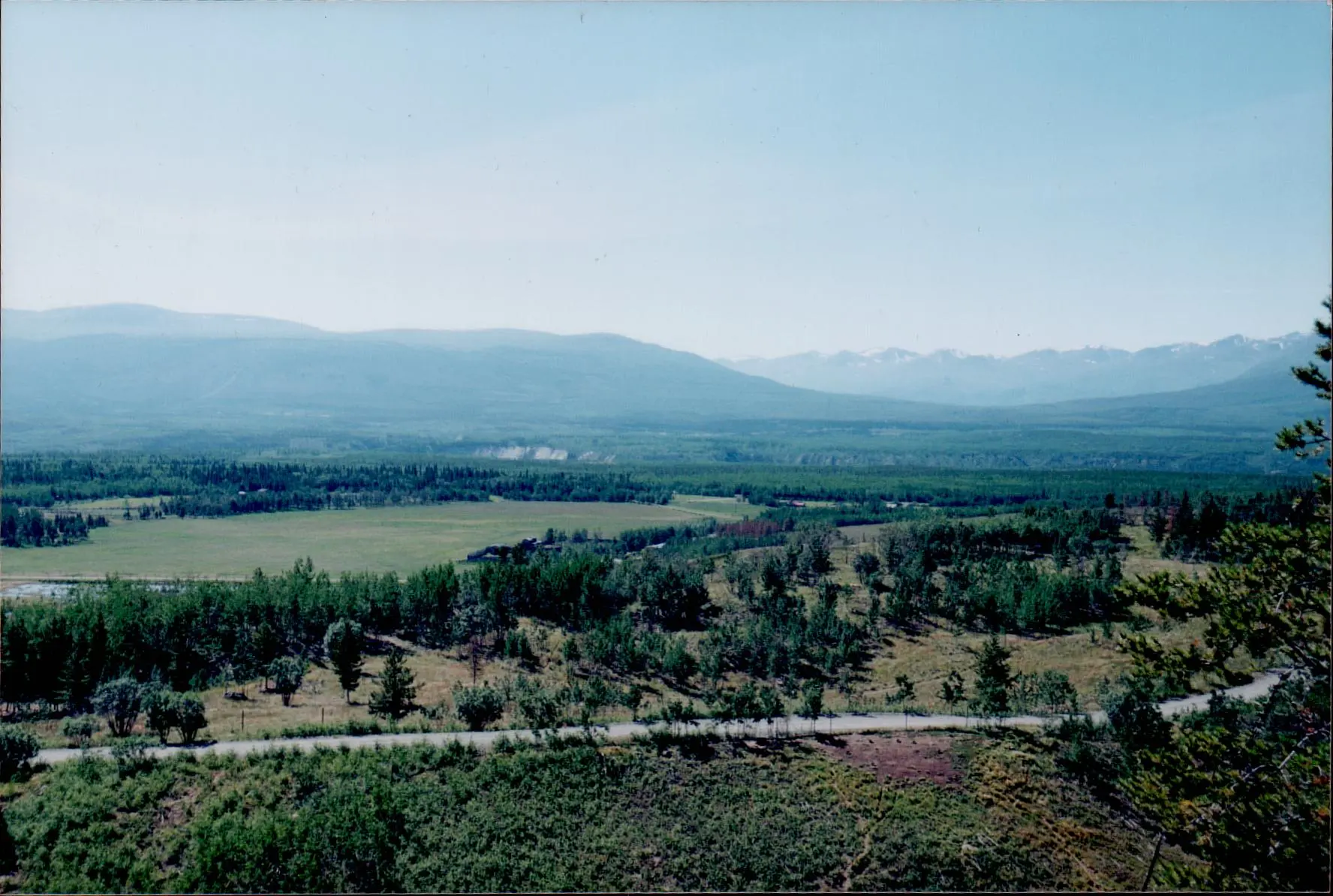
When the Nowlans purchased the property, it had a variety of high and low land, but the central feature was a wetland where today there is a big field.  The property needed roads and trails to be accessible for visitors and, although the marsh attracted wildlife, it was not part of Danny’s vision. At a local auction, he picked up a large earth mover (“scraper”) and a D8 caterpillar tractor with a cable-controlled blade (“cable cat”). This machinery was difficult to operate but it would be instrumental in building roads through the property - and Danny had a bigger plan than just roads.

He built a dam across the drainage from the cliffs to dry out the wetland and create a pasture for first mule deer and later bison. A pond developed behind the dam, and it attracted migratory birds and small mammals. The small animals attracted fox and coyotes, so the next step was fencing. He used whatever came to hand, including 3” pipe from the CANOL pipeline, an ill-fated World War Two project. He put a fence around an area with a small herd of grazing mule deer, and the Game Farm had its first large residents.

Some of the early buildings on the Game Farm were interesting. Danny bought the Yukon’s first airport hanger and moved it out to his property. His daughter Peregrine remembers two baby bears living under it. The Nowlans’ little home by the road did double duty as an animal hospital as Danny brought in wounded and abandoned animals. An owl with a broken wing was put in Erika’s book room and it roosted there on a shelf. She was forever cleaning owl poop off her books. A baby mink always wanted to swim. He joined the kids at bath time, and he developed a terrible habit of swimming in the toilet bowel if someone left the lid up at night. 

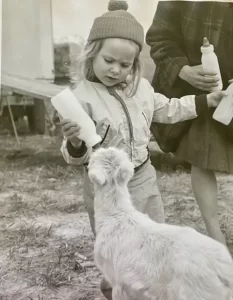
Sabrina Nowlan with a Dall lamb. Danny' and Erika's second daughter, born 1965 and lived 17 years on the farm and in Whitehorse. Photo provided by Sabrina Nowlan.

One night Erika screamed and woke the kids because a wet mink was running around inside her sleeping bag. She loved animals and endured a lot of chaos. Like the time Danny put their four-year-old daughter Sabrina astride a moose called Susiecue. The moose took off, and Danny was yelling for it to come back and shaking a bucket of oats. Sabrina went for quite a ride and remained completely fearless. Erika was not impressed.

Dall’s sheep were to be the Game Farm’s main attraction. They are magnificent creatures, they can be difficult for the ordinary person to see in the wild, and there was a market for them in southern zoos and game farms. After obtaining the necessary permits, a crew of hardy folk set off to capture some breeding stock at Thechàl Dhâl (Sheep Mountain) near Kluane Lake. Danny’s kids, Peregrine and Sabrina, looked after those first little lambs and kept them in their bedrooms. Wildlife biologist Manfred Hoefs was in the capture group. At that time, Manfred was a graduate student studying Dall’s Sheep horns. Danny, who had a Grade 2, a Grade 3, or a Grade 6 education (depending on who he was talking to), was famous for the amount of research he did on animals and their habitat. He was also famous for the number of useful contacts he developed with experts in many fields. Manfred continued to visit the sheep on the Game Farm for many, many years and established a Dall’s Sheep horn measuring protocol that the Yukon Wildlife Branch used to build a valuable and still-used research dataset.

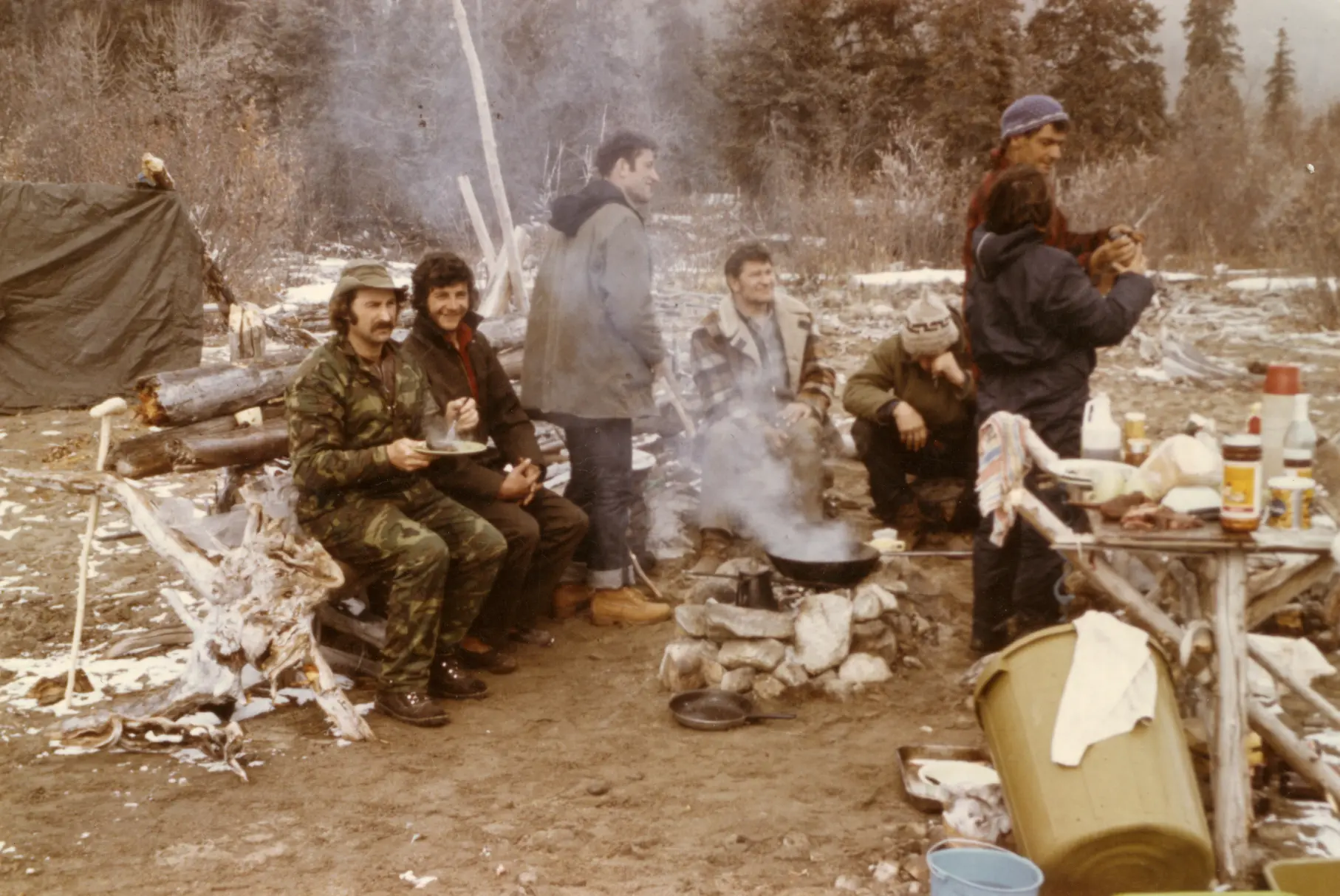
Sheep camp for sheep capture - from left to right: Unknown, Teddy Yardley, Herb Zollweg, Unknown, Unknown, Danny Nowland and Erika Nowlan

All of Danny’s friends enjoyed a good story, and one of them involved the Game Farm sheep and the road building equipment. Danny was never very careful with equipment, and the machinery ended up sitting in the sheep enclosure. Manfred came to the Farm one time and found the rams all lined up and running at one of the scraper’s huge tires. They would bang into the rubber, bounce off, and run at it again. Manfred said they were loving it – the best thing they had ever hit in their lives. They just kept going – bang, bang, bang. Sort of like Danny – living and loving life to the fullest.

• • •

Photo gratefully provided by Uli Nowlan unless otherwise noted.

Sally Robinson, October 2023
with words from interviews with Peregrine Nowlan, Sabrina Nowlan and David Mossop.

Sally Robinson

Sally Robinson

Vintage Ventures - Researcher & Writer

Sally is currently an independent consultant in the heritage field. Throughout her career, after working 20 years with Yukon museums as a researcher, curator and exhibit designer/producer, she joined the Yukon Government to work for 16 years as the Historic Sites Interpretive Planner.

Lindsay Caskenette

Lindsay Caskenette

Manager Visitor Services

Lindsay joined the Wildlife Preserve team March 2014. Originally from Ontario, she came to the Yukon in search of new adventures and new career challenges. Lindsay holds a degree in Environmental Studies with honours from Wilfrid Laurier University and brings with her a strong passion for sharing what nature, animals, and the environment can teach us.

867-456-7400
Lindsay@yukonwildlife.ca

Explore by Category

Explore by Author

Little Muskox, Big Journey

Little Muskox, Big Journey

nature preserve

by Brittney Forsythe | May 25, 2025

2 minute read -

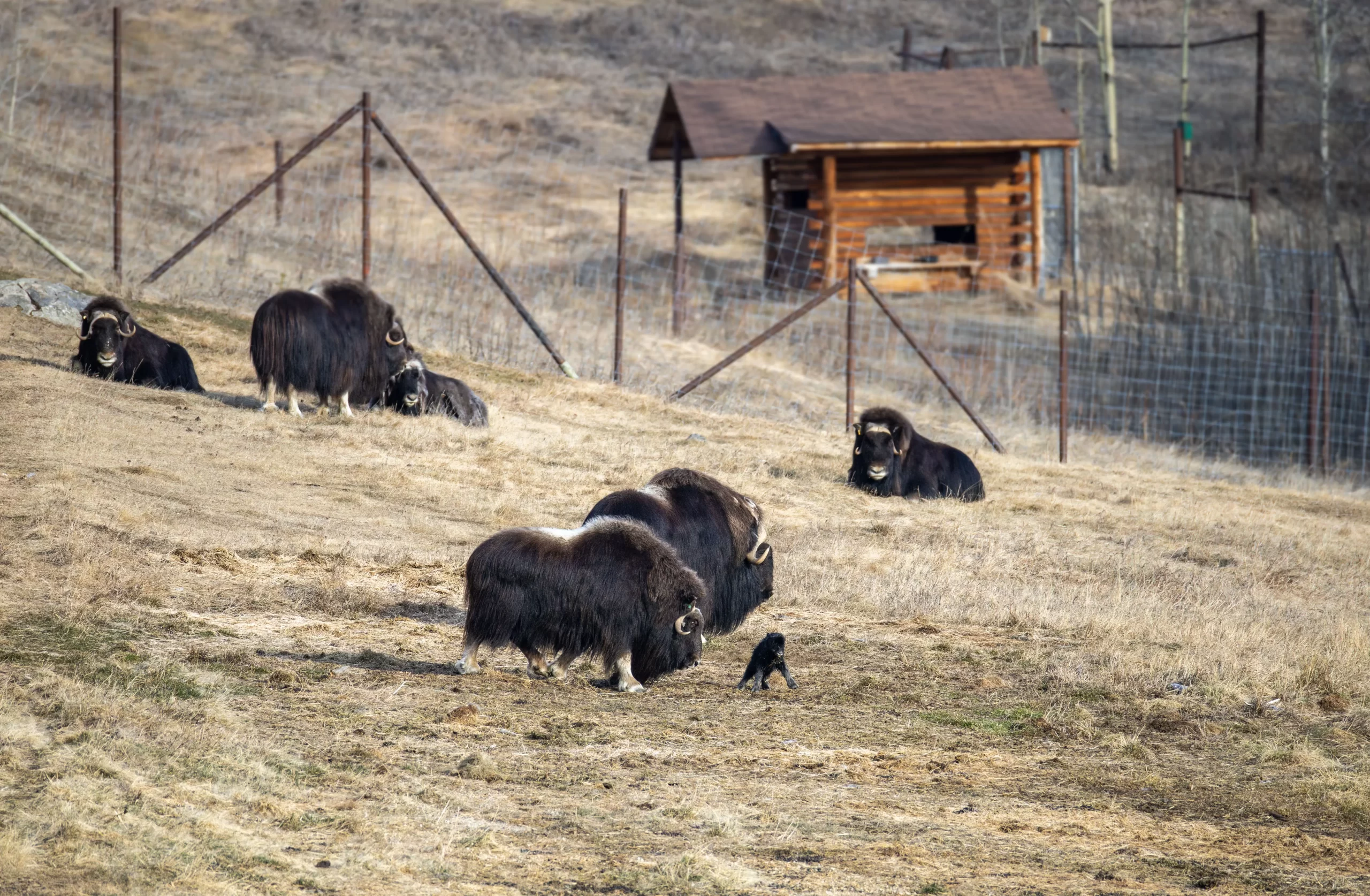
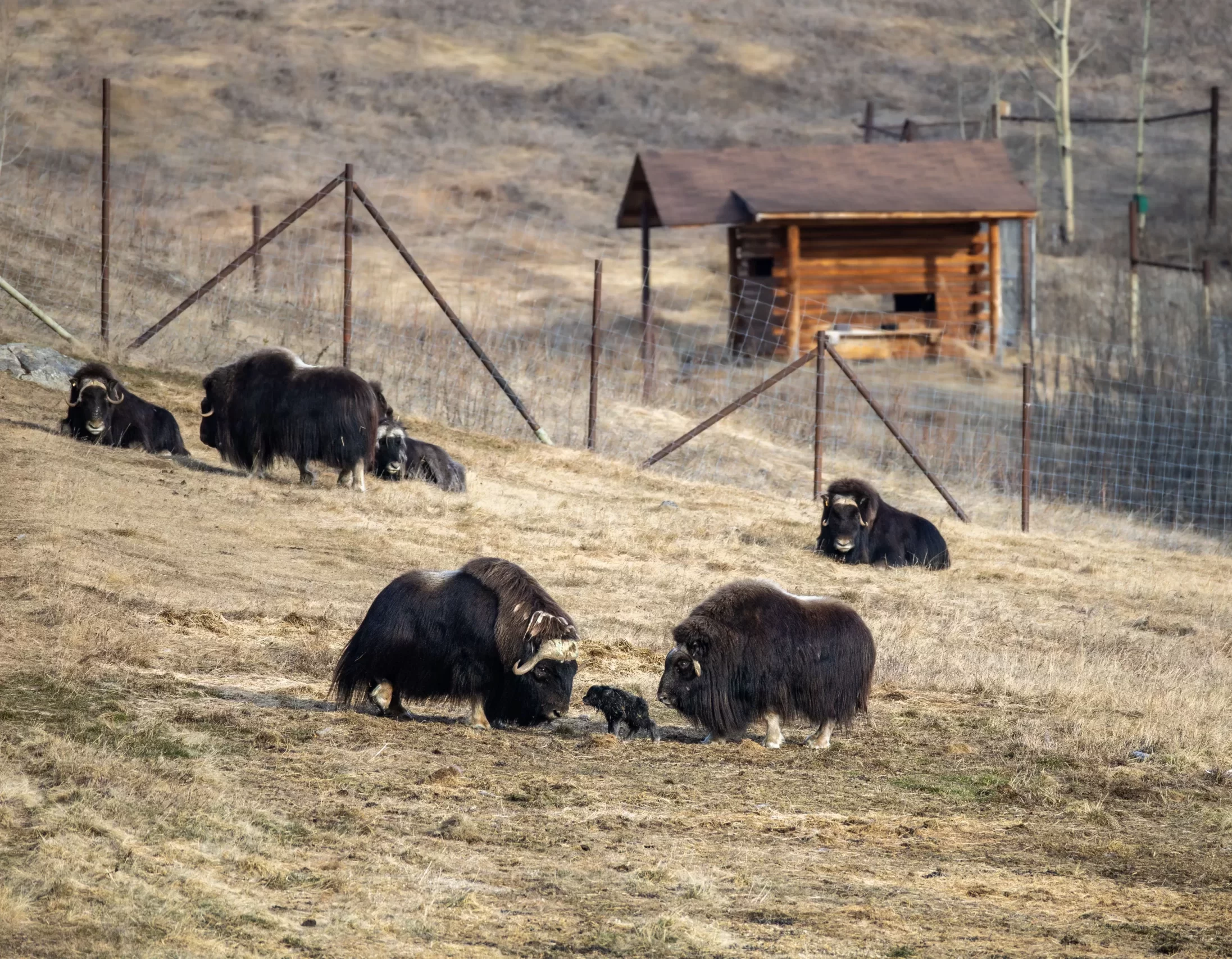
Nature is beautiful — and often unpredictable. On April 30th, the Yukon Wildlife Preserve welcomed its first muskox calf of the year. But shortly after his arrival, it became clear that something wasn’t quite right. Despite hopes for a strong maternal bond, the mother muskox wasn’t allowing the newborn to nurse. The reason for this rejection remained unclear —  the muskox bull was also seen interacting with the calf in a way that raised safety concerns.

Baby Muskox with Mom and Bull Photo Credit Jake Paleczny

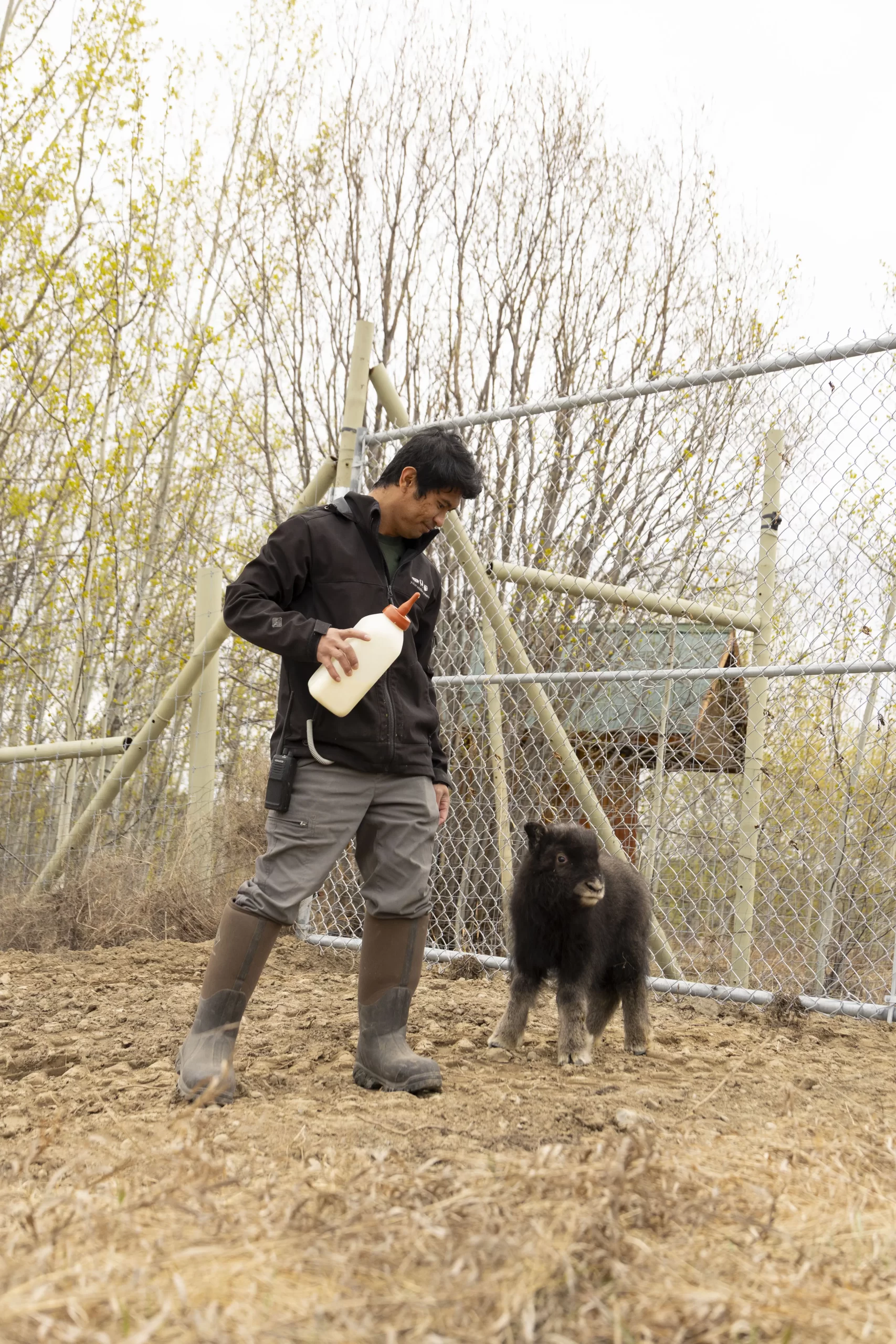
To protect the calf, our team made the decision to intervene. He was brought into our Wildlife Rehabilitation Centre, where he began receiving around-the-clock care and 1L of specialized milk replacer daily. While it wasn’t the beginning we’d envisioned for him, the calf showed resilience and strength from the very start.

At the same time, the veterinary team kept a close watch on the mother muskox. When it became apparent she hadn’t passed her placenta, she was safely immobilized and given medication to support the process. After several days of monitoring in a separate enclosure, she recovered well and was eventually reunited with the rest of the herd.

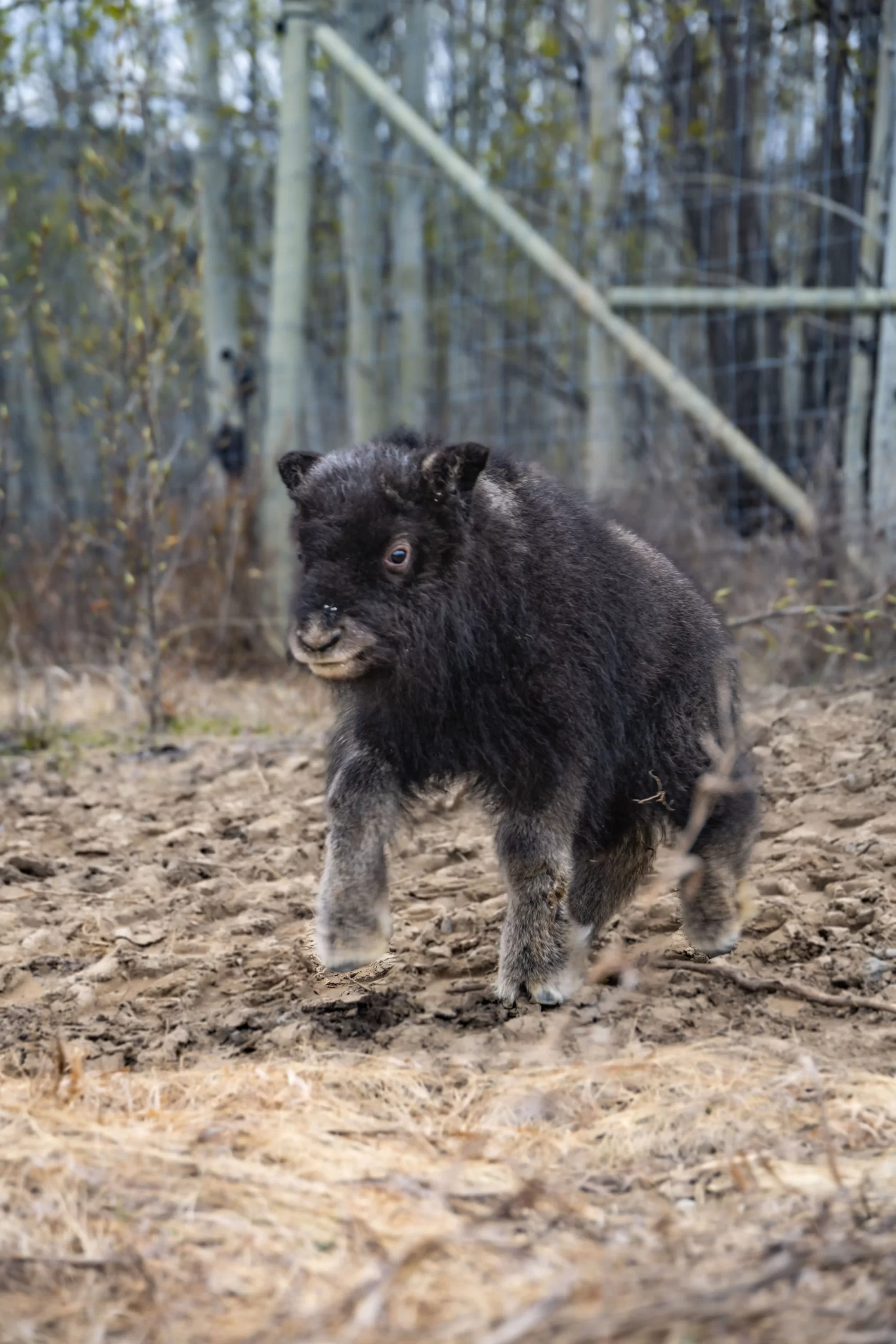
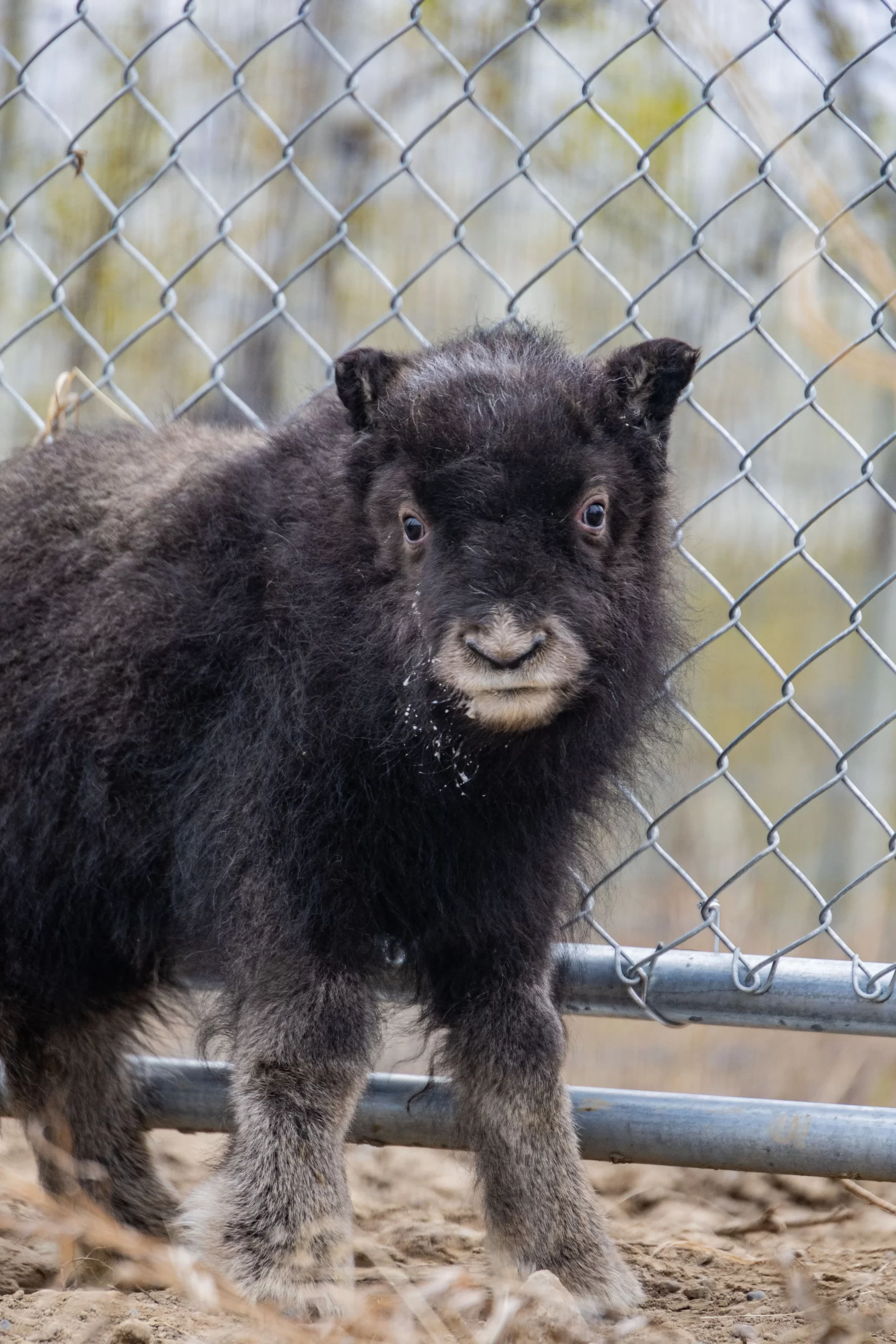
Baby Muskox Photo Credit Britt Forsythe

As for the little muskox calf — he’s growing quickly! On May 22nd, at just over three weeks old, he was moved out of the Rehabilitation Centre and into a transitional habitat adjacent to the main herd. This new space allows our team to continue feeding him safely while also helping him gradually reintroduce to his species — a gentle reminder that he is indeed a muskox, even if his first few weeks have looked a little different.

Though he’s still receiving bottle feedings and close care, he’s doing well. If you're visiting the Preserve, you might just catch a glimpse of him  — look up towards the office when standing at the Thinhorn Sheep Ewe's feeding station — but as always with muskox sightings, a zoom lens or binoculars will be your best friend!

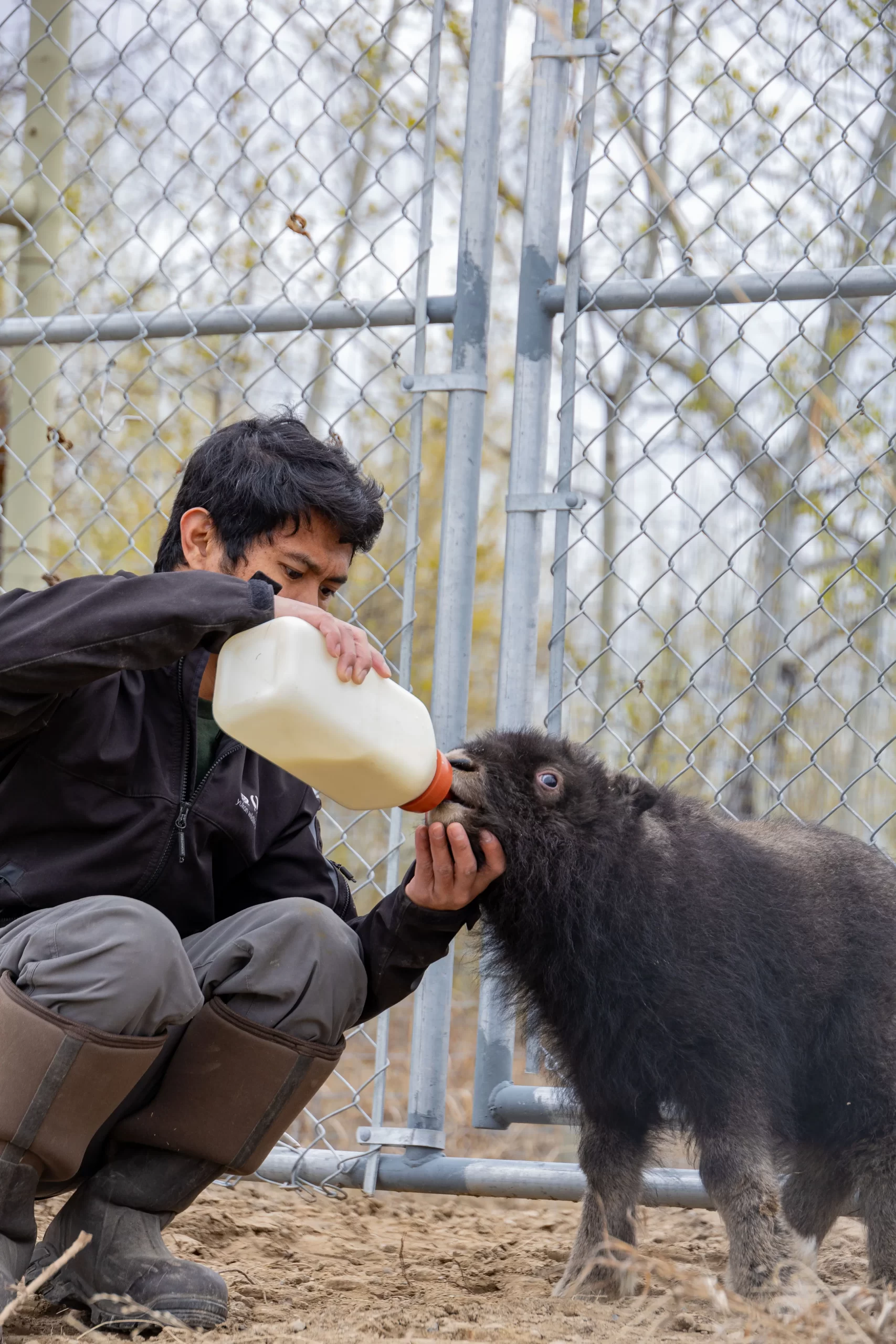
Senior Wildlife Care and Rehabilitation Technician Michael Salilig feeding the baby muskox 

Photo credit: Britt Forsythe

Brittney Forsythe

Brittney Forsythe

She/Her - Visitor Services Coordinator

Brittney joined the Wildlife preserve in the summer of 2023. Growing up on Northern Vancouver Island, surrounded by the temperate rainforest, nature and animals have always been a part of her life. It exploded into a passion, when she started her dog walking business in 2017 and she began spending 6-7 days a week in the forest, rain or shine! This sparked an even deeper appreciation for the cyclical nature of the land and how all of the plants & animals work together symbiotically. She is forever ‘that girl’ on the hike, pointing out different rocks and plants, explaining their origin or what they could be used for medicinally. Brittney and her dog Cedar relocated to the Yukon to help care for 31 sled dogs. She is so excited to expand her local knowledge as a part of the Preserve team.

867-456-7400
 Brittney@yukonwildlife.ca

Explore by Category

Explore by Author

Aspen Seeds Needed

Aspen Seeds Needed

nature preserve

by Sophia Slater | Apr 23, 2025

5 minute read -

Beginning this spring and continuing over the next three years, Yukon Seed and Restoration in partnership with Yukon Government's Wildland Fire Management Branch will collect 6,000 g of native Trembling aspen (Populus tremuloides) seed to use in projects throughout the territory for its fire resistant characteristics. This will include planting in the Whitehorse south fuel break, a 365 hectare fuel break being built to protect the city in case of a severe wildfire.

The Yukon climate is characterized by a short growing season, cold temperatures, and limited water availability. These specific environmental conditions require Yukon native seeds to be used in this project to give the trees the best chance at survival.

Have a favourite trembling aspen stand? Let us know on iNaturalist! Photo credit: Sophia Slater, YSR.

We are aiming to collect aspen seed from the Southern Lakes and Yukon Plateau North/Central ecoregions, but are interested in populations all over the territory. 

Who Are We?

Yukon Seed and Restoration, or YSR, is a plant focused environmental consulting company majority owned by the Na-Cho Nyäk Dun Development Corporation. We provide ecological restoration through land reclamation projects, honourable harvesting of Yukon native plant species, and invasive species management. 

We strive to make the land good through our work with First Nation, industry, and government clients. 

(Some of) our team. Photo Credit: Ainsley Taggett, YSR

One of the ways we support ongoing restoration work across the Yukon is through the Yukon Native Seed Bank and our Hudzi ni plant processing facility. We aim replace non-native seeds used on restoration projects with Yukon native seed that is better suited to our northern climate. We also develop workshops and programming to build capacity throughout the Yukon.

Aspen Identification

Trembling aspen is a deciduous tree that grows up to 20 m tall. They are a clonal species that reproduce by sending out shoots along their lateral roots. In a small area, most likely all individual aspen stems are genetically the same. They are dioecious, meaning that individuals are either male or female, and the female trees produce the seeds. 

Trembling aspen have smooth greenish-white, sometimes powdery, bark with black markings. The bark does not peel like on birch trees. The leaves are smooth and round with a nearly flat base and a pointed tip. They shake or tremble in the wind, giving the tree its name.

Trembling aspen bark (left), leaves (middle), and stand (right). Photo credits: YSR (left, middle), Ainsley Taggett, YSR (right).

On average, male trees flower in late April, and females in early May. Identifying flowering populations helps us to prepare for seed collection. Flowering male catkins are 2.5-7 cm long and red with white fluff, whereas flowering female catkins are 2-5 cm long and less conspicuous than their male counterparts.

Flowering male catkin (left) and flowering female catkin (right). Photo credits: iNaturalist (left), Hilary Lefort, YSR (right).

Aspen seed collection is a very time sensitive task. Later in May, female catkins turn green and lengthen. Eventually the seed pods open, releasing the white, fluffy seeds. Once the aspen seeds start to fluff out, it may only be 48-72 hours before the entire seed crop has dispersed. Usually this falls around the end of May or beginning of June, so beginning in mid-May we check on stands frequently to assess the seed crop, looking at the fruiting female catkins and breaking them open to see the seed inside.

We aim to collect the female catkins when they are green (left), just before the seeds are released. We can confirm their readiness by looking at the seed: yellowy seed (middle) is immature, and brown seed (right) is mature. Photo credits: iNaturalist (left), Moench (middle, right).

Aspens and Fire

Wildfire plays a critical role in Yukon ecosystems and has been used traditionally by Yukon First Nations to manage forests. However, due to a history of fire suppression and an increase in temperatures caused by climate change, fires are becoming more frequent and more severe in the territory.

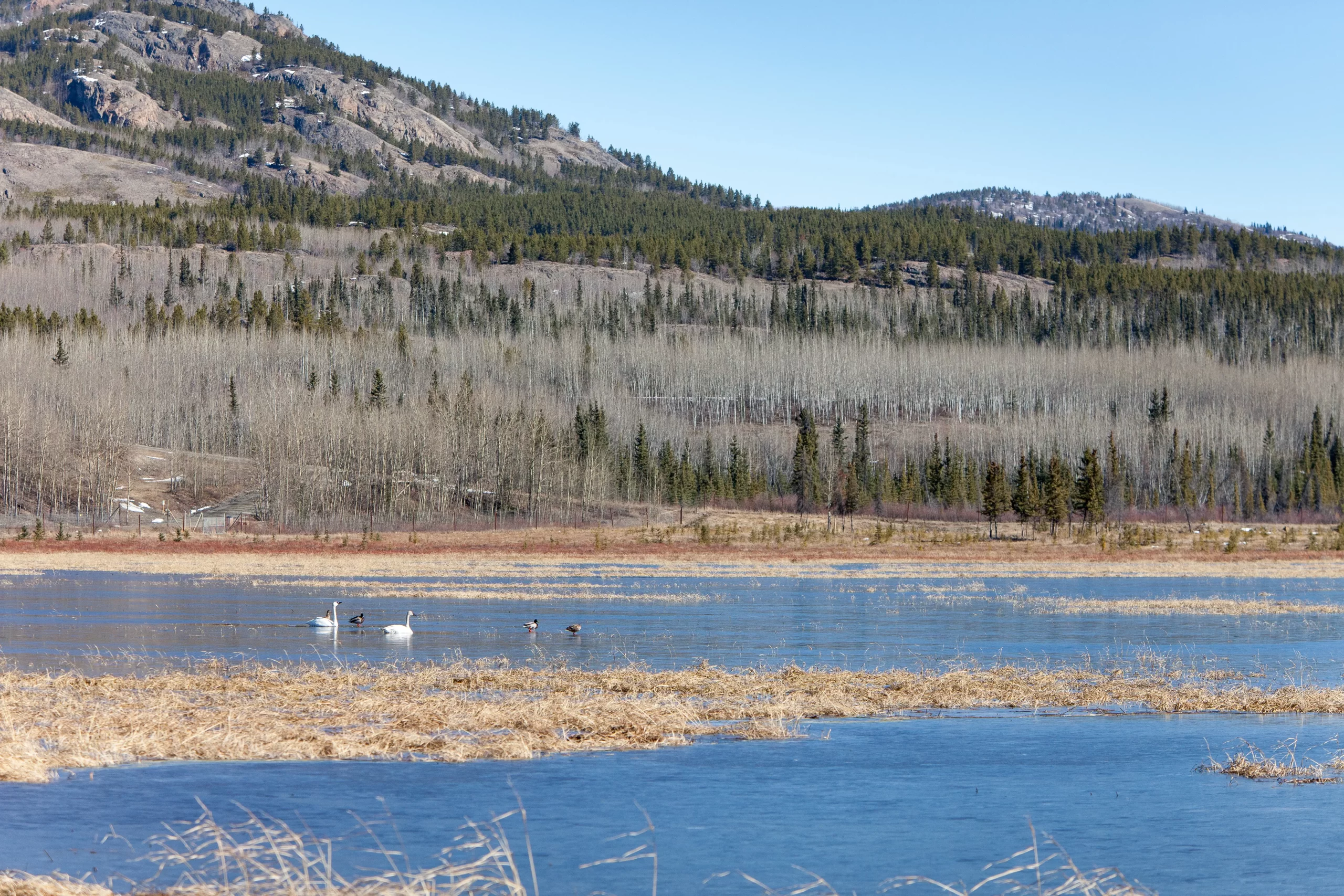
Pushup from a muskrat in the Preserve's Moose Pond with a wide view of the land including snowy mountains and boreal forest. Photo Credit; Rebecca Carter.

The Ethel Lake burn near Mayo/Stewart Crossing. Photo credit: Naomi Butterfield, YSR.

Conifer trees like white spruce and lodgepole pine pose a greater risk than deciduous trees in wildfires, because of their flammable bark, relatively high density, and buildup of ground and ladder fuels. Deciduous trees like trembling aspen are relatively fire resistant due to their higher moisture content, lower density, limited ladder fuels, and shading of the understory, which protects it from moisture loss. Additionally, trembling aspen grows quickly in burned soil.

How Can You Help?

This scale of project will require many aspen populations. Over the next three years, if you see aspen populations with lots of trees, and specifically with female flowers/catkins (see Aspen Identification), let us know!

Join our iNaturalist platform to tag populations of reproductive aspens and contribute to the reforestation of the fuel break. Email photos and locations to us at matthew@yukonseed.ca.

If you are interested in helping out with collections, we are looking for casual labour and volunteers at the end of May and June. Stay tuned to our Facebook for seed collection dates. Contact matthew@yukonseed.ca for more information or to get involved.

References

Government of Alberta. 3 August 2012. How different tree species impact the spread of wildfire. Government of Alberta. Available from: https://www1.agric.gov.ab.ca/$department/deptdocs.nsf/all/formain15744/$FILE/tree-species-impact-wildfire-aug03-2012.pdf 

Mackinnon A, Pojar J, Coupé J. 2021. Plants of Northern British Columbia, Expanded Second Edition.

Moench RD. Aspen Seed Collection. Part of Nursery Information Series. For Colorado State Forest Service.

Shinneman DJ, Baker WL, Rogers PC, Kulakowski D. 2013. Fire regimes of quaking aspen in the Mountain West. Forest Ecology and Management, 299: 22-34.

Sophia Slater

Sophia Slater

Intermediate Restoration Ecologist

Sophia was one of the Interpretive Wildlife Guides and animal care assistants at the Preserve. She moved to the Yukon from Ontario, where she just graduated with a Bachelor of Science in Biology from Nipissing University.  Now you can find her at Yukon Seed and Restoration as an Intermediate Restoration Ecologist or summiting the many beautiful mountains in the Yukon this summer! 

Explore by Category

Explore by Author