I Have to Sell!

I Have to Sell!

wilderness

This article was made possible thanks to support from the Yukon 125 Fund. Learn the incredible history of the Yukon Wildlife Preserve, and Yukon Game Farm from the people of the past through this series of articles.

Danny Nowlan is one of Yukon’s colourful, and at times, notorious characters. He was a polarizing figure who cared deeply for animals and connecting them to kids. He was also the subject of one of Yukon’s most expensive trials ever. His work on the Yukon Game Farm would eventually result in the creation of the Yukon Wildlife Preserve. That is a legacy that is still experienced by many Yukoners – although many of the stories are not known or well understood. 

The stories of Danny Nowlan are important threads that are woven through the tapestry of Yukon’s recent history. This project gives us the opportunity to capture and share this history before its lost. This includes the opportunity to celebrate the positive lasting legacy and to learn about and grapple with the challenging aspects of this legacy. 

In 2023 historian Sally Robertson collected oral histories from more than a dozen people who knew Danny. Out of this work, Sally wrote a series of stories about Danny and his adventures.

(9 minute read)

Danny and Erika Nowlan had a dream, and the Yukon Game Farm was established in the mid-1960s. Danny had to struggle several times over the years to keep the Yukon Game Farm operating. It was never profitable until the falcon breeding program was in place. Until 1990, the Nowlans were in business to raise breeding stock and sell young animals to international zoos and wildlife farms. In the case of birds of prey, their market was falconers wherever they happened to live. A Dall’s sheep ram might occasionally bring $2,000 and a trained gyrfalcon might be sold for $13,000, but there were many animals on the Farm, and they all needed care and a constant supply of huge quantities of food.  

Danny considered selling the Yukon Game Farm in the 1970s, when it seemed there would be never-ending bank loans. This was a time when Danny had close friendships with Yukon Game Branch employees, both guardians (Conservation Officers) and biologists. Government biologist Dave Mossop came to Danny with a plan to replenish Yukon’s wild stock of peregrine falcons. This was successful and, building on that, the Yukon Game Farm purchased gyrfalcons from the government and embarked on a successful breeding program.

Danny with Gyrfalcon


Danny needed even more money to establish the infrastructure and so, instead of selling the whole property he tried to subdivide and sell some lots along the Hot Springs Road. The government prohibited the sale and Danny’s attitude toward bureaucracy started changing towards antipathy. In the end, the approach of a government official elicited a yell of ‘cops’ from Danny and furious barking from his well-trained dogs. Followed by Danny’s famous laugh.

Prohibited from selling titled property, Danny instead sold 999-year leases. The government challenged this sale, and Danny won in court, so the parcels became titled land. Selling the road frontage kept him in business for a while, and also had the advantage of providing some protection for the animals. Before they were moved away from the road, there were incidents of animals being injured and one ram sheep with trophy-sized horns was killed.

In the mid-1980s, Danny, his second wife Uli, and well-respected biologist Dave Mossop were arrested and dragged into court on charges associated with the capture and illegally selling of endangered falcons to wealthy Saudi Arabians.  Operation Falcon was an undercover operation that started in the United States and reached into the Yukon. The Yukoners were judged not guilty of all charges, but the trial affected reputations and bank accounts. After the trial, the Game Farm’s elaborate infrastructure for breeding, raising, and replenishing wild stocks was in shambles, and Danny and Uli were no longer able to realize a profit from selling the birds they were so successful at raising.

In the 1980s, elk farming became a profitable business in Canada and Danny was quick to acquire a herd of about 300 animals. He and a number of other Yukoners became successful elk farmers before the Korean market for Canadian elk antlers and velvet collapsed. Some elk farmers in the United States changed their operations to hunt farms, places where hunters could pay to shoot animals. The only legal option in the Yukon was the sale of elk meat, and that was not part of Danny’s vision of an educational preserve to showcase Yukon wildlife. He told a friend that the day he had to sell a pound of elk meat was the day he was out of business.

Elmer-1st and Danny especially favorite elk bull came from Chuck and Clara from California 1983 visit.


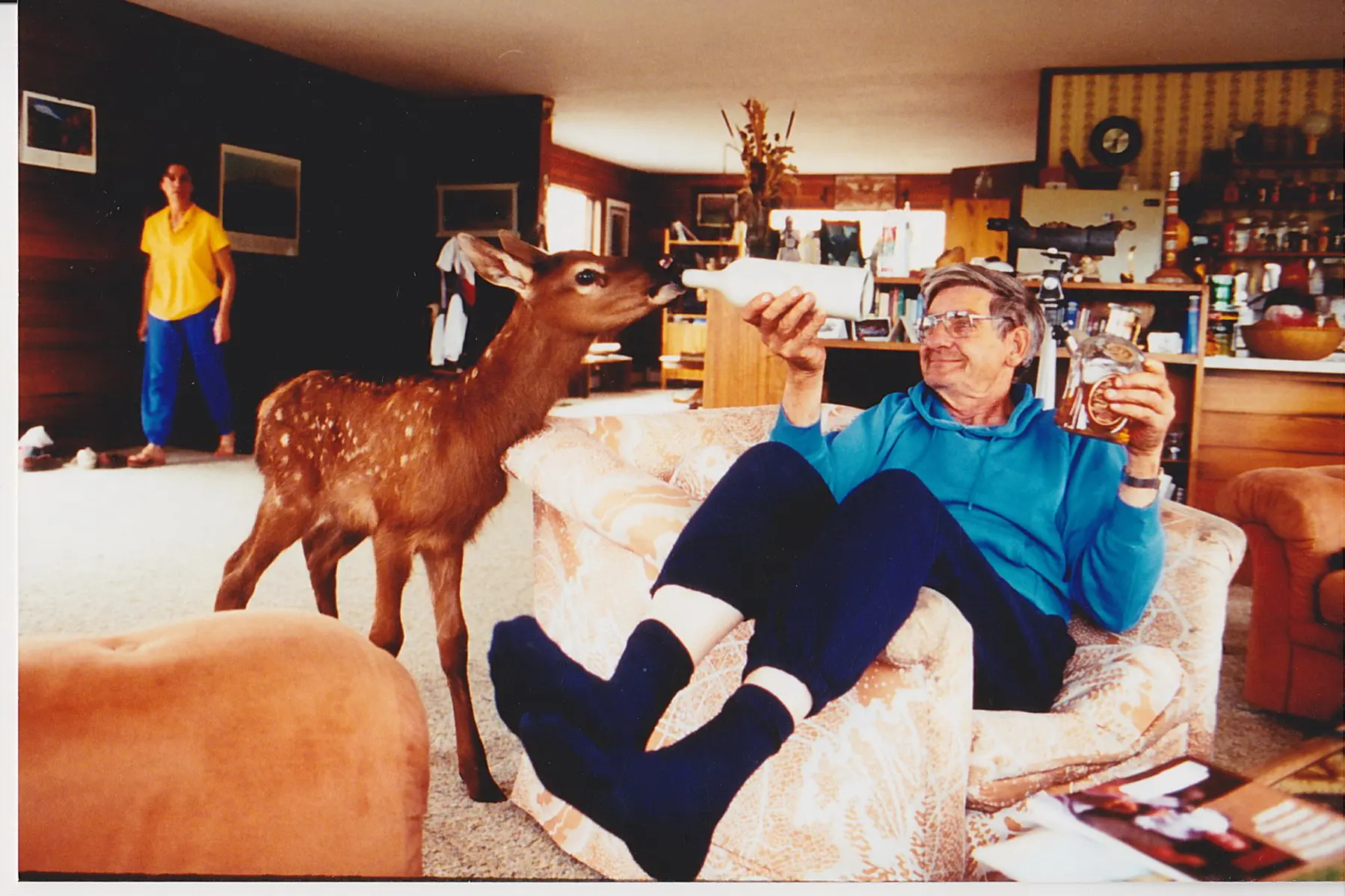
Fortunately, just at this time the Nowlans were approached by Holland America to provide a tourist attraction for the company’s bus tours. This was in line with Danny’s vision. He needed to upgrade the roads and fences, and acquire more northern species, but the Nowlans were still able to sell animals and care for the injured and abandoned ones that were constantly being dropped off at their door.  This change in direction was formalized by a change in name; the Yukon Game Farm became the Yukon Wildlife Preserve in 1989.

Original logo created by Peregrine Nowlan in 1989 when the name change occured from Yukon Game Farm. Later when the facility was sold and run as a non-profit the name remained and the logo updated to its current version.

Around 2000, Danny was once again faced with the serious problem of keeping the operation in business. Animal sales were still an option, but there was a dawning awareness in Canada of spreading diseases affecting wildlife. Danny needed permits to move animals across borders, and these became increasingly difficult to obtain. The matter came to a head for the Yukon Wildlife Branch when public attention was drawn to one of Danny’s mountain goats that appeared on a steep hill across the North Klondike Highway from the sod farm. Government officials were worried about the transmission of disease from domestic animals to wildlife, and two escaped mountain goats could have travelled past agricultural farms containing domestic goats.

Danny was unable to recapture his animals, and the Yukon government’s Philip Merchant came to the rescue with a helicopter and a tranquilizer gun. The story of the capture is a harrowing tale for another time, but no animal (human or goat) was terribly injured, and Danny was presented with the bill. 

Danny said, “I want to go fishing” and he started looking for buyers. He could have made a lot of money by letting a developer divide the Game Farm into acreages. Many Yukoners were reluctant to see this happen, and the Friends of the Yukon Wildlife Preserve was established in 2002. The Board of Directors included successful businesspeople, educators, and wildlife biologists who recognized the Preserve’s potential economic, preservation, and educational worth to the Yukon. The society tried to raise funds to buy and operate the facility as a business, and they received support from individuals and potential partners.
In July 2003, the Yukon Fish and Wildlife Management Board wrote a letter to support a proposal where a not-for-profit society would run the facility with assistance from the Yukon Government, as long as the facility obtained accreditation from the Canadian Association of Zoos and Aquariums. The government, for many reasons, was reluctant to commit to any involvement at that time, and the Board of Directors dissolved the Friends of the Yukon Wildlife Preserve association in August 2003.

The public facing entrance to the Yukon Wildlife Preserve. Photo Rebecca August 2004.

There are many opinions about why the government persuaded a number of the original Friends and others to form an operating society, and then purchased the Yukon Game Farm in April 2004. Danny talked to the media and there was considerable public pressure in support of the sale. It was, and remains, a controversial decision especially for those opposed to seeing wildlife in pens. However, the Yukon Wildlife Preserve is a delight for children of all ages, and the expansive habitats created by Danny Nowlan make the residents very happy.

About his ability to get things done, Wendy Brassard says Danny would get these ideas and he wouldn't abandon them. He wouldn't just let them die or turn away from them. He'd think about it, he'd read because there was no Internet back then, he'd make phone calls, and the next thing you know, everything's changed. And he just kept evolving. He was such a good example of ingenuity and resourcefulness, and never say die. Just if you think it's right and it's going to work and it's a good thing? Do it.” David Smiley says Danny was an amazing character; that guy was different. Both good and bad. He had a rough side and he had a Grade 3 education. But he could develop a plan that somebody from a university would have trouble figuring out the nuances. He was a good planner. Randy Hallock concluded that Danny was interesting and always full of ideas. He just built the place and not much could stop him. He had ideas, and he made them work. People telling him ‘no’ just made him that much more driven. 

Minister Dixon, Department of Environment, Yukon Government and YWPOS board member Bill Klasson.
Photo taken 2013 on the signing of a 5 year agreement.

David Mossop is involved with the Game Farm in its current form as the Yukon Wildlife Preserve. He says it's interesting that all these years later, they haven't changed anything. It's basically exactly as Danny and Erika envisioned it – except brought to fruition a lot more. Their idea was to create something where the children of the Yukon could come and see the creatures that live here. And that's basically what happened.

The memories that were collected during this oral history project speak to the impact that Danny had on so many friends, kids, and animals - and the Nowlans’ legacy remains intact for Yukoners and Yukon visitors. We think Erika would be proud to see a fully realized wildlife preserve with its visitation of wide-eyed children. Uli Nowlan often visits the facility and keeps a watchful eye on the operation. Danny didn’t become an avid fisherman, but he did relax knowing his animals, and his legacy, were in good hands. 

• • •

On June 12, 2004, was the Grand Opening of the Preserve!

Danny Nowlan Life and Death - June 4th, 1929 - October 23rd, 2011.

Photos gratefully provided by Uli Nowlan.

Sally Robinson, October 2023
with words from interviews with Uli Nowlan, David Mossop, Philip Merchant, Wendy Brassard, Randy & Maria Hallock, David Ford. 

Sally Robinson

Sally Robinson

Vintage Ventures - Researcher & Writer

Sally is currently an independent consultant in the heritage field. Throughout her career, after working 20 years with Yukon museums as a researcher, curator and exhibit designer/producer, she joined the Yukon Government to work for 16 years as the Historic Sites Interpretive Planner.

Lindsay Caskenette

Lindsay Caskenette

Manager Visitor Services

Lindsay joined the Wildlife Preserve team March 2014. Originally from Ontario, she came to the Yukon in search of new adventures and new career challenges. Lindsay holds a degree in Environmental Studies with honours from Wilfrid Laurier University and brings with her a strong passion for sharing what nature, animals, and the environment can teach us.
867-456-7400
Lindsay@yukonwildlife.ca

Explore by Category

Explore by Author

Bonaparte’s Gull Release

Bonaparte’s Gull Release

wilderness

by Lindsay Caskenette | Jun 25, 2024

4 minute read - 

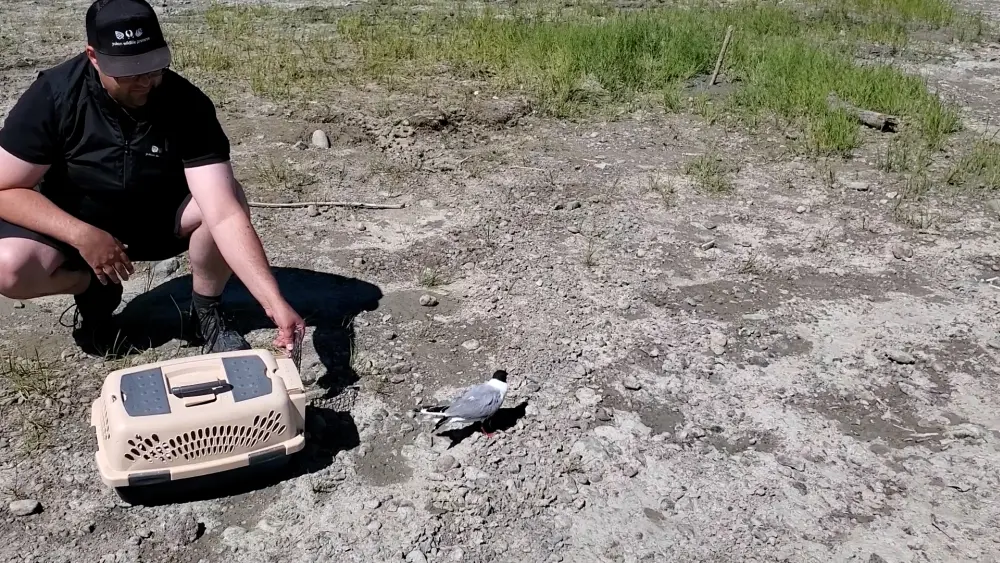
A Bonaparte's gull was brought into the Wildlife Rehabilitation Centre at the Yukon Wildlife Preserve after it was found flightless on the side of the road. The bird has no significant injuries, some feather damage and was likely concussed. A short time in the centre to recover, eat fish and get strong meant a successful release of the animal to Tàa'an Män — Lake Laberge on the traditional territory of the Ta'an Kwach'an Council.

Lindsay Caskenette

Lindsay Caskenette

Manager Visitor Services

Lindsay joined the Wildlife Preserve team March 2014. Originally from Ontario, she came to the Yukon in search of new adventures and new career challenges. Lindsay holds a degree in Environmental Studies with honours from Wilfrid Laurier University and brings with her a strong passion for sharing what nature, animals, and the environment can teach us.

867-456-7400
Lindsay@yukonwildlife.ca

Explore by Category

Explore by Author

Northern Neck Tubes

Northern Neck Tubes

wilderness

by Lindsay Caskenette | Oct 29, 2021

6 min read

The Visitor Services team is working hard to connect with local artist to bring the connections to nature home with you. We strongly feel that by taking the time to explore these partnerships we can create unique items that guests to the Preserve can take home all while knowing their purchase in the Preserve's Little Gift Shop not only supports these northern people but all revenue from the retail sales goes back into the operations of the Preserve, supporting the northern animals in our care.

Right now the Preserve does not do online sales. We're a really small team that is situated out of town, and with some staff also living out of town, doing online sales and shipping feels a bit outside our capacities for the time being. 

• • •

Photo of moose in water.

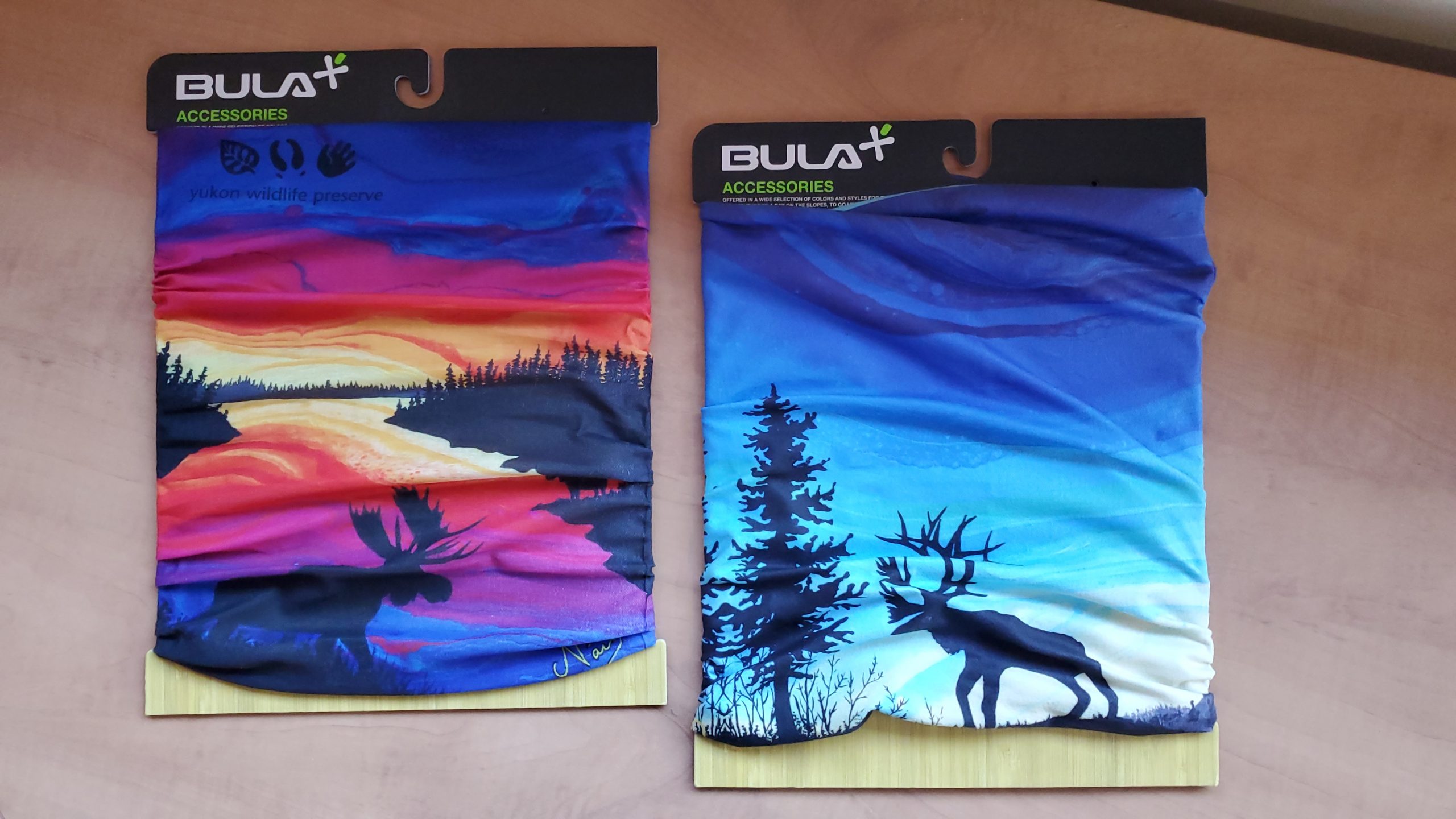
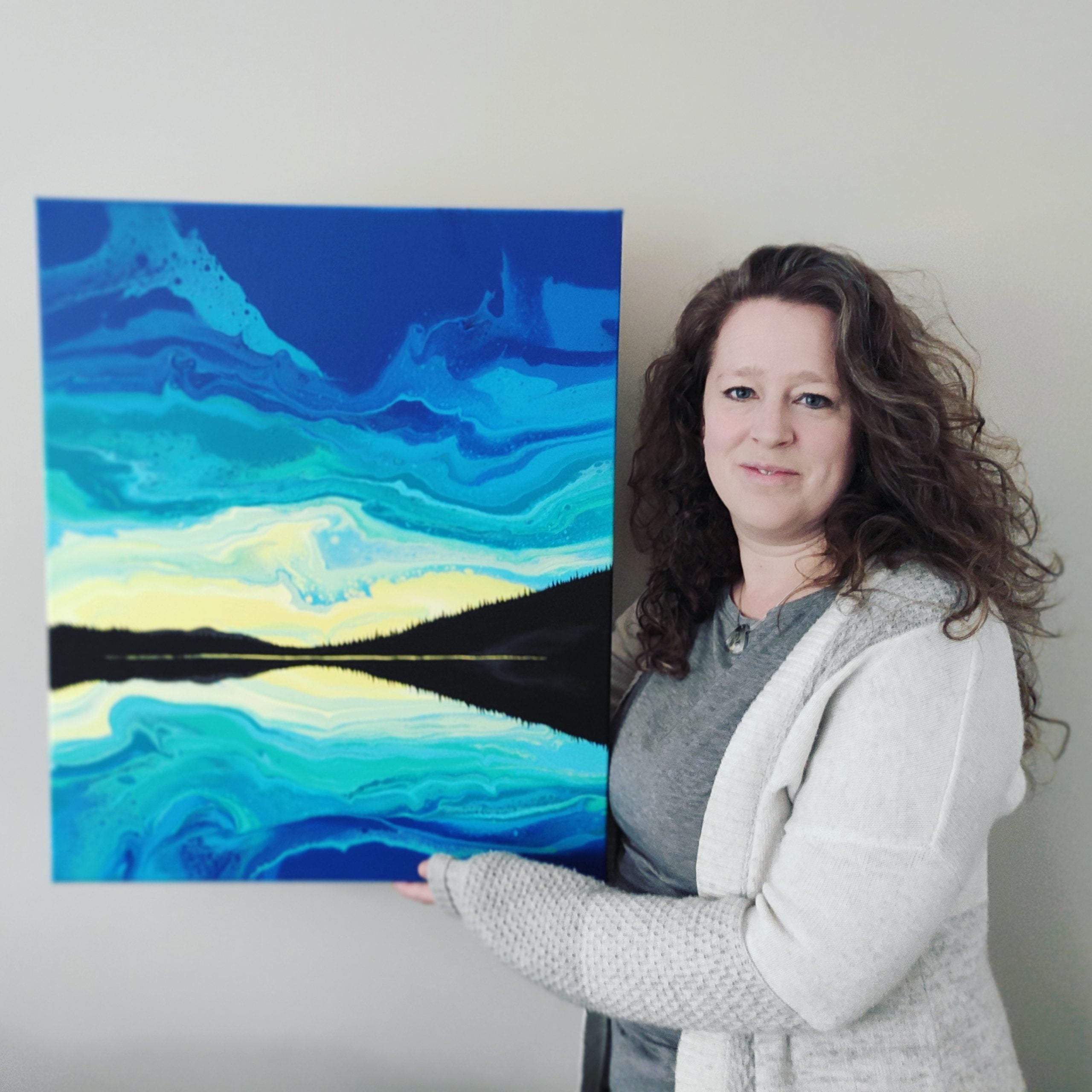
This artist collaboration was an incredibly fun and colourful one - Niki Parry was the perfect artist to do a neck tube collab with given her use of silhouttes on vibrant beautiful and colourful landscapes.

Whatever you call them - neck tubes, neck gaiters, buffs, neck warmers (and now, sometimes facemasks) they are a staple of year-round outdoor gear and you can never have too many.

• • •

We reached out to Niki in September of 2020 to see if she was interesed in working on this idea with YWP. Niki jumped on it and in the following months we started sorting out details of design ideas and applications. 

We sought after Yukon Wildlife Preserve inspiration from the landscape and the animals. 

Two photos inspired Niki especially once we decided what species we wanted to capture. 

• • •

Photo credit: J.Paleczny

Niki Parry is a visual artist working primarily in acrylic paint.  Her artwork represents natural scenes with an element of abstract.  She works with bright vibrant colours and creates dynamic abstract landscapes utilizing silhouettes to create an intense contrast and bring the scene to life.    

Niki has worked with many different types of artwork throughout her life, drawn primarily to the projects where she can focus on and explore colour.  Niki was introduced to fluid acrylics six years ago and fell in love.  The combination of playing with colours in that dynamic fluid form and the process of creating joyful natural landscapes from these images had her hooked.  She has been intensively developing her painting skills and techniques ever since. 

• • •

Photo of team providing care for moose in the field.

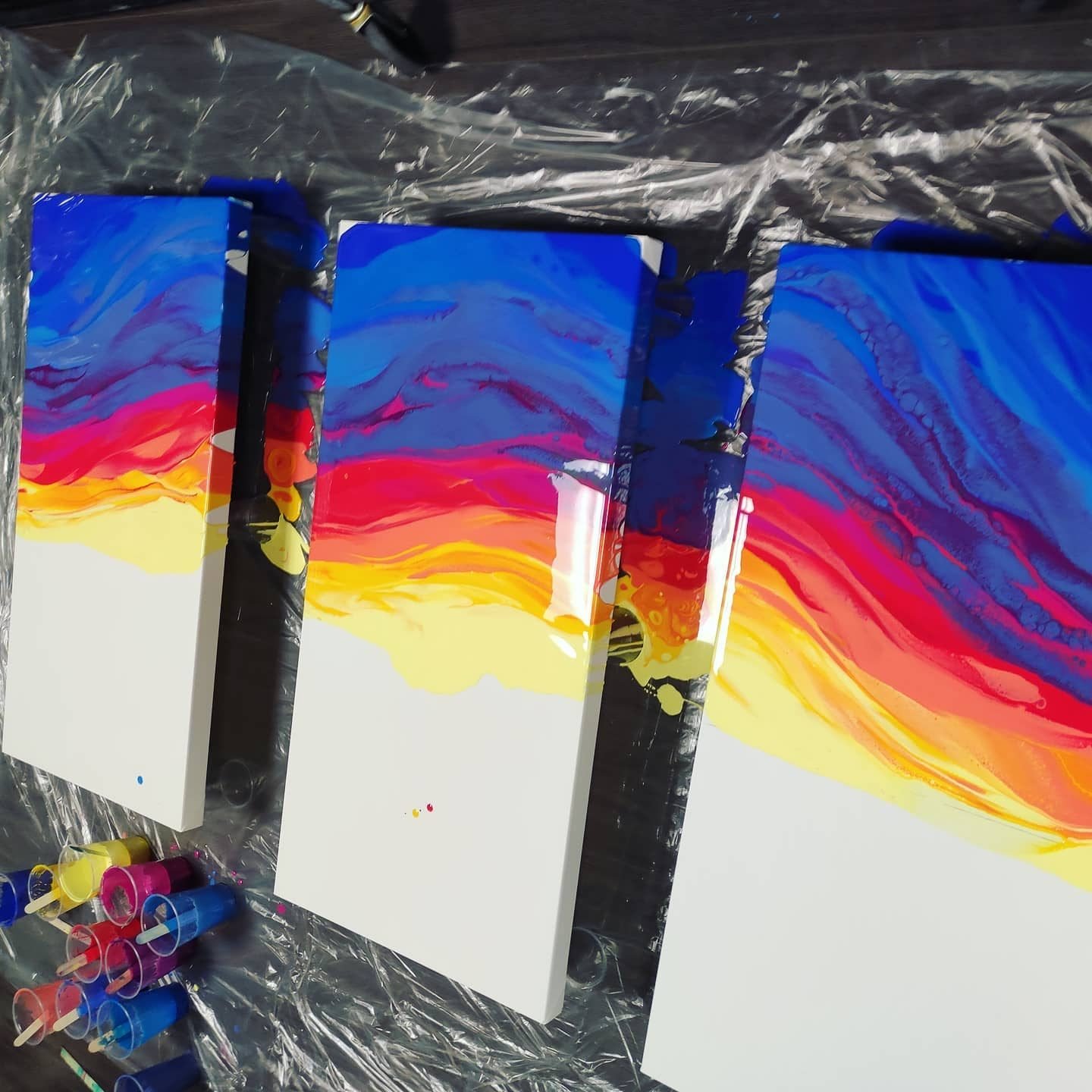
Niki's artistic process involves two separate components, one for creating the background and the second for hand painting to complete the scene.  The backgrounds are created with fluid acrylic paint, where acrylic paint is diluted with mediums to become runny. 

• • •

Photo of staff using stethoscope to listen to moose heart rate.

The paint is then poured onto the canvas, rather than using a brush.  It is then manipulated by moving the canvas around with gravity and other tools to mix the paint on the canvas.   Once the background is completed, then it takes 24 to 48 hours to dry before it can be moved, or else the paint will slide off the canvas.

• • •

The secondary process involves working with the background to determine how the final painting will come together.  Generally there is a plan for the background; however, with fluid paint it can be difficult to completely control all the exact details of how it will come together.  This is part of the beauty of the process, the balance between control and working with what presents itself.  The design for the painting is finalized once the background is fully dried, and the final plan for the composition is created.  The final image is created with acrylic brush painting. 

• • •

Photo of staff using stethoscope to listen to moose heart rate.

We worked with Corina at Taku Sports Group Inc. and Bula Canada to take Niki's artwork and make it perfectly fit onto two different neck gaiters - one, a single layer do it all tube featuring two moose and a double layer, reversible fleece perfect for winter warmth featuring of course the northern iconic caribou!

• • •

These special neck tubes will be available at the Preserve's Little Gift Shop. Niki will also have a few on hand at both the Cranberry Fair and the Spruce Bog Christmas Boutique. Both are great events to check out and support local buinesses, and artists like Niki Parry! 

• • •

Photo of staff using stethoscope to listen to moose heart rate.

Niki's goal for creating artwork is to bring a smile to your face and lift your spirits.  She finds a great deal of happiness in creating these images and loves to share her uplifting artwork with others.

We are so grateful  (and pretty darn excited) to have worked with Niki and share her vision. We endeavour to source and support local and share a product that helps you tackle all the outdoor feats while looking extremely fashionable and warm.

From Bula - Stay Warm, Play Longer

• • •

Single Layer tube                           $38
Double Layer reversible tube       $44

Photo of staff using stethoscope to listen to moose heart rate.
Lindsay Caskenette

Lindsay Caskenette

Manager Visitor Services

Lindsay joined the Wildlife Preserve team March 2014. Originally from Ontario, she came to the Yukon in search of new adventures and new career challenges. Lindsay holds a degree in Environmental Studies with honours from Wilfrid Laurier University and brings with her a strong passion for sharing what nature, animals, and the environment can teach us.
867-456-7400
Lindsay@yukonwildlife.ca

Explore by Category

Explore by Author

Yukon Wildlife Preserve
Box 20191
Whitehorse, Yukon
Y1A 7A2

Proud member of:

CAZA Logo

With the support of:

Yukon Government Logo
What’s That Scat?

What’s That Scat?

wilderness

by Sophia Slater | Jul 23, 2021

4 minute read.

As we are out enjoying some of the many trails the Yukon has to offer, we often have to watch our step to make sure we’re not putting our boots in something smelly! These unexpected trail obstacles can be great indicators of whose habitat we are walking into, what they are eating, and how they are digesting it. Just like us, many animals have dynamic diets, and will eat what is available. Scat can be interesting but can also spread diseases, even to humans, so it should be looked at and not touched, especially by our furry companions.

Bears

Black bears are opportunistic omnivores who will eat whatever food they can find, including fish, fruit, meat, insects, and herbs and grasses. Grizzlies have a similar diet, but tend to favour high-energy meat and insects more than the smaller black bears. Like their diets, bear scat appearance is quite varied, and often contains fragments of their last meal, like seeds, bits of berries, or small animal bones. Wildlife Interpreter Maureen recounts seeing a landscape covered in red wine-coloured piles that were actually scat from grizzlies that had eaten a lot of cranberries!

Light brown bear scat with seeds visible.

Bears are relatives of mammalian carnivores, they have a digestive system similar to carnivores, without a cecum or extended large intestine. This limits how efficiently they can process leafy plant material and they must eat a lot if they are relying on these foods, which is common in the spring. As a result, when a bear eats a lot of plant material their scat often has a green tinge from the undigested grasses or a fibrous appearance. Typically, their scat is brown or black and tapered, though sometimes it can appear as more globular if it is loose. Grizzly scat tends to be a bit wider and larger piles than black bear scat. It can be hard to distinguish between the two, but both should make a hiker cautious of the trail ahead. Remember bear spray and noisemakers and stay bear safe!

Left to right: Older bear scat; bear scat that is darker brown in colour with grasses visible.

If you’re interested in getting involved in bear research, the Operation Ursus Research using Scat (OURS) project is aimed at estimating the Yukon grizzly and black bear populations using DNA available in bear scat. Lucile leads the study and shares the project story Bear Poo and You with YWP.

Canines

Foxes, wolves, and coyotes are more exclusively carnivorous than bears, but may occasionally eat berries and seeds. Their digestive system is similar to that of a bear, as is their scat. Wolves' stomachs are specially adapted to hold a lot of food so that after a hunt they can get their share of the reward. Additionally, their stomach is very acidic to kill off any pathogens in the meat. It is tubular and tapered and may contain bits of bones, fur, or berries. It may be lighter, as it varies from tan to dark brown in colour. It is, however, smaller than bear scat: fox scat is about 1.25 cm in diameter, coyote scat is about 2 cm, and wolf scat is usually at least 2.5 cm in diameter.

Wolf scat with fur visible.

There will likely be much less of it as well. Foxes often defecate in obvious areas to mark their territory. The Wildlife Preserve exists as an ecosystem within a larger ecosystem and foxes are one of the many wild animals that visit. They seem to like to use the boardwalks at the front cabin to do their business!

Foxes often defecate in obvious places to mark their territory.

Left photo credit: L.Caskenette.

Feline - Lynx

Unlike generalist bears and canines, lynxes are specialists. Snowshoe hares are their primary food source, and can make up 75% of their winter diet. Meat is highly digestible, meaning that most of what is consumed can be broken down and absorbed easily. Lynx digestive systems, therefore, have shorter small intestines relative to body size and less developed caecum than canines.

Lynx scat of varying ages among grass.

Their scat is black, tubular and tapered, and does not have so much undigested material as the bears or canines. It is also very smelly. Like a house cat, they will cover their scat with dirt or snow, probably to hide their presence from nearby animals. Also like house cats, they often defecate in the same latrine over and over, which can be seen in our lynx habitat.

Lynx, like house cats, often poop in the same places every time. This is one of the latrines in the lynx habitat at the Preserve.

Cervids

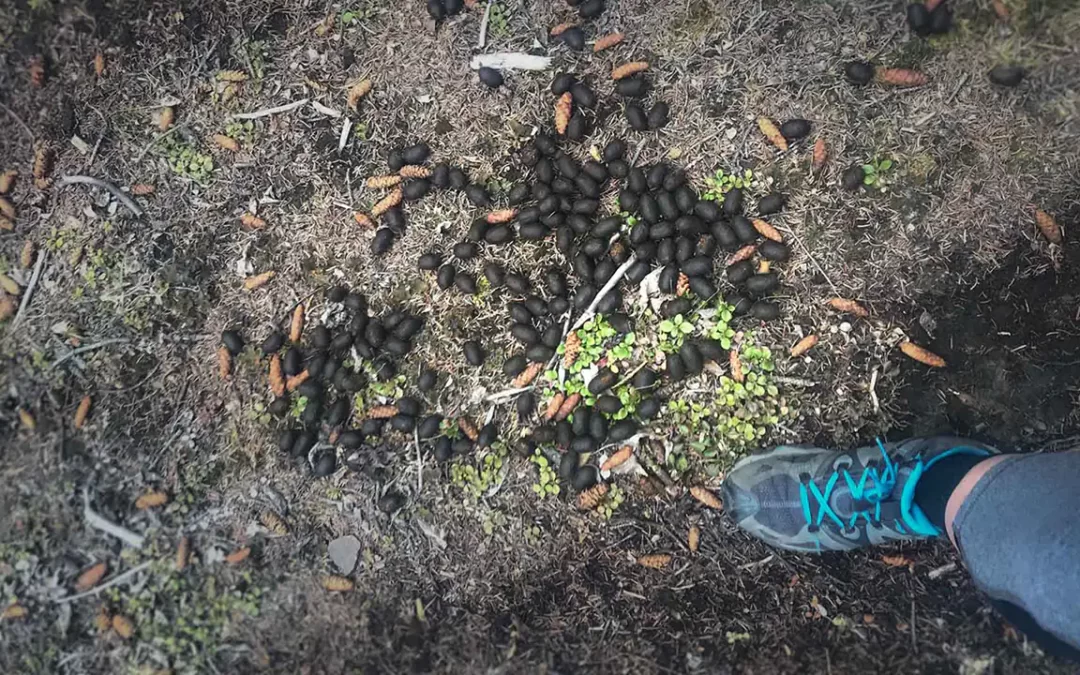
The Yukon has a great variety of cervids (antler bearing animals) or members of the deer family. Their diets, digestive systems, and scat have many similarities. In general, they produce uniform, dark brown or black oval-shaped pellets, which result from uniform movements of smooth muscles in the large intestine and its sphincters.

From left to right: Caribou, moose, mule deer and elk. Photo Credit: L.Caskenette & J.Paleczny.

Their diets are often high in fibrous, dry tree materials like leaves and twigs, which is why their feces forms pellets. If they are eating more grasses, in the summer, it may appear softer and more clumpy. Cervids are all ruminants which means that their stomachs have four compartments: the rumen, the reticulum, the omasum and the abomasum.  This allows for fermentation by bacteria and other processes that break down vegetation. This is part of the reason that cervid scat does not have as much undigested material as the carnivores’, despite their plant diet having less digestible material. In addition, they will regurgitate their food and chew it again, also called chewing their cud!

Left to Right: Soft caribou scat clumps together versus caribou scat in pellet form.

Deer pellets are small, about 1 cm in diameter, and are left in piles of many pellets. They defecate an average of 13 times per day! Elk scat is similar but 1-1.5 cm in diameter, and moose scat is even larger at 1.5-2 cm in diameter. Deer and elk pellets are rounder than moose pellets.

Softer deer scat often clumps together as seen here.

Moose are more strictly browsers, that eat only tree materials, so mostly their pellets are harder. Caribou scat appears somewhat more rough than deer or moose scat. It is often in harder pellet form in the winter when they eat a lot of lichens and sedges. In the summer, when their diet switches to grasses and vegetation with a high moisture content, their scat often forms larger soft clumps.

Moose scat in pellet form, darker brown because it's older.

Bovids

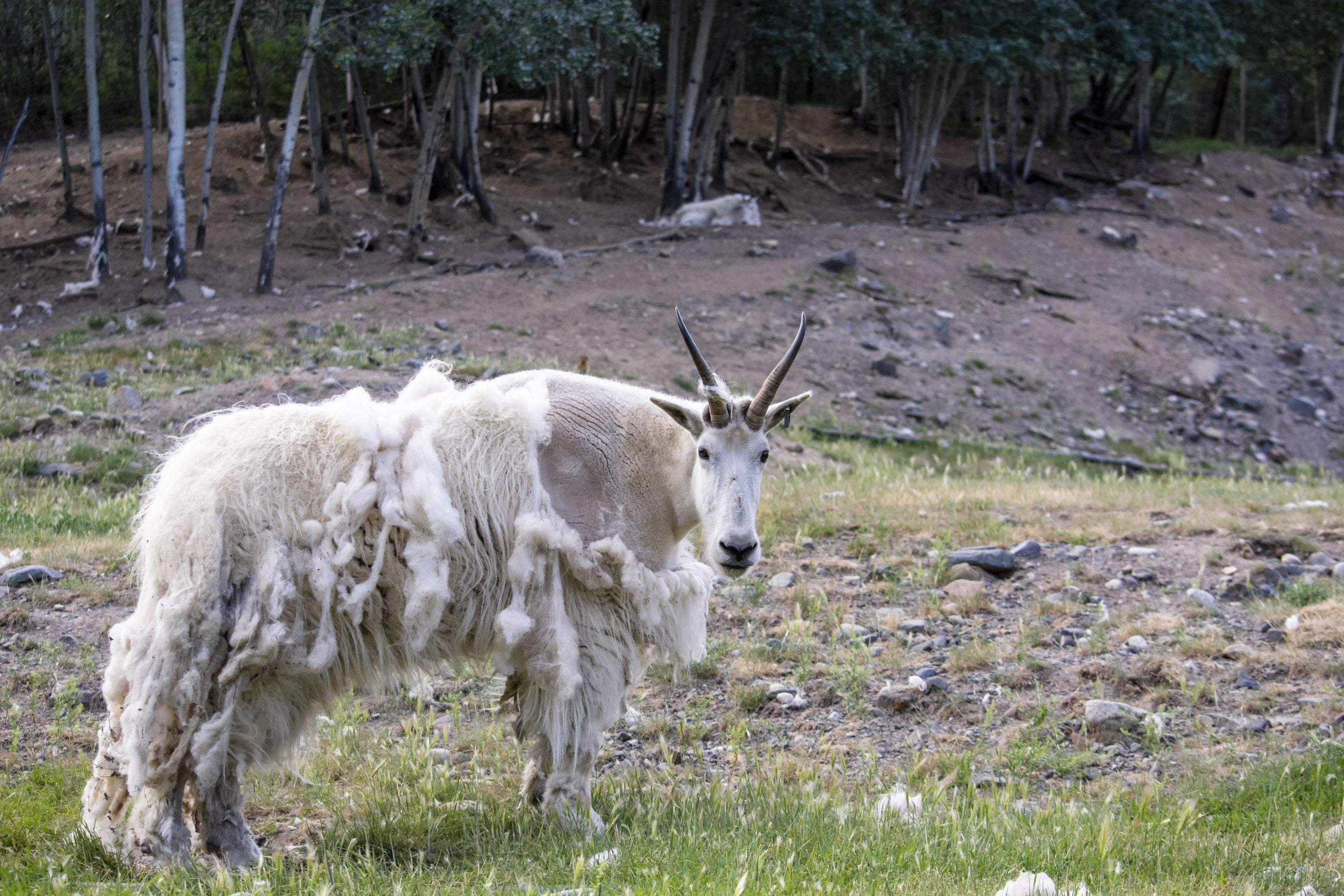
There are also a wide variety of bovids (horn bearing animals) in the Yukon. Our mountain sheep, mountain goats, muskox, and bison are all ruminants, just like the cervids. They are all herbivores who eat a variety of grasses, sedges, seedlings, and leaves.

Left to Right: Muskox, bison, mountain goat, thinhorn sheep. Photo Credit: L. Caskenette

Muskox, mountain goats, and thinhorn mountain sheep also form pellet scat, even when their diets consist largely of grass. That’s because their digestive tracts are highly evolved to reabsorb as much water as possible, likely an adaptation to their arid alpine (goats and sheep) and tundra (muskox) habitats.

Sheep scat forms pellets.

Goats have varied diets that includes browse, shrubs, lichens, grasses, and even trees. Their alpine foraging sites may be sparse, which doesn’t allow them to be picky eaters. Muskoxen eat grasses, forbs (herbaceous flowering plants), and willows, which they often have to dig out from the frozen arctic ground by smashing the permafrost with their heads and pawing the ice pieces out of the way. Mountain sheep eat mostly grasses and some other low growing sedges.

Muskox scat.

Bison scat is distinct from all the other ruminants mentioned above, because it forms an indistinct pile. Their diet is also primarily grasses and other low-lying herbaceous plants, but they may eat some willows and twigs. Grasses would make their scat more loose, but we’re taking suggestions for what makes their scat so different from the other grass-loving bovids!

Bison patty.

Hopefully after hearing all of these scat facts you can see scat as more than just something gross to be avoided on the side of the trail. It can tell you who’s habitat you are in, but also what they have been eating. It is interesting to watch it change throughout the season. Of course biologists may be able to find out way more about an animal through their scat, for instance genetic samples or presence of pathogens. There is so much to learn from the scat around us!

Although all the different scat we explored above is only a small number of animals, all species do it and we encourage you to:

1. Explore other species scat/defecation/poop - whatever you want to call it!

2. Pack out yours and your furry companions (yours domestic canines) poo in the backcountry and wilderness places you visit!

3. Sing the Scat Rap Song!  

It starts with an S and it ends with a T
It comes out of you
and it comes out of me
I know what you’re thinking
But don’t call it that
Let’s be scientific, and call it SCAT
It was a piece of scat
(PIECE OF SCAT!)

You can find it on the ground
It’s usually colored brown
It is shaped in a mound
It is a piece of scat
(PIECE OF SCAT!)

You can smell it with your nose
It’s gonna decompose
It’s where the fungus grows
It is a piece of scat
(PIECE OF SCAT!)

Birds flying through the air
Look out! Beware!
It landed in your hair
It was a piece of scat
(PIECE OF SCAT!)

I was hiking through the fog
When I saw a big log
It came from a dog
It was a piece of scat
(PIECE OF SCAT!)

I was tired of TV
I was checking out the trees
I could smell it on the breeze
It was a piece of scat
(PIECE OF SCAT!)

I know it’s kind of gory
But it’s a true story
It marks territory
It is a piece of scat
(PIECE OF SCAT!)

I picked up a chicken
And something was drippin’
It wasn’t finger-lickin’
It was a piece of scat
(PIECE OF SCAT!)

A squirrel ate a nut
Digested in its gut
It came out of its butt
It was a piece of scat
(PIECE OF SCAT!)

If you park your car
By the woods or a field
You might find something on your windshield
Full of berries
Both purple and white
You just got bombed by a bird in flight
It was a piece of scat
(PIECE OF SCAT!)

Photo Credit: Sophia Slater or as otherwise credited.

References:

Alaska Department of Fish and Game. Caribou (Rangifer tarandus granti) sign. ADFG. 

Blood, D.A. Mountain sheep. Hinterlands Who’s Who. 

Blood, D.A. (2000). Mountain Goat in British Columbia. British Columbia Ministry of Environment Land and Parks.

Bosch, G., Hagen-Plantinga, E., & Hendriks, W. (2015). Dietary nutrient profiles of wild wolves: Insights for optimal dog nutrition? British Journal of Nutrition, 113(S1), S40-S54. doi:10.1017/S0007114514002311

Keith, L.B. Canada lynx. Hinterland’s Who’s Who. 

Central Sierra Environmental Resource Center (2018, June 25). What scat can tell you about your wildlife neighbors. CSERC

Costello, C.M., Cain, S.L., Pils, S., Frattaroli, L., Haroldson, M.A., & van Manen, F.T. (2016). Diet and macronutrient optimization in wild Ursids: A comparison of grizzly bears with sympatric and allopatric black bears. PLoS ONE, 11(5).

Gray, D.R. Muskox. Hinterland’s Who’s Who. 

Hatch, K., Roeder, B., Buckman, R., Gale, B., Bunnell, S., Eggett, D., Auger, J., Felicetti, L., & Hilderbrand, G. (2011). Isotopic and gross fecal analysis of American black bear scats. Ursus, 22(2), 133–140. 

Howard, W.T., Hutjens, M., Kilmer, L., Linn, A., Otterby, D., & Shaver, R. (2021). The ruminant digestive system. University of Minnesota Extension

Winand, C.J. (2008, September). Deer Pelletology. Buckmasters Magazine

Sophia Slater

Sophia Slater

Wildlife Interpreter & Animal Care Assistant

Sophia is one of the Interpretive Wildlife Guides and animal care assistants at the Preserve. She is new to the Yukon and moved here from Ontario, where she just graduated with a Bachelor of Science in Biology from Nipissing University. Hiking mountains is her newfound passion while she’s here, and she’s hoping to summit as many as she can this summer. At the preserve, she loves getting to talk to and learn from guests who come from all over the Yukon and beyond about their experiences with wildlife.

Explore by Category

Explore by Author

Why are red foxes so happy among us?

Why are red foxes so happy among us?

wilderness

by Danette Moule | Jul 16, 2021

5.5 minute read. 

Red foxes are as familiar to any Yukoner as seeing their friend or colleague walking down the street. They are a welcome resident of Whitehorse, and most urban environments in Canada. Though many species numbers have declined since Europeans arrived to the shores of what is now North America, the red fox is the exception to the rule. Red fox populations have only increased since human settlements have grown and expanded. In fact, the red fox is one of the most widely distributed territorial mammals in the world.1even in the Arctic

So why are red fox numbers growing alongside human populations? One reason that the arrival of Europeans coincided with a growth in the red fox population in Canada is that Europeans brought foxes with them. There was already a species of native red fox living here at that time, so both native and non-native red foxes live in North America. Native red foxes are what we typically see in the north; they are the Canadian Boreal Forest species that colonised here shortly after the last glacial period, around 11,000 years ago. Non-native red foxes are found further south, where they were released by European settlers in the mid 1700s, for hunting purposes. However, introduced red foxes are not the only reason fox numbers have increased since colonisation. Though it is commonly thought that people are generally bad for wildlife, there are certain species that benefit greatly from people, and red foxes are one of them!

Despite red foxes having plenty of wildland in which to settle and bear their young, they’ve often chosen human settlements to set up shop. Red foxes are part of the group called ‘synanthropic species.’ These species live near humans and directly benefit from human-altered landscapes. Animals such as mice, rats, pigeons, racoons, skunks, and coyotes are synanthropic species. Red foxes, like these other animals, benefits from our landscape alterations, including gardens, bird feeders, garbage dumps, sheds, porches, and barns, all of which provide either suitable food or shelter, and often both. These species have learned how to exploit human settlements to their advantage, and they thrive in suburbs and cities that are in or near forests or fields. An ‘edge species’ lives at the border of two different habitat types, or ecotones, such as where forest meets grassland. A city like Whitehorse could be an ecotone in and of itself, since its boundaries are rich forest area. But in other cities such as large metropolises, humans have created habitats that very closely mimic an edge species’ natural environment. Gardens and yards that back onto bushy or forested area are perfect for red foxes and other edge species. Because rats, mice, and voles enjoy human suburban environments, red foxes have an abundant food source when living near people, not to mention the garbage that people inevitably leave lying around or in unsecured garbage cans.

Moreover, red foxes require shelter for denning, and the underside of sheds and decks, or your rotting wood pile all offer what a fox needs to rear its young. And because human settlements are typically near a water source, foxes will have access to that as well. Many gardeners also choose to provide bird baths or other water sources on their property, and this makes great habitat for all edge species, including foxes. A bushy yard near a field or forest is a great environment for a red fox, since they benefit from both the human environment and the natural landscape. And suburban environments offer fields where they can hunt, ditches with food and water, and woody parks which offer cover, safety, food, and denning opportunities. A great environment means large litter sizes, and high survival rates among young. The Wilderness City is the perfect environment for a red fox, and the perfect place for fox populations to thrive.

So human environments are great for red foxes, but how are red foxes great for people? As we’ve seen, our environments attract a variety of animals that people find a nuisance. Mice, rats, voles, and pigeons are all things that people don’t enjoy having in or around their house. Fallen fruit such as crab apples and berries attract mice into our yards, and without foxes, these animals can cause problems for people. Luckily, these animals are all great food sources for foxes. And people generally find foxes cute and enjoyable to observe. They aren’t threatening, even to children, and they generally won’t go after a full grown healthy cat. Foxes generally don’t cause problems for people who don’t have chickens or rabbits that they keep outside, and even then, modern fencing is good enough to often keep these animals safe. Foxes can carry rabies, which can cause problems for people, but in the Yukon, rabies is thankfully not a common disease. People have traditionally enjoyed keeping cats to help curb the rodent population, but cats also kill songbirds, and are one of the leading causes of songbird decline in North America. Foxes generally don’t kill songbirds, and subsist mostly on rodents and whatever they can scavenge. In other words, they eat what we don’t like.

Red foxes are the perfect species for urban populations, and because of this mutually beneficial relationship, fox populations will continue to grow and thrive alongside people. Come see our two resident red foxes next time you’re at the Wildlife Preserve!

This interpretetive panel is placed next to our fully fundraised Red Fox exhibit. It shares the story of red fox success across the Northern Hemisphere, from the Arctic to urban enviroments.

Photo credit: Danette Moule

Danette Moulé

Danette Moulé

Wildlife Interpreter

Danette is new to working at the Wildlife Preserve, but not new to appreciating it! Danette currently lives between the Yukon in summers, and BC / Alberta in the winters. She holds a Master's of Natural Resource Management, and has always been a big appreciator of wildlife and our natural world. Danette was raised in the mountains of western Canada, and is enjoying getting to know the north.

Explore by Category

Explore by Author