Wildlife Q&A

Wildlife Q&A

wildlife

5 Min Video - 

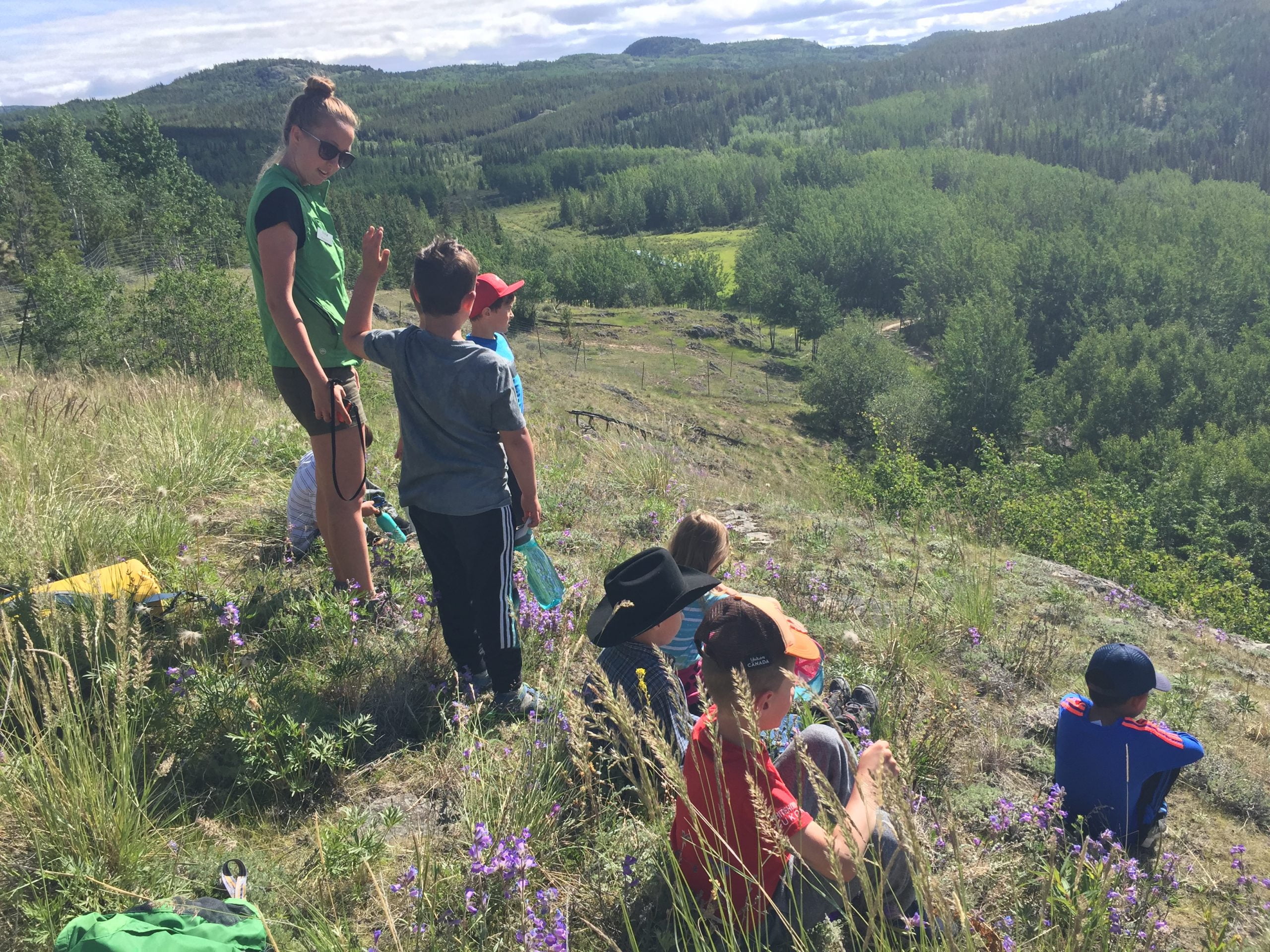
We love finding out what makes kids curious!  We asked kids to send us their video questions about the Preserve and Yukon’s wildlife.  Watch the video to hear YWP staff answer:

  1. Do Caribou go in big groups?  And if they do, how big of groups do they go in?
  2. How do mountain goats climb?
  3. Do bunnies only eat carrots or not?
  4. How can people help the wildlife preserve?

Are you a kid? Do you have questions about Yukon Wildlife Preserve or Yukon wildlife? Send your video question to us at info@yukonwildlife.ca. (Some help from parents may be required 😉 )

Jake Paleczny

Jake Paleczny

He/Him - Executive Director/ CEO

Jake Paleczny is passionate about interpretation and education. He gained his interpretative expertise from a decade of work in Ontario’s provincial parks in addition to a Masters in Museum Studies from the University of Toronto. His interests also extend into the artistic realm, with a Bachelor of Music from the University of Western Ontario and extensive experience in galleries and museums.

867-456-7313
jake@yukonwildlife.ca

Explore by Category

Explore by Author

Wandering Wood Bison

Wandering Wood Bison

wildlife

by Sarah Stuecker | Apr 28, 2020

7 minute read - "Winter Is Here" series continues with the true behemoth of the north - Wood Bison! 

At first glance, the Wood Bison (Bison bison athabascae) seems to be ill-suited to live in the far North.  Especially when we think about its Southern cousin, the Plains Bison (Bison bison bison), which historically has made its home on the rolling hills and endless grasslands of the prairies.  It seems fairly safe to assume that compared to the prairies, it is a completely different game of horns to survive the winter in the Yukon.  Extended periods of extreme cold, a short growing season - hence relatively scarce food sources, combined with unforgiving, mountainous and swampy terrain pose a different set of challenges.  Yet bison are thriving - how do they do it?  Through a series of adaptations in structure, behaviour and physiology, we will see that Wood Bison are in fact quite at home in the far North.

The Wood Bison is a giant:  the largest living land mammal in North America.  Males can weigh up to 2000 pounds, which is up to 30% larger than its Southern relative; * roughly *  the difference between a SmartCar and a VW Golf.  In colder climates it actually pays to be bigger! Larger individuals (which have a smaller surface area-to-volume ratio) are better at retaining heat. This rule of nature is known as Bergmanns Rule. A pattern, where species tend to be larger in colder climates than similar species of the same genus living in warm climates, is certainly not law - not all species of nature comply with it.  Yet, bison do, and living large in a cold climate means the more fat you can store to help you get through winter. 1[Read more about the complexity of nature pertaining to Bergmanns Rule

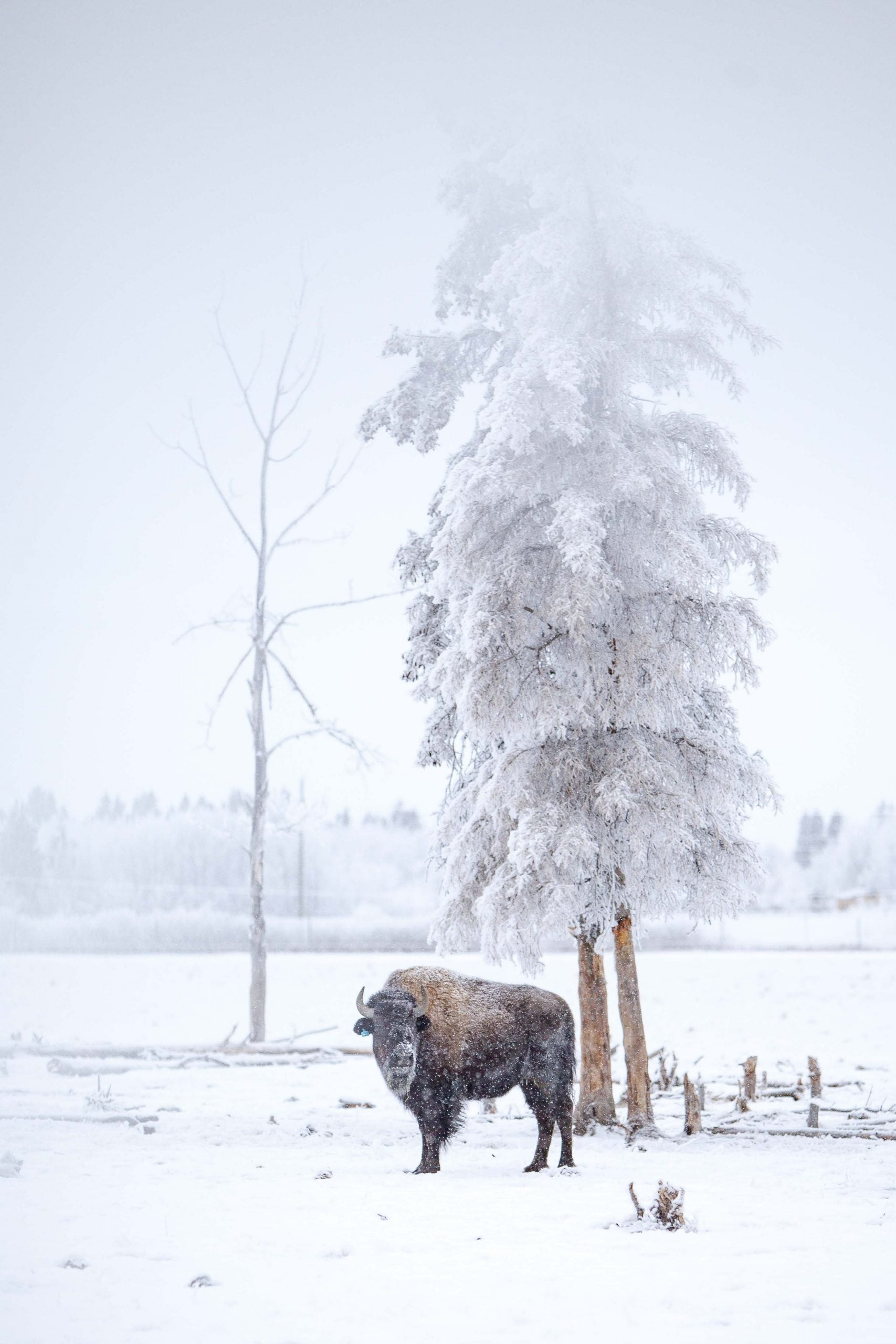
Two Wood Bison bulls at the Yukon Wildlife Preserve. Take note of the large shoulder hump and the massive head and broad face. 

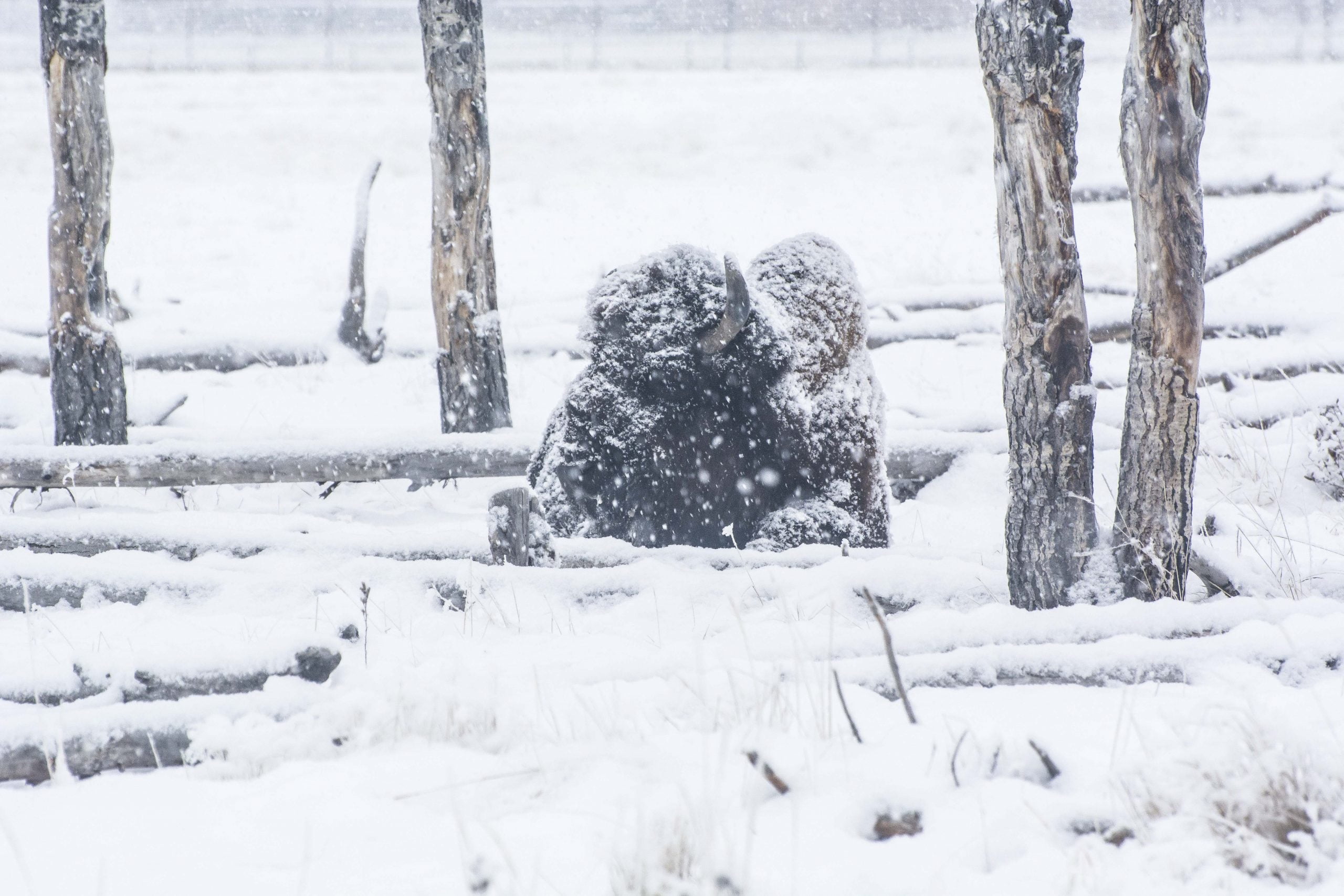
Beyond size, additional adaptations assure the success of Wood Bison including a very thick and woolly winter coat. This extremely dense coat of durable hair is so warm, combined with that retained body heat, and incredibly thick skin, falling snow that accumulates on its coat does not melt, thus keeping them dry and warm. 

Foraging for food in the winter is a challenge - summer vegetation is buried in deep snow and is of low nutritional value. Wood Bison “dig” for food by swinging their large, heavy heads. Within that big hump on their shoulders are long spines on the vertebrae, muscles and ligaments which support large neck muscles and the head. Now you know – that big odd hump on their shoulders is not just fat – it is a vital tool for their survival.

To manage decreased food availability and quality bison cannot just simply eat more food, more often, to sustain itself. As an ancillary adaptation, and most fascinatingly, Wood Bison are able to slow their metabolism during winter as a way to conserve energy. Just like cows, grass is a bison's staple food in the wild but it does not contain many nutrients in the winter. By slowing down their metabolism it also slows down digestion, thus the food is kept longer in the intestinal tract which allows them to draw more energy out of one feeding. Rather than putting out critical energy by digging through snow (with their giant head!) and foraging for food, they can instead conserve energy by slowing their metabolism and getting more available nutrition from one feeding. This slowed digestion is doing double duty for the bison. As they are able to squeeze every bit of nutrients from a feeding this anatomical process is also producing valuable internal body heat.

In the Yukon landscape, Bison have been roaming for millennia; first as the Steppe Bison, predecessor to the Wood Bison.  Due to a number of reasons however, they became extirpated in their Yukon homerange in the early 1900’s.  It is believed it may have been a combination of habitat loss due to climate change, disease and human predation.  In the 1980’s, the Yukon Government joined the National Wood-Bison Recovery Program and re-introduced a herd of about 170 bison.  Since then, Yukon’s wild Bison have re-adapted to life in the North - quite well too! Making best use of their terrain, they seek shelter in treed valleys when the weather gets nasty.  Interestingly, they can also be found on alpine plateaus up to 5000ft.  High altitude meadows are exposed to wind, which reduces the snow cover and allows the bison to find the underlying grass more easily. Typically good habitat for bison; however when winter weather patterns swing it can add additional challenges to these food driven behemoths. A sudden warming in the winter of 2018 caused peril for a few of these wandering bison.  2An odd case of bison death in the Yukon

Consciously or not, wood bison may make use of a weather phenomenon that sometimes occurs when temperatures drop:  the inversion layer. Under some conditions, a layer of cold dense air accumulates in the valleys and without wind, may stay there for days.  Meanwhile, on the mountain tops the air can be up to 20C degrees warmer - well worth undertaking the climb.  One could argue, with all science put aside and simply as the Kings and Queens of living large, they might like to hang out on top of their kingdom.  If this was me living out there, that’s what I would do!

These mighty large creatures might seem fairly sedentary but their numbers have grown strong and steadily since re-introduction. They have proven their adaptability to varying habitat; moving among forested stands and meadows, alongside caribou and moose, to wandering hill-side, among mountain sheep. They are a formidable ungulate, and one of the most, among the prey animals in the Yukon. Their massive size and mass consumption of greens is not to be mistaken for sluggish or unresponsive carriage. Wood Bison are intelligent animals that are quick on their feet when needed. Their ability to outrun predators such as wolves or humans is unprecedented. These monumental animals could quickly leave you in the snow-dust as they purposefully trek their northern landscape in order to thrive.

Sarah Stuecker

Sarah Stuecker

Wildlife Interpreter

As a wilderness guide, Sarah has spent many days out in the bush over the years. Sitting out there glued to the scope is just as fascinating to her as observing and following animal tracks in the depth of winter, trying to draw conclusions of what this particular critter might have been up to. Sarah is passionately sharing her stories as part of our team of wildlife interpreters. 


867-456-7300
 info@yukonwildlife.ca

Explore by Category

Explore by Author

Stay Put – The Muskox Mantra

Stay Put – The Muskox Mantra

wildlife

by Sarah Stuecker | Apr 21, 2020

6 minute read - "Winter Is Here" series continues with the legend of cold climate survivors - Muskox! 


Ice age survivor - Oomingmak (Inuit for The Bearded One) is living proof of long-term successful adaptation to a narrow niche - the treeless and blizzard-beaten landscape of the High Arctic Tundra.  In the wild, Muskox inhabit parts of the Circumpolar North - Greenland, Alaska, Norway, Russia and Northern Canada - thriving in some of the coldest, longest and darkest parts of the world. 

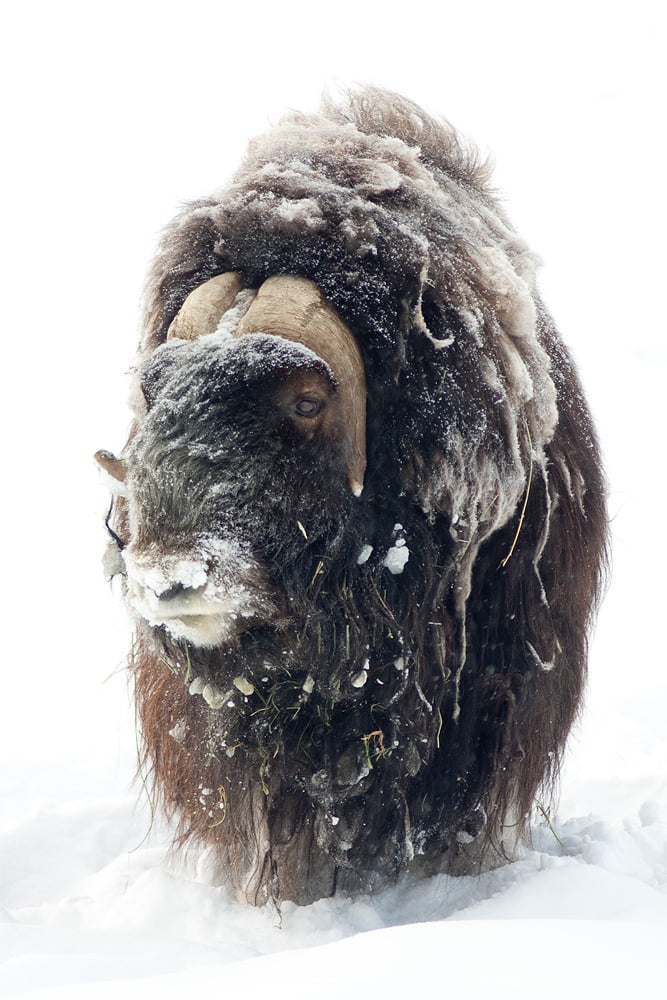
Muskox have evolved to have a stout body posture and short legs to conserve body heat in the winter. Their coat, however, is the most fascinating part within the array of adaptations Muskox possess. While the long guard hair reaches all the way down their legs, like a skirt, to offer protection against wind and snow, their thick undercoat, called qiviut, is really what keeps them alive. Qiviut (kiv'-ee-ute) is warmer than sheep wool and is considered one of the softest and warmest materials on earth (and also among the most expensive). Thanks to the unique make-up and extremely high density of this undercoat, combined with the protection provided by the guard hairs, the cold and wet hardly penetrate all the way to the animals’ skin. The qiviut underlayer is grown every year before winter and in the spring, the animal sheds the dense hair again to avoid overheating during the summer months.

In addition to structural adaptations that are easily visible, the Muskox have a number of behavioural traits and physiological adaptations that help them in their harsh natural environment. For instance, food availability and the severity of weather affects how old a muskox female is for her first breeding cycle and also whether calves are born on an interval of every year or every 2 to 3 years. This results in a low reproductive rate for the species but does lower the stress on an individual muskox so they can breed during a year when conditions are more favourable.  From the moment of birth Muskox calves are even prepared to withstand the harsh elements of their new, still winter, world. Born between April and June, their landscape (unlike many of our own that time of year) is still heavily blanketed in snow featuring temperatures well below 0°C.  Calves do not tend to take on the stay-put mantra at birth since that could lead to trouble, quickly. Instead, within minutes of birth, calves are mobile miniature woolly mimics of their adult family members, cleaving to their mothers side and her additional protective skirt. 

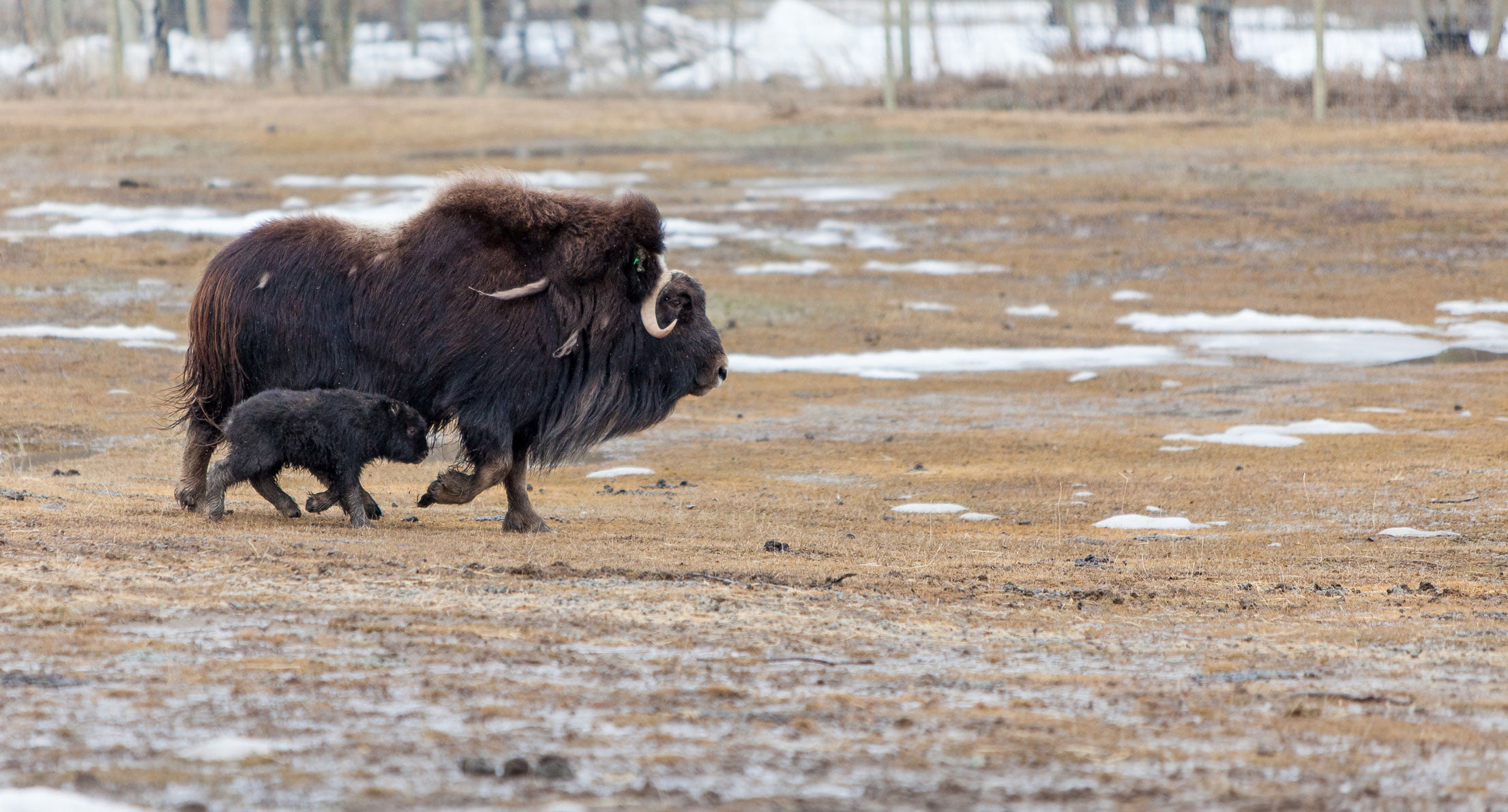
A newborn Muskox calf at the Yukon Wildlife Preserve from 2017 and its mom on the move within minutes of being born. 

One behavioural adaptation to the cold is sometimes observed in howling blizzard conditions. Standing stoically in a tight group, Muskox have been able to withstand temperatures up to 70 degrees below zero.  Only in the most severe weather will a Muskox lie down with its back to the wind as added protection. Another behavioural adaptation is to be slow moving and to not roam on long migrations like caribou do 1Learn more about Caribou adaptations. This keeps energy output low and allows the large muskox to thrive on low quality food available in their area.

The Arctic Tundra, the only wild home to Muskox, enjoys winter for up to 8 months per year.  By September there may be snow on the ground and muskoxen are well equipped with front hooves larger than hind, to dig through wind-blown crusted snow, to get to the food below - grasses, sedges and willows.  Muskoxen typically feed in areas where the snow cover is relatively shallow (like valleys). It is usually easy for the Muskox to dig down to the food below, but when the snow crust makes it more challenging, they can lift and drop their head on to the crust to break through to gain access to vegetation.

Where muskox find ways to meet their nutritional needs in a winter-barren landscape their predators, arctic wolves, just the same must test the muskoxen's formidable stay put mantra. As a survival adaption and anti-predator strategy, fight or flight physiological reaction is important for any prey animal. Many ungulates will choose flight at the sign of threat - fleeing to the protection of forests, like caribou, or to a precipice perfect for only a thinhorn sheep or mountain goat. However, without the protection of any trees; a low variety land form landscape and a dark skyline that merge into one seemingly endless marathon; it's critical to choose energy conservation, to stay put, and put up a fight through a protective ring. If the Muskox chose flight, it would be less favourable for those calves to keep up to a swiftly moving herd - unless you're the arctic wolf.   

Muskox are built to last - they persevered through an ice age, after all!  At the Yukon Wildlife Preserve, which is located in a more southern environment than their natural range, they are applying millennia worth of adaptions even in this niche.   Their habitat intentionally faces north, with options for them to take rest in the shade provided by trees of our lower latitude. This further helps preserve a longer snow patch during a typically earlier spring thaw for our muskox, while their more northern and wild cousins still endure weeks to months of true winter.  You might see them as dark bumps resting in the snow, apparently doing nothing. Now you know though, they are just doing what they do best -  saving energy.

To learn more about Muskox and their unique habitat check out Wildlife Management Advisory Counsil - North Slope

A special animated video sharing this incredible animals Yukon story can be watched here!


Sarah Stuecker

Sarah Stuecker

Wildlife Interpreter

As a wilderness guide, Sarah has spent many days out in the bush over the years. Sitting out there glued to the scope is just as fascinating to her as observing and following animal tracks in the depth of winter, trying to draw conclusions of what this particular critter might have been up to. Sarah is passionately sharing her stories as part of our team of wildlife interpreters. 


867-456-7300
 info@yukonwildlife.ca

Explore by Category

Explore by Author

Free Protein and Sexual Success

Free Protein and Sexual Success

wildlife

by Joelle Ingram | Apr 15, 2020

10 minute Read - Free Protein and Sexual Success : the benefits of infanticide and cannibalism for northern squirrel populations

If you’ve spent some time in the Yukon, you’re familiar with the seasonal challenges the territory can throw your way: the wildly varying levels of daylight, bush fires, frostbite, and horseflies that could carry off a toddler. Sometimes, life here in the North can be pretty rough. Fortunately, for most people, when the going gets tough, the not-so-tough can throw on the propane heater and order Domino’s. Which, incidentally, is my winter survival strategy. 

Unlike me, the denizens of the Yukon wild have had to develop a whole range of interesting adaptation and survival tactics to cope with the extreme winters and the highly variable resource availability that the Yukon has to offer. Migration and hibernation seem to be popular choices for our resident fauna to pass by periods of hateful weather i.e., winter and slim pickings in the food department.  Some particularly interesting and, let’s say, pragmatic approaches some tiny beasts have taken to help them survive and thrive is cannibalism and infanticide! Yes, not the prettiest or kindest of survival approaches but there is a dark practicality to it. A surprisingly large number of animals do it but today we’re going to be looking at squirrels!

As my coworkers often remind me, we can’t apply human morality to animals, I still do so from a strictly practical lens, let’s take a look at the benefits of cannibalism and infanticide. Cannibalism is a handy dandy way to reduce your pool of competitors and bolster your own odds of success by turning your rival into a snack. Infanticide has a similar purpose but instead of eliminating your current competion, you eliminate your competitor’s offspring which helps ensure that your babies have better odds at success and your  genes have a better chance at remaining in the pool. I’m sorry that I keep saying “your” like this is something you do on weekends. I’m sure you don’t, it’s a non-specific “you”. We are not condoning you kill and eat your neighbours or their children. 

Cannibalism and infanticide in the animal kingdom are interesting practices that can magically change conspecifics (animals of the same species) from enemy into food source or, at the very least, a non-issue. This is especially beneficial in areas that have limited or inconsistently available resources which is definitely the case here in the Yukon. We’ll look more in depth into how these benefits apply to squirrels but first, let’s learn a bit more about these fuzzy friends.

Despite both being squirrels and both being known to dabble in cannibalism and infanticide, red squirrels and arctic ground squirrels lead very different lives. Red squirrels are solitary, tree-dwelling creatures that live in non-overlapping territories that they defend aggressively. They base the location of these territories around where they have stashed food. The diet mainly revolves around mast producing trees (trees that produce seeds) that tend to grow wildly different amounts of seeds depending on the year. Remember this, it will be important later. Red squirrels also eat mushrooms, flowers, fruits, bugs, bark, sap, “animal products” (because most rodents are opportunistic omnivores!), and the insulation in the ceiling of my cabin. 

Unlike the aggressive loner red squirrel, arctic ground squirrels believe in strength in numbers. They live in large subterranean colonies and even engage in altruistic behavior to keep other members of that colony safe: they’ll stand up on their hind legs and give off an alarm call to warn others of predators. This makes the caller a lot more noticeable to predators in the area but gives their colony buddies better odds of getting away. Isn’t that nice? I think that’s nice.

Instead of toughing out the winter like red squirrels, arctic ground squirrels hibernate through the cold months. After putting on as much fat as possible, they tuck themselves into cozy burrows for a multi-month nap, which in my opinion, is the ideal way to spend your winter. They build that hibernation mass on a generalized and mostly plant-based diet. Unlike red squirrels who rely mainly on tree seeds, ground squirrels are happy to consume any part of a wide range of vegetation including leaves, seeds, buds, and flowers. In addition to their leafy greens, these ground dwelling nuggets supplement their diet with invertebrates and other vertebrates including birds, lemmings, smaller rodents, and, you guessed it, other squirrels!

Now with their highly generalized diet and limited time to pack on the grams before the long winter sleep, the ground squirrel is very opportunistic when it comes to food. There are documented cases of these round little rodents hunting and killing lemmings and many grizzly photos on the internet of arctic ground squirrels chomping through mice and other small rodents (I checked so you don’t have to). If they’re willing to consume the tasty meat of other rodents, why not each other? If you get very, very, VERY practical about it, after they kill a conspecific, that squirrel is just a readily available source of meat. If two squirrels get in a territorial tussle and one kills the other, the formerly-alive squirrel has ceased to be a threat and has instead become a handy source of protein. It’s a truly grisly double win for the victor! These adult-squirrel-eating-adult-squirrel situations seem to be mostly incidental and opportunistic rather than squirrels actively hunting each other but personally, I am not discounting the possibility of a Hannibal Lecter squirrel prowling the Northern underground. 

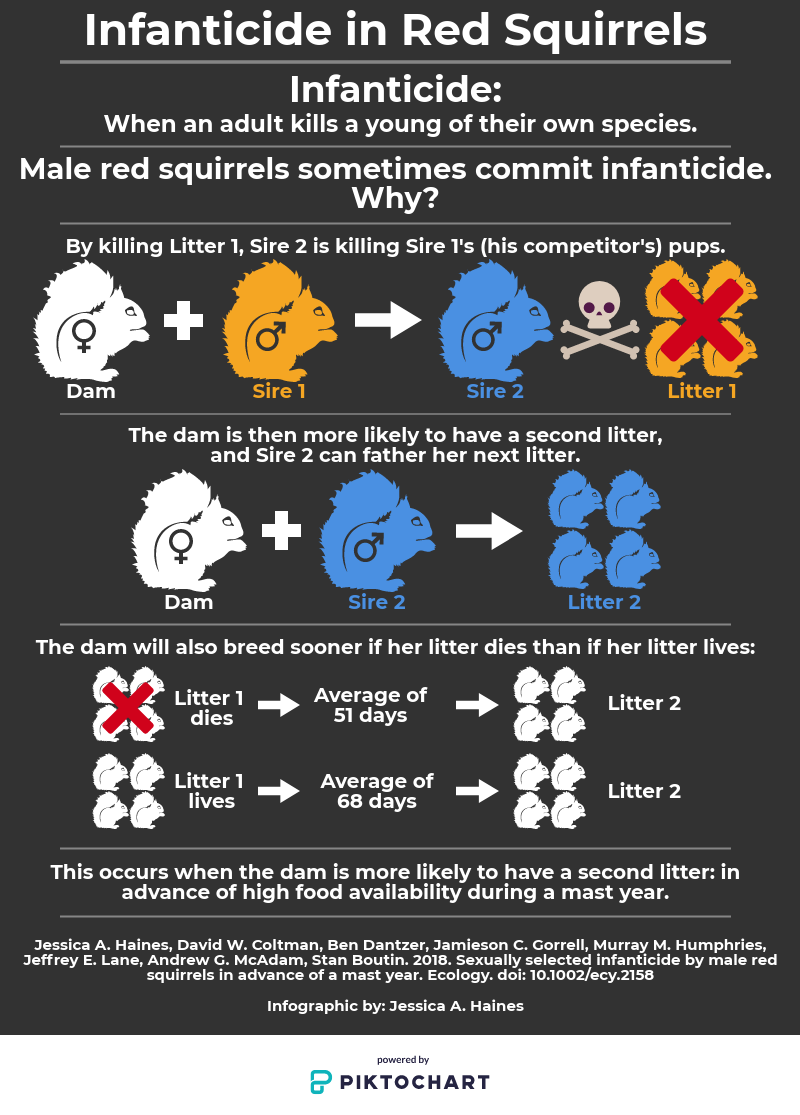
Unfortunately, we’re not just dealing with adult squirrels snacking on adult squirrels here in the Yukon. A study at our very own Kluane Red Squirrel Project spotted a male red squirrel killing the pups of a female squirrel and consuming parts of them. This murderous male hadn’t sired these pups and shuffling these wee baby squirrels from this mortal coil, he was actually  increasing his chances of siring pups of his own. How? Good question.

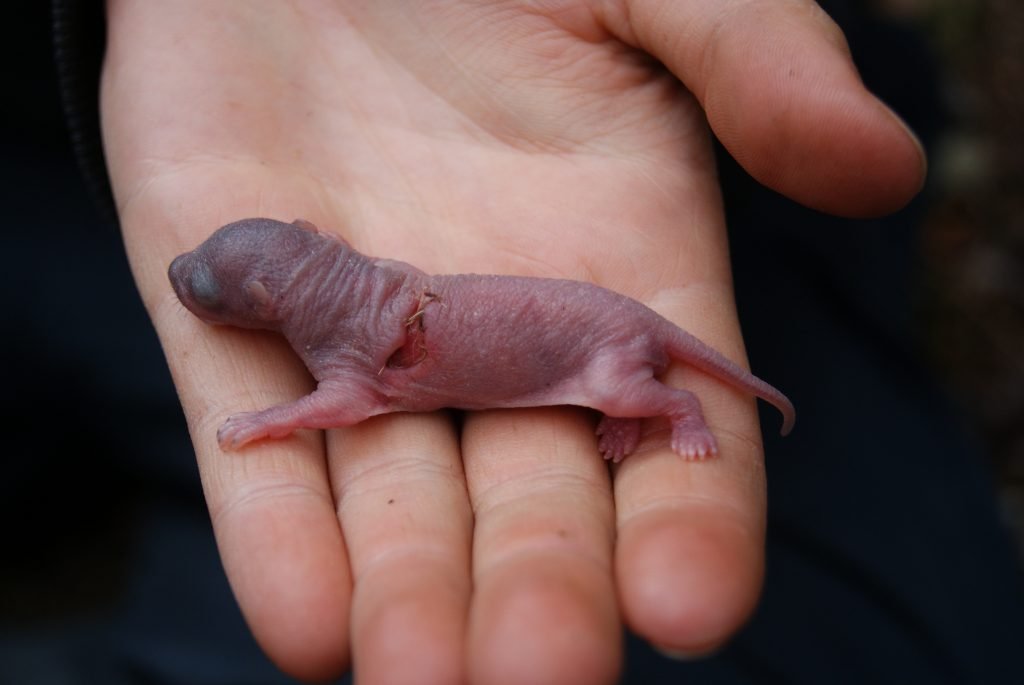
This newborn pup had wounds similar to the bite marks seen on other pups attacked by adult males. Permission of use and Credit Dr. Jessica Haines.  

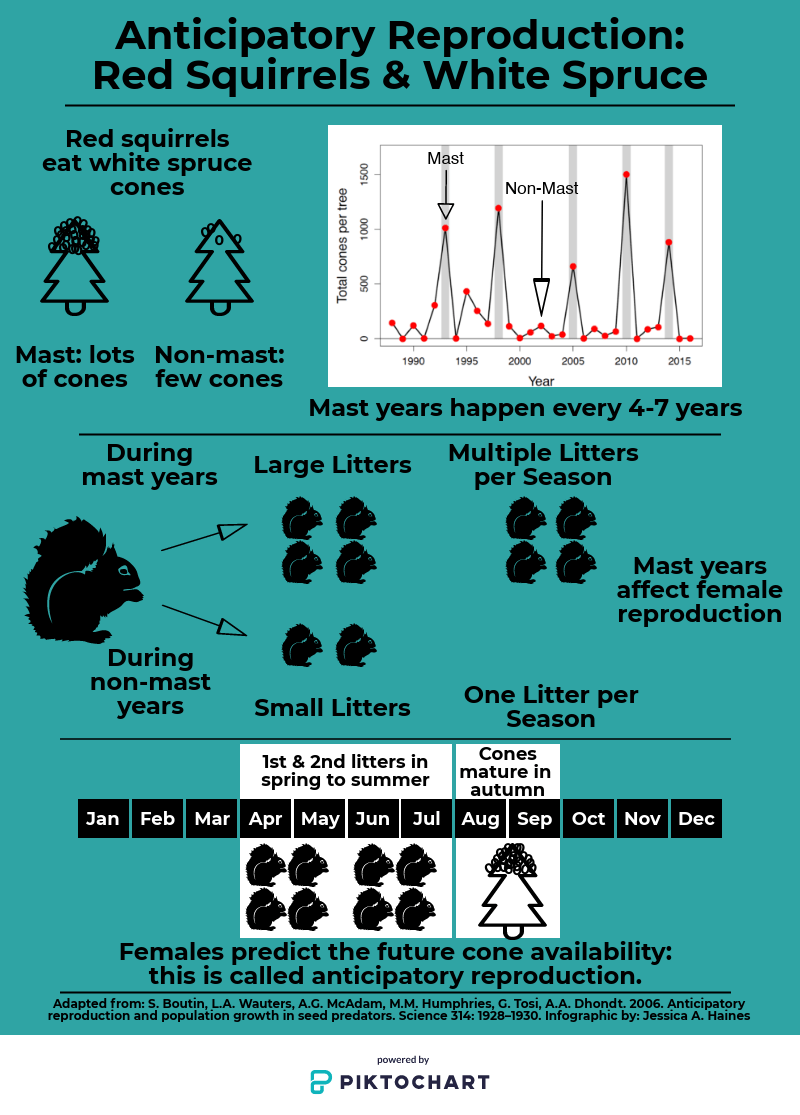
During a mast year, a year when seed producing trees have exceptionally high yield, female red squirrels will have multiple litters of pups. On an average year, if a male squirrel killed a litter of pups that had been sired by another male, it wouldn’t really improve his odds of passing on his genetics because the female squirrel won’t be having another batch of babies until the following season. However, during mast seasons when there are oodles of seeds to nourish the mother and, by extension, her young, having multiple births in one season are both possible and sustainable! Should one of her litters mysteriously die, the female squirrel will be more likely to re-nest giving the infanticidal male an in! Again, if we get very practical about it, it’s an effective strategy. 

Infographic created by Dr. Jessica Haines. Permission of use and Credit Dr. Jessica Haines.  

Not to be left out of some casual cannibalism, some of the pups noted in the Kluane Red Squirrel Project study were missing part of their heads which were presumed to have been consumed. Like the arctic ground squirrels, this was probably opportunistic cannibalism: the male red squirrel was going to kill the pups anyway so he could sire his own babies with the female so why not get a quick protein treat while he’s at it? Fun fact about consuming the head in particular: the brain is a great source of fats and protein similar to the seeds that compose a lot of the red squirrels diet! Okay, maybe that isn’t a fun fact but we’re already in the nightmare zone so let’s discuss it anyway. Squirrels aren’t alone at the brain buffet, the eyes and brain are the preferred soft delicacies for raptors so if you should wake up one morning to find a rabbit head in your yard, it’s probably not a mafia threat and more likely the work of a hawk. There is also anecdotal and documented evidence of picas, racoons, rats, and mice going after the high-fat thought organ of other small mammals and birds. And why not, it’s a soft, easy-to-consume organ packed with amino acids and fats to help these critters power through their high energy lives and if you have built-in chisel teeth, it is not hard to get at. It’s like squishy, fleshy Cliff Bar. Mmmm gross.

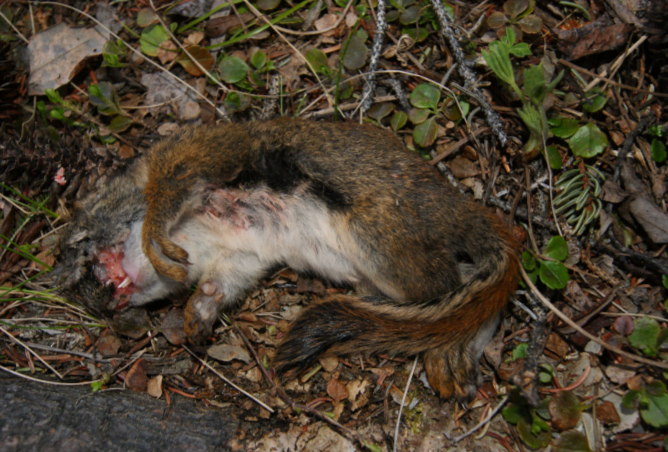
FIG. 1. A dead pup whose littermate was killed by an adult male red squirrel. This pup was found dead within 5 m of the nest where the incidence of infanticide was observed. Blood on its chest indicates chest wounds, and its head was partially missing, presumably consumed. The pup that was killed by infanticide had similar wounds inflicted to its chest and upper abdomen. Permission of Use obtained and Credit Dr. Jessica Haines Photo Source: The Science Naturalist 

Anyway! If you thought that we were going to leave it there and that I wasn’t going to tell you that arctic ground squirrels are part of the baby butcher brigade, think again! Infanticide is in fact more common with arctic ground squirrels because it isn’t dependent on mast years. That’s right, male ground squirrels can do infanticide anytime

Despite living in large networks of underground tunnels with many other ground squirrels, male ground squirrels will defend specific territories within that network in order to have exclusive reproductive access to the females in that territory. More ladies, more babies, no competition from other male’s offspring. It doesn’t actually work out that way, but we’ll get to it. 

Sometimes, these little dudes will be usurped by another male. When that new male takes over the territory of another male, he settles in to his new home by killing any of the offspring left over by the previous male. This grim form of house cleaning is similar in purpose to what the red squirrels do; they’re reducing competition to their offspring but killing off the offspring of another. 

Infographic created by Dr. Jessica Haines. Permission of use and Credit Dr. Jessica Haines.  

In a study of infanticidal ground squirrels done in our very own Kluane National park, the researcher noted that some of the baby squirrels that were killed as part of these grim housewarmings were found partially consumed. However, there was a lot of flesh left behind and there were definitely more caracasses created than one squirrel could consume so the main purpose of this infanticide was not food. This leads us to an interesting aside: in this same study, it was noted that the males weren’t the only ones to engage in a little casual cannibalism. 

After one of the new males had rampaged through his new territory on a baby cleanse, a female from that territory was observed bringing several of her dead offspring above the surface. Was it for a solemn above-ground funeral? Nope, it was so she could eat her freshly killed pups with other females in the area. I guess having a new guy move into town can be a stressful situation and you just really need to decompress with a ladies’ brunch. I would be loathe to see the mimosa that pairs with that.

So there you have it, folks! Squirrels are cute, squirrels are fuzzy, squirrels are highly practical baby-eating cannibals that will improve their rates of survival by any means necessary because being a tiny prey species in the north is a struggle and you need any advantage you can get.

A lot of exciting research on squirrels is happening right here in the Yukon. If you haven't had our fill yet, check out these resources!

"Sexually selected infanticide by male red squirrels in advance of a mast year"

"Territoriality and male reproductive success in arctic ground squirrels"

Dr. Jessica A. Haines, educator and ecologist, her past work in Kluane and ongoing efforts to connect others with the natural world is a shared goal with the Yukon Wildlife Preserve. 

Joelle Ingram

Joelle Ingram

Human of Many Talents

Joelle is a former archaeologist, former wildlife interpreter, and a full-time random fact enthusiast. She received her master’s degree in anthropology from McMaster University. One of the four people who read her thesis gave it the glowing review “It’s a paper that would appeal to very specific group of people,” which is probably why only four people have read it. Her favourite land mammal is a muskox, her favourite aquatic mammal is a narwhal. She thinks it’s important that you know that.

867-456-7400
 info@yukonwildlife.ca

Explore by Category

Explore by Author

Bull On Encounter!

Bull On Encounter!

wildlife

by Bree Parker | Mar 30, 2020

Right place right time! Animal Care Assistant, Bree Parker spends day after day diligently supporting our veterinarian Dr. Maria Hallock in caring for, feeding and ensuring the well-being of our collection of wildlife residents. 

Equally as important and valuable as literally providing food for the animals also is observing the animals. Observation is a critical part of our animal care process. This is when staff ensure an individual animal's behaviour is normal. Observing them eating, moving and interacting helps us know that animal is content and full-filling life needs. Signs something is off can include: the animal has a limp; they are not coming to the feed stations and eating; or, they are not socializing in a typical  herd group. These observations could indicate that there might be an ailment to the individual that deserves closer observation or possibly even intervention. However, sometimes this observation can be quite enlightening, it can catch incredible moments of animal encounters and wild behaviours we strive for our individuals to be able to fulfill.  

We've been waiting for the young bull to drop his antler for months now. . .

Bree starting filming this interaction simply because she thought it was fascinating and humorous to see the younger bull (on the left) asserting dominance with another bull, an older bull, with no antlers. Then everything got pretty exciting, pretty quickly!  "We've been waiting for the younger bull to drop his antlers for months now. The older bulls lost theirs in December" said Bree.

This is typical to have individuals vary on antler shed timing, especially between different aged individuals related to sexual maturity. Over the next several months both these individuals, along with all our antler-bearing cervid's (like moose, elk and mule deer) will be re-growing their antlers in preparation for fall. Alas, as another rut season comes and goes, so too will their antlers!

Bree Parker

Bree Parker

Animal Care Assistant

All animal lover to her very core! Bree has had a menagerie of pets over the years, including mice, crayfish and a hedgehog. After completing her Environmental Technician diploma at Seneca College, she realized her true calling was with animals, sending her back to Ontario this coming fall for University of Guelph Ridgetown Campus’s Veterinary Technology program. Bree is always eager to learn new facts about the animals at the Preserve that she can share with visitors.

Explore by Category

Explore by Author