Aspen Seeds Needed

Aspen Seeds Needed

Aspen Seeds Needed

5 minute read –

Beginning this spring and continuing over the next three years, Yukon Seed and Restoration in partnership with Yukon Government’s Wildland Fire Management Branch will collect 6,000 g of native Trembling aspen (Populus tremuloides) seed to use in projects throughout the territory for its fire resistant characteristics. This will include planting in the Whitehorse south fuel break, a 365 hectare fuel break being built to protect the city in case of a severe wildfire.

The Yukon climate is characterized by a short growing season, cold temperatures, and limited water availability. These specific environmental conditions require Yukon native seeds to be used in this project to give the trees the best chance at survival.

Have a favourite trembling aspen stand? Let us know on iNaturalist! Photo credit: Sophia Slater, YSR.

We are aiming to collect aspen seed from the Southern Lakes and Yukon Plateau North/Central ecoregions, but are interested in populations all over the territory. 

Who Are We?

Yukon Seed and Restoration, or YSR, is a plant focused environmental consulting company majority owned by the Na-Cho Nyäk Dun Development Corporation. We provide ecological restoration through land reclamation projects, honourable harvesting of Yukon native plant species, and invasive species management. 

We strive to make the land good through our work with First Nation, industry, and government clients. 

(Some of) our team. Photo Credit: Ainsley Taggett, YSR

One of the ways we support ongoing restoration work across the Yukon is through the Yukon Native Seed Bank and our Hudzi ni plant processing facility. We aim replace non-native seeds used on restoration projects with Yukon native seed that is better suited to our northern climate. We also develop workshops and programming to build capacity throughout the Yukon.

Aspen Identification

Trembling aspen is a deciduous tree that grows up to 20 m tall. They are a clonal species that reproduce by sending out shoots along their lateral roots. In a small area, most likely all individual aspen stems are genetically the same. They are dioecious, meaning that individuals are either male or female, and the female trees produce the seeds. 

Trembling aspen have smooth greenish-white, sometimes powdery, bark with black markings. The bark does not peel like on birch trees. The leaves are smooth and round with a nearly flat base and a pointed tip. They shake or tremble in the wind, giving the tree its name.

Trembling aspen bark (left), leaves (middle), and stand (right). Photo credits: YSR (left, middle), Ainsley Taggett, YSR (right).

On average, male trees flower in late April, and females in early May. Identifying flowering populations helps us to prepare for seed collection. Flowering male catkins are 2.5-7 cm long and red with white fluff, whereas flowering female catkins are 2-5 cm long and less conspicuous than their male counterparts.

Flowering male catkin (left) and flowering female catkin (right). Photo credits: iNaturalist (left), Hilary Lefort, YSR (right).

Aspen seed collection is a very time sensitive task. Later in May, female catkins turn green and lengthen. Eventually the seed pods open, releasing the white, fluffy seeds. Once the aspen seeds start to fluff out, it may only be 48-72 hours before the entire seed crop has dispersed. Usually this falls around the end of May or beginning of June, so beginning in mid-May we check on stands frequently to assess the seed crop, looking at the fruiting female catkins and breaking them open to see the seed inside.

We aim to collect the female catkins when they are green (left), just before the seeds are released. We can confirm their readiness by looking at the seed: yellowy seed (middle) is immature, and brown seed (right) is mature. Photo credits: iNaturalist (left), Moench (middle, right).

Aspens and Fire

Wildfire plays a critical role in Yukon ecosystems and has been used traditionally by Yukon First Nations to manage forests. However, due to a history of fire suppression and an increase in temperatures caused by climate change, fires are becoming more frequent and more severe in the territory.

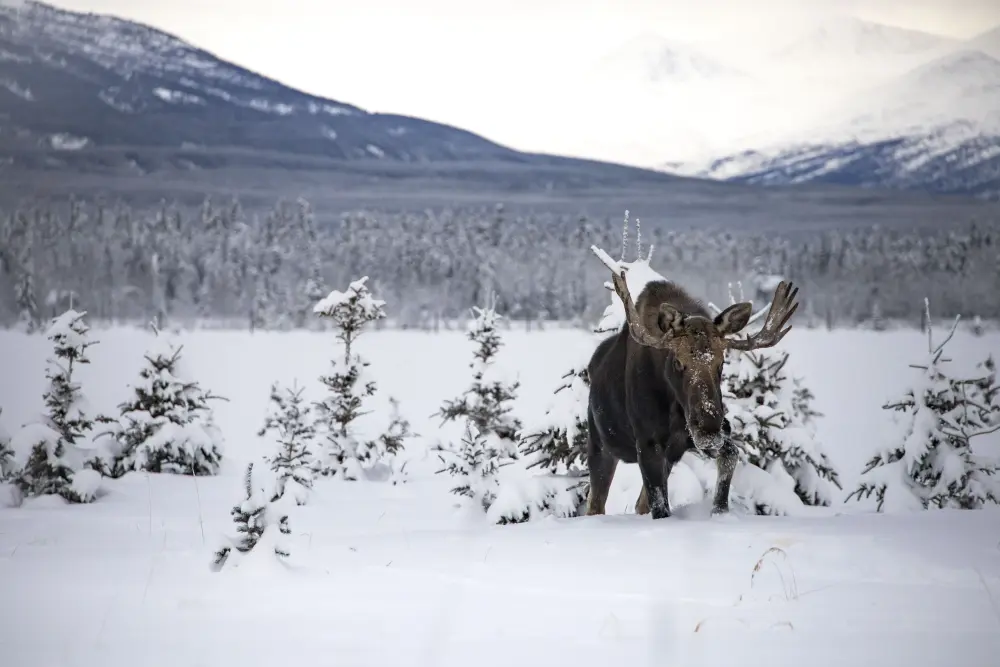
Pushup from a muskrat in the Preserve's Moose Pond with a wide view of the land including snowy mountains and boreal forest. Photo Credit; Rebecca Carter.

The Ethel Lake burn near Mayo/Stewart Crossing. Photo credit: Naomi Butterfield, YSR.

Conifer trees like white spruce and lodgepole pine pose a greater risk than deciduous trees in wildfires, because of their flammable bark, relatively high density, and buildup of ground and ladder fuels. Deciduous trees like trembling aspen are relatively fire resistant due to their higher moisture content, lower density, limited ladder fuels, and shading of the understory, which protects it from moisture loss. Additionally, trembling aspen grows quickly in burned soil.

How Can You Help?

This scale of project will require many aspen populations. Over the next three years, if you see aspen populations with lots of trees, and specifically with female flowers/catkins (see Aspen Identification), let us know!

Join our iNaturalist platform to tag populations of reproductive aspens and contribute to the reforestation of the fuel break. Email photos and locations to us at matthew@yukonseed.ca.

If you are interested in helping out with collections, we are looking for casual labour and volunteers at the end of May and June. Stay tuned to our Facebook for seed collection dates. Contact matthew@yukonseed.ca for more information or to get involved.

References

Government of Alberta. 3 August 2012. How different tree species impact the spread of wildfire. Government of Alberta. Available from: https://www1.agric.gov.ab.ca/$department/deptdocs.nsf/all/formain15744/$FILE/tree-species-impact-wildfire-aug03-2012.pdf 

Mackinnon A, Pojar J, Coupé J. 2021. Plants of Northern British Columbia, Expanded Second Edition.

Moench RD. Aspen Seed Collection. Part of Nursery Information Series. For Colorado State Forest Service.

Shinneman DJ, Baker WL, Rogers PC, Kulakowski D. 2013. Fire regimes of quaking aspen in the Mountain West. Forest Ecology and Management, 299: 22-34.

Sophia Slater

Sophia Slater

Intermediate Restoration Ecologist

Sophia was one of the Interpretive Wildlife Guides and animal care assistants at the Preserve. She moved to the Yukon from Ontario, where she just graduated with a Bachelor of Science in Biology from Nipissing University.  Now you can find her at Yukon Seed and Restoration as an Intermediate Restoration Ecologist or summiting the many beautiful mountains in the Yukon this summer! 

Explore by Category

Explore by Author

Moose Hair Loss Study

Moose Hair Loss Study

Moose Hair Loss Study

This article was originally published in The Preserve Post newsletter in Spring 2019. In April 2022 Emily et al., published a paper Improving Widescale Monitoring of Ectoparasite Presence in Northern Canadian Wildlife with the Aid of Citizen Science on this project.
10 minute read – 

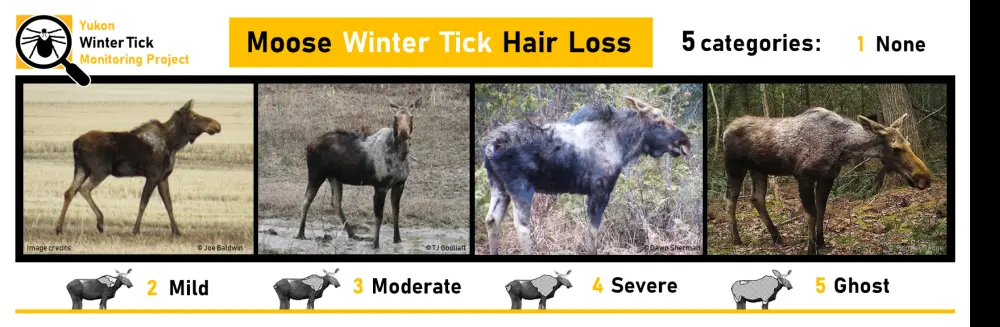
Ever had an itch you just can’t scratch? For moose and other large deer species, winter ticks are an annual burden. These blood-feeding parasites live for only one year and spend almost their whole life on the same host. Moose are often the worst affected – and although a few ticks on an individual is no big deal, winter tick numbers can sometimes reach 50,000-100,000 ticks per animal. These severely infested moose just keep scratching, trying to rid themselves of the parasites, and may lose large amounts of blood, valuable time feeding, and significant amounts of hair. The distinct patterns of tick-induced hair loss are most noticeable on moose from March to May when the ticks are at their largest, and is a key indicator that winter ticks are present in a region. Hair loss can range from very mild, with just a few patches on the shoulders and neck, to extremely severe or “ghost moose”, which have damaged or missing hair over more than 80% of their body.


The Yukon Winter Tick Monitoring Project is a collaboration between Environment Yukon and researchers at the University of Toronto. Its aim is to find out where in Yukon winter ticks are now, and where they could be in future, given the effects of climate change. Until recently, there were no winter ticks found in Yukon. Early reports began in the 1990s, and although relatively low numbers of them have been found to date, little is known about their distribution and effect on native Yukon species. Changing environmental and climate conditions play an important role in the winter tick-host relationship, with warmer, wetter seasons and shorter winters known to increase tick survival. Finding new methods of detecting winter ticks and their impact on hosts is important for us to understand how and when management could be needed.
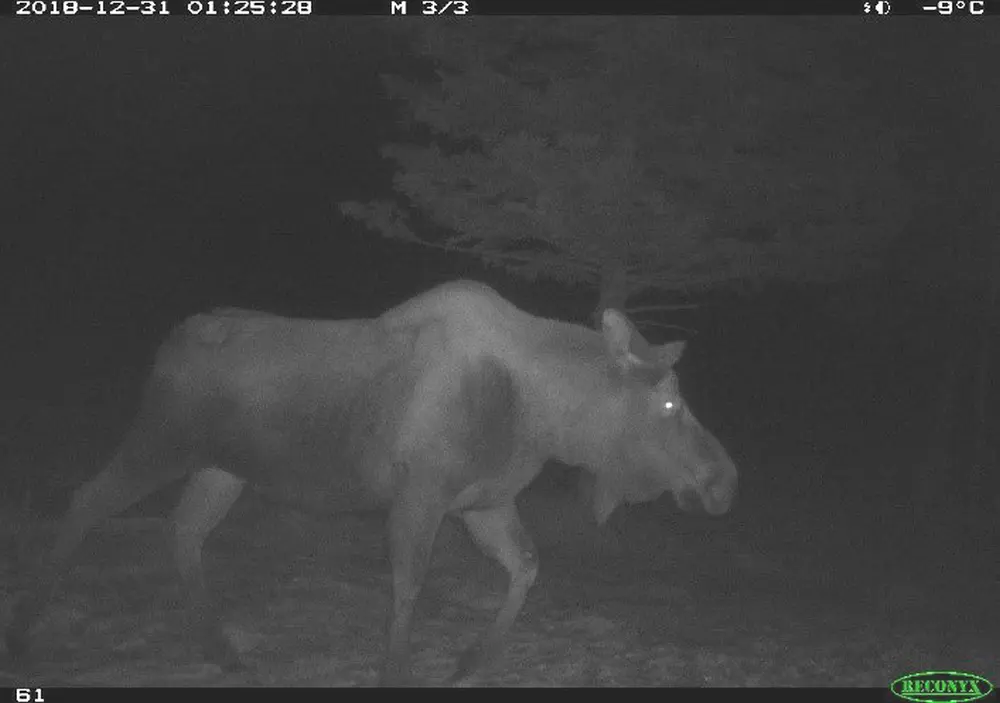
To help with this research, the moose at the Preserve have been having their photograph taken more than usual! Moose, like many other mammals, shed their heavier winter coat each year, resulting in a natural pattern of hair loss. To better understand what a healthy, tick-free Yukon moose looks like over the winter and into spring, two high-resolution
wildlife cameras were installed in the moose enclosure in December 2018. These cameras automatically take a photograph every time a moose walks past, and will continue to capture thousands of images each month until May.
The resulting catalogue of monthly moose hair shedding patterns will form a critical baseline from which to compare images of wild moose, photographed by additional remote cameras that have been set up throughout southern Yukon. This work will allow us to examine the current effects of winter ticks in this region and will additionally form an important part of a larger
scale study that looks at winter tick spread under climate change throughout North America.
Interested in Contributing?
If you see a moose or other animal with patchy hair, you can help to inform this research by submitting a  photograph directly to Emily (emily.chenery@mail.utoronto.ca), online through the Yukon Winter Tick Monitoring Project Facebook page, or citizen science app iNaturalist. Sightings can also be reported directly to
Environment Yukon’s Animal Health Unit in Whitehorse. Yukon Winter Tick Monitoring Project.
Emily Chenery

Emily Chenery

Guest Researcher / Author

Emily Chenery is a PhD student at the University of Toronto Scarborough studying the range expansion of winter ticks into Yukon. This project at Yukon Wildlife Preserve is being assisted by BSc student Maegan McCaw (University of Alberta), and funded by EC’s W. Garfield Weston Fellowship from the Wildlife Conservation Society (WCS) Canada, with additional support from Environment Yukon’s Animal Health Unit.

Explore by Category

Explore by Author

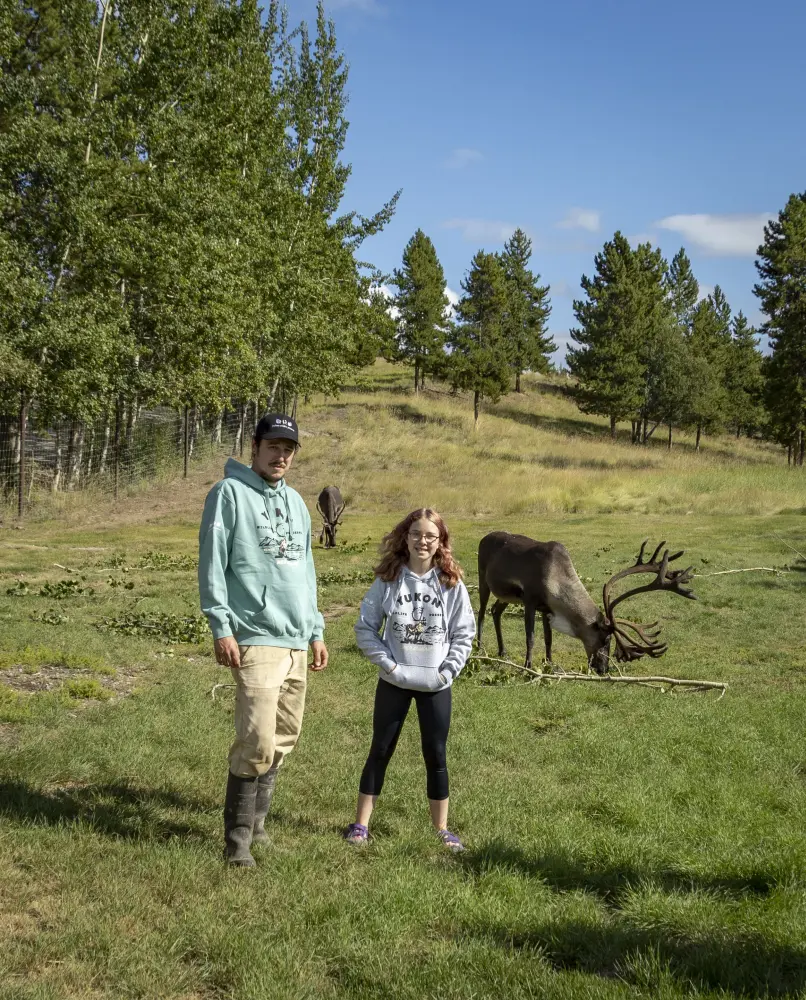
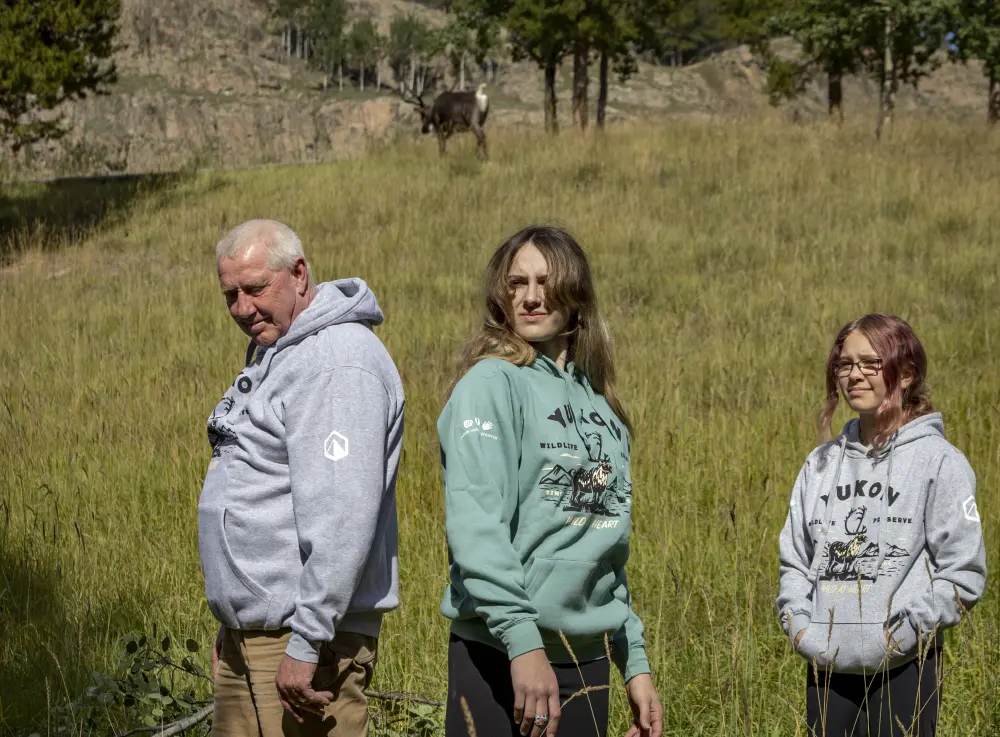
Yukon Collaboration Sweater

Yukon Collaboration Sweater

Yukon Collaboration Sweater

6 min read

The Visitor Services team is working hard to connect with local artist to bring the connections to nature home with you. We strongly feel that by taking the time to explore these partnerships we can create unique items that guests to the Preserve can take home all while knowing their purchase in the Preserve’s Little Gift Shop not only supports these northern people but all revenue from the retail sales goes back into the operations of the Preserve, supporting the northern animals in our care.

Right now the Preserve does not do online sales. We’re a really small team that is situated out of town, and with some staff also living out of town, doing online sales and shipping feels a bit outside our capacities for the time being. 

Yukon Built is selling stock of these sweaters online – check it out!

• • •

Photo of moose in water.

Way back in 2020, when travel came to a near stand-stil, Lindsay, Manager of Visitor Services, started exploring ideas for the Preserve’s Little Gift Shop to help diversify our products and bring them a little closer to home. We wanted products that celebrated our community and are inspired by anc created in the Yukon, the North. I had a bit more time then to explore connections with Yukon artist and from that over the years we created hats, mugs, and necktubes, and stickers and t-shirts.

• • •

From this we started to connect with locals for the first time through our gift shop, previously, mostly non-local visitors were supporting the gift shop with purchases to commemorate their visit. We just didn’t have items in the gift shop that seemed to spark the interest of our local community. 

• • •

Photo credit: J.Paleczny

Over the years, I heard visitors and staff alike say we needed a sweater in the gift shop. After collaborating with Tedd Tucker for a YWP special design t-shirt, and the popularity of this, we knew we wanted to go back to this talent and get some help with some new design idea that would fit well on a sweater. 

• • •

Photo of team providing care for moose in the field.

We also knew there was a strong, well-loved local brand that dialed in the comfy minimalist hoodie style and also did other Northern collaborations with Air North and the Yukon Quest. So, you guessed it, we reached out to Yukon Built back in December of 2020 and started, what ended up being a long (but worthy) journey to this very perfect Northern collaboration sweater! 

• • •

Photo of staff using stethoscope to listen to moose heart rate.

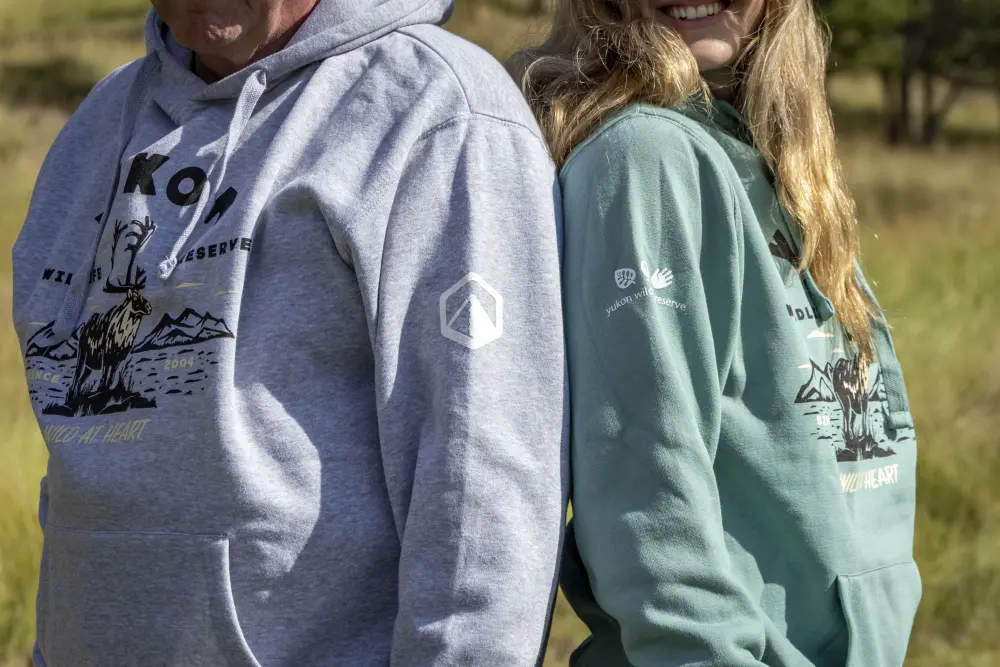
Wild at heart – all the proceeds from the sweater sales will be going back into the Preserve, and directly support the Wildlife Rehabilitation program. The Preserve has been the place in the Yukon where injured and orphaned animal get a second chance at life. The support from our community, local and afar, has helped us give them the best possible veterinary care – and get that back on their feet or wings! Purchasing this sweater will also help us keep Yukon wild at heart! 

• • •

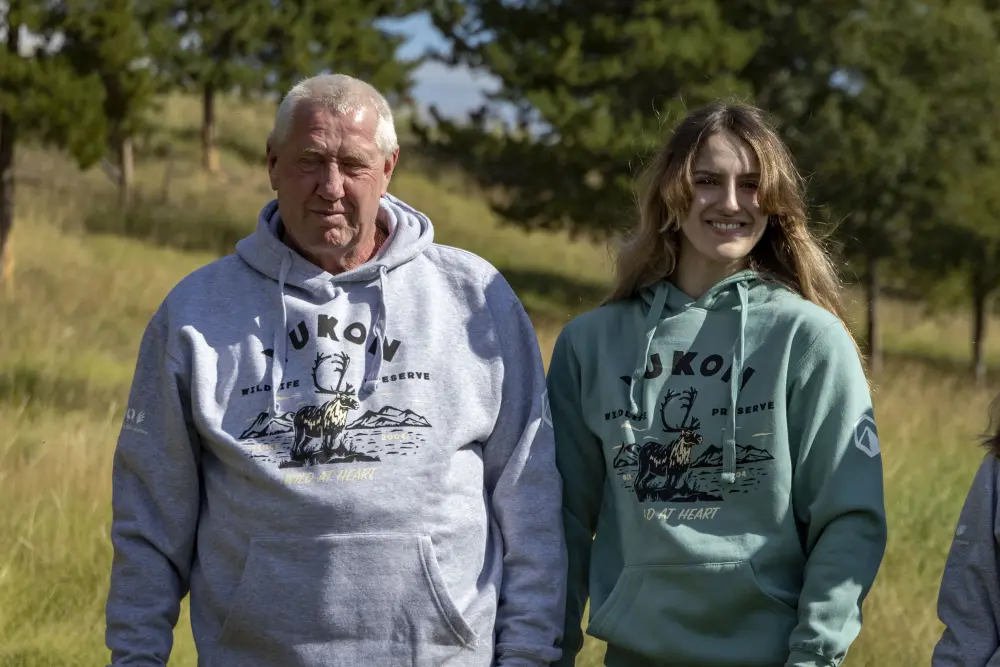
The Preserve has grey and sage colours for sale only at their Little Gift Shop. Yukon Built store in Whitehorse is selling grey and a sandy beige colour!  Yukon Built has also elected to take a portion of their sales from each sweater sale for wildlife rehabilitation at the the Preserve. 

Learn more about wildlife rehabilition at the Preserve! 

• • •

Photo of staff using stethoscope to listen to moose heart rate.

Whether you’re camping, hiking, or just hanging out, this mid-weight fleece hoodie is up for the task.

  • Features: This classic hoodie features a special edition YUKON WILDLIFE PRESERVE print, a flat draw cord, and a double-layered fleece-lined hood

  • Fit: Unisex sizing with regular fit

  • Material: 60% cotton, 40% polyester ring-spun fleece

  • Care: Due to the cotton content, this hoodie may shrink a little! Wash in cold water with like colours and air dry.

Sweater                          $75
(with each sweater sale proceeds go towards Wildlife Rehabilitation). 

• • •

Photo of staff using stethoscope to listen to moose heart rate.
Lindsay Caskenette

Lindsay Caskenette

Manager Visitor Services

Lindsay joined the Wildlife Preserve team March 2014. Originally from Ontario, she came to the Yukon in search of new adventures and new career challenges. Lindsay holds a degree in Environmental Studies with honours from Wilfrid Laurier University and brings with her a strong passion for sharing what nature, animals, and the environment can teach us.

867-456-7400
Lindsay@yukonwildlife.ca

Explore by Category

Explore by Author

Yukon Wildlife Preserve
Box 20191
Whitehorse, Yukon
Y1A 7A2

Proud member of:

CAZA Logo

With the support of:

Yukon Government Logo