What’s in the Feed Station: Moose?

What’s in the Feed Station: Moose?

yukon

3:45 min Video -

Hello and welcome to the moose feeding station!

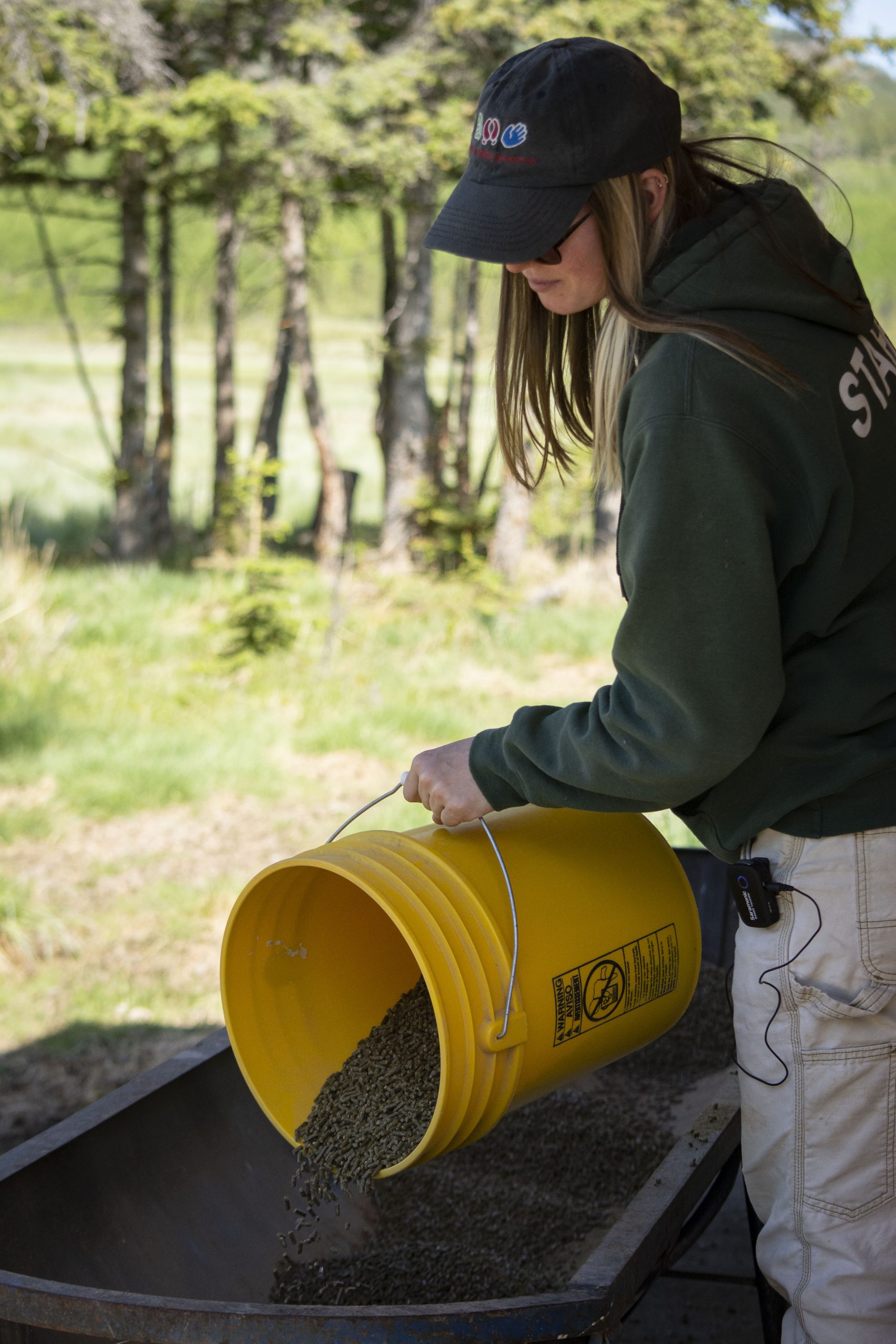
The feeding stations exist to make my job easier. Inside they have a big bag of pellets, a bale of hay, a bucket and scoop, a rake, a shovel, a pitchfork, a broom and a feeding chart.

The moose get 25 lbs of pellets a day as a supplement of vitamins and trace minerals in a form they like.  25 lbs may not sound like a lot for 4 moose, but there are lots of natural foraging opportunities in their habitat. In the wild, moose eat leaves, bark and twigs from trees and shrubs as well as aquatic plants. Our moose also have a bale of hay placed in the trees in the back corner of the 48.5 acre habitat and we give them browse, which are tree branches with lots of leaves. We also get produce from local grocery stores or other community members (things like lettuce and veggies) to feed the moose.
The tools in the feeding station are used to clean the area and also for protection. We never enter the moose habitat when they are nearby. It’s just too easy for something to go wrong, without the moose even meaning to hurt us. So when we feed them we take a tool with us. If the moose decide to come up too close, we can wave the rake and they perceive us as being larger than we are and hopefully they back off. If they are very hungry, and come towards us too close and too fast, we might be forced back into the feeding station. In that case, we can use the scoop to pour the pellets through the slat in the wall into the trough outside.
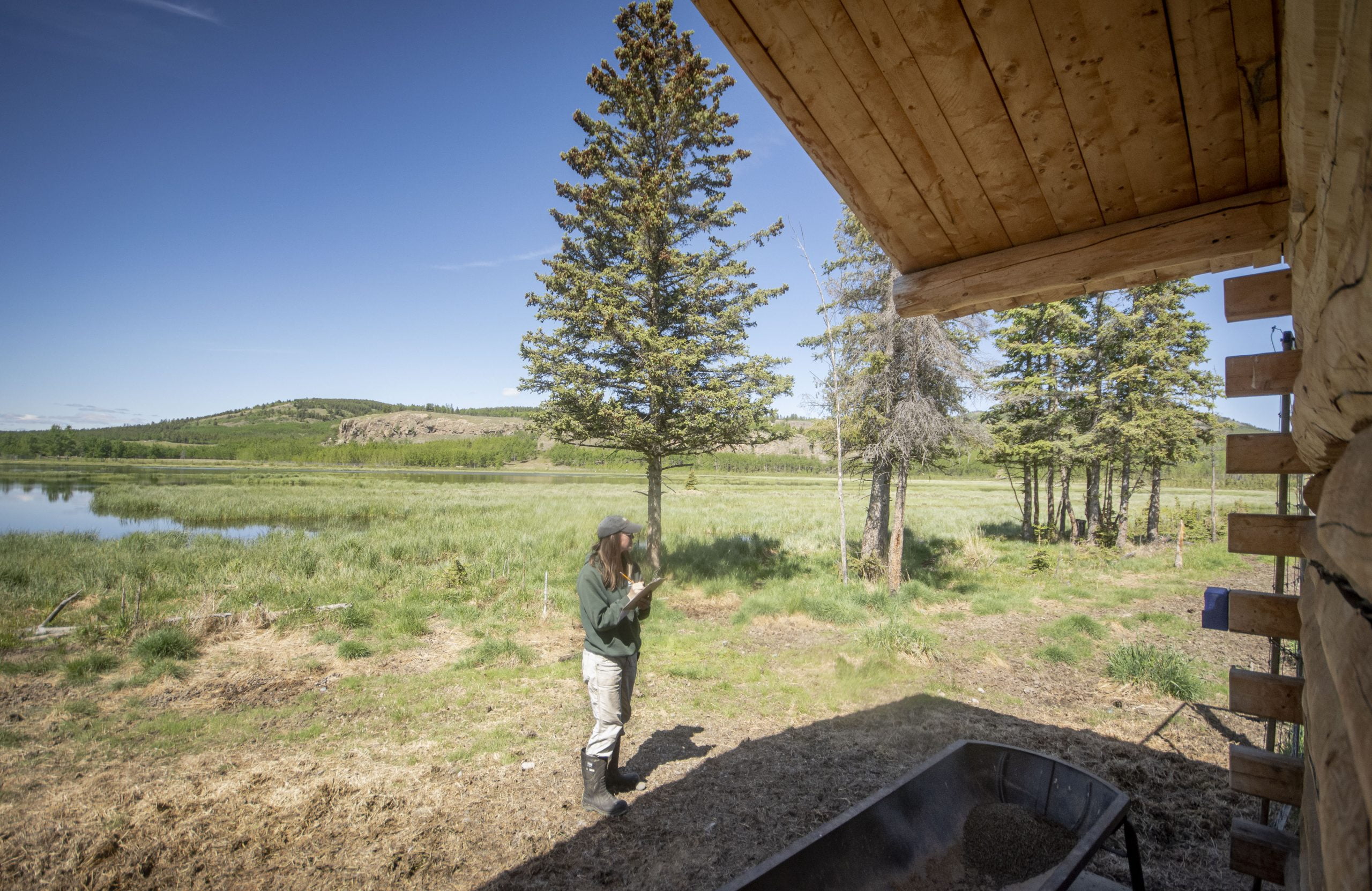
Each feeding station has a clipboard with a feeding chart. The feeding chart is a place for animal care staff to record information. Every day, we record the number of animals we saw, how much and what kind of food they got, and any comments or observations about the animals. If we ever go a couple days without seeing all the animals in a habitat, we let the veterinarian, Dr. Maria Hallock, know, and she will walk around the perimeter of the habitat to locate the animal or animals and make sure they’re ok.

As an example, there was one time last fall when I was feeding Watson his bottle of formula, with my animal care coworker and we noticed he had a patch of green and red on one of his “knees” and we were concerned he may have hurt himself. We sent a picture to the veterinarian, and tried to think of anything that could have caused the discolouration. We then remembered that we had fed him some produce that had beets, lettuce, and celery and he must have knelt in it, causing the staining on his knee. We all got a little chuckle out of it, and were relieved it was nothing serious.
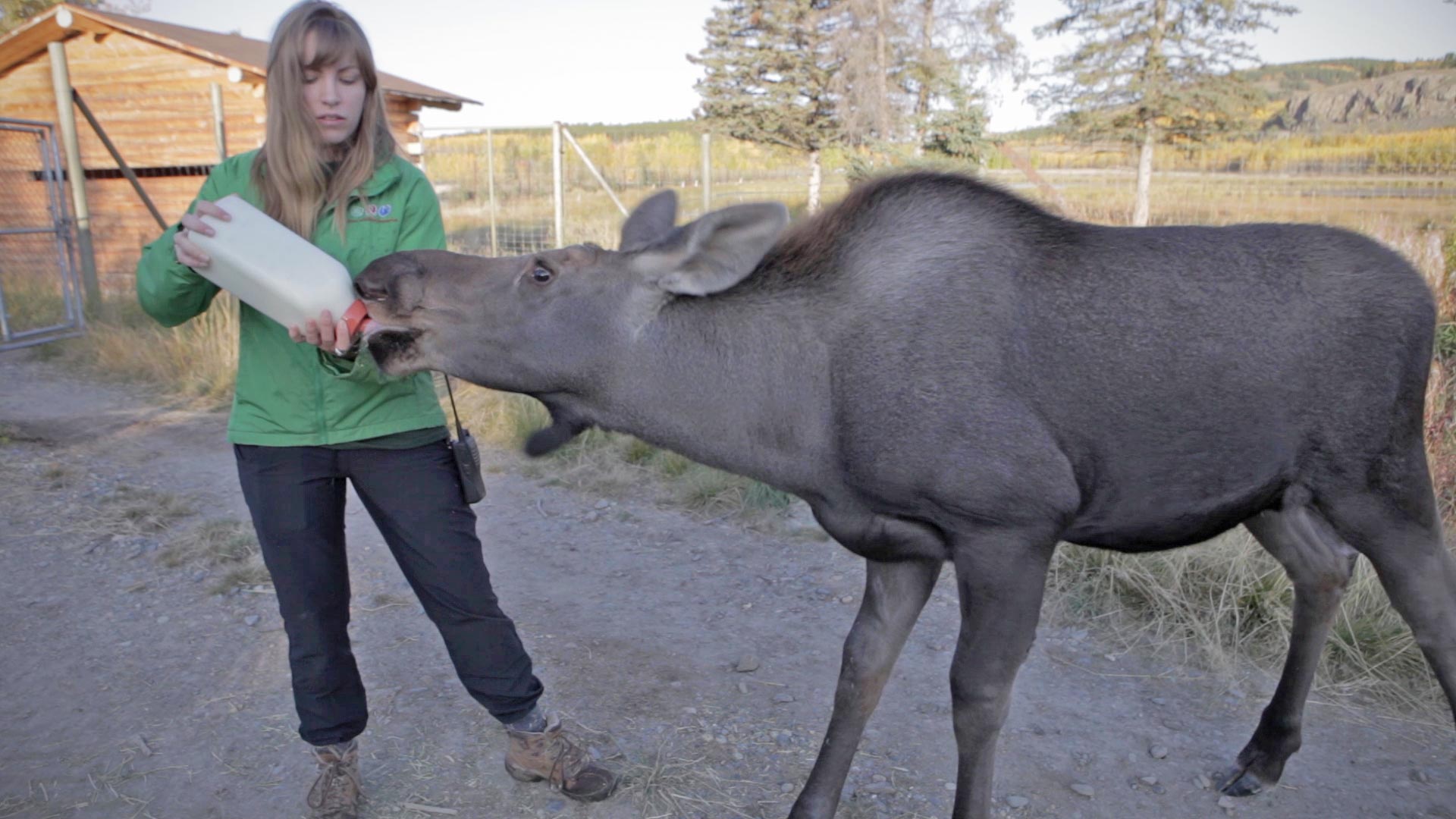
Read Watson's original story  and then watch the video of Watson taking the first steps to his larger habitat, after his initial rehabilitation.

Animal Care at Yukon Wildlife Preserve involves feeding, cleaning and diligent observations.  Thanks for joining me on this tour of the moose feeding station.

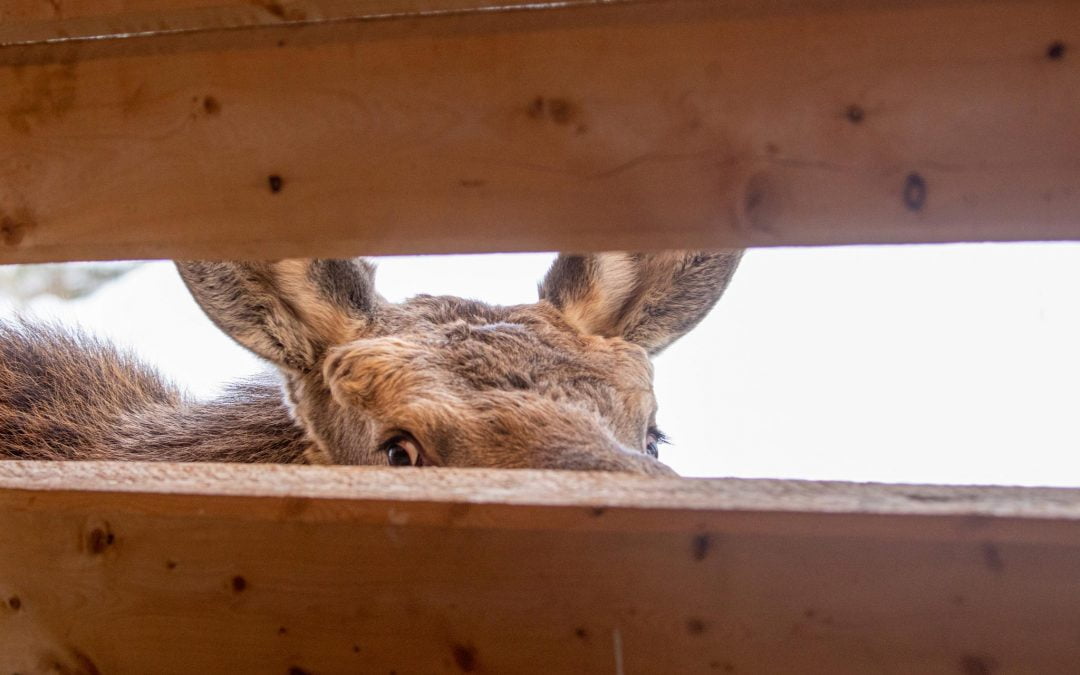
Banner photo credit Neil Zeller:  Watson gets curious and says hello through the slats in the Animal Feeding station.

Watch Bree explain how Yukon Wildlife Preserve feeds Wood Bison!

Learn as Dr. Maria Hallock provide hoof trims to Rocky Mountain Goats!
Bree Parker

Bree Parker

Animal Care Assistant

All animal lover to her very core! Bree has had a menagerie of pets over the years, including mice, crayfish and a hedgehog. After completing her Environmental Technician diploma at Seneca College, she realized her true calling was with animals, sending her back to Ontario this coming fall for University of Guelph Ridgetown Campus’s Veterinary Technology program. Bree is always eager to learn new facts about the animals at the Preserve that she can share with visitors.

Explore by Category

Explore by Author

Royal and Magnificent Elk

Royal and Magnificent Elk

yukon

Jun 17, 2020 | 1 comment

1.5 min read -

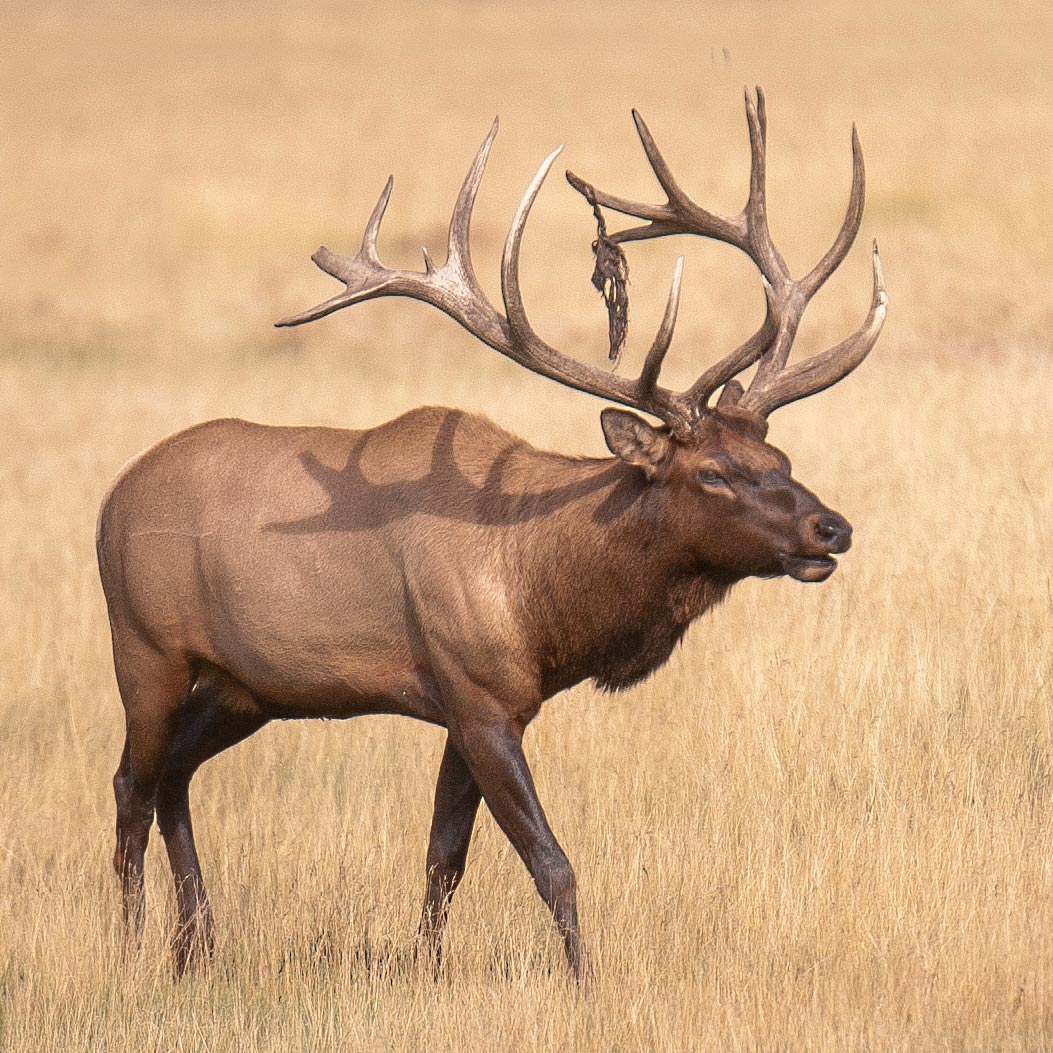
Have you seen our bull elk lately - striding regally across his habitat like a king checking his realm?

The magnificence of the elk and his European cousin, the red deer stag, has inspired many legends and made its way into European heraldry (the art of Coats of Arms and family crests). Along with poetry and music, the stag is associated with harmony, purity and fleetness. Antlers represent strength and fortitude.

The stag may symbolize faith and repentance, but most commonly, it was seen as a symbol of the virtuous and noble person.

Europeans brought their heraldry with them to North America. Canadian heraldry incorporates distinctly Canadian symbols like native flora and fauna as well as First Nation references. Coats of arms are used throughout Canada by citizens, businesses and all levels of government. Any Canadian citizen can petition for a Coat of Arms.

Our North American elk is on many Canadian coats of arms including the Provincial arms of British Columbia and the municipal arms of Brandon, Manitoba.  Makes you wonder what a Wildlife Preserve Coat of Arms might look like!

Photo credit Kevin Pepper

Pete Neilson

Pete Neilson

Wildlife Interpreter

'Sir' Pete grew up in suburban Southern Ontario north of Toronto. In the late 80's, he followed the lure of London and Service to the Yukon. 'Sir' Pete has lived off grid in the Yukon all along from a wall tent and later a tepee in his earlier years and now a small cabin near Twin lakes. He guided wilderness canoe trips many years in the 90's and early 2000's and got his first sled dog in ’91; currently he has 15 dogs for recreational mushing. 'Sir' Pete enjoys being at home or out with his dogs as much as he can.

Explore by Category

Explore by Author

Red Fox in 360 Video

Red Fox in 360 Video

yukon

by Erin Jamieson | Jun 15, 2020 | 1 comment

4.5 min video - watch in either English or French -

Wild and curious Red Foxes are a common sight in the Yukon. The natural adaptability and resourcefulness of this species makes them well-suited to coping with human presence, but sometimes they need us to remember that they are wild animals. To learn more, watch this curriculum based video for schoolkids of all ages and then check out our website!

Red Foxes are very curious and highly adaptable members of the Canid Family.  People often love to see foxes and enjoy being close to wildlife, but the temptation to feed them can cause problems.  Unlike the Red Fox in this photo who has been raised in human care, wild foxes can and should hunt their own food.  To make sure that wild foxes don’t come too close, we can keep things that attract them out of their reach. Keeping garbage, pet food, and anything that they might eat or steal kept safely out of the way is essential.

Les Renards roux sauvages et curieux sont communs à voir au Yukon. L’adaptabilité naturelle et l’ingéniosité de cette espèce les rendent bien adaptés à la présence humaine, mais il faut se rappeler qu’ils sont des animaux sauvages. Pour en apprendre plus sur les renards roux, regardez cette vidéo pour les étudiants - de toutes âges, et visitez notre site web!

Education Team

Education Team

This 360 video is brought to you by the hard work and creativity of the Education team at Yukon Wildlife Preserve.  French translation for 2020 has been provided by Anna Tölgyesi.

Explore by Category

Explore by Author

Arctic Fox Adaptations in 360 Video

Arctic Fox Adaptations in 360 Video

yukon

by Erin Jamieson | Jun 15, 2020 | 0 comments

4 min video - watch in either English or French - 

Surviving in the North is not for everyone. Those who make it need more than strength and endurance, they also need the ability to adapt to a challenging climate! Arctic Foxes are well-adapted to their frozen home in many ways. To learn more, watch this curriculum based video for schoolkids of all ages, then check out our website!

As you can see, the Arctic Foxes here at the Yukon Wildlife Preserve still have their winter coats on, but take a look at their muzzle for darker bits of fur showing through - that’s a sign they have begun shedding their winter coat.  These foxes might look cute, but they have also adapted to thrive in a really tough environment.

Survivre dans le Nord n’est pas pour tout le monde. Ceux qui survivent ont besoin de force, d’endurance et de capacité à s'adapter à un climat difficile! Les renards arctiques sont bien adaptés à leur habitat froid de plusieurs façons. Pour en apprendre plus sur les renards arctiques, regardez cette vidéo pour les étudiants - de toutes âges et visitez notre site web!

Education Team

Education Team

This 360 video is brought to you by the hard work and creativity of the Education team at Yukon Wildlife Preserve.  French translation for 2020 has been provided by Anna Tölgyesi.

Explore by Category

Explore by Author

Muskox Get Shaggy

Muskox Get Shaggy

yukon

2 minute read - 

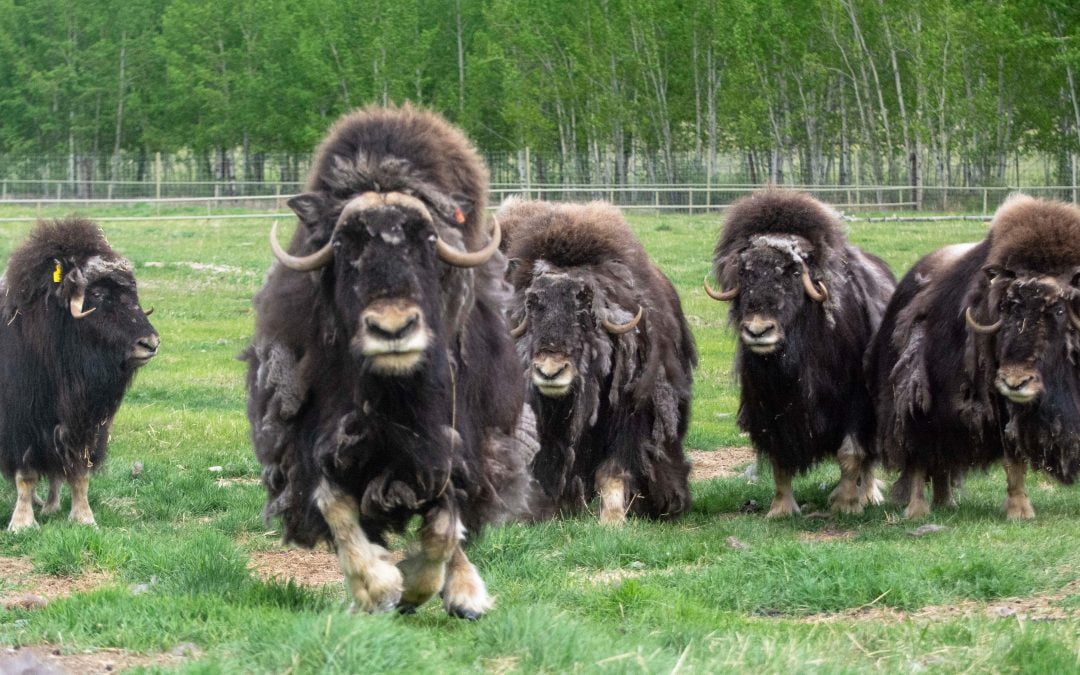
In late Spring, Muskox start to look pretty shaggy and not very impressive.  They look like they could use a good combing - why is that?

To best answer the question…..let’s first talk a bit about muskox.

Muskox live on the tundra of the high arctic. This is a harsh environment and to protect themselves from cold temperatures, blowing snow and a lack of protection like hills, mountains….or even trees….the muskox has evolved some physical adaptations to not only survive, but to thrive.

The focus of this article and video is one of those adaptations:  their hair coat.

In this photo, guard hairs are clearly a coarser, darker brown hair.  Qiviut appears fleecier, greyish or lighter brown in colour and appears in straggly patches from the shoulder, across the back and over the hip.

Muskox sport long guard hairs that reach all the way down to their hooves. This acts as “almost” a weather proofing - it keeps the wind, snow and ice out.

Qiviut is the underlayer hair - a soft, warm, fleecy undercoat. The two layers - guard hairs and qiviut, work together to keep the muskox warm and dry through the long arctic winters, which can last up to 8 months! 

During spring, the muskox shed their qiviut, otherwise they run the risk of overheating.  The qiviut comes off in long dense layers - making them appear straggly and patchy. The qiviut gets caught in the environment on rocks and bushes. Other animals like ground squirrels and birds will gather it up to line their nests.

Humans are another animal who will gather qiviut - but we do so in order to knit with this very soft, fine and warm fibre. While we can knit with 100% qiviut, it is sometimes blended with other fibres, such as sheep’s wool.

Adaptations like qiviut and guard hair must be working, because muskox has survived since the last ice age. Now, that’s impressive.

Photo and video credit L. Caskenette

Lindsay Caskenette & Julie Kerr

Lindsay Caskenette & Julie Kerr

Visitor Services Manager and Visitor Services Coordinator

Lindsay and Julie love to share the Preserve the same way they explore life – full on and full of adventure!  They have a collective love of:  Animals....Lindsay dogs, Julie foxes; Adventure.... Lindsay dog mushing, Julie extreme camping;  both take on animal personas during story telling.  Together they support the Preserve with a strong Visitor Services presence and often, they even get work done (this happens most often when the other one is out of the office).   

867-456-7400
 info@yukonwildlife.ca

Explore by Category

Explore by Author