How are Animals Named?

How are Animals Named?

How are Animals Named?

11 min read –

Throughout history, various languages and cultures have contributed to a wide – and often confusing – vocabulary used to describe animals’ genders, the young stages of their lives and what they may be called when they are gathered together in groups.

Mule deer:
Males are called bucks. Females are called does & young are fawns.
A group of deer are often called a herd but more fun versions include a bevy, a bunch, a rangale or a parcel
– though a parcel is often in reference to a group of young deer.

Historically, adjectives were the labels of choice to communicate animal gender identifiers. A broad selection of these labels has resulted – which are not universally applied, even within the same species. For example: in the deer family or Cervidae, males are identified as bucks and females are called does. In moose, and caribou – also members of the Cervidae family – males are called bulls and females are called cows while elk males are referred to as stags.
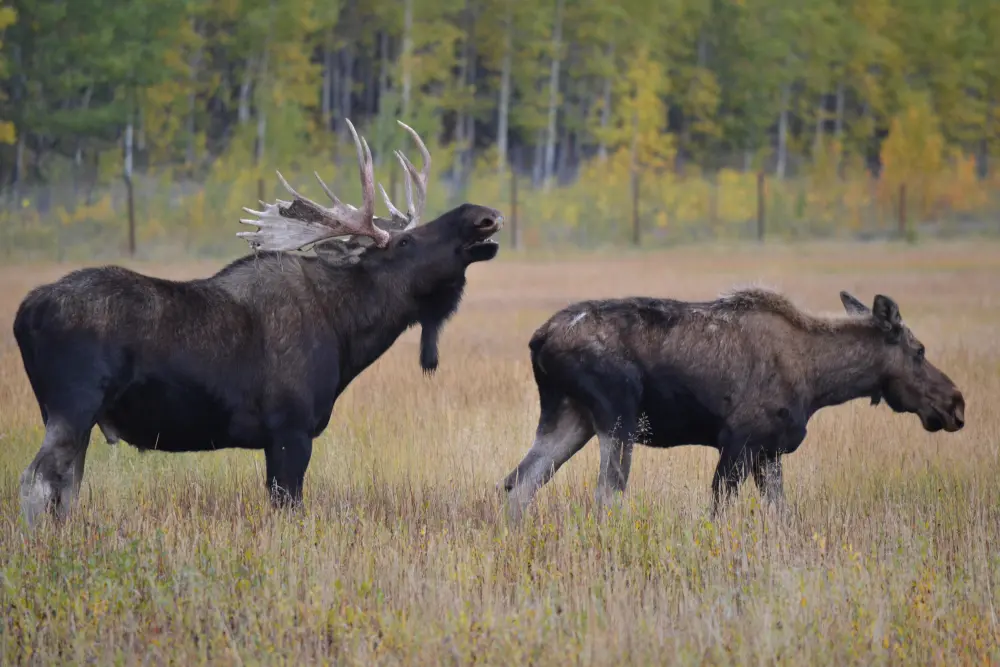
Cervids
From left to right – moose, caribou and Elk.
Males are called bulls (elk are called stags) and females are called cows.

Generally these cervids in groupings would be called herds (though moose are not actually herd animals) while elk can be also called a gang – watch out!

Not limited to just fur-bearing creatures, these titles are applied to other species and there are often departures from the naming conventions used. Rabbits are called bucks and does while steelhead trout males are called bucks, with females being called hens rather than does.

There is also a vast difference in the scientific naming of all creatures. Over the centuries a number of early scientists attempted to establish a format to classify animal groups. Ancient Chinese created the first recorded reference in 2700 BC, but it was quite limited and focused primarily on flora (vegetation) of their geographic region. 

Check out our Facebook post to learn more about Vulpes vulpes; not all red foxes are created equally but all are a red fox!

  1. Remember Fox and the Hound? A male is called a tod (sometimes a reynard or a dog), while females are referred to as vixens.
  2. Young are most commonly called kits but can also go by cubs, or pups.
  3. The collective noun to describe a group of foxes are a skulk, earth or a leash! These names are related to fox behaviour corresponding respectively as a group hunting together, a mama fox with her kits, and a group of domesticated or captive foxes as a leash.

Now, there are other foxes including Arctic fox (Vulpes lagopus), swift fox (Vulpes velox), fennec fox (Vulpes zerda), and others across the world for a total of 12 species that comprise the largest genus, Vulpes.

Smaller classifications exist within the genus Urocyon which include the gray fox. The only extant species of fox belonging to the Otocyon genus is that of the bat-eared fox found in the African savanna.

Ancient Greek philosopher and scientist Aristotle described a large number of natural groups, and although he ranked them from simple to complex, his order was not an evolutionary one. He was far ahead of his time in separating invertebrate animals into different groups and was aware that whales, dolphins, and porpoises had mammalian characters and were not fish. The Aristotelian method dominated classification for many centuries. During this period, it provided a procedure for attempting to define living things through careful analysis, it neglected the variations between living things.

In 1758 Carolus Linnaeus, who is usually regarded as the founder of modern taxonomy and whose books are considered the beginning of modern botanical and zoological nomenclature, drew up rules for assigning names to plants and animals. He was the first to use binomial nomenclature consistently. Although he introduced the standard hierarchy of class, order, family, genus, and species, his main success in his own day was providing workable keys, making it possible to identify plants and animals from his cataloging. Linnaeus was the father of the Field Guide.
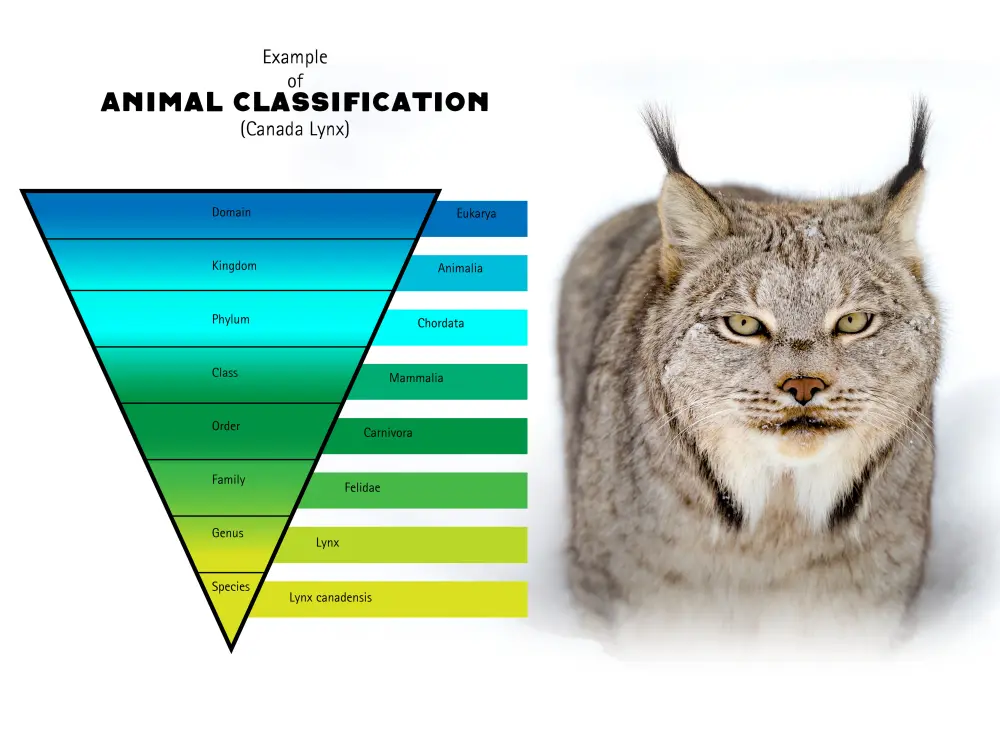
Lynx classification

Over the centuries a number of paleontologists, biologists, and scientists contributed to refining Taxonomy as we know it today. Perhaps the most notable of these was Charles Darwin – who explained his theory of evolution by describing how animals changed over time, yet still remained within specific categories in taxonomy.

Below is a table defining each classification of steppe Bison, the 15,000-year-old ancestor of today’s wood bison. As you can see, their classifications are not much different, other than identifying wood bison as a sub-species.

While their scientific classifications are very similar, the animals themselves were quite different. Steppe bison persisted through the great extinction of the last Ice Age up until about 5,400 years ago. A relatively recent find in Whitehorse city limits proves steppe bison persisted giving rise to the bison seen in the Yukon today but are not the direct descendants of the steppe bison.

Darwin’s famous illustration The Tree of Life displays the evolutionary relationships between species. This idea caused a great deal of controversy when he concluded that mankind evolved from the apes which was contrary to the religious teachings of the day.

Muskox and bison – both species are members of the Bovidea family. In this family, males are called bulls and females are called cows. The young are called calves and groups of both species are referred to as “herds”. But that is where the line is drawn for their nomenclatures. The Inuit name for muskox is “omingmak,” which means “the animal with the skin like a beard.” Geographically, today’s populations of muskox and bison do not overlap and their adaptions to winter survival as a result are very different.

We can see from this phylogenetic tree how bovids (horn bearing) and cervids (antler bearing) are related to each other. The animals with icons represent those species at the Yukon Wildlife Preserve. The Yukon has 9 of the 11 ungulates of North America, excluding the bighorn sheep and pronghorn antelope. What’s also interesting to note is that mountain goats are their own genus and muskox are more closely related to sheep and goats than they are bison!

When we dive into the scientific name we can see how the classifications carry over. For instance muskox, Ovibos, share genus naming from sheep and cow. Caribou or Rangifer tarandus is reindeer in Latin, from the Greek tárandos, also meaning reindeer. So when someone asks you the difference between caribou and reindeer, you can say, nothing! (Except, reindeer fly!)

Classification tree for ungulates bovid and cervid

(Note: this a general phylogenetic tree; it is not complete and does not represent accurate branch length for amount of genetic change and complexities of sub-taxa).

Beyond the labels used for animal species, their offspring also suffer from a variety of descriptors to classify their young age. There are calves, fawns, foals, pups, cubs, kittens, chicks, hatchlings, fry and owlets to name a few. Yes, there is a lot to remember, but with practice you can master the various names used to identify animal difference.

These descriptor variations also extend to the words used to describe a group of an individual species. There are herds, colonies, congresses, tribes, swarms, flocks, droves, clutches, packs, murders, litters, pods, braces, convocations, gangs, schools, hordes, gaggles, bands, and numerous other words used to describe a group of same-species creatures. There are even names given to groupings of animals that are, in fact, unlikely to group together given their territorial and/or solitary nature – like owls, moose or wolverines.

Even within a class of animals like birds, its a complex web of classification and further to each species’ grouping names.

Birds:

  • In general – Flock
  • Eagle – convocation
  • Falcon – cast
  • Owl – parliament, stare or wisdom
  • Swallows – flight, gulp
  • Swans – bevy, wedge
  • Ptarmigans – covey
  • Ravens – unkindness, rave, conspiracy
  • Magpies – tiding, mischief
  • Grouse – pack, covey
  • Crane – sedge
  • Ducks – raft in water and skein when flying
    • mallards on the ground can be called a sord
  • Geese – gaggle
  • Loons – asylum


Other mammals:

  • Squirrel – scurry
  • Wild canids, dogs – pack
  • Goats – tribe
  • Otters – romp
  • Porcupines – prickle
  • Voles – colony
  • Wolverines – mob
  • Martens – richness

Invertebrates:

  • Bees – grist, hive or swarm
  • Caterpillars – army
  • Flies – business

Amphibians (no reptiles in the Yukon):

  • Frogs – army
  • Toads – knot

Fish:

  • Trout – school
  • Salmon – bind, draught or run

It’s an interesting read to understand the many different words used to describe an animal’s gender, how they are identified when they are youngsters and in groups together. Of course, the list above is centered on animals that make their home in the Yukon – imagine some of the animals that live in your neck of the woods, or places you’ve travelled to, and what those animals’ naming classifications may be.

What is more, the naming of animal’s as described by history must also recognize that many of these species, (beyond the few mentioned like Wapati and Omingnak), also hold Traditional and First Nation naming of animals that are descriptive, communicating the animals’ place, use or spiritual significance.

Do you have any interesting or favourite animal classification terms/names? Share them with us in the comment section below!
Doug Caldwell

Doug Caldwell

Wildlife Interpreter

Doug is one of the Interpretive Wildlife Guides here at the Preserve. An avid angler and hunter he has a broad knowledge of Yukon’s wilderness and the creatures that live here. With a focus on the young visitors to the Preserve, Doug takes the extra time to help our guests to better appreciate the many wonders of the animal kingdom here in the Yukon.

Lindsay Caskenette

Lindsay Caskenette

Manager Visitor Services

Lindsay joined the Wildlife Preserve team March 2014. Originally from Ontario, she came to the Yukon in search of new adventures and new career challenges. Lindsay holds a degree in Environmental Studies with honours from Wilfrid Laurier University and brings with her a strong passion for sharing what nature, animals, and the environment can teach us.

867-456-7400
Lindsay@yukonwildlife.ca

Explore by Category

Explore by Author

Carrots for the Critters

Carrots for the Critters

Carrots for the Critters

This story was originally published December 12, 2020 in the e-blast newsletter to Yukon Wildlife Preserve’s membership.

Are you a member but don’t receive these email Newsletters?  Contact us at info@yukonwildlife.ca to update your email preferences.

Banner photo credit L. Caskenette

This territory is full of incredible people of the north and without a doubt Steve and Bonnie Mackenzie-Grieve are among them!

Steve and Bonnie own and operate the Yukon Grain Farm, not far from the Preserve. They are pillars of the community and work hard to produce and provide local – they also immensely support local.

Every year, the Yukon Grain Farm donates a giant bag of, often brightly coloured but not considered beautiful, vegetables to the Preserve and its critters. This year, 1000lbs or so of carrots came in. While they are bright orange, grown right on the banks of the beautiful Yukon River, the carrots themselves are not deemed beautiful by the human eye. Instead of wasting this bounty the animals will gladly enjoy them, ground into their regular diet, as enrichment over the months to come!

Thank you Yukon Grain Farm for your ongoing support to the north!

Lindsay Caskenette

Lindsay Caskenette

Manager Visitor Services

Lindsay joined the Wildlife Preserve team March 2014. Originally from Ontario, she came to the Yukon in search of new adventures and new career challenges. Lindsay holds a degree in Environmental Studies with honours from Wilfrid Laurier University and brings with her a strong passion for sharing what nature, animals, and the environment can teach us.
867-456-7400
Lindsay@yukonwildlife.ca

Explore by Category

Explore by Author

A-Moosing Move

A-Moosing Move

A-Moosing Move

This story was originally published October 24, 2020 in the e-blast newsletter to Yukon Wildlife Preserve’s membership.

Are you a member but don’t receive these email Newsletters?  Contact us at info@yukonwildlife.ca to update your email preferences.

Banner photo credit:  J. Paleczny

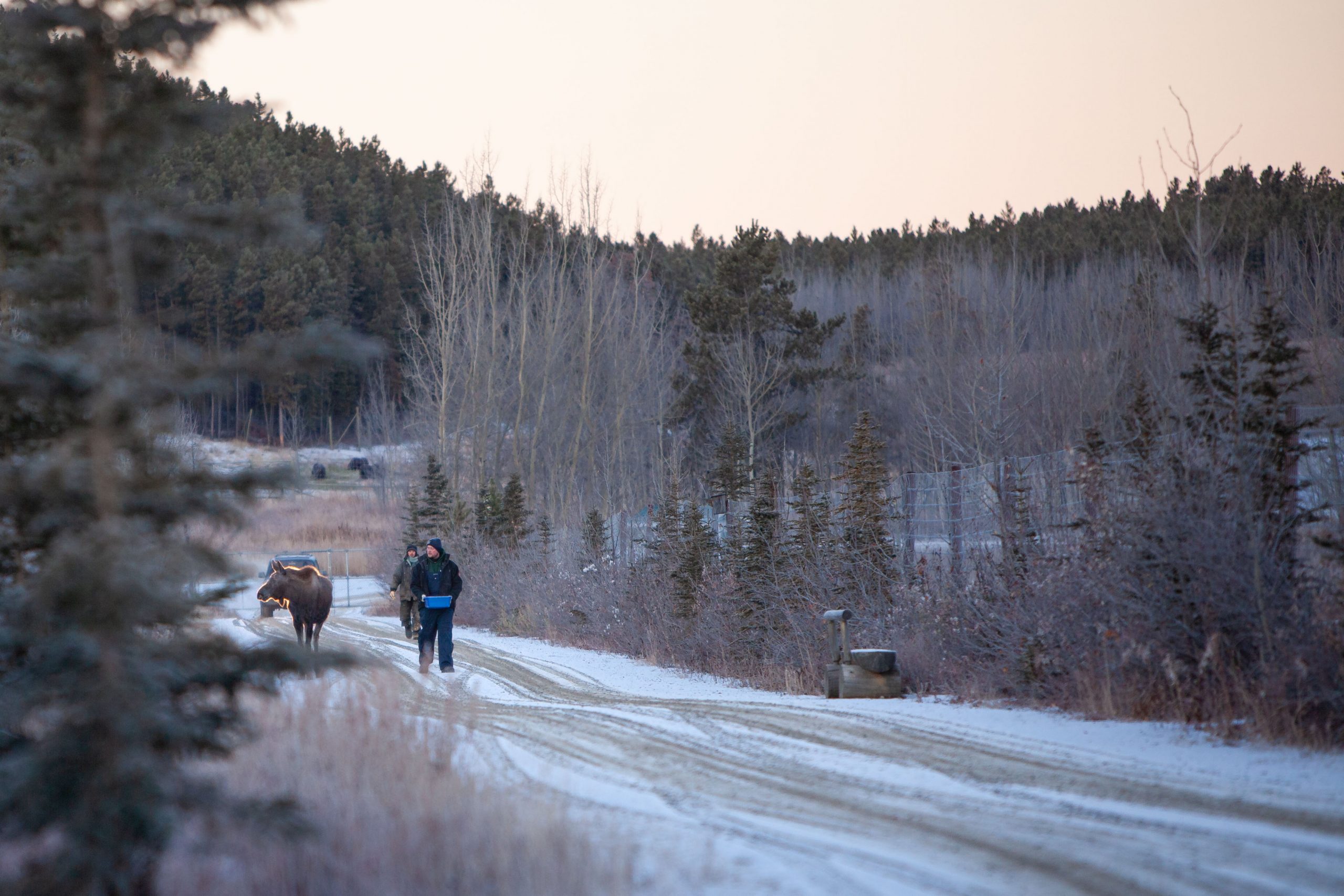
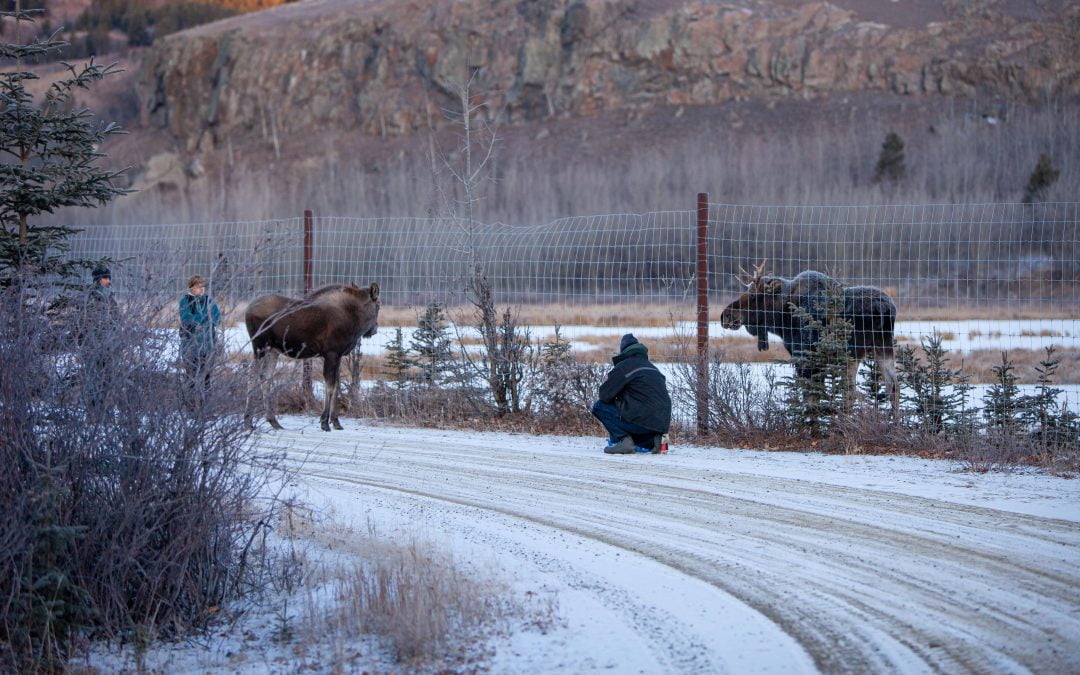
Early on Thursday morning (October 22), during those chilly hours before we are open to the public, the Animal Care team successfully moved the little male moose calf; walking from his temporary off-display habitat to the public viewing area near our other 4 moose.

Now you might be wondering how that happens, and safely. The wide roadways, snaking in a figure-8 through the Preserve are not only a means for you to explore the Preserve and its wildlife residents, they’re also the way in which we, using a series of gates and the fencing for each habitat, guide animals from one area to another.

This little male moose will spend time alone in this intermediate habitat (in between the 2 other males in the marsh habitat and the 2 females in the adjacent habitat) before being introduced in with the females.

He’s quite skittish, very cautious of new surroundings and people. While he remains in this secondary, temporary home a stand-off barrier is in place to ensure he feels he has enough space to be comfortable and explore his surroundings while reducing stress as he gets to know you, our visitors.

A trip down Memory Lane:  remember when this moose orphaned in July moved to his temporary off-display habitat?  And here’s the early October pre-A-Moosing Move update thanks to CBC Yukon!

Lindsay Caskenette

Lindsay Caskenette

Manager Visitor Services

Lindsay joined the Wildlife Preserve team March 2014. Originally from Ontario, she came to the Yukon in search of new adventures and new career challenges. Lindsay holds a degree in Environmental Studies with honours from Wilfrid Laurier University and brings with her a strong passion for sharing what nature, animals, and the environment can teach us.

867-456-7400
Lindsay@yukonwildlife.ca

Explore by Category

Explore by Author

Bald Eagle:  Right Carpal Infection

Bald Eagle: Right Carpal Infection

Bald Eagle: Right Carpal Infection

This story was originally published October 24, 2020 in the e-blast newsletter to Yukon Wildlife Preserve’s membership.

Are you a member but don’t receive these email Newsletters?  Contact us at info@yukonwildlife.ca to update your email preferences.

Banner Photo:  Dr. Maria Hallock and the Animal Care team weigh the bald eagle upon it’s arrival to Yukon Wildlife Preserve’s Rehabilitation Centre.  Credit:  L. Caskenette
On Tuesday October 20 a bald eagle arrived at our Rehabilitation Centre from Mayo via CO services. It’s common that we do not know the circumstances surrounding an animal’s injury, as is the case with this bald eagle. In cases like this, CO services are the link between animals in the wild, human concerns for their health and welfare, and Yukon Wildlife Preserve’s Rehabilitation Centre. CO Services and YG’s Animal Health Unit will respond and evaluate an appropriate course of action (which may include bringing it to YWP). While the YWP can accept injured wildlife, we do not have a field response team to conduct rescues.
The good news is that while this bald eagle is underweight at 2.6 kg he has a good appetite, is alert and fairly strong. X-rays performed at Yukon Wildlife Preserve show no fractures. The challenge faced by this bald eagle while in our Rehabilitation Centre will be in overcoming and healing an infection in his right carpal joint (that’s a bird’s wrist!), and some other abscesses that have been drained by Dr. Hallock. The eagle will be on antibiotics, and will remain inside to give the team the ability to monitor him closely. Follow up x-rays will be taken in a week to assess how the eagle is progressing and his health plan will be tailored based on the findings. It’s early days on the road to this eagle’s hopeful recovery. The Preserve now has 3 eagles within the Rehabilitation Centre (1 Golden Eagle and 2 Bald Eagles). While this can be abnormal for this time of year, we do know that animals encounter illness and injury year-round. To help keep Yukon Wild at Heart, consider a donation. If you encounter an animal that you feel needs help, be informed. A good first step is to check our website for Wildlife Emergency protocols and contacts.

The following update was originally published January 23, 2021 in the e-blast newsletter to Yukon Wildlife Preserve’s membership.

A Convocation of Eagles

Lindsay Caskenette & Julie Kerr

Lindsay Caskenette & Julie Kerr

Visitor Services Manager and Visitor Services Coordinator

Lindsay and Julie love to share the Preserve the same way they explore life – full on and full of adventure!  They have a collective love of:  Animals....Lindsay dogs, Julie foxes; Adventure.... Lindsay dog mushing, Julie extreme camping;  both take on animal personas during story telling.  Together they support the Preserve with a strong Visitor Services presence and often, they even get work done (this happens most often when the other one is out of the office).

 867-456-7400
 info@yukonwildlife.ca

Explore by Category

Explore by Author

Golden Eagle:  Scapular Fracture

Golden Eagle: Scapular Fracture

Golden Eagle: Scapular Fracture

This story was originally published August 8, 2020 in the e-blast newsletter to Yukon Wildlife Preserve’s membership.

Are you a member but don’t receive these email Newsletters?  Contact us at info@yukonwildlife.ca to update your email preferences.

Banner photo credit:  L. Caskenette

The golden eagle is a young one – it arrived on August 7th. Conservation Officers brought the eagle from Watson Lake to the Yukon Wildlife Preserve’s Wildlife Rehabilitation Centre.

Upon arrival the eagle weighed 2.3kg. It had a fracture to scapular (not much we can do just needs time to heal). With some rest time and observation the eagle was then moved to the large flight pen on August 11th. He weighed 2.6kg at that time. A healthy individual should weigh in around 4-5.5kg, while females are slightly larger and heavier.

This individual needs to gain some more weight to get stronger before it will attempt any flying. On Thursday, our Veterinarian, Dr. Maria Hallock weighed the eagle in at 3.25kg. Gaining 600g in the last two week is a positive sign of recovery. The eagle has been eating well – anywhere from 3-6 quail/day (each one weighing 200-250g). We will continue to monitor his weight and movement/behaviour. We expect to see him recover, fly and build up muscles to return to the wild, timing remains up to him!

The following update was originally published October 10, 2020 in the e-blast newsletter to Yukon Wildlife Preserve’s membership.

 What’s Up Yukon connected with us to get the latest story on the Golden Eagle that is in care at the Wildlife Rehabilitation Centre at the Preserve.  This eagle can be found working on his flight and recovering in the large outdoor aviary, as he overwinters with us at the Preserve!

The following update was originally published January 23, 2021 in the e-blast newsletter to Yukon Wildlife Preserve’s membership.

A Convocation of Eagles

Lindsay Caskenette

Lindsay Caskenette

Manager Visitor Services

Lindsay joined the Wildlife Preserve team March 2014. Originally from Ontario, she came to the Yukon in search of new adventures and new career challenges. Lindsay holds a degree in Environmental Studies with honours from Wilfrid Laurier University and brings with her a strong passion for sharing what nature, animals, and the environment can teach us.

867-456-7400
Lindsay@yukonwildlife.ca

Explore by Category

Explore by Author