

Pouncing Fox
human wildlife conflict
A red fox streaks by on a snowy November morning. I stop my activity, pivot and watch through the window. While I am inside and the fox is outside, it is so close to the window of my home that I know any movement on my part will translate to sound, making this wild animal aware of my presence: potentially altering the behaviour I hope to witness.
The fox runs through the snow in a straight line across my yard and suddenly stops. Its head rotates one way, then the other – placing the fox’s ears at slightly different distances and angles from the sound, helping pinpoint prey location. Sounds like the scurrying rustles of small mammals underneath the snow – mammals such as voles living in the subnivean space.
The fox stops moving completely. Yet it is not still. It vibrates, becoming a coiled bundle of energy as it readies itself and suddenly, in a giant leap it pounces! Straight up and out and then down, landing buried face first in the snow – to the depth of its ears.
The fox comes up from the snow and twists around, looking behind it – did the prey escape? I watch as the fox swivels and rotates its head, again, before quivering to the build up to leap in a POUNCE. It continues to come up, quickly looking one way, and then the other, as its prey evades capture.


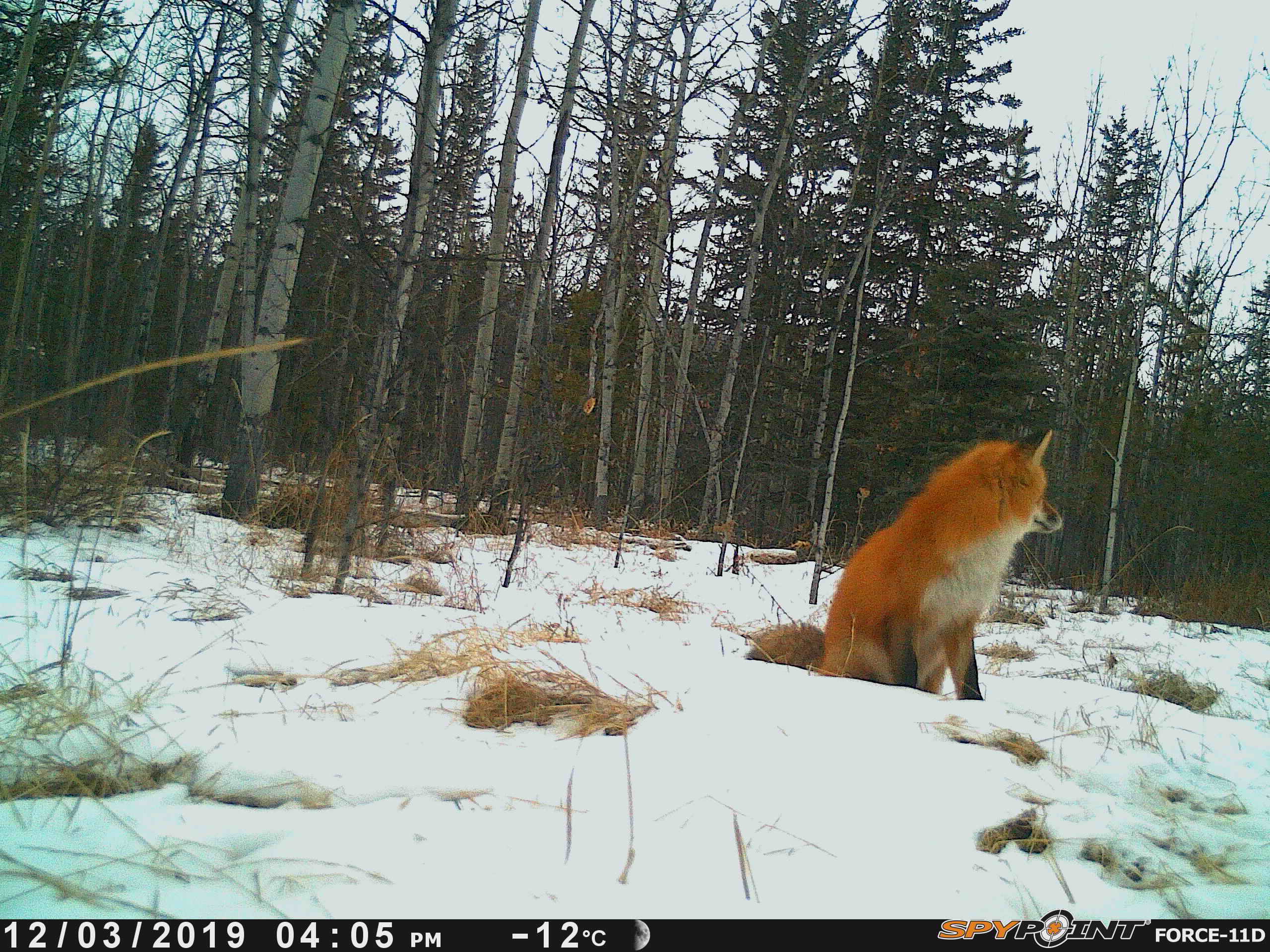
Trail cam photos from the author's yard shows the red fox running through the property, intently listening and even approaching the entrance to its den.
Small mammals living in the subnivean space – the layer between the snow cover and the ground, often have excellent hearing and a detailed knowledge of their extensive tunnel system under the snow, which allows fast escape reactions. In order to successfully hunt this prey, a red fox needs to minimize the sound it makes so as to not alert its prey – even if that prey lives under the snow. A fox can execute a silent, surprise attack by lunging from a still position, from some distance away.
These actions repeat for several minutes – each time the fox swivels its head to locate its prey, then stays extremely still while building its energy before leaping to POUNCE. Until the time that the fox has a vole in its mouth. Successful hunt!
Or is it? Now, I watch the red fox throw the vole in its mouth in to a snow bank with a flick of its head. I watch the fox hunt this vole again. And again…..this scenario happens several times – perhaps the vole is fighting back or perhaps the fox is playing or perhaps it is simply ensuring its meal is unable to escape.
Finally, the red fox runs through my yard, with its meal in its mouth and I think I’ll watch it consume well-needed winter calories. Yet, the red fox has one more surprise in store for me. I watch it search several locations, before choosing one to its liking, and it buries the vole under the snow, using its muzzle to dig down, deposits its prey, and then covers the cache tidily with snow. Satisfied with its caching, the red fox trots out of my yard, knowing it has secured food for the future.
What a treasure to witness such unguarded and natural behaviour; although I confess I do wonder – are there many similar caches buried in my yard?

Julie Kerr
Visitor Services Coordinator
Julie is a Registered Veterinary Technologist, living and working in Whitehorse since 2012. She joined the team in May 2018. She is passionate about wildlife, nature and living in a conscious manner with both. Her free time is spent outdoors observing wild animals and ecosystems; her connection to the natural world around her brings great joy – joy she loves to share with anyone interested. Honestly? Work and life blend rather seamlessly.


Recent Comments