Wandering Wood Bison

Wandering Wood Bison

northern animals

by Sarah Stuecker | Apr 28, 2020

7 minute read - "Winter Is Here" series continues with the true behemoth of the north - Wood Bison! 

At first glance, the Wood Bison (Bison bison athabascae) seems to be ill-suited to live in the far North.  Especially when we think about its Southern cousin, the Plains Bison (Bison bison bison), which historically has made its home on the rolling hills and endless grasslands of the prairies.  It seems fairly safe to assume that compared to the prairies, it is a completely different game of horns to survive the winter in the Yukon.  Extended periods of extreme cold, a short growing season - hence relatively scarce food sources, combined with unforgiving, mountainous and swampy terrain pose a different set of challenges.  Yet bison are thriving - how do they do it?  Through a series of adaptations in structure, behaviour and physiology, we will see that Wood Bison are in fact quite at home in the far North.
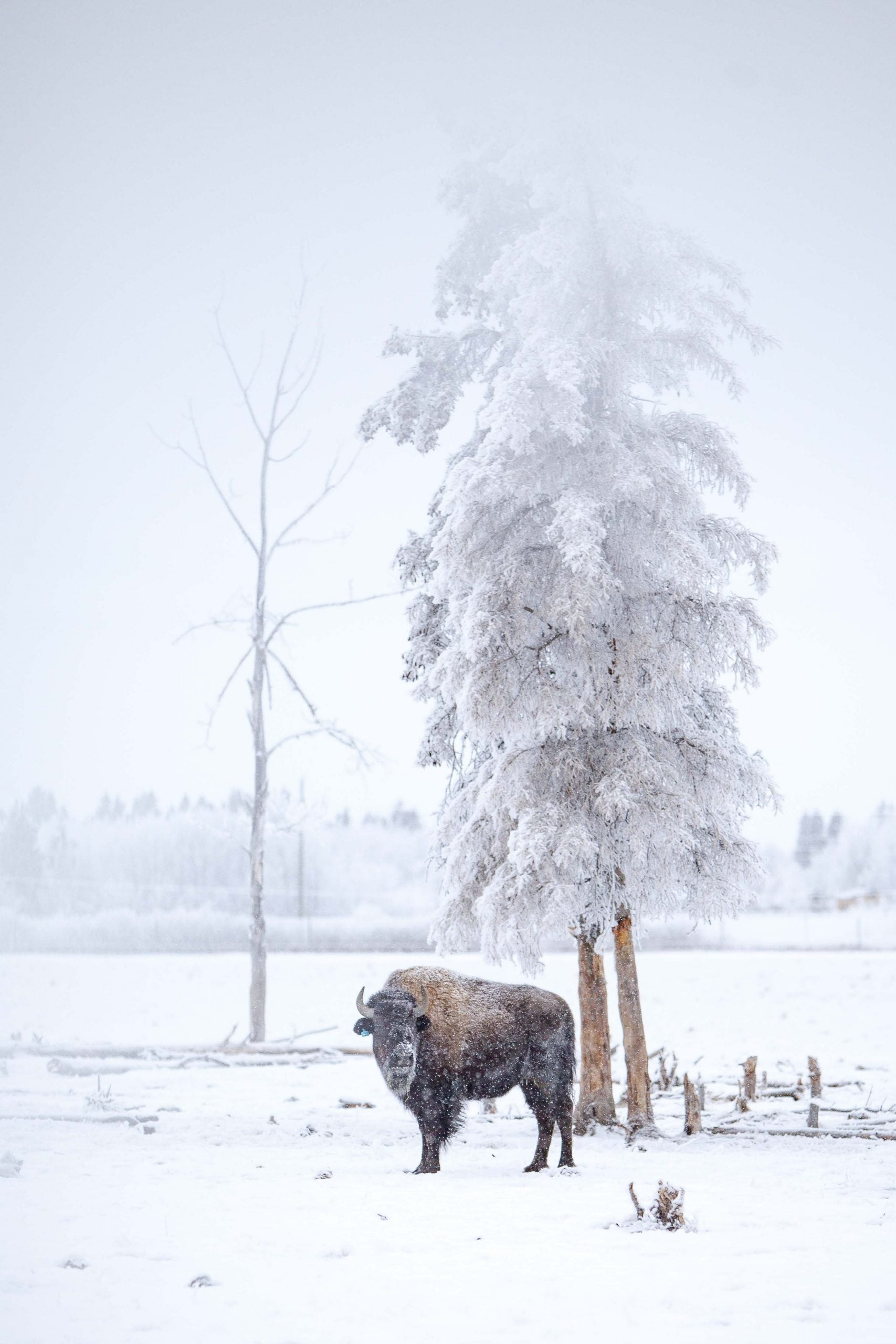
The Wood Bison is a giant:  the largest living land mammal in North America.  Males can weigh up to 2000 pounds, which is up to 30% larger than its Southern relative; * roughly *  the difference between a SmartCar and a VW Golf.  In colder climates it actually pays to be bigger! Larger individuals (which have a smaller surface area-to-volume ratio) are better at retaining heat. This rule of nature is known as Bergmanns Rule. A pattern, where species tend to be larger in colder climates than similar species of the same genus living in warm climates, is certainly not law - not all species of nature comply with it.  Yet, bison do, and living large in a cold climate means the more fat you can store to help you get through winter. 1[Read more about the complexity of nature pertaining to Bergmanns Rule

Two Wood Bison bulls at the Yukon Wildlife Preserve. Take note of the large shoulder hump and the massive head and broad face. 

Beyond size, additional adaptations assure the success of Wood Bison including a very thick and woolly winter coat. This extremely dense coat of durable hair is so warm, combined with that retained body heat, and incredibly thick skin, falling snow that accumulates on its coat does not melt, thus keeping them dry and warm. 
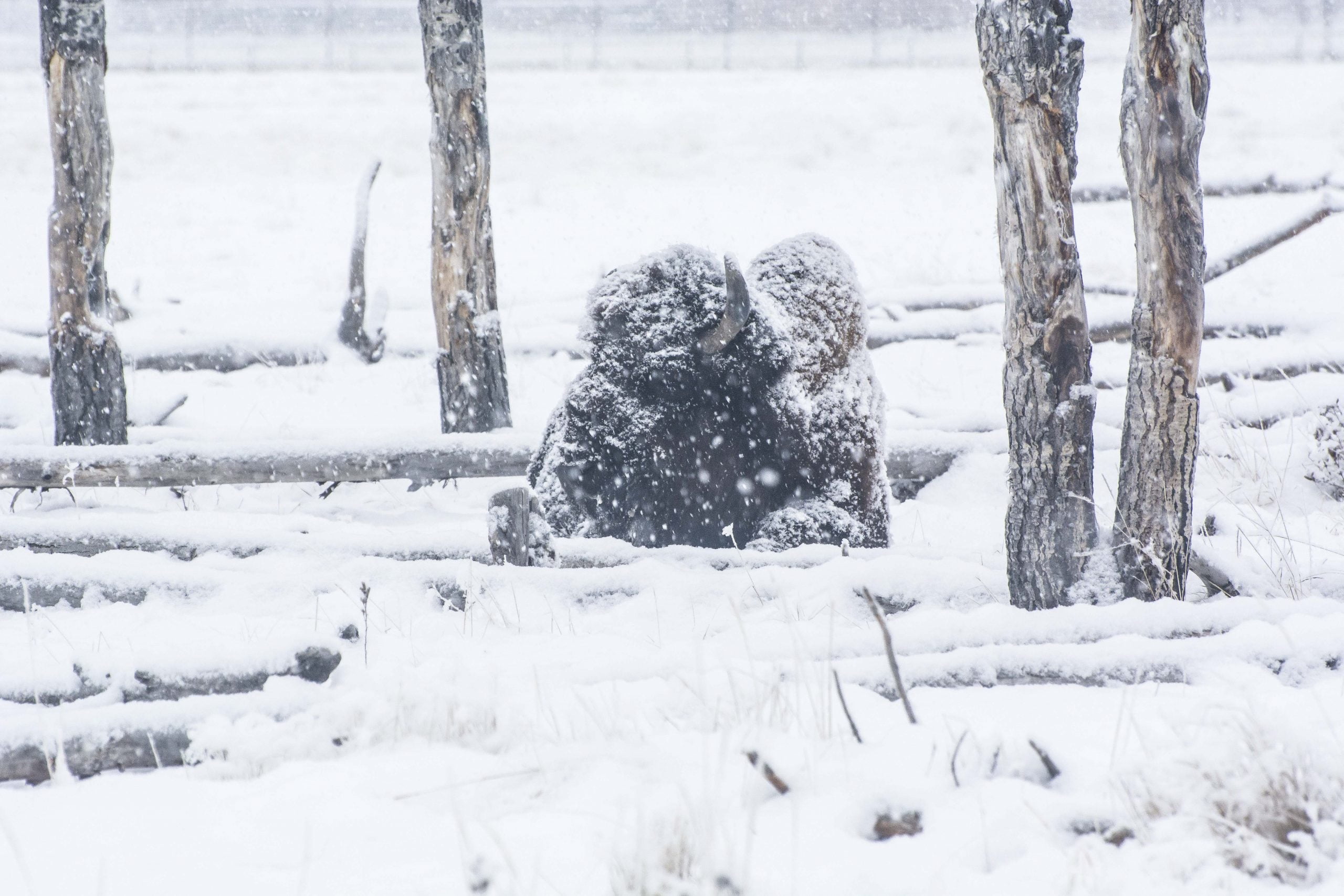
Foraging for food in the winter is a challenge - summer vegetation is buried in deep snow and is of low nutritional value. Wood Bison “dig” for food by swinging their large, heavy heads. Within that big hump on their shoulders are long spines on the vertebrae, muscles and ligaments which support large neck muscles and the head. Now you know – that big odd hump on their shoulders is not just fat – it is a vital tool for their survival.

To manage decreased food availability and quality bison cannot just simply eat more food, more often, to sustain itself. As an ancillary adaptation, and most fascinatingly, Wood Bison are able to slow their metabolism during winter as a way to conserve energy. Just like cows, grass is a bison's staple food in the wild but it does not contain many nutrients in the winter. By slowing down their metabolism it also slows down digestion, thus the food is kept longer in the intestinal tract which allows them to draw more energy out of one feeding. Rather than putting out critical energy by digging through snow (with their giant head!) and foraging for food, they can instead conserve energy by slowing their metabolism and getting more available nutrition from one feeding. This slowed digestion is doing double duty for the bison. As they are able to squeeze every bit of nutrients from a feeding this anatomical process is also producing valuable internal body heat.

In the Yukon landscape, Bison have been roaming for millennia; first as the Steppe Bison, predecessor to the Wood Bison.  Due to a number of reasons however, they became extirpated in their Yukon homerange in the early 1900’s.  It is believed it may have been a combination of habitat loss due to climate change, disease and human predation.  In the 1980’s, the Yukon Government joined the National Wood-Bison Recovery Program and re-introduced a herd of about 170 bison.  Since then, Yukon’s wild Bison have re-adapted to life in the North - quite well too! Making best use of their terrain, they seek shelter in treed valleys when the weather gets nasty.  Interestingly, they can also be found on alpine plateaus up to 5000ft.  High altitude meadows are exposed to wind, which reduces the snow cover and allows the bison to find the underlying grass more easily. Typically good habitat for bison; however when winter weather patterns swing it can add additional challenges to these food driven behemoths. A sudden warming in the winter of 2018 caused peril for a few of these wandering bison.  2An odd case of bison death in the Yukon

Consciously or not, wood bison may make use of a weather phenomenon that sometimes occurs when temperatures drop:  the inversion layer. Under some conditions, a layer of cold dense air accumulates in the valleys and without wind, may stay there for days.  Meanwhile, on the mountain tops the air can be up to 20C degrees warmer - well worth undertaking the climb.  One could argue, with all science put aside and simply as the Kings and Queens of living large, they might like to hang out on top of their kingdom.  If this was me living out there, that’s what I would do!

These mighty large creatures might seem fairly sedentary but their numbers have grown strong and steadily since re-introduction. They have proven their adaptability to varying habitat; moving among forested stands and meadows, alongside caribou and moose, to wandering hill-side, among mountain sheep. They are a formidable ungulate, and one of the most, among the prey animals in the Yukon. Their massive size and mass consumption of greens is not to be mistaken for sluggish or unresponsive carriage. Wood Bison are intelligent animals that are quick on their feet when needed. Their ability to outrun predators such as wolves or humans is unprecedented. These monumental animals could quickly leave you in the snow-dust as they purposefully trek their northern landscape in order to thrive.

Sarah Stuecker

Sarah Stuecker

Wildlife Interpreter

As a wilderness guide, Sarah has spent many days out in the bush over the years. Sitting out there glued to the scope is just as fascinating to her as observing and following animal tracks in the depth of winter, trying to draw conclusions of what this particular critter might have been up to. Sarah is passionately sharing her stories as part of our team of wildlife interpreters. 


867-456-7300
 info@yukonwildlife.ca

Explore by Category

Explore by Author

Bull On Encounter!

Bull On Encounter!

northern animals

by Bree Parker | Mar 30, 2020

Right place right time! Animal Care Assistant, Bree Parker spends day after day diligently supporting our veterinarian Dr. Maria Hallock in caring for, feeding and ensuring the well-being of our collection of wildlife residents. 

Equally as important and valuable as literally providing food for the animals also is observing the animals. Observation is a critical part of our animal care process. This is when staff ensure an individual animal's behaviour is normal. Observing them eating, moving and interacting helps us know that animal is content and full-filling life needs. Signs something is off can include: the animal has a limp; they are not coming to the feed stations and eating; or, they are not socializing in a typical  herd group. These observations could indicate that there might be an ailment to the individual that deserves closer observation or possibly even intervention. However, sometimes this observation can be quite enlightening, it can catch incredible moments of animal encounters and wild behaviours we strive for our individuals to be able to fulfill.  

We've been waiting for the young bull to drop his antler for months now. . .

Bree starting filming this interaction simply because she thought it was fascinating and humorous to see the younger bull (on the left) asserting dominance with another bull, an older bull, with no antlers. Then everything got pretty exciting, pretty quickly!  "We've been waiting for the younger bull to drop his antlers for months now. The older bulls lost theirs in December" said Bree.

This is typical to have individuals vary on antler shed timing, especially between different aged individuals related to sexual maturity. Over the next several months both these individuals, along with all our antler-bearing cervid's (like moose, elk and mule deer) will be re-growing their antlers in preparation for fall. Alas, as another rut season comes and goes, so too will their antlers!

Bree Parker

Bree Parker

Animal Care Assistant

All animal lover to her very core! Bree has had a menagerie of pets over the years, including mice, crayfish and a hedgehog. After completing her Environmental Technician diploma at Seneca College, she realized her true calling was with animals, sending her back to Ontario this coming fall for University of Guelph Ridgetown Campus’s Veterinary Technology program. Bree is always eager to learn new facts about the animals at the Preserve that she can share with visitors.

Explore by Category

Explore by Author

Roam and Reign – “Winter is Here” Caribou Edition

Roam and Reign – “Winter is Here” Caribou Edition

northern animals

by Sarah Stuecker | Mar 20, 2020

6 minute read – “Winter Is Here” series begins with the "king of the tundra" – Caribou!

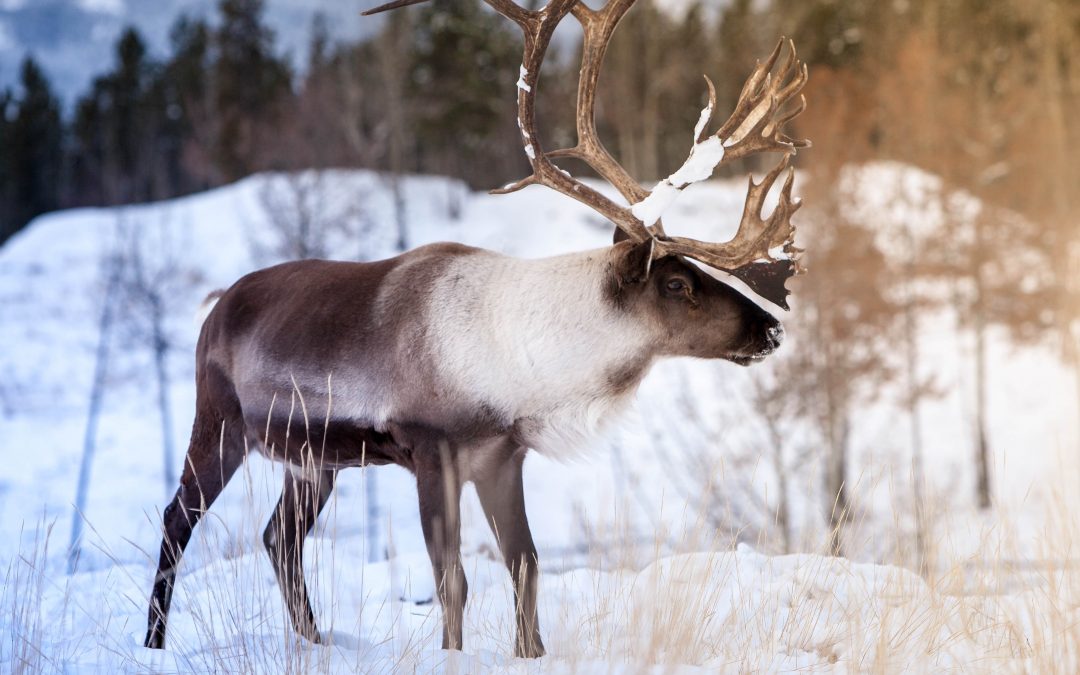
Here comes the king of the tundra. Being one of the few animals escaping the mass extinction of species after the last ice age, caribou are royally adapted to life in the North, which happens to be predominantly winter season! In the wild, they live all across the circumpolar region, including Europe and Russia, where they are called Reindeer. Both Caribou and Reindeer are the same species, only the Reindeer is generally a bit smaller and most herds on the Eurasian continent are actually domesticated. The Wildlife Preserve is home to a group of the Boreal Woodland Caribou, the largest representative of its kind. 


Compared to their body size, Caribou have relatively large, split-hooves which they can spread the toes out wide. This enables them to distribute their weight onto a larger surface and walk across snow, ice and sort-of-frozen swamps more efficiently. Their hooves also harden up in the winter and become overgrown by hair. The hair insulates the live, fleshy inside part of the hoof from the cold and the hardened horn on the outside helps them to paw through the snow cover to get to their food. 

Like most arctic animals, their posture is stocky and compact, in order not to lose too much body heat. A crucial addition to body shape is their coat. Like most dogs, caribou have a double coat with a softer underlayer and a coarse outer layer. This prevents heat loss but also from getting wet when they lie in the snow for example. Hairs of the outer coat are hollow, which offers further insulation. 

Even their noses are designed for the cold – the inner bones are shaped to increase the surface area inside the nostrils so when they breathe in the cold air, it has more time to warm up within the body before reaching the lungs. And on the way out, the air is cooled down on the way and most of the body heat is retained before breathing it out. Have you ever noticed steam coming out of a caribou’s nostrils? Neither have we and that’s why. 


Caribou and reindeer follow ancient migration routes throughout the seasons. Some just change a mountain range to get to their winter food supply and spring calving grounds, others travel over hundreds of miles to get to a different habitat. Their roaming is also believed to have evolved following environmental conditions. Compared to the storm-beaten, treeless tundra, the boreal taiga forest offers better shelter and easier access to food due to thinner snow cover. 

In the wild, the Caribou’s main diet is an algae-like organism called lichen. It grows on rocks and on specific soil conditions such as the wide pine tree stands of the boreal forest. The animal reaches its food by pawing away the snow on top of it with their hooves or scratching it away with their antlers, sometimes even pushing through thin ice layers. As well adapted as caribou have become over millennia, the – in evolutionary terms – recent climate change poses entirely new challenges. Temperatures don’t always remain below freezing all winter. There are so-called warm spells, where snow on the ground melts and re-freezes as a thick, impenetrable layer of ice once temperatures drop again. This can – and has been – detrimental to the survival of the caribou. While their technique with hooves and antlers works well in the fluffy, powder-like snow that falls in dry northern climates, intermediate melting of the snow cover, increased humidity from lack of sea ice and in some cases even freezing rain – make it impossible for caribou to punch through the thick layer of ice in order to get to their food. In 2016, tens of thousands of reindeer died of starvation during exceptional weather conditions. 

Caribou at the Preserve fare quite well even in those exceptional weather conditions. Staff monitor and feed animals daily. In the summer the individuals are able to bulk-up on plenty of high nutrient foods.  It's important that wild caribou populations have good summer food sources to consume for both the success of their offspring and ultimately their species! Protecting these special places so caribou can thrive has been an on-going effort in the territory and beyond. In the territory and specific to woodland caribou the rebounding Southern Lakes Caribou sub-population has been a long but successful story by many . We have been able to expand our learning and understanding to these animals' needs, movements and adaptations in a ever changing world.  

Sarah Stuecker

Sarah Stuecker

Wildlife Interpreter

As a wilderness guide, Sarah has spent many days out in the bush over the years. Sitting out there glued to the scope is just as fascinating to her as observing and following animal tracks in the depth of winter, trying to draw conclusions of what this particular critter might have been up to. Sarah is passionately sharing her stories as part of our team of wildlife interpreters. 
 

867-456-7300
 info@yukonwildlife.ca

Explore by Category

Explore by Author