Old Crow Bald Eagle

Old Crow Bald Eagle

wildlife preserve

by Lindsay Caskenette | Jun 12, 2024

1 minute read - 

In the remote, fly-in community of Old Crow, on the Traditional Territories of Vuntut Gwitchin First Nations a juvenile bald eagle was found by Robert, at the dump, flightless and injured. The eagle was coaxed into a crate and eventually brought to the Yukon Wildlife Preserve after it made a stop in Dawson and caught a flight via Air North.  
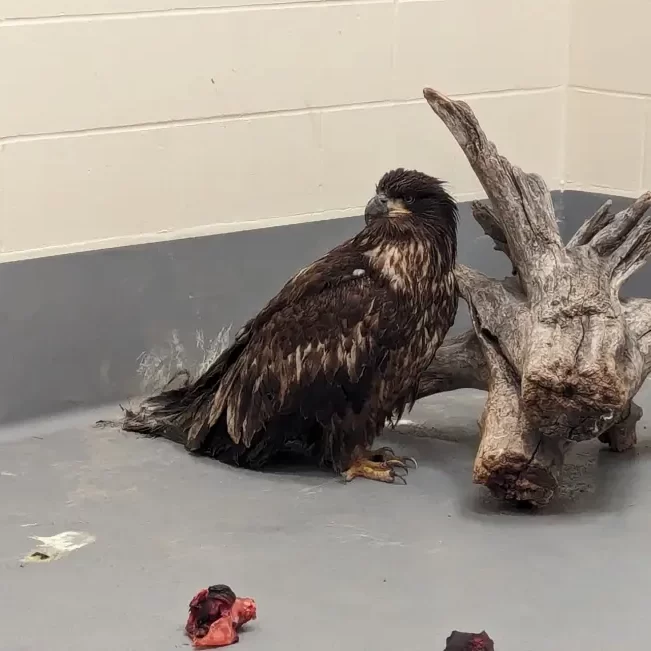
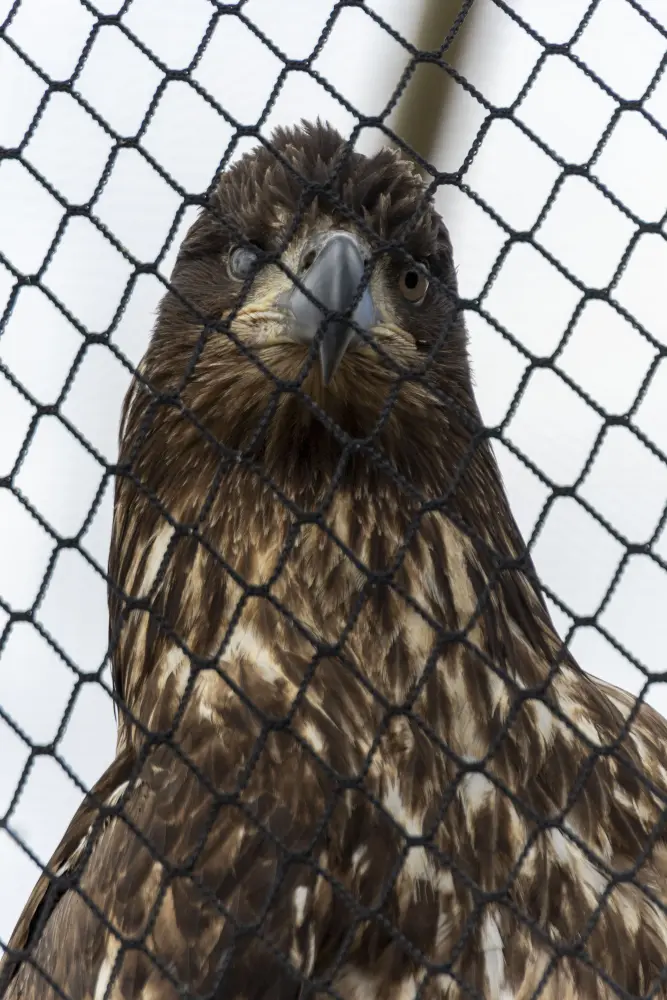
Old crow bald eagle upon arrival and admittance into the Wildlife Rehabilitation Centre at the Preserve. May 10th. Photo credit L.Caskenette

The bald eagle, thak tth'ak came to the Preserve's Wildlife Rehabilitation Centre on May 10th underweight (4.3kg) and with a OD (medical term for right eye) chronic corneal ulcer. 

mature bald eagle in rehabilitation

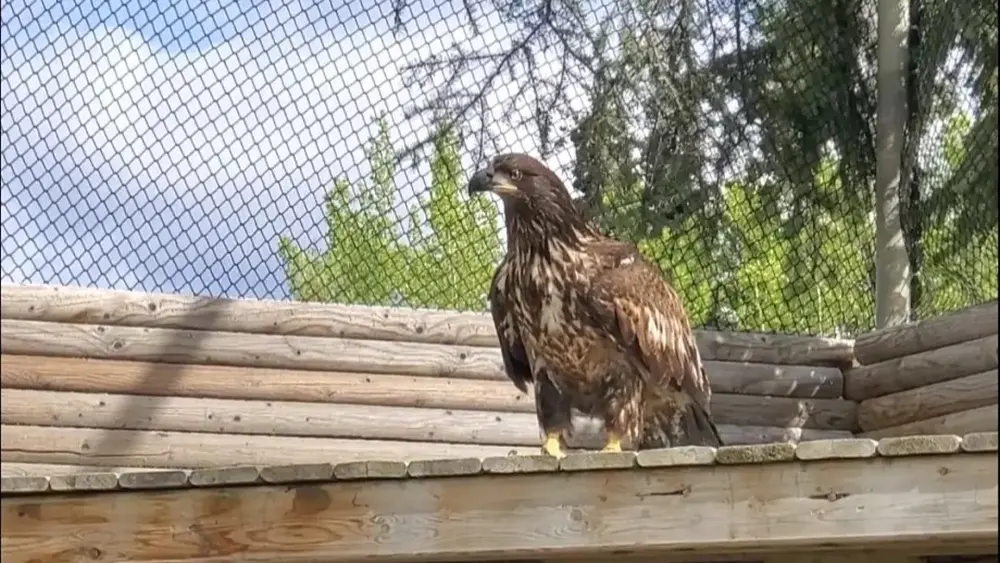
Likely a she, given the large size of the animal. She has gained sufficient weight, coming in at 4.83kg. She has been viewable in the aviary as she works to build up flight muscles. Now she is ready for her public release back to the wild this Friday. She has a cloudy eye but has been successful catching live food and as a predominantly scavenging animal she is likely to do quite alright back in the wild even with this limitation.
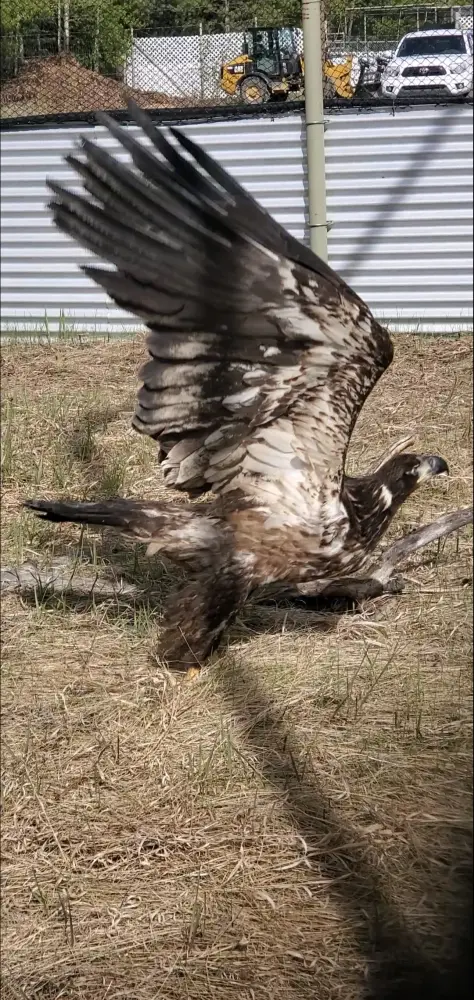
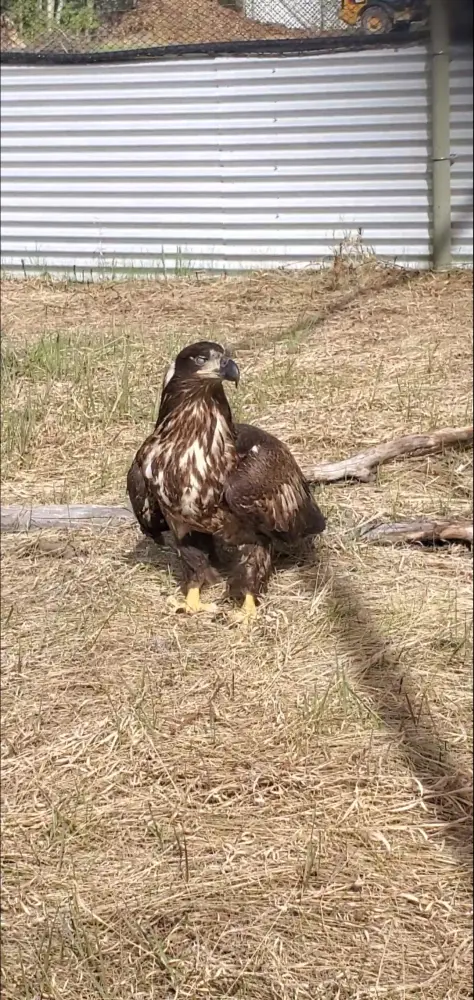
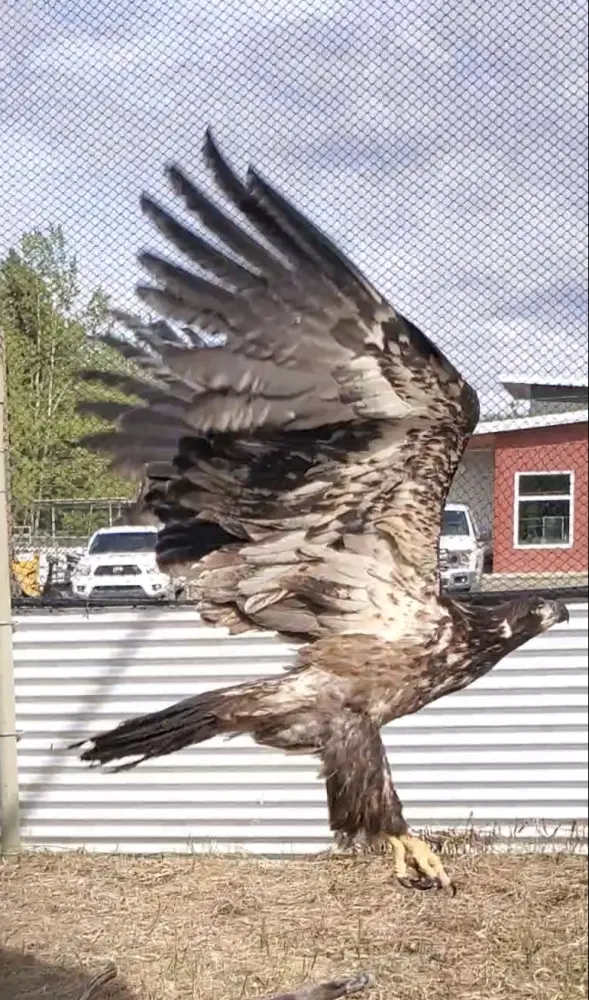
She will not be returned to Old Crow due to the long travel and stress concerns related to transfer. Instead, she was released outside of Whitehorse on Friday June 14th at 7pm. 

Around 40 people joined the event to send off the bird. Thank you to everyone who joined the release, it was a perfect evening. The sky welcomed us all without a drop of rain. Thank you to all who provided good vibes and sent off the eagle with strength and grace.

Thank you to Wylie, Corrine, and Thay K'i Anint'l for the prayer and blessing for this bird's return to the wild and resilience for a long eagle life. 

Thank you to everyone who helped this Eagle along its path to recovery. To Robert K who found the bird and ensured it got a second chance at life. To Norma, to the team at the Preserve that helped with the bird release event. To Air North for giving the bird some helping wings South to the Rehabiliation Centre.  Thank you, Masshi, Gunalchîsh????

She took her time deciding to soar but this allowed everyone to share in more details of her story, to practice patience and to grow our appreciation of her and others' incredible story of resilience. 

• • •

The beginning of June the Preserve welcomed a visitor who had, and later shared with us, an extraordinary experience with the eagle while it was recovering in the aviary. 

She shared with us the following:

I felt a very special spirit from her. A very conscious and intelligent bird.
I heard she didn't have a name. 
Horus came to mind for me because of her eyes and her mystical spirit.
"Horus, in ancient Egyptian religion, a god in the form of a falcon whose right eye was the sun or morning star, representing power and quintessence, and whose left eye was the moon or evening star, representing healing."
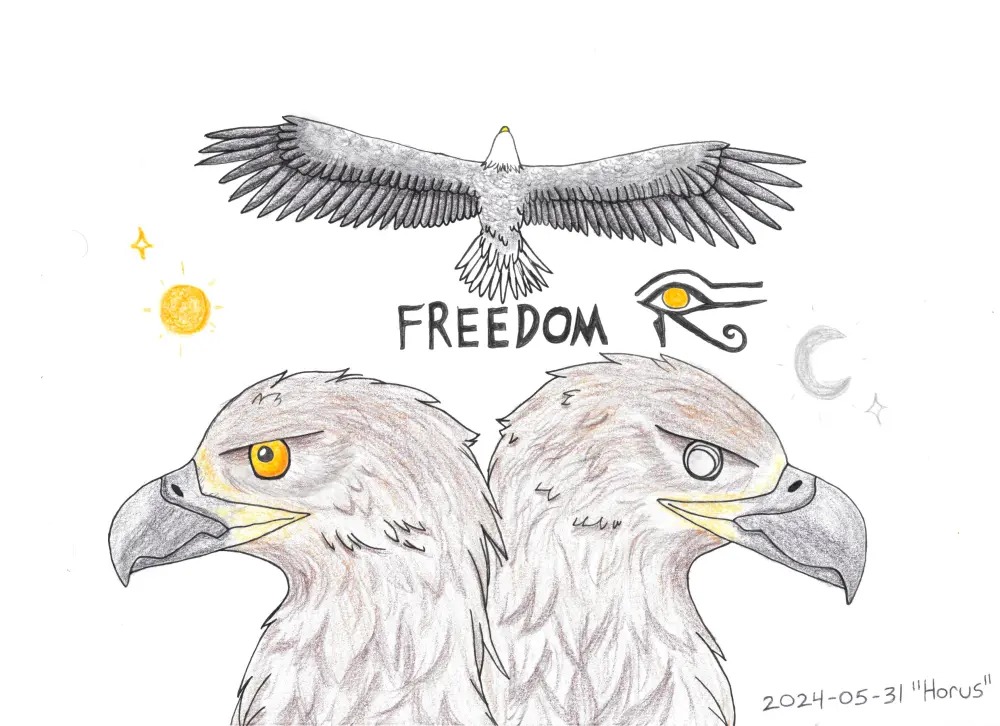
"Horus, in ancient Egyptian religion, a god in the form of a falcon whose right eye was the sun or morning star, representing power and quintessence, and whose left eye was the moon or evening star, representing healing." The old crow bald eagle was given and unofficial name by a visitor, Jasmine Colomby who also drew and shared this interpretation.

Help us get them back on their wings. We could use your help. If you are able to support the care of these two animals, please consider donating. Every contribution makes a difference and as a non-profit charitable organization, you can receive a charitable tax receipt for your support. 

Photo credit: B.Forsythe
Britt Forsythe

Britt Forsythe

Visitor Services Coordinator

Brittney joined the Wildlife preserve in the summer of 2023. Growing up on Northern Vancouver Island, surrounded by the temperate rainforest, nature and animals have always been a part of her life. It exploded into a passion, when she started her dog walking business in 2017 and she began spending 6-7 days a week in the forest, rain or shine! This sparked an even deeper appreciation for the cyclical nature of the land and how all of the plants & animals work together symbiotically. She is forever ‘that girl’ on the hike, pointing out different rocks and plants, explaining their origin or what they could be used for medicinally. Brittney and her dog Cedar relocated to the Yukon to help care for 31 sled dogs. She is so excited to expand her local knowledge as a part of the Preserve team.

 867-456-7400

 brittney@yukonwildlife.ca
 

Lindsay Caskenette

Lindsay Caskenette

Manager Visitor Services

Lindsay joined the Wildlife Preserve team March 2014. Originally from Ontario, she came to the Yukon in search of new adventures and new career challenges. Lindsay holds a degree in Environmental Studies with honours from Wilfrid Laurier University and brings with her a strong passion for sharing what nature, animals, and the environment can teach us.

867-456-7400
Lindsay@yukonwildlife.ca

Explore by Category

Explore by Author

How are Animals Named?

How are Animals Named?

wildlife preserve

Nov 22, 2023

11 min read -

Throughout history, various languages and cultures have contributed to a wide - and often confusing - vocabulary used to describe animals' genders, the young stages of their lives and what they may be called when they are gathered together in groups.

Mule deer:
Males are called bucks. Females are called does & young are fawns.
A group of deer are often called a herd but more fun versions include a bevy, a bunch, a rangale or a parcel
- though a parcel is often in reference to a group of young deer.

Historically, adjectives were the labels of choice to communicate animal gender identifiers. A broad selection of these labels has resulted - which are not universally applied, even within the same species. For example: in the deer family or Cervidae, males are identified as bucks and females are called does. In moose, and caribou - also members of the Cervidae family - males are called bulls and females are called cows while elk males are referred to as stags.

Cervids
From left to right - moose, caribou and Elk.
Males are called bulls (elk are called stags) and females are called cows.

Generally these cervids in groupings would be called herds (though moose are not actually herd animals) while elk can be also called a gang - watch out!

Not limited to just fur-bearing creatures, these titles are applied to other species and there are often departures from the naming conventions used. Rabbits are called bucks and does while steelhead trout males are called bucks, with females being called hens rather than does.

There is also a vast difference in the scientific naming of all creatures. Over the centuries a number of early scientists attempted to establish a format to classify animal groups. Ancient Chinese created the first recorded reference in 2700 BC, but it was quite limited and focused primarily on flora (vegetation) of their geographic region. 

Check out our Facebook post to learn more about Vulpes vulpes; not all red foxes are created equally but all are a red fox!

  1. Remember Fox and the Hound? A male is called a tod (sometimes a reynard or a dog), while females are referred to as vixens.
  2. Young are most commonly called kits but can also go by cubs, or pups.
  3. The collective noun to describe a group of foxes are a skulk, earth or a leash! These names are related to fox behaviour corresponding respectively as a group hunting together, a mama fox with her kits, and a group of domesticated or captive foxes as a leash.

Now, there are other foxes including Arctic fox (Vulpes lagopus), swift fox (Vulpes velox), fennec fox (Vulpes zerda), and others across the world for a total of 12 species that comprise the largest genus, Vulpes.

Smaller classifications exist within the genus Urocyon which include the gray fox. The only extant species of fox belonging to the Otocyon genus is that of the bat-eared fox found in the African savanna.

Ancient Greek philosopher and scientist Aristotle described a large number of natural groups, and although he ranked them from simple to complex, his order was not an evolutionary one. He was far ahead of his time in separating invertebrate animals into different groups and was aware that whales, dolphins, and porpoises had mammalian characters and were not fish. The Aristotelian method dominated classification for many centuries. During this period, it provided a procedure for attempting to define living things through careful analysis, it neglected the variations between living things.

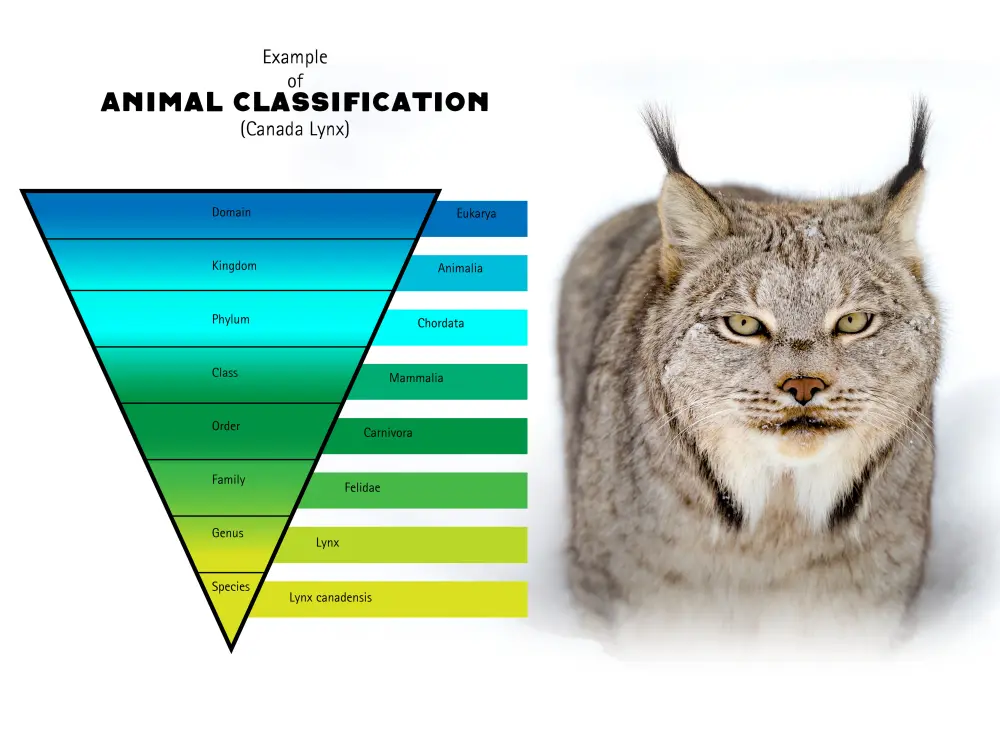
In 1758 Carolus Linnaeus, who is usually regarded as the founder of modern taxonomy and whose books are considered the beginning of modern botanical and zoological nomenclature, drew up rules for assigning names to plants and animals. He was the first to use binomial nomenclature consistently. Although he introduced the standard hierarchy of class, order, family, genus, and species, his main success in his own day was providing workable keys, making it possible to identify plants and animals from his cataloging. Linnaeus was the father of the Field Guide.

Lynx classification

Over the centuries a number of paleontologists, biologists, and scientists contributed to refining Taxonomy as we know it today. Perhaps the most notable of these was Charles Darwin - who explained his theory of evolution by describing how animals changed over time, yet still remained within specific categories in taxonomy.

Below is a table defining each classification of steppe Bison, the 15,000-year-old ancestor of today’s wood bison. As you can see, their classifications are not much different, other than identifying wood bison as a sub-species.

While their scientific classifications are very similar, the animals themselves were quite different. Steppe bison persisted through the great extinction of the last Ice Age up until about 5,400 years ago. A relatively recent find in Whitehorse city limits proves steppe bison persisted giving rise to the bison seen in the Yukon today but are not the direct descendants of the steppe bison.

Darwin’s famous illustration The Tree of Life displays the evolutionary relationships between species. This idea caused a great deal of controversy when he concluded that mankind evolved from the apes which was contrary to the religious teachings of the day.

Muskox and bison - both species are members of the Bovidea family. In this family, males are called bulls and females are called cows. The young are called calves and groups of both species are referred to as "herds". But that is where the line is drawn for their nomenclatures. The Inuit name for muskox is "omingmak," which means "the animal with the skin like a beard." Geographically, today's populations of muskox and bison do not overlap and their adaptions to winter survival as a result are very different.

We can see from this phylogenetic tree how bovids (horn bearing) and cervids (antler bearing) are related to each other. The animals with icons represent those species at the Yukon Wildlife Preserve. The Yukon has 9 of the 11 ungulates of North America, excluding the bighorn sheep and pronghorn antelope. What's also interesting to note is that mountain goats are their own genus and muskox are more closely related to sheep and goats than they are bison!

When we dive into the scientific name we can see how the classifications carry over. For instance muskox, Ovibos, share genus naming from sheep and cow. Caribou or Rangifer tarandus is reindeer in Latin, from the Greek tárandos, also meaning reindeer. So when someone asks you the difference between caribou and reindeer, you can say, nothing! (Except, reindeer fly!)

Classification tree for ungulates bovid and cervid

(Note: this a general phylogenetic tree; it is not complete and does not represent accurate branch length for amount of genetic change and complexities of sub-taxa).

Beyond the labels used for animal species, their offspring also suffer from a variety of descriptors to classify their young age. There are calves, fawns, foals, pups, cubs, kittens, chicks, hatchlings, fry and owlets to name a few. Yes, there is a lot to remember, but with practice you can master the various names used to identify animal difference.

These descriptor variations also extend to the words used to describe a group of an individual species. There are herds, colonies, congresses, tribes, swarms, flocks, droves, clutches, packs, murders, litters, pods, braces, convocations, gangs, schools, hordes, gaggles, bands, and numerous other words used to describe a group of same-species creatures. There are even names given to groupings of animals that are, in fact, unlikely to group together given their territorial and/or solitary nature - like owls, moose or wolverines.

Even within a class of animals like birds, its a complex web of classification and further to each species' grouping names.

Birds:

  • In general - Flock
  • Eagle - convocation
  • Falcon - cast
  • Owl - parliament, stare or wisdom
  • Swallows - flight, gulp
  • Swans - bevy, wedge
  • Ptarmigans - covey
  • Ravens - unkindness, rave, conspiracy
  • Magpies - tiding, mischief
  • Grouse - pack, covey
  • Crane - sedge
  • Ducks - raft in water and skein when flying
    • mallards on the ground can be called a sord
  • Geese - gaggle
  • Loons - asylum


Other mammals:

  • Squirrel - scurry
  • Wild canids, dogs - pack
  • Goats - tribe
  • Otters - romp
  • Porcupines - prickle
  • Voles - colony
  • Wolverines - mob
  • Martens - richness

Invertebrates:

  • Bees - grist, hive or swarm
  • Caterpillars - army
  • Flies - business

Amphibians (no reptiles in the Yukon):

  • Frogs - army
  • Toads - knot

Fish:

  • Trout - school
  • Salmon - bind, draught or run

It's an interesting read to understand the many different words used to describe an animal’s gender, how they are identified when they are youngsters and in groups together. Of course, the list above is centered on animals that make their home in the Yukon - imagine some of the animals that live in your neck of the woods, or places you've travelled to, and what those animals' naming classifications may be.

What is more, the naming of animal's as described by history must also recognize that many of these species, (beyond the few mentioned like Wapati and Omingnak), also hold Traditional and First Nation naming of animals that are descriptive, communicating the animals' place, use or spiritual significance.

Do you have any interesting or favourite animal classification terms/names? Share them with us in the comment section below!

Doug Caldwell

Doug Caldwell

Wildlife Interpreter

Doug is one of the Interpretive Wildlife Guides here at the Preserve. An avid angler and hunter he has a broad knowledge of Yukon’s wilderness and the creatures that live here. With a focus on the young visitors to the Preserve, Doug takes the extra time to help our guests to better appreciate the many wonders of the animal kingdom here in the Yukon.

Lindsay Caskenette

Lindsay Caskenette

Manager Visitor Services

Lindsay joined the Wildlife Preserve team March 2014. Originally from Ontario, she came to the Yukon in search of new adventures and new career challenges. Lindsay holds a degree in Environmental Studies with honours from Wilfrid Laurier University and brings with her a strong passion for sharing what nature, animals, and the environment can teach us.

867-456-7400
Lindsay@yukonwildlife.ca

Explore by Category

Explore by Author

Bison vs. Muskox

Bison vs. Muskox

wildlife preserve

by Lindsay Caskenette | Nov 15, 2023

2 minute read - 

Bison versus muskox! What's the same? What's different? Who is more cool? Top 5 reasons muskox and bison are NOT the same animal, at all.

One of the first animals visitors see when they explore the Preserve is bison. As folks continue to explore the Preserve they will later come upon another large, brown animal and often say, 'hey, look bison again!" In fact, they are looking at muskox. Both animals in their appearance can look similar but they are indeed quite different!

Similarities:

  1. Both animals belong to the Bovidae family.
    • These animals comprise the biological family of mammals that are cloven-hoofed and ruminants. A member of this family can be called a bovid.
  2. Both animals (and both males and females) have horns.
    • While shape and size differ the basic structure is always that of a pair of simple bony protrusions without branches, and each covered in a permanent sheath of keratin.
  3. It's a family affair.
    • both species form herds, and their social structure often involves a dominant individual. With this grouping the species is usually polygnous.
    • Safety is a game of numbers and larger groupings allow for greater protection of the herd than if they were solitary animals. 
  4. The Holocene, Ice Age and Pleistocene - History.
    • Both present day species, Ovibos moschatus and Bison bison athabascae were on the land during the Early Holocene (10,000 - 5,000). Both current day species were reintroduced in the Yukon.

Differences:

  1. Physical appearance
    • Bison are bigger and heavier. Males can be almost twice the weight of a muskox. As an Arctic specialist and ice age survivor it pays for muskox to be compact. Don't worry though, the biggest land mammal in North America is adapted well to survival in the North.
    • Muskox have a lot of hair, everywhere! Two coats including an exterior, thick and long guard hair layer called their skirt - 'cause it goes down to the ground. Underneath that, a soft, extremely warm wool called qiviut, keep the muskox warm in the wild Arctic. Now, wood bison have a massive build, a pronounced hump on their shoulders and shaggy hair around their head, face and forelimbs.
    • Horns grow differently - muskox sport almost mustache looking horns form on top of the head, with males having larger and denser helmet structure to absorb the headbutt actions that happen in rut season. On the other horn, er, hand . . . bison have horns grow from the sides of their head and quickly curve upwards.
  2. Bison are like wild cows, while muskox are more closely related to mountains goats.
    • This is represented in subfamily observation where the muskox is classified under the Caprinae subfamily.
  3. What happened when the cow and the goat walked into the bar?
    • Nothing - they wouldn't be in the same place at the same time! Muskox are a narrow niche specialist, occupying the high arctic tundra of the Circumpolar North! Wood bison roam grasslands, forest and mountain slope environments across northwestern North America.
  4. Fight or flight?
    • Bison choose flight - they will flee as a herd for safety when threatened.
    • Muskox fight - they form a defensive circle with young inside and adults facing outwards. This behaviour makes sense given we know that muskox live in an arctic tundra environment. Fleeing would be a near endless, waste of precious energy.
  5.  History is confusing but muskox are true Ice Age survivors.
    • While wood bison were present during the Holocene  it was a narrow window within this geological epoch that the Bison bison evolved from its predecessors Bison priscus (commonly known as Steppe Bison) and Bison occidentalis. Both subspecies of present day bison (plains and wood) are reintroductions to their current ranges. 
    • Muskox, Ovibos moschatus not only were present during the Holocene they were present during the Pleistocene. Muskox as we know them today - tundra muskox or Ovibos moschatus  persisted alongside other Ice Age animals like the Helmeted Muskox and other large megafauna like Steppe bison, and mammoths but they did not go extinct!

We say the winner is, Muskox! They are cooler! What do you think?

Bison versus muskox whats the same? Whats different? Who is cooler?
Lindsay Caskenette

Lindsay Caskenette

Manager Visitor Services

Lindsay joined the Wildlife Preserve team March 2014. Originally from Ontario, she came to the Yukon in search of new adventures and new career challenges. Lindsay holds a degree in Environmental Studies with honours from Wilfrid Laurier University and brings with her a strong passion for sharing what nature, animals, and the environment can teach us.
867-456-7400
Lindsay@yukonwildlife.ca

Explore by Category

Explore by Author

Moose Hair Loss Study

Moose Hair Loss Study

wildlife preserve

by Emily Chenery | Nov 13, 2023

This article was originally published in The Preserve Post newsletter in Spring 2019. In April 2022 Emily et al., published a paper Improving Widescale Monitoring of Ectoparasite Presence in Northern Canadian Wildlife with the Aid of Citizen Science on this project.

10 minute read - 

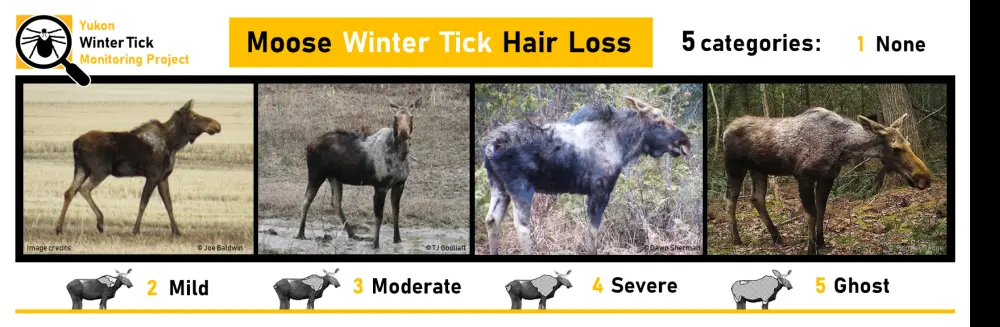
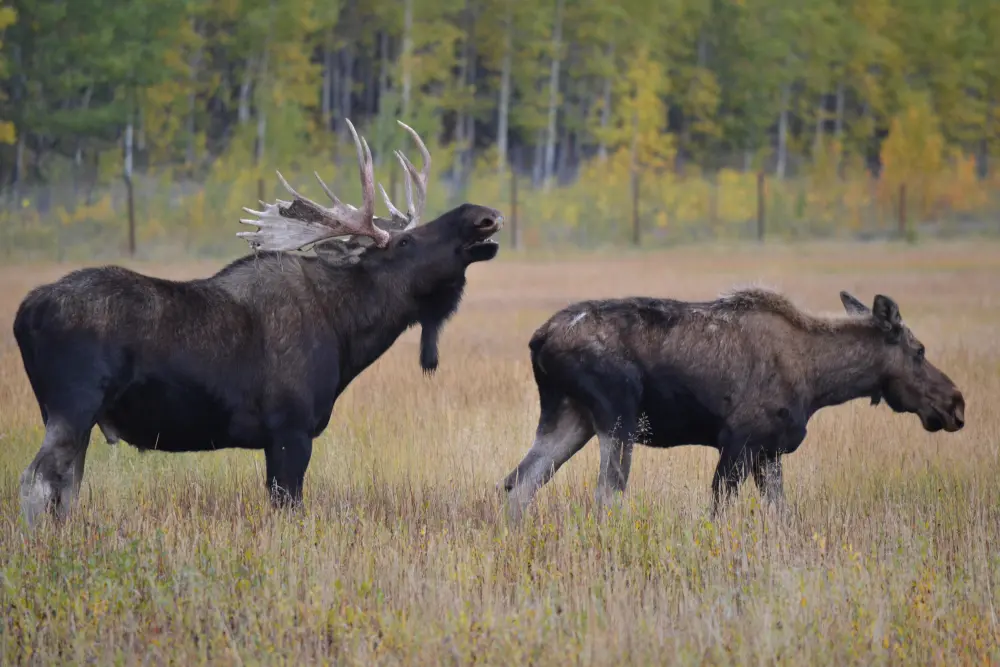
Ever had an itch you just can’t scratch? For moose and other large deer species, winter ticks are an annual burden. These blood-feeding parasites live for only one year and spend almost their whole life on the same host. Moose are often the worst affected - and although a few ticks on an individual is no big deal, winter tick numbers can sometimes reach 50,000-100,000 ticks per animal. These severely infested moose just keep scratching, trying to rid themselves of the parasites, and may lose large amounts of blood, valuable time feeding, and significant amounts of hair. The distinct patterns of tick-induced hair loss are most noticeable on moose from March to May when the ticks are at their largest, and is a key indicator that winter ticks are present in a region. Hair loss can range from very mild, with just a few patches on the shoulders and neck, to extremely severe or “ghost moose”, which have damaged or missing hair over more than 80% of their body.


The Yukon Winter Tick Monitoring Project is a collaboration between Environment Yukon and researchers at the University of Toronto. Its aim is to find out where in Yukon winter ticks are now, and where they could be in future, given the effects of climate change. Until recently, there were no winter ticks found in Yukon. Early reports began in the 1990s, and although relatively low numbers of them have been found to date, little is known about their distribution and effect on native Yukon species. Changing environmental and climate conditions play an important role in the winter tick-host relationship, with warmer, wetter seasons and shorter winters known to increase tick survival. Finding new methods of detecting winter ticks and their impact on hosts is important for us to understand how and when management could be needed.

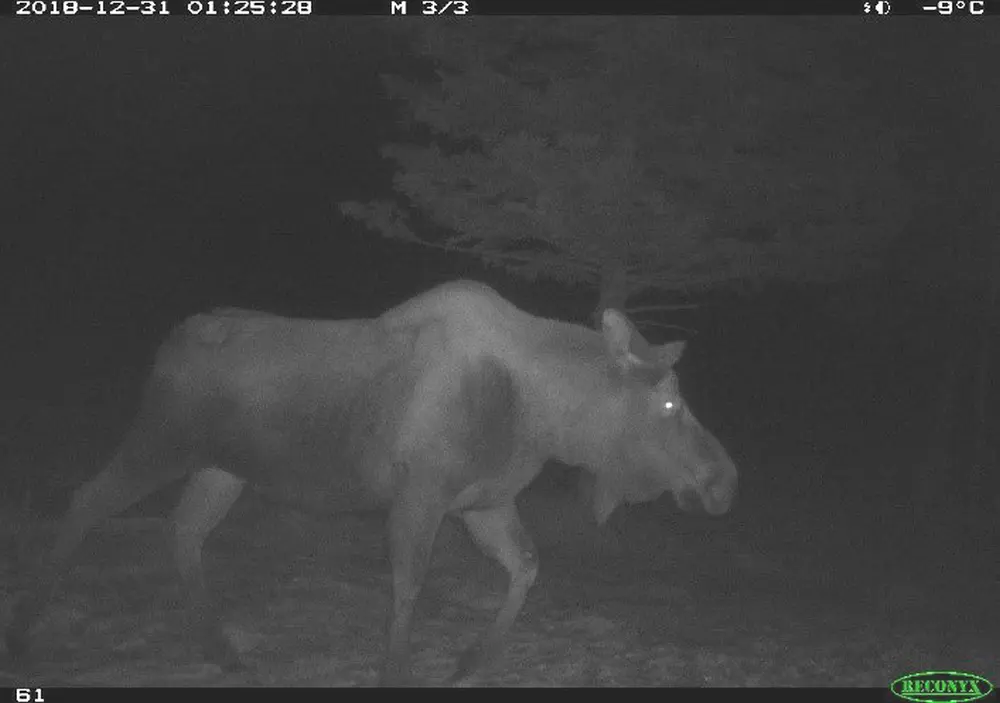
To help with this research, the moose at the Preserve have been having their photograph taken more than usual! Moose, like many other mammals, shed their heavier winter coat each year, resulting in a natural pattern of hair loss. To better understand what a healthy, tick-free Yukon moose looks like over the winter and into spring, two high-resolution
wildlife cameras were installed in the moose enclosure in December 2018. These cameras automatically take a photograph every time a moose walks past, and will continue to capture thousands of images each month until May.

The resulting catalogue of monthly moose hair shedding patterns will form a critical baseline from which to compare images of wild moose, photographed by additional remote cameras that have been set up throughout southern Yukon. This work will allow us to examine the current effects of winter ticks in this region and will additionally form an important part of a larger
scale study that looks at winter tick spread under climate change throughout North America.

Interested in Contributing?

If you see a moose or other animal with patchy hair, you can help to inform this research by submitting a  photograph directly to Emily (emily.chenery@mail.utoronto.ca), online through the Yukon Winter Tick Monitoring Project Facebook page, or citizen science app iNaturalist. Sightings can also be reported directly to
Environment Yukon’s Animal Health Unit in Whitehorse. Yukon Winter Tick Monitoring Project.

Emily Chenery

Emily Chenery

Guest Researcher / Author

Emily Chenery is a PhD student at the University of Toronto Scarborough studying the range expansion of winter ticks into Yukon. This project at Yukon Wildlife Preserve is being assisted by BSc student Maegan McCaw (University of Alberta), and funded by EC’s W. Garfield Weston Fellowship from the Wildlife Conservation Society (WCS) Canada, with additional support from Environment Yukon’s Animal Health Unit.

Explore by Category

Explore by Author

Faces of the Preserve: Doug

Faces of the Preserve: Doug

wildlife preserve

by Doug Caldwell | May 12, 2023

12 min read -

It takes passion and love for Yukon’s wild spaces and the wildlife that inhabit it, to support the Yukon Wildlife Preserve - a non-profit organization dedicated to the education and protection of Yukon’s natural spaces. 

Meet our Wildlife Interpreter Doug! Here he shares his unique and fascinating life story that led him to not only to the Yukon but eventually to the Wildlife Preserve.

"I was born in Victoria, BC in the mid 50s and am the eldest of four children. Mom said I was born with an extra helping of curiosity. We were the typical nuclear family of the day. Both my parents enjoyed camping and the outdoors, so we did that a lot. I can remember wet, rainy days in a small tent on the beach near Tofino or in one of the provincial parks up island. When I was around seven, we quit the tent and graduated to a small travel trailer for our camping shelter.

We kids explored everything that did not run away as we got closer. Each year we would expand our knowledge of the forest plants and animals, the rocks, waterways and seashore to see what we could collect as we explored and combed the beaches with our shoulders sunburned from squatting in tidal pools observing all the life they contained. Mom was ever diligent to make sure nothing that was dead or could die found its way into the trailer or the back seat of the car. I had to empty my pockets into a plastic pail before I could enter…it was a rule!

One morning, my sister Sharon found a tiny grey kitten snuggled up to the warm rocks of the campfire at Ivy Green Provincial Park. That was the only creature we were ever permitted to take home with us and that cat named Smoky lasted a good long time as I recall, probably because it was spoiled terribly compared to the life of a feral animal trying to make a living in the wilderness.

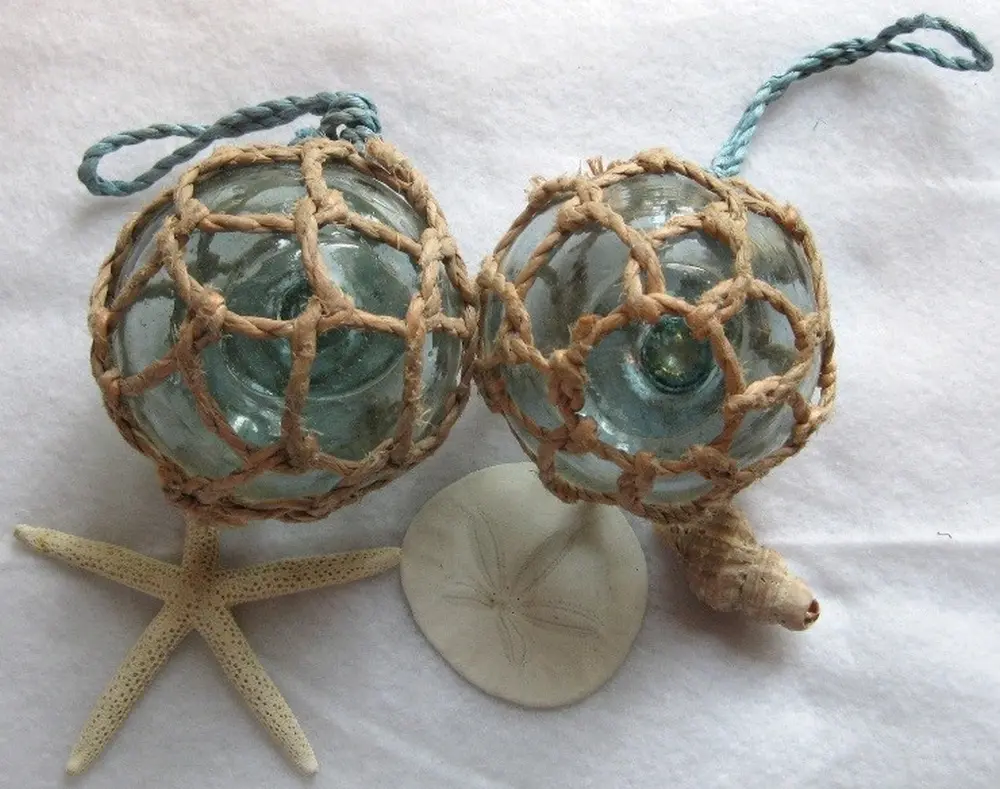
My siblings and I lived in a time that is far removed from today. Back then flotsam on the beach may have included Japanese fishing floats hand-blown from coarse green glass and wrapped in netting woven from long eel grass. We hunted sand dollars of all colours & sizes (the best ones were at Tribune Bay on Hornby Island), crustacean shells, wave-polished glass and stones, crustaceans and hermit crabs out shopping for a new shell to call home, and the jetsam that washed in on the previous high tides. Each day was fresh and new waiting to be discovered, poked, prodded and inspected.

Flotsam on the beach may have included Japanese fishing floats hand-blown from coarse green glass and wrapped in netting woven from long eel grass

Sometimes we would find something that we had seen in a nature book our paternal grandfather had given as a gift, so returning home the book was found and we would learn more about our latest discovery.  My grandfather was hopeful that we kids would take an interest in the natural world, and he would buy us books to inspire our curiosity to all facets of the earth and all that crawls on it. He gifted us with the complete Time Life series of the natural world and an annual subscription to National Geographic. I still have those books and I will sometimes open one and be transported back to the big green chair in our living room sitting next to my grandfather’s spirit as I re-read the descriptions of animals or the planet and how it all works as a singular complex biological entity. 

My grandfather was a keen and accomplished angler who infected my dad as a kid with the same passion for testing wits with fish. Grandpa and dad passed this affliction to my brothers and I, and we would often be on the Malahat long before the sun came up; my brother Dave and I slept in the back seat while Dad and Uncle John navigated us to that day’s selected fishing spot. The Cowichan, or Englishman’s River, the Oyster and Gold Rivers, Sooke and Campbell River and many others, were flogged with fly patterns and spinners for rainbows, sea-run cutthroat, seasonal salmon and steelhead. Sometimes we drove along an old logging road to get to a special spot my dad fished with grandpa when he was our age.

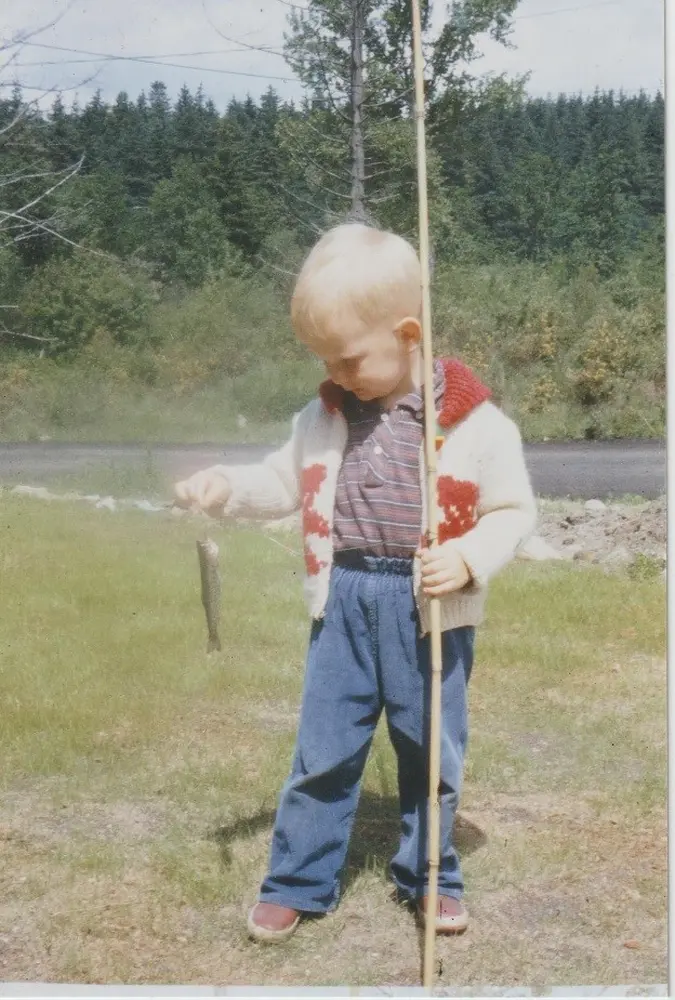
Doug's First Fish!

My first fish!

My grandfather was a significant contributor to my perspectives today and I often recall his comments from my childhood when I am telling our visitors about the wildlife here at the Preserve. Back then it was called ecology, today it’s called environmentalism. In each time frame it is still a profound love of our world and all the creatures that live with us.”

When I was twelve the family moved to the mainland and we settled in the cattle farming region of south Surrey. I won’t bore you with my teen years, suffice to say I was right and all those who opposed me were not.

After graduating high school at Lord Tweedsmuir High School in Cloverdale, I worked various jobs in the marine sector from maintenance to a deckhand on a salmon trawler to eventually a trained mechanic with the Mercury Marine in Burnaby, B.C.  

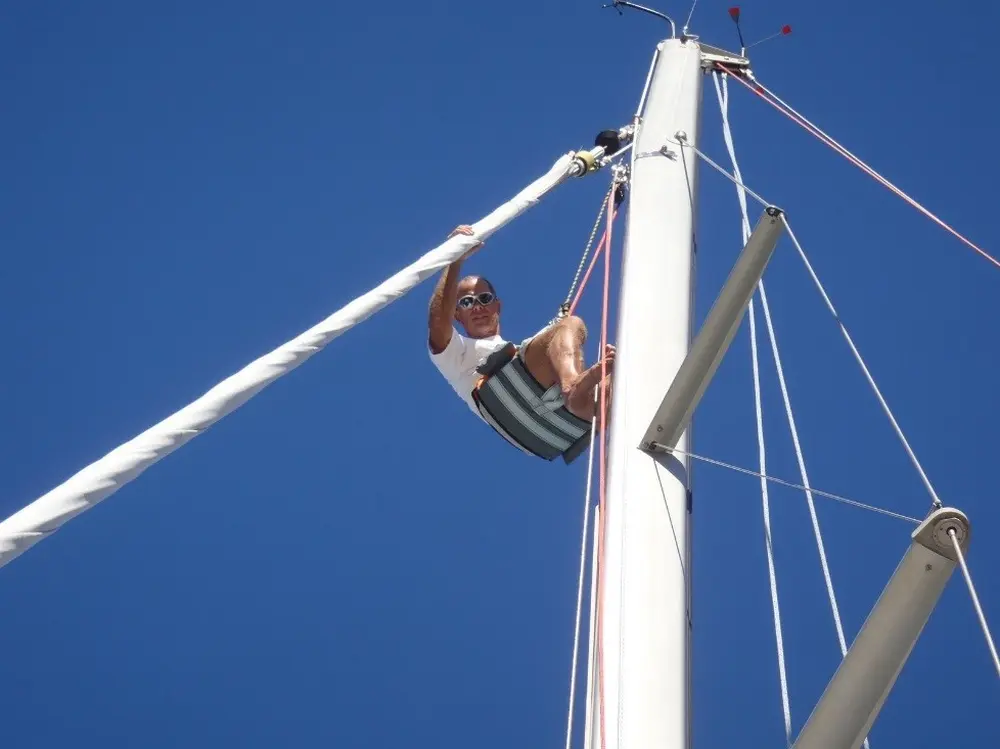
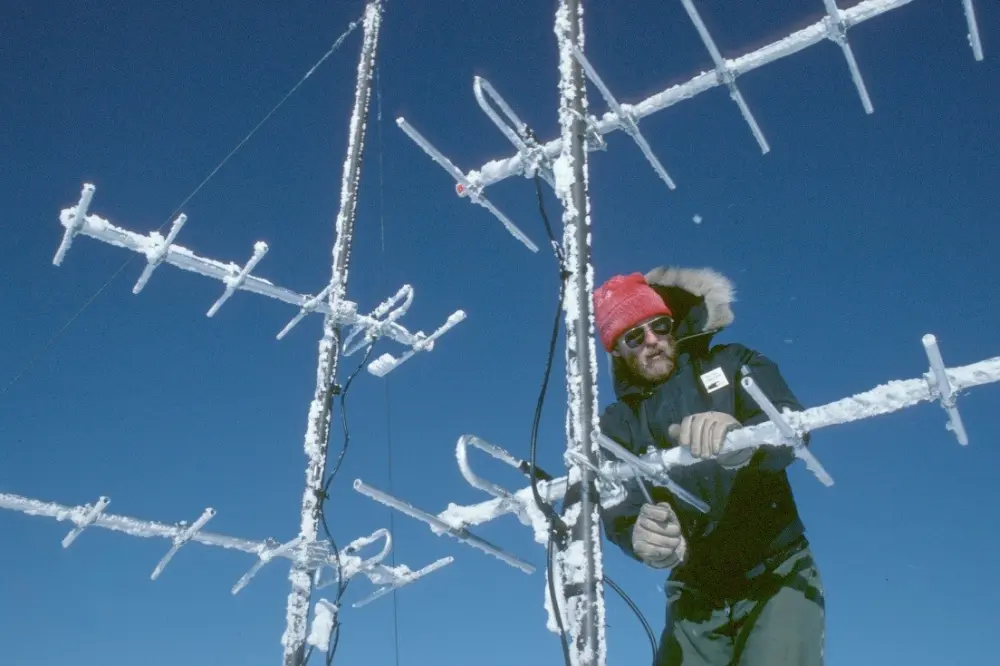
“Being a not-so-big-kinda guy I often got the jobs working down in the oily dank and sour bilges and honestly I quickly developed a dislike for that working environment, so I began to learn about navigational gear and other electronics that don’t live in the bilges, rather they cling high up on the masts and elevated superstructures where a skill-testing climb was required. I quit being a bilge rat and became a mast monkey. I spent a few years installing and repairing radio gear, radar systems, and similar equipment in boats, aircraft, cars and trucks.

My mast monkey days!

Time passed and I met and married my wife Chris. In the fall of 1976, I was recruited for a job working as a marine mechanic for the National Geographic’s support depot in Perth, Australia. At the same time my dad had a business venture here in Whitehorse he wanted me to work in. Two job offers: One hot - one cold. My mom ended up making the choice for us as she quite passionately said she was not going to sit on an airplane for 15 bloody hours to visit her grandchildren. We moved to Whitehorse.

For our first two years in the Yukon, I spent working to get my dad’s business up and running, then I worked at Sea-Land Recreational fixing boats until I jumped out of one and injured my knee which would require 8 weeks in a cast. Thus began my four year gig at CKRW as an announcer/operator- a DJ in common terms. I loved that job; playing music and informing the audience of the day’s events. But we had another baby on the way which required more income, so without another job waiting, I quit the radio business in 1984 and looked for new employment opportunities which led me to a different kind of radio business.

Next, I accepted a job with Total North Communications which took me to many remote wilderness locations all across the North as we installed remote communications systems for mining camps, exploration ventures, governments, community radio and TV stations, and mountaintop repeater systems which put us right in the middle of the wilderness.

Repraing the Carcross TV system.

I got paid to travel to exotic remote northern places that people pay dearly to visit and experience. While working in the Kluane National Park area on a mountaintop, young Dall sheep would be sniffing in our toolboxes unafraid as we were quite probably the first humans they had ever seen. We watched from the safety of a helicopter as the namesake grizzly of the Golden Bear Mine south of Atlin tore apart a repeater box we thought would be bear-proof…we were wrong. One trip into the far north we had to land the Twin Otter on the frozen tundra, roll a couple fuel drums off the plane and pump the fuel into the plane as a group of caribou watched from some distance. Then we put everything back into the plane and resumed our travel before it got too dark.

Left to right: Refueling the Carcross TV systems on Caribou Mountain; Repeater cornshell Kluane National Park; Installing a repeater near Kluane Lake. 

This job took me to some awe-inspiring locations, often where humans had not yet made footprints. I met some truly amazing people and had some adventurous experiences, some of which prompted my wife to beg me to quit field work and find something safer. Hard landing a helicopter is not a crash, but she saw things differently than I, so after the third hard landing I gave up field work and moved upstairs into sales and marketing and got fat.

In 1991 I was hired on with the Yukon Government’s Executive Council Office to work in policy and communications and the next 25 years went by in a blur. In 2016, I retired from my formal working career with the government, but I don’t sit still very well and needed something to do.

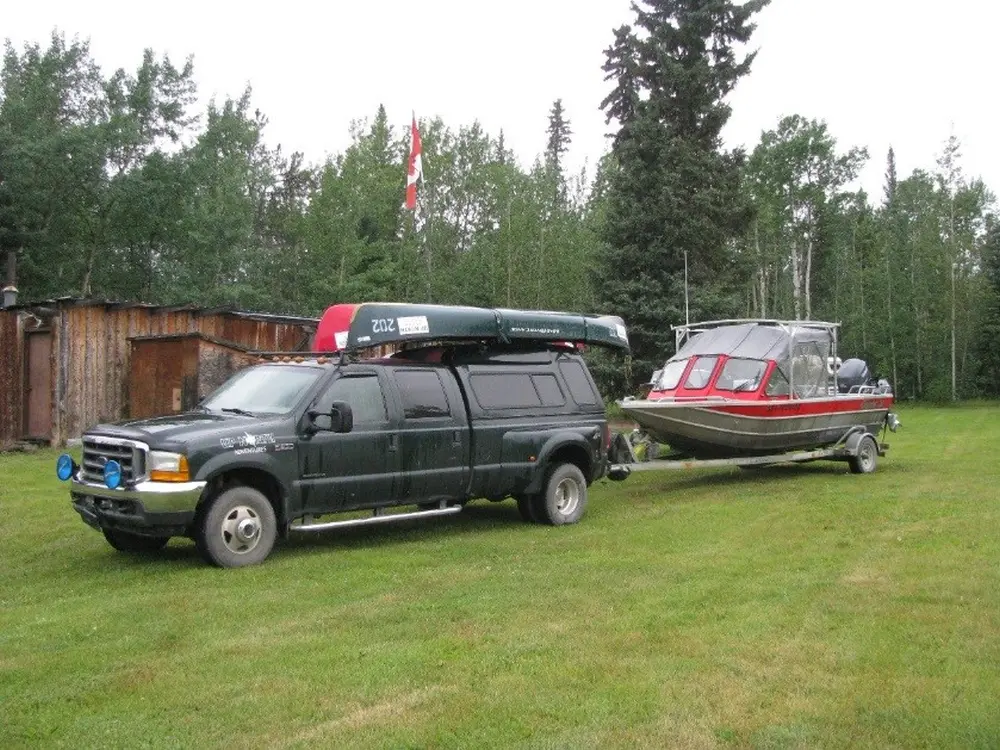
After a month of completing chores around the house and finishing the ‘honey-do’ list, Up North Adventures called to ask if I would be interested in piloting their rough water support boat used to ferry canoe tour groups through the rough and dangerous waters of Lake Laberge and a few other Yukon water systems. Additionally, I would guide fishing parties in search of our local fish species. Inspired by working in that wilderness setting once again, I thought I was set for the rest of my working days. I had a portable office that met my needs very well.”

My portable office for a few years!

After an injury however, a change of pace was needed.

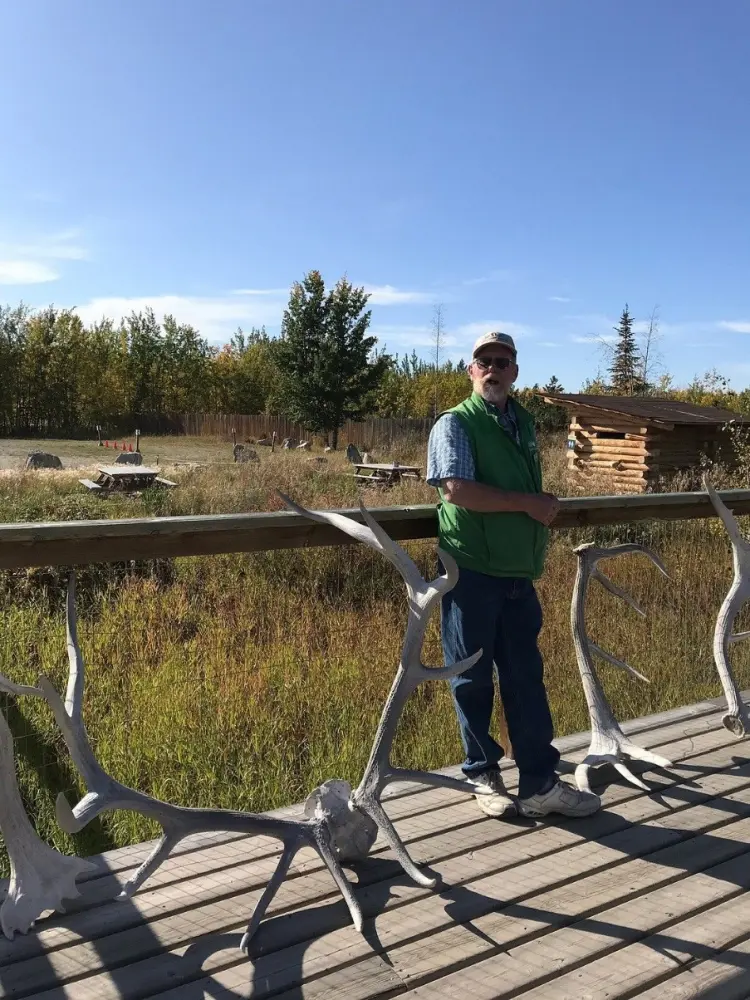
"I saw the job posting here at the Preserve and I considered this would be a great place to work based on previous visits with my grandchildren, and the lack of heavy lifting suited me as I hoped to grow gracefully into my autumn years.

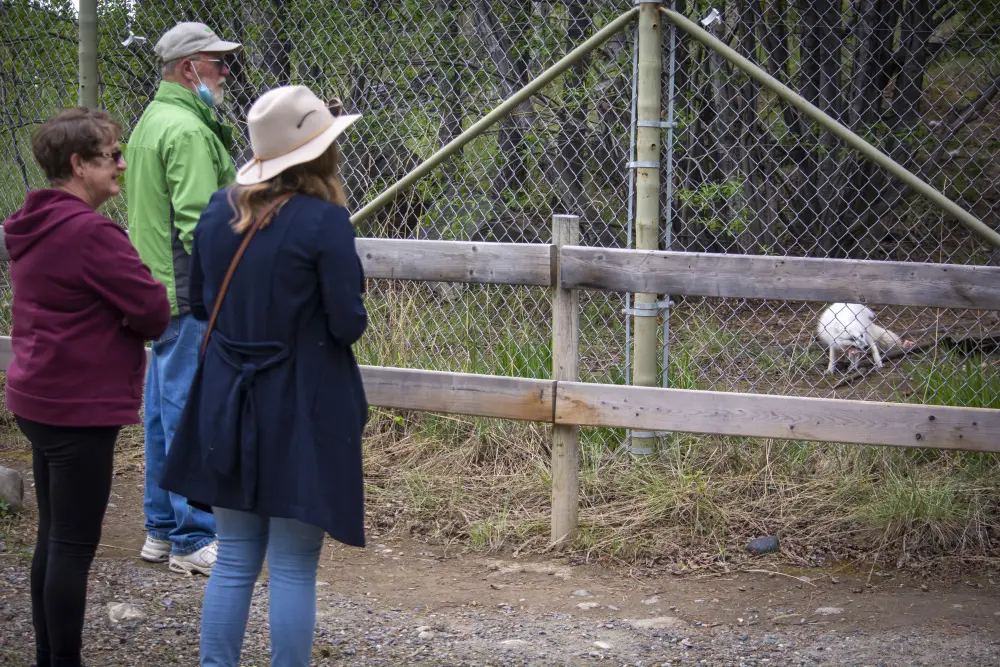
Doug shares stories with guests about the Arctic Fox.
Photo credit: L.Caskenette

When hired and oriented to my new role as a Wildlife Interpreter it took some time for me to become satisfied with the tour presentation I had created. There is so much to share in just the limited hour and a half of a bus tour. Then one day, my memory took me back to one of those chats with my grandfather explaining the world around us and I then knew what my goal here at the Preserve was and I have been refining my tour presentations ever since. I have a presentation now for each season focusing on what the animals are doing at that time in their lives.

I have made it my mission to try and inspire young people to have the same sense of awe and wonder of our natural world as I did when it was explained to me in ways I understood and appreciated. So that’s my focus today - I want to inspire the next generations to love, understand and admire our natural wilderness and the ecology that makes it work.

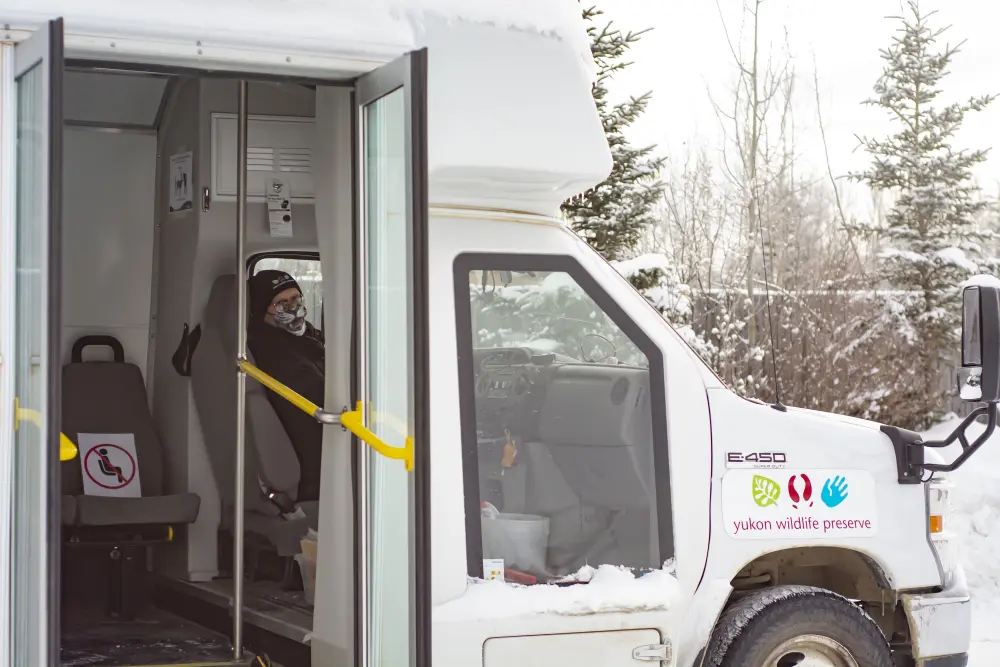
Guided bus tours are offered daily at the Preserve. Book online!
Photo credit: L.Caskenette

Getting to know our visitors is another part of the job I love. Our international visitors are often drawn here by the romantic stories of the Gold Rush and other days gone by in the North. Many of them hope to see the iconic animals of our unspoiled paradise and learn more about them. I am happy to report we often make some long-held wishes come true for these people as they see a real live moose, musk ox, or other favourite creature up close for the first time. Many visitors are already awestruck with the Yukon and have questions about living here and enduring the cold winters, viewing the Aurora and how we cope without all the big-city conveniences they are familiar with. Some of our elderly visitors are transported back to the memories of their childhood when indoor plumbing was a luxury few had in their homes, very few owned automobiles and the technologies of today were promoted in Popular Mechanics.”

Northern and Arctic icons, moose and muskox.
Photo credit: L.Caskenette

Over the past five years, Doug has met quite a number of people from different walks of life, but a few occasions have stuck out to him.

“One was in the winter of 2018 when a couple from Barcelona toured the Preserve. They were the only ones on the bus and it was around 20 below and we had stopped at the muskox platform for a closer look. I told them about the animals and their natural environment and answered their questions. The lady walked closer to the fence and Jesse, one of our cow musk oxen slowly walked through the snow towards her and stopped so they were only about ten feet apart, face to face with just the wire fence between them. They remained silently staring at each other this way for a bit of time until we got back on the bus. Seated behind me, I could hear the couple quietly speaking in Spanish with some very impassioned tones until the lady began to cry softly. Later in the tour she came to me and apologised for being so emotional.

She could not explain why she felt the way she did but was grateful she had connected with the musk ox and how it was meaningful for her and she would remember it always.

Face to face with Northern wildlife.
Photo credit: L.Caskenette

During my introductory comments on the bus I want people to relax and enjoy themselves and participate rather than just staring out the windows. So as an icebreaker to promote dialog I often point to one of them and ask “What’s your favourite animal in the whole world?” Some need some time to think about it before answering while others answer almost immediately. I have heard everything from horses, dogs and common pets to tarantulas, anacondas, giraffes and polar bears. Animals they adored as kids still have a special appeal for them. It’s that inner-child I want to connect with and helping them to recall being a kid helps to make that happen more easily. I often see the expression on people’s faces that says, “Ask me next!””

Join Doug for a guided bus tour
Photo credit: L.Caskenette

Doug is one of the integral members of the Yukon Wildlife Preserve and his passion helps to connect visitors to Yukon’s iconic wildlife and the habitat in which they live. Next time you visit, stop in and say hello to Doug or share your own story. 

“I have a wonderful opportunity to help our visitors to better understand and appreciate the natural world around us, how it came to be, how it works and how we can help to ensure it continues as it has for millions of years. Kids are keen to know more and I figure if I can help them to understand Nature better, they’ll be inspired to protect it better than previous generations have. As my grandfather demonstrated to me all those years ago, knowledge of our natural world is key to this success. So, I hope I do as good a job with our visitors as he did with me.”

Stories by Doug Caldwell. Read more from Doug. Photos - Doug Caldwell unless otherwise noted.

Doug Caldwell

Doug Caldwell

Wildlife Interpreter

Doug is one of the Interpretive Wildlife Guides here at the Preserve. An avid angler and hunter he has a broad knowledge of Yukon’s wilderness and the creatures that live here. With a focus on the young visitors to the Preserve, Doug takes the extra time to help our guests to better appreciate the many wonders of the animal kingdom here in the Yukon.

Explore by Category

Explore by Author