Your Yukon NightHawks

Your Yukon NightHawks

wildlife research

by Lindsay Caskenette | Dec 14, 2023 | 0 comments

This article was originally published in The Preserve Post newsletter in Spring 2016. More current information and contact for the regional project can be doing on WildResearch.

2 minute read - 

Is it true, that the early bird gets the worm? Not always!

COIN male. 
Credit: Anne Brigham

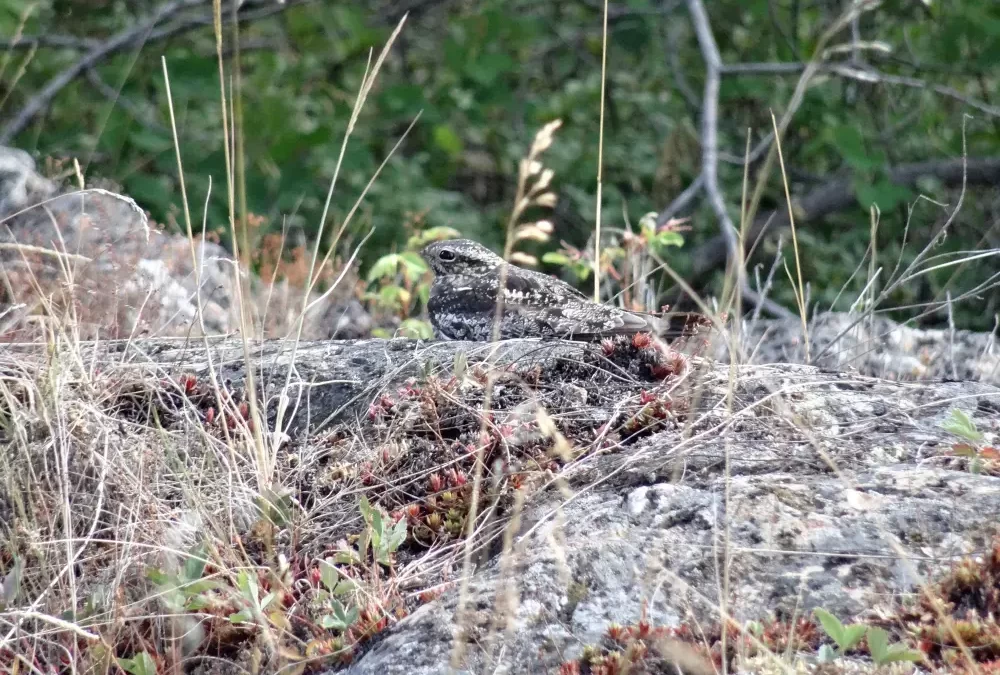
A group of highly camouflaged birds, called nightjars, spend their days resting, waking  up just in time for sunset. These birds are most active during twilight – not actually early birds!

The Common Nighthawk, the Yukon’s only nightjar, can often be found feasting on insects above the YWP wetlands during those twilight hours.


offspring nightjars nighthawk, wildlife research blog.

Common nighthawk chicks July 7.
Credit: Andrea Sidler

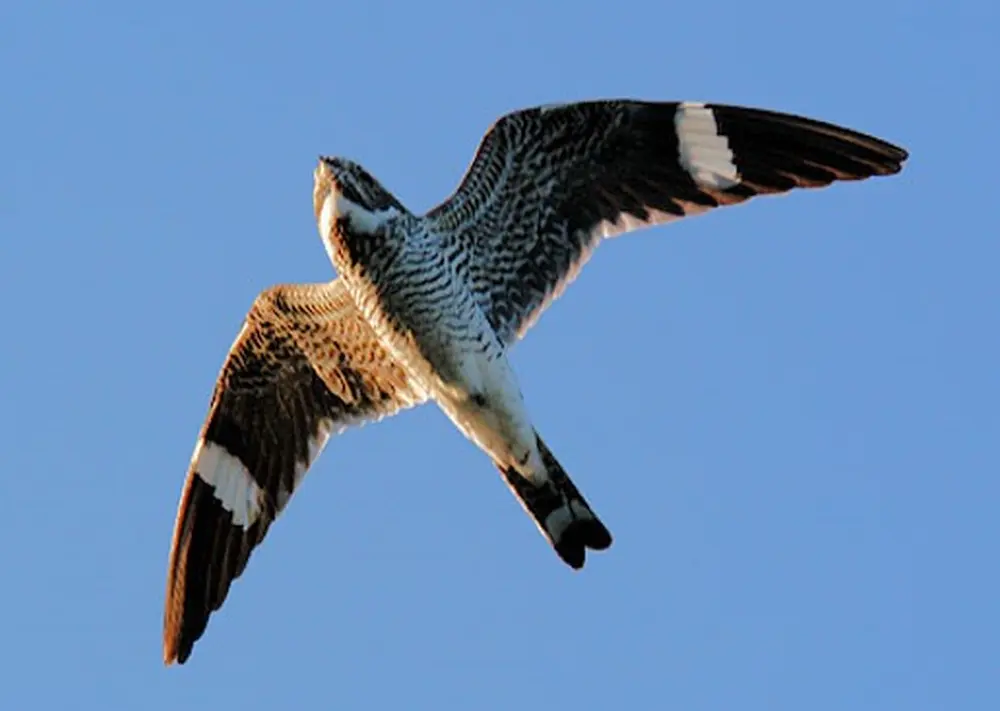
You’ve likely heard the electric peent calls of nighthawks filling the air, or maybe observed their silhouettes circling high above. Perhaps you’ve witnessed the males’ aerial maneuvers as he protects a territory. He shows off his white wing-bars to potential mates while performing spectacular dives toward the ground, pulling up at the last minute, and creating a  mechanical “booming” sound with his wings.

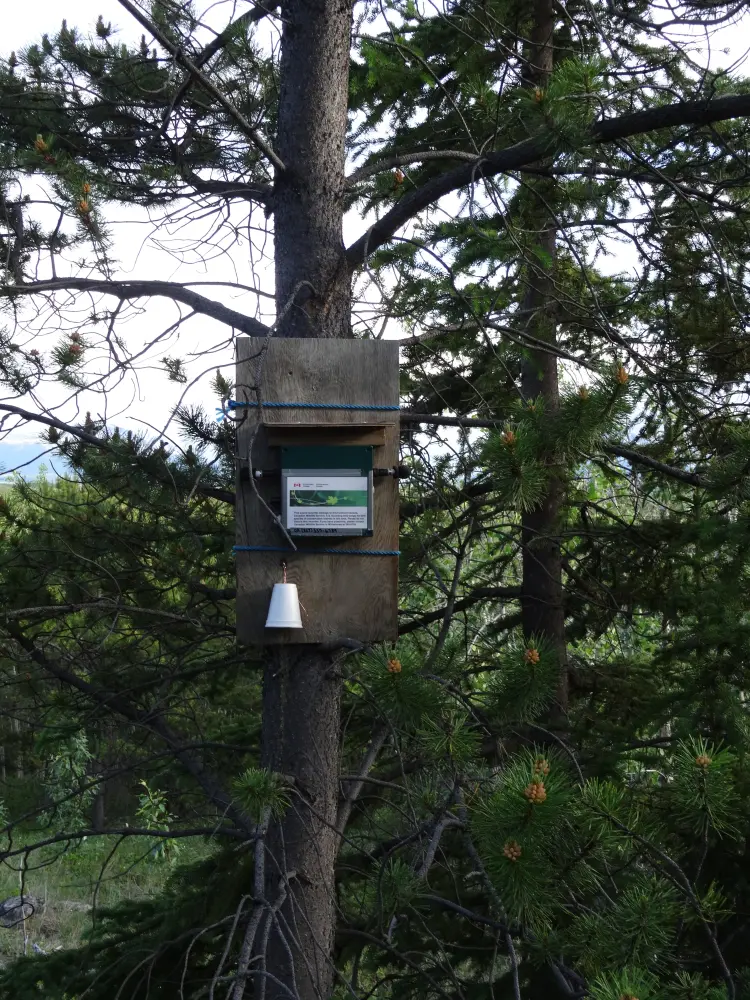
Nighthawk sound recorder. Audio wildlife research.

A sound recorder mounted to a tree with some information for a, human passerby. Credit: Andrea Sidler

In the Yukon, we are lucky we get to experience these unique birds. It is not like this everywhere. In fact, Canadian populations have declined by over 50% in just 30 years (status: Threatened). As a species, nighthawks are poorly understood, particularly here, on their boreal forest breeding grounds.

By using remotely recording sound meters, Canadian Wildlife Service investigated how the Norths’ perpetual daylight influenced the timing of nighthawk activity. For two summers, the YWP was home to recorders which, each night, recorded the calls of resident populations. During June, nighthawks were most active around 2:00 am. However, by the end of July, as true night returned to the YT, this changed.

female nighthawk, nightjars. wildlife research blog

A well camoflauged female.
Credit: Andrea Sidler

There were two activity peaks, one at dawn (4:00 am) and one at dusk (11:30 pm) –similar to southern populations - demonstrating that nighthawks are indeed affected by the changing day-length!

We are trying to learn more about what landscapes our nighthawks use. To help address this, WildResearch is expanding their nighthawk surveying program to the Yukon this summer. WildResearch relies on the collective power of volunteer citizen scientists to conduct surveys (2-3 hrs), which contribute data to conservation efforts. If you’re interested in getting involved contact your regional coordinator. Find out who that is by visiting the WildResaearch site.

Andrea Sidler

Andrea Sidler

Guest Researcher / Author

Explore by Category

Explore by Author

How are Animals Named?

How are Animals Named?

wildlife research

Nov 22, 2023 | 2 comments

11 min read -

Throughout history, various languages and cultures have contributed to a wide - and often confusing - vocabulary used to describe animals' genders, the young stages of their lives and what they may be called when they are gathered together in groups.

Mule deer:
Males are called bucks. Females are called does & young are fawns.
A group of deer are often called a herd but more fun versions include a bevy, a bunch, a rangale or a parcel
- though a parcel is often in reference to a group of young deer.

Historically, adjectives were the labels of choice to communicate animal gender identifiers. A broad selection of these labels has resulted - which are not universally applied, even within the same species. For example: in the deer family or Cervidae, males are identified as bucks and females are called does. In moose, and caribou - also members of the Cervidae family - males are called bulls and females are called cows while elk males are referred to as stags.

Cervids
From left to right - moose, caribou and Elk.
Males are called bulls (elk are called stags) and females are called cows.

Generally these cervids in groupings would be called herds (though moose are not actually herd animals) while elk can be also called a gang - watch out!

Not limited to just fur-bearing creatures, these titles are applied to other species and there are often departures from the naming conventions used. Rabbits are called bucks and does while steelhead trout males are called bucks, with females being called hens rather than does.

There is also a vast difference in the scientific naming of all creatures. Over the centuries a number of early scientists attempted to establish a format to classify animal groups. Ancient Chinese created the first recorded reference in 2700 BC, but it was quite limited and focused primarily on flora (vegetation) of their geographic region. 

Check out our Facebook post to learn more about Vulpes vulpes; not all red foxes are created equally but all are a red fox!

  1. Remember Fox and the Hound? A male is called a tod (sometimes a reynard or a dog), while females are referred to as vixens.
  2. Young are most commonly called kits but can also go by cubs, or pups.
  3. The collective noun to describe a group of foxes are a skulk, earth or a leash! These names are related to fox behaviour corresponding respectively as a group hunting together, a mama fox with her kits, and a group of domesticated or captive foxes as a leash.

Now, there are other foxes including Arctic fox (Vulpes lagopus), swift fox (Vulpes velox), fennec fox (Vulpes zerda), and others across the world for a total of 12 species that comprise the largest genus, Vulpes.

Smaller classifications exist within the genus Urocyon which include the gray fox. The only extant species of fox belonging to the Otocyon genus is that of the bat-eared fox found in the African savanna.

Ancient Greek philosopher and scientist Aristotle described a large number of natural groups, and although he ranked them from simple to complex, his order was not an evolutionary one. He was far ahead of his time in separating invertebrate animals into different groups and was aware that whales, dolphins, and porpoises had mammalian characters and were not fish. The Aristotelian method dominated classification for many centuries. During this period, it provided a procedure for attempting to define living things through careful analysis, it neglected the variations between living things.

In 1758 Carolus Linnaeus, who is usually regarded as the founder of modern taxonomy and whose books are considered the beginning of modern botanical and zoological nomenclature, drew up rules for assigning names to plants and animals. He was the first to use binomial nomenclature consistently. Although he introduced the standard hierarchy of class, order, family, genus, and species, his main success in his own day was providing workable keys, making it possible to identify plants and animals from his cataloging. Linnaeus was the father of the Field Guide.

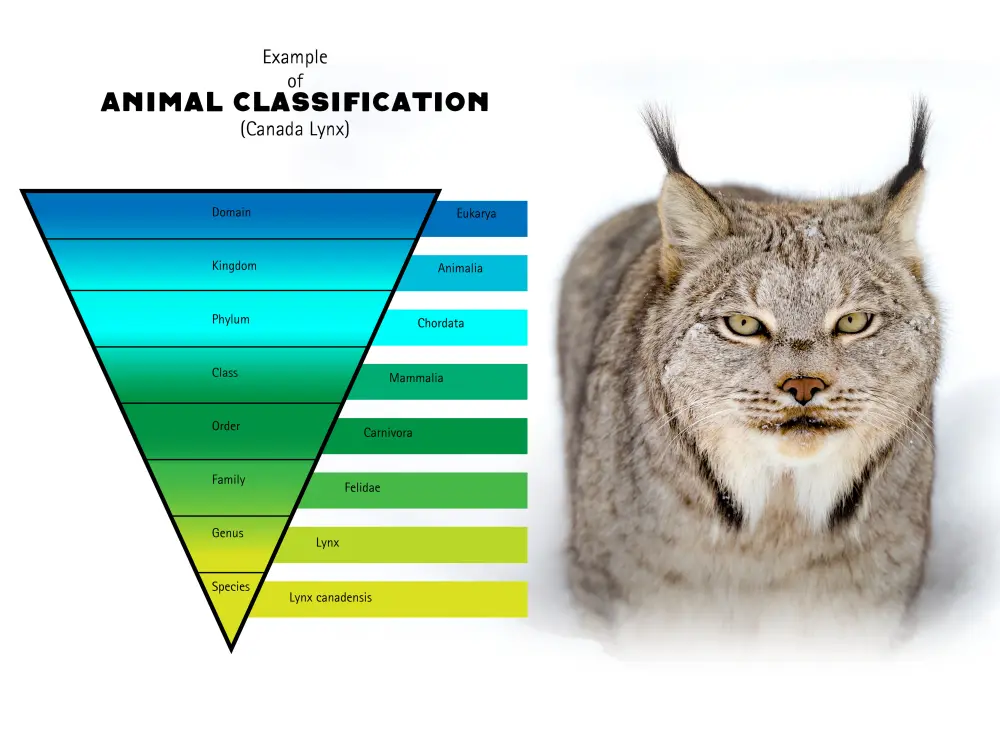
Lynx classification

Over the centuries a number of paleontologists, biologists, and scientists contributed to refining Taxonomy as we know it today. Perhaps the most notable of these was Charles Darwin - who explained his theory of evolution by describing how animals changed over time, yet still remained within specific categories in taxonomy.

Below is a table defining each classification of steppe Bison, the 15,000-year-old ancestor of today’s wood bison. As you can see, their classifications are not much different, other than identifying wood bison as a sub-species.

While their scientific classifications are very similar, the animals themselves were quite different. Steppe bison persisted through the great extinction of the last Ice Age up until about 5,400 years ago. A relatively recent find in Whitehorse city limits proves steppe bison persisted giving rise to the bison seen in the Yukon today but are not the direct descendants of the steppe bison.

Darwin’s famous illustration The Tree of Life displays the evolutionary relationships between species. This idea caused a great deal of controversy when he concluded that mankind evolved from the apes which was contrary to the religious teachings of the day.

Muskox and bison - both species are members of the Bovidea family. In this family, males are called bulls and females are called cows. The young are called calves and groups of both species are referred to as "herds". But that is where the line is drawn for their nomenclatures. The Inuit name for muskox is "omingmak," which means "the animal with the skin like a beard." Geographically, today's populations of muskox and bison do not overlap and their adaptions to winter survival as a result are very different.

We can see from this phylogenetic tree how bovids (horn bearing) and cervids (antler bearing) are related to each other. The animals with icons represent those species at the Yukon Wildlife Preserve. The Yukon has 9 of the 11 ungulates of North America, excluding the bighorn sheep and pronghorn antelope. What's also interesting to note is that mountain goats are their own genus and muskox are more closely related to sheep and goats than they are bison!

When we dive into the scientific name we can see how the classifications carry over. For instance muskox, Ovibos, share genus naming from sheep and cow. Caribou or Rangifer tarandus is reindeer in Latin, from the Greek tárandos, also meaning reindeer. So when someone asks you the difference between caribou and reindeer, you can say, nothing! (Except, reindeer fly!)

Classification tree for ungulates bovid and cervid

(Note: this a general phylogenetic tree; it is not complete and does not represent accurate branch length for amount of genetic change and complexities of sub-taxa).

Beyond the labels used for animal species, their offspring also suffer from a variety of descriptors to classify their young age. There are calves, fawns, foals, pups, cubs, kittens, chicks, hatchlings, fry and owlets to name a few. Yes, there is a lot to remember, but with practice you can master the various names used to identify animal difference.

These descriptor variations also extend to the words used to describe a group of an individual species. There are herds, colonies, congresses, tribes, swarms, flocks, droves, clutches, packs, murders, litters, pods, braces, convocations, gangs, schools, hordes, gaggles, bands, and numerous other words used to describe a group of same-species creatures. There are even names given to groupings of animals that are, in fact, unlikely to group together given their territorial and/or solitary nature - like owls, moose or wolverines.

Even within a class of animals like birds, its a complex web of classification and further to each species' grouping names.

Birds:

  • In general - Flock
  • Eagle - convocation
  • Falcon - cast
  • Owl - parliament, stare or wisdom
  • Swallows - flight, gulp
  • Swans - bevy, wedge
  • Ptarmigans - covey
  • Ravens - unkindness, rave, conspiracy
  • Magpies - tiding, mischief
  • Grouse - pack, covey
  • Crane - sedge
  • Ducks - raft in water and skein when flying
    • mallards on the ground can be called a sord
  • Geese - gaggle
  • Loons - asylum


Other mammals:

  • Squirrel - scurry
  • Wild canids, dogs - pack
  • Goats - tribe
  • Otters - romp
  • Porcupines - prickle
  • Voles - colony
  • Wolverines - mob
  • Martens - richness

Invertebrates:

  • Bees - grist, hive or swarm
  • Caterpillars - army
  • Flies - business

Amphibians (no reptiles in the Yukon):

  • Frogs - army
  • Toads - knot

Fish:

  • Trout - school
  • Salmon - bind, draught or run

It's an interesting read to understand the many different words used to describe an animal’s gender, how they are identified when they are youngsters and in groups together. Of course, the list above is centered on animals that make their home in the Yukon - imagine some of the animals that live in your neck of the woods, or places you've travelled to, and what those animals' naming classifications may be.

What is more, the naming of animal's as described by history must also recognize that many of these species, (beyond the few mentioned like Wapati and Omingnak), also hold Traditional and First Nation naming of animals that are descriptive, communicating the animals' place, use or spiritual significance.

Do you have any interesting or favourite animal classification terms/names? Share them with us in the comment section below!

Doug Caldwell

Doug Caldwell

Wildlife Interpreter

Doug is one of the Interpretive Wildlife Guides here at the Preserve. An avid angler and hunter he has a broad knowledge of Yukon’s wilderness and the creatures that live here. With a focus on the young visitors to the Preserve, Doug takes the extra time to help our guests to better appreciate the many wonders of the animal kingdom here in the Yukon.

Lindsay Caskenette

Lindsay Caskenette

Manager Visitor Services

Lindsay joined the Wildlife Preserve team March 2014. Originally from Ontario, she came to the Yukon in search of new adventures and new career challenges. Lindsay holds a degree in Environmental Studies with honours from Wilfrid Laurier University and brings with her a strong passion for sharing what nature, animals, and the environment can teach us.
867-456-7400
Lindsay@yukonwildlife.ca

Explore by Category

Explore by Author

Moose Hair Loss Study

Moose Hair Loss Study

wildlife research

by Emily Chenery | Nov 13, 2023 | 2 comments

This article was originally published in The Preserve Post newsletter in Spring 2019. In April 2022 Emily et al., published a paper Improving Widescale Monitoring of Ectoparasite Presence in Northern Canadian Wildlife with the Aid of Citizen Science on this project.

10 minute read - 

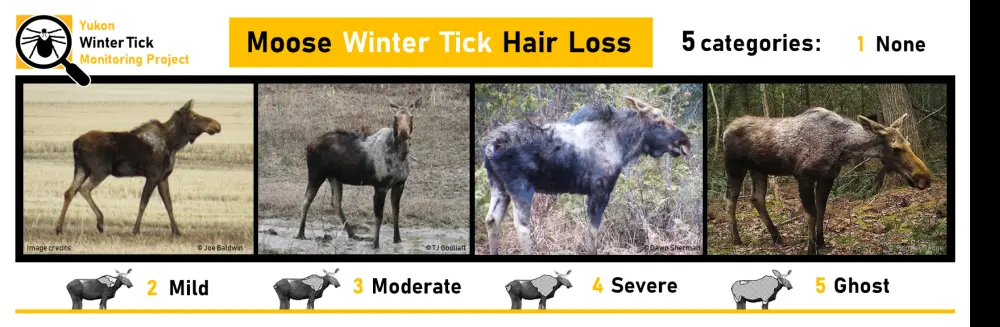
Ever had an itch you just can’t scratch? For moose and other large deer species, winter ticks are an annual burden. These blood-feeding parasites live for only one year and spend almost their whole life on the same host. Moose are often the worst affected - and although a few ticks on an individual is no big deal, winter tick numbers can sometimes reach 50,000-100,000 ticks per animal. These severely infested moose just keep scratching, trying to rid themselves of the parasites, and may lose large amounts of blood, valuable time feeding, and significant amounts of hair. The distinct patterns of tick-induced hair loss are most noticeable on moose from March to May when the ticks are at their largest, and is a key indicator that winter ticks are present in a region. Hair loss can range from very mild, with just a few patches on the shoulders and neck, to extremely severe or “ghost moose”, which have damaged or missing hair over more than 80% of their body.


The Yukon Winter Tick Monitoring Project is a collaboration between Environment Yukon and researchers at the University of Toronto. Its aim is to find out where in Yukon winter ticks are now, and where they could be in future, given the effects of climate change. Until recently, there were no winter ticks found in Yukon. Early reports began in the 1990s, and although relatively low numbers of them have been found to date, little is known about their distribution and effect on native Yukon species. Changing environmental and climate conditions play an important role in the winter tick-host relationship, with warmer, wetter seasons and shorter winters known to increase tick survival. Finding new methods of detecting winter ticks and their impact on hosts is important for us to understand how and when management could be needed.

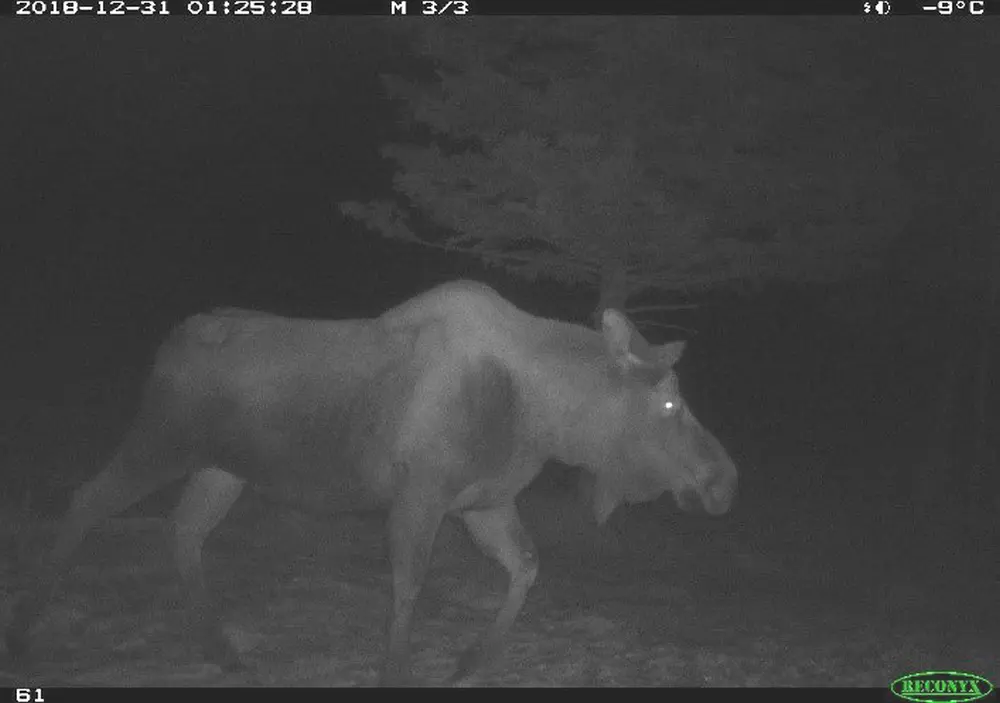
To help with this research, the moose at the Preserve have been having their photograph taken more than usual! Moose, like many other mammals, shed their heavier winter coat each year, resulting in a natural pattern of hair loss. To better understand what a healthy, tick-free Yukon moose looks like over the winter and into spring, two high-resolution
wildlife cameras were installed in the moose enclosure in December 2018. These cameras automatically take a photograph every time a moose walks past, and will continue to capture thousands of images each month until May.

The resulting catalogue of monthly moose hair shedding patterns will form a critical baseline from which to compare images of wild moose, photographed by additional remote cameras that have been set up throughout southern Yukon. This work will allow us to examine the current effects of winter ticks in this region and will additionally form an important part of a larger
scale study that looks at winter tick spread under climate change throughout North America.

Interested in Contributing?

If you see a moose or other animal with patchy hair, you can help to inform this research by submitting a  photograph directly to Emily (emily.chenery@mail.utoronto.ca), online through the Yukon Winter Tick Monitoring Project Facebook page, or citizen science app iNaturalist. Sightings can also be reported directly to
Environment Yukon’s Animal Health Unit in Whitehorse. Yukon Winter Tick Monitoring Project.

Emily Chenery

Emily Chenery

Guest Researcher / Author

Emily Chenery is a PhD student at the University of Toronto Scarborough studying the range expansion of winter ticks into Yukon. This project at Yukon Wildlife Preserve is being assisted by BSc student Maegan McCaw (University of Alberta), and funded by EC’s W. Garfield Weston Fellowship from the Wildlife Conservation Society (WCS) Canada, with additional support from Environment Yukon’s Animal Health Unit.

Explore by Category

Explore by Author

Those Things On Their Heads – Antlers Vs. Horns

Those Things On Their Heads – Antlers Vs. Horns

wildlife research

by Doug Caldwell | Jan 27, 2023 | 3 comments

10 minute read -

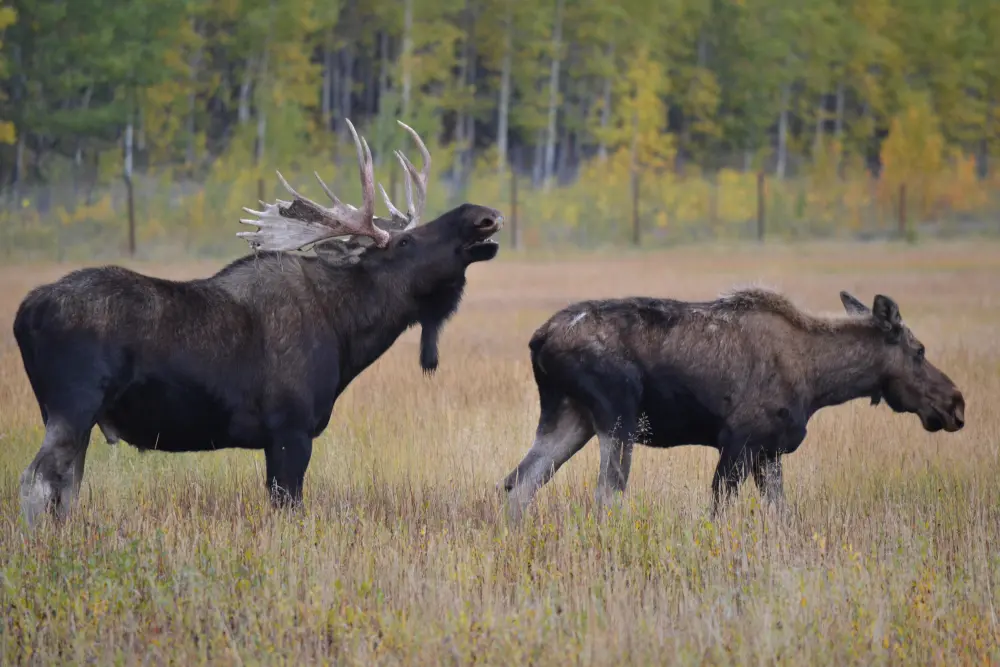
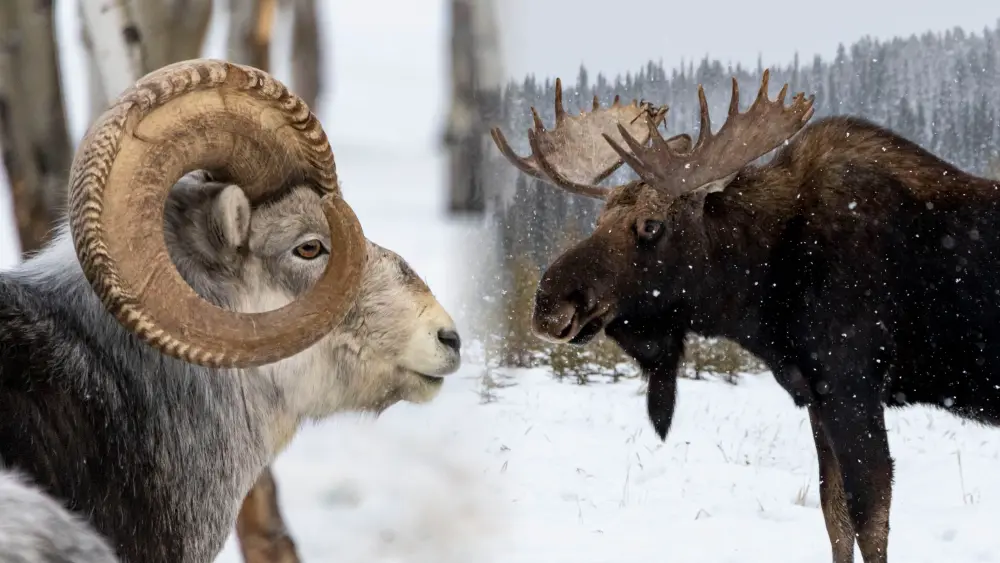
In our modern language usage, some terms or words may be incorrectly applied when describing an item. For example: some people do not always distinguish between horns and antlers where they incorrectly refer to all animal headgear as horns. Antlers and horns are very different in a number of ways and these variations are the result of millions of years of evolution and adaptation for the animal species to live a healthy life in the environment they occupy.

Bovids, or members of the horn-bearing group of animals versus cervids, or members of the deer, antler-bearing group of animals. 
Photo left to right:  Mountain goat, bison, moose, caribou. 
Credit: L.Caskenette & J.Paleczny

Headgear has influenced many aspects of some species and how they conduct themselves through the year; including the obvious breeding cycle but also their comfort in the heat of summer and how they communicate and identify themselves visually.

Let’s begin with construction materials: Horns are made from keratin- the same material as your hair and fingernails- whereas antlers are made from bone. Horns are a two-part structure. An interior portion of bone (an extension of the skull) is covered by an exterior sheath grown by specialized hair follicles called keratin.

Horns grow from the base where it attaches to the animal’s skull, antlers grow from the tips. Antlers are grown only by males of the deer species except for Caribou where females grow lightweight antlers, an adaptation for their grazing in snow for lichen. Horns are present on both male and females of most horned species with the males typically having larger horns than the females. 

Bovid family of animals have horns and both females and males with grow these horns. Typically female horn growth is smaller than males. Sexual selection plays a role here for large displays in both horn and antler bearing animals.

Perhaps the greatest difference between horns and antlers is that antlers are shed and regrow each year, where horns are permanent and remain and grow with the animal for all its life, or until they get broken off. Once they are broken, they do not grow back. The animal will carry a damaged or missing horn for the rest of its life.  Antlers also factor into the breeding cycles of the males who employ them to demonstrate their virility and to impress the females.

Antlers too may become broken or removed completely due to carelessness or fighting. These will grow back, but not right away. The animal must wait for the annual antler shed-regrow cycle for that year to conclude, usually in mid-winter before a new antler will form during the next year’s cycle, this may cause the animal to be without an antler for up to a year. 

Horns appear to form earlier than antlers on younger animals such as goats or bison, where Mountain Goat kids will be displaying small pointed black horns within a few short weeks of its birth, while antler buds appear at several months or so after a calf or fawn is born. But once they are in place and growing, they grow quickly.

Left to right: Mountain goat kids show horn formation, easily seen against the white; Watson the moose shows nubs of antlers developing in his first winter of life in 2019. Bison calves also show horn development early on in life. 

Antler is the fastest growing tissue of any mammal on the planet. With a healthy diet and high caloric intake, a moose can put on as much as a pound of antler in a single day. In the scope of just eight months' growth, moose antler can grow from tiny buds as big as your thumb to gigantic antler racks measuring up to six feet across or 1.8 meters from tip to tip. A large moose’s antlers can weigh up to forty pounds or nearly 20 kilograms on average. Some very large moose antlers may weigh up to 75 pounds or 35 kilograms.

Credit Alaska News Source

Source credit: Alaska News Source

Back to construction for a moment; another key difference between horned and antlered animals is how the physiology of horns and antlers differ.

Horns have a central, conical bony core or cornual process that grows out from the frontal bone of the skull. On close examination of a horn you will see what appears to be layers of horn material (keratin) growing a new layer at the base which will grow longer over time and become thicker with subsequent new layers of keratin forming as the animal ages.

After 6 months of age, the bone becomes hollow and the space within it is continuous with the frontal sinuses. The surface of the bone is rigid and porous and is covered with an internal surface which keratinizes and forms the protective covering of the horn. The new horn produced at the base is soft and often transparent giving the horn a glossy appearance. Horn growth function is similar to how the cuticle on your fingers and toes produce the nails.

Source credit: Talmudology

Antlers however attach to the animal’s skull between the eye and ear at a place called the pedicel where they will grow to full size for that year over about eight to ten months. The antlers separate from the skull at the point of attachment, the pedicel.

Antlers separate from the skull at the pedicel, typically in the winter months.

The antler side is called the corona and forms a bone to bone connection with the pedicel on the skull that is remarkably strong until the its time to shed that year’s antlers. There is a chemical influence when the animal’s hormones change following the rut and seasonal progress that causes the bone between the corona and the pedicel to dissolve where eventually it weakens enough that the skull can no longer support the weight of the antler and it falls off. Both antlers may fall off at the same time, but it is common for both antlers to fall off over a couple of days.

Horns are mostly hollow, white antlers are made up of less dense, sponge-like bone called the trabecular that has been highly vascularized during formation allowing blood to flow to the tips of the antlers to facilitate their growth. Antlers require blood to grow while horns do not.

While antlers are covered in velvet, they are also engorged with blood which provides another important benefit besides growing the antler. As animals do not perspire or sweat in any way, they must expel excessive body heat by panting as many animals do. Antlers perform like radiators where body heat is expelled by the blood-filled antlers.

Ears of most deer species shed the fur and hair off them in the warmer months so they too can dissipate body heat. If they would let you, you could take the pulse of an antlered animal by finding a blood vessel on their fuzzy antler and placing your fingers on it to feel the beat of his heart. Don’t try this at home…or anywhere else.

Both horns and antlers have also been used by people since prehistoric times for tools of various kinds.   The hollow nature of horns has made them desirable for spoons, scoops and hand shovels or scrapers while the strength and hardness of antlers has often found them to be the material of choice for making hunting points for spears and arrow heads. Antler has also been a popular material for handles of tools like knives and axes.

Creativity and need, guided the early peoples to adapt and modify both horns and antlers for a wide variety of tools and other purposes to better their quality of life. They have often been used to make buttons for clothing or ornamentation. Antlers have been carved into needles for sewing of clothes, shelter and similar products, Horns were popular as gun powder containers as they would prevent the powder from getting wet and were easy to carry and measure the appropriate amount of powder into the firearm.

Yukon art Hints of Easter by Faye Chamberlain, 2021. Yukon Permanent Art Collection.

Both antlers and horns provide important functions for the animals that grow them so they may live healthy, secure lives. Their headgear has also influenced many of their social behaviors that have developed and evolved over the centuries. These include mating rituals and protective activities against potential predators.

Most of us have seen sheep rams rearing up on their hind legs and pounding their horns against another ram in courtship competitions, but they may use their horns to communicate in less violent ways. Rams may interlace their horns and gently rub ear to ear as a form of communication that we can only guess what it means.

Antlered animals also employ their antlers as a means to communicate for example when two young bulls will use their antlers to joust or push each other around like a game of reverse tug o war.

Antlers are also a means of displaying size and age which will determine their social order of who is dominant and who is subordinate. From a distance the size of the antler rack quickly displays the animal’s placement in the local social order, typically around the breeding season or rut when many male moose may gather in an area for an opportunity to breed with cow moose drawn to the area by pheromones carried in the wind.

Bulls with smaller antlers will size each other up based on their antler racks and determine their chances of winning a fight with a larger bull.

Animal headgear serves a number of important benefits for the creatures that grew them. Humans have also found inventive and beneficial uses for both antlers and horns once the animals are finished using them. Humans often use antlers and horns for tools, but they can also be transformed into wonderful works of art. Nature provides.

Doug Caldwell

Doug Caldwell

Wildlife Interpreter

Doug is one of the Interpretive Wildlife Guides here at the Preserve. An avid angler and hunter he has a broad knowledge of Yukon’s wilderness and the creatures that live here. With a focus on the young visitors to the Preserve, Doug takes the extra time to help our guests to better appreciate the many wonders of the animal kingdom here in the Yukon.

Explore by Category

Explore by Author

Uneasy neighbours: red foxes and arctic foxes in the north

Uneasy neighbours: red foxes and arctic foxes in the north

wildlife research

by Joelle Ingram | Mar 30, 2021 | 11 comments

This article was made possible thanks to support from the Environmental Awareness Fund. Engage and educate yourself in this blog series, about Yukon Biodiversity.

15 minute read -

Once upon a time in the distant year of 2015, a Canadian wildlife photographer, Don Gutoski won Wildlife Photograph of the Year with a haunting snapshot of a red fox scarfing down the body of an arctic fox it had just killed. This grisly image titled “The Tale of Two Foxes” was heralded as a stark depiction of climate change in the north where warmer climates lead to red foxes encroaching on the territory of arctic foxes. While climate change is both a real and palpable threat to arctic ecosystems, the reasons behind the expansion of red fox ranges into the arctic and their subsequent relationship with their tiny northern counterparts isn’t that straightforward. When is it ever, am I right? Life is complicated!

Credit: Don Gutoski's photo titled "A Tale of Two Foxes" won Britain's Natural History Museum Wildlife Photographer of the Year 2015. It also sparked some assumptions and conversations about climate change and species competition in the changing Arctic. 

First off, it’s unfair to treat red foxes as an invasive pest freshly arrived on the arctic tundra. Historical fur harvest records from trading outposts in northern Canada show the presence of red foxes in the arctic starting in the early 20th century. In other words, they aren’t new to the neighbourhood. One of the popular hypotheses out there attributes the red fox’s northward expansion to the warmer temperatures caused by climate change. Milder winters definitely help red fox survival in their arctic home as they are nowhere near as well insulated as arctic foxes. But this balmy weather (balmy being a relative term, the arctic is still chilly as heck) is not the only factor behind their northern migration and it’s probably not even the main driving force; people are.

A study that compared the movement of red foxes with historical climate data and the development of sedentary settlements in the Canadian arctic found that it was the settlements, not the temperature, that was most closely linked to fox migration. Why? Well, it’s probably because we’re a great food source. If you live in Whitehorse, you do not need me to tell you that red foxes thrive around human settlements. It’s a fox paradise with all the garbage and unattended dog food that they can eat and a wondrous array of leather goods to steal. The fox that sleeps under my dryer vent probably feels like it has a very plush life. Quick question: It once left a decapitated grouse on my back porch; does that count as paying rent??

In a place like the arctic where resources are scarce, human settlements and by extension, human garbage (or “anthropogenic waste subsidies” if you want to impress your friends) can provide a relatively bountiful food source for red foxes. This isn’t really a good thing though. While both red and arctic foxes like to yummy down on some trash, human-created food sources favour the survival of red foxes over arctic foxes. This in turn could lead to diminished arctic fox populations in the future.

Red foxes are bigger and heavier than arctic foxes so when it comes to direct competition between the two, red foxes are more likely to be the victor. We already have grim photographic evidence of that exact scenario. Both types of foxes also have very similar diets, similar subsistence strategies (scavenging and food caching), and both of their reproductive success depends on having a den to shelter their pups. Leading very similar lifestyles put these two fox species in direct competition for resources. If this is the case, why haven’t red foxes wiped arctic foxes off the map? It’s probably because the relative survival of these two species isn’t contingent on a fox vs. fox death match. Sorry to disappoint. 

If I’m being completely candid with you, dear reader, when I was initially handed this topic, I was kind of hoping to write a shocking and grisly article about fox-on-fox violence. The carnage! The tragedy! Oh the terrible realities of nature! Not because I want bad things to happen to tiny foxes (I don’t), but because I am an absolute ghoul of a human being and that kind of content makes for a gripping article. Either way, this is not the case and I am legitimately relieved to know the arctic tundra isn’t strewn with fuzzy white bodies. Yes, red foxes do prey on arctic foxes but they are by no means out there slaughtering their smaller arctic counterparts into extinction. I mean red foxes also eat other red foxes, it’s the nature of well… Nature.

A group of researchers conducted a forty-year study of fox dens on Herschel Island and the Yukon’s coastal mainland to investigate the relative abundance of red and arctic foxes in the area. In those four decades, both of these fox populations remained relatively unchanged. We (and by “we” I really mean the researchers and biologists who specialize in this kind thing and not myself, a humble turnip and writer) don’t entirely understand all the factors that keep the balance between these two residents of the Yukon arctic. It’s a very complicated relationship and there’s a lot to unravel; here is what we know/can infer from previous studies.

Two major characteristics of the Yukon arctic that limit red fox expansion and increase the arctic fox’s competitive edge are a) limited food resources and b) the cold. As I mentioned before, red foxes are bigger and heavier which helps them bully arctic foxes away from food sources and denning sites but it also means they need to eat more. Both red and arctic foxes are opportunistic carnivores that feed on small to medium sized animals and the carcasses left behind by larger predators. While the arctic fox’s diet is largely reliant on lemmings, the red fox’s diet is more generalized which can help offset their greater need for food. But does it offset it enough? Nope.

During the winter, when food availability is at its lowest, red foxes are burning through a lot more energy than arctic foxes to keep warm. Obviously, they can survive the bitter chill of arctic winters as they’ve been up there for about a century. Red foxes can survive the winter, sure, but arctic foxes were designed for it. Not only do they need less food than red foxes, but they can drop their basal metabolic rate during the winter to conserve more energy and thus need even less food! Arctic foxes also have an incredibly dense winter coat so they need less energy to stay warm and they have a lighter foot-load (meaning they sink down less when they’re scooting around in the snow) so they burn less energy in transit. Arctic foxes are just super energy efficient, folks, I don’t know what to tell ya! While the red fox’s food and energy needs decrease their survival rates in the winter, arctic foxes can coast through it with a lemming and a box of tic tacs. Okay, that’s an exaggeration but you get the picture.

Their dietary requirements can also restrict red foxes spatially. We can see a good example of this if we look at the denning strategies of red and arctic foxes. Denning isn’t easy in the arctic: digging a burrow has a high energy cost and suitable denning sites are limited by the climate, soil type, and that ever-present permafrost. Here’s the real kicker, ideal denning areas and food rich areas don’t occur in the same place! Prime denning real estate is a high, dry area like a ridge, mound, or bank with coarse sediment, lots of sun exposure (i.e.: less frozen dirt to dig through) and low snow accumulation. This setup provides foxes and their pups with protection from the elements, predators and they’re less likely to get snowed in.

Food rich areas, on the other hand, are low, wet places like stream valleys where a higher yield of plant life results in a higher number of delicious rodents. Essentially the complete opposite of the ideal denning area. Great. Foxes then have to make a choice: choose a den with more protection from predators and the weather or choose a den closer to your food? Clearly, the red foxes with their greater need to feed are going to pick the den that’s closer to the buffet. Red foxes often move into dens dug by arctic foxes so they’ll effectively push arctic foxes out of these areas. However, arctic foxes have more flexibility when it comes to denning since they have lower food requirements. When red foxes and arctic foxes are occupying the same area, arctic foxes will prioritise dens with great predator protection and lower food density. When red foxes aren’t around, arctic foxes will favour dens closer to food rich zones instead.

With all this considered, the effects of climate change should have increased the red foxes dominance of the tundra. Warmer winters decrease the arctic fox’s advantage over red foxes and warmer weather increases the amount of plant growth and, in turn, the amount of rodent-based food sources. However, this hasn’t happened. Why? Researchers believe that the answer to that also lies in climate change and the food-related limitations of the red fox. Seal carcasses left behind by polar bears are a really important food source for foxes in the arctic. The warmer temperatures caused by climate change are reducing the ice sheets, increasing the ice-free season, and changing the patterns of seasonal ice flow. All of this is putting stress on polar bear populations and stressed polar bears likely lead to fewer seal kills and thus fewer seal carcasses. Climate change giveth, climate change taketh away, I guess.

It’s also been noted in Sweden and Norway that global warming is actually dampening rodent reproduction rather than increasing it. The resulting drop in the rodent population is having a negative impact on the arctic fox populations in these regions. If the same is true in the Yukon, it would have an even larger negative effect on red foxes due to their greater resource needs. Unfortunately, we’re lacking long term data on rodent populations in the Yukon so we don’t know if this is the case or not.

This complicated web of physical needs, adaptations, and environmental factors have led to this not entirely understood balance between two fox species and who knows which ways the scale will tip in the future. There is one thing I can tell you for sure though: previous studies have shown that an effective way to increase or reduce red fox populations is the addition or removal of human-related waste. This isn’t so much an issue in the mostly-vacant Yukon arctic but in other arctic regions with mining or oil drilling operations, it poses a potential problem. Red foxes aren’t a horrible invasive species laying waste to adorable arctic foxes but a garbage-induced boom in red fox population could negatively impact their little arctic counterparts. So clean up your garbage, don’t feed foxes, and rest a bit easier knowing that while climate change is messing up the arctic, at least it’s not inducing a fox war up on the tundra. It’s really more of a muted territorial scuffle.

Joelle Ingram

Joelle Ingram

Human of Many Talents

Joelle is a former archaeologist, former wildlife interpreter, and a full-time random fact enthusiast. She received her master’s degree in anthropology from McMaster University. One of the four people who read her thesis gave it the glowing review “It’s a paper that would appeal to very specific group of people,” which is probably why only four people have read it. Her favourite land mammal is a muskox, her favourite aquatic mammal is a narwhal. She thinks it’s important that you know that.

867-456-7400
 info@yukonwildlife.ca

Explore by Category

Explore by Author