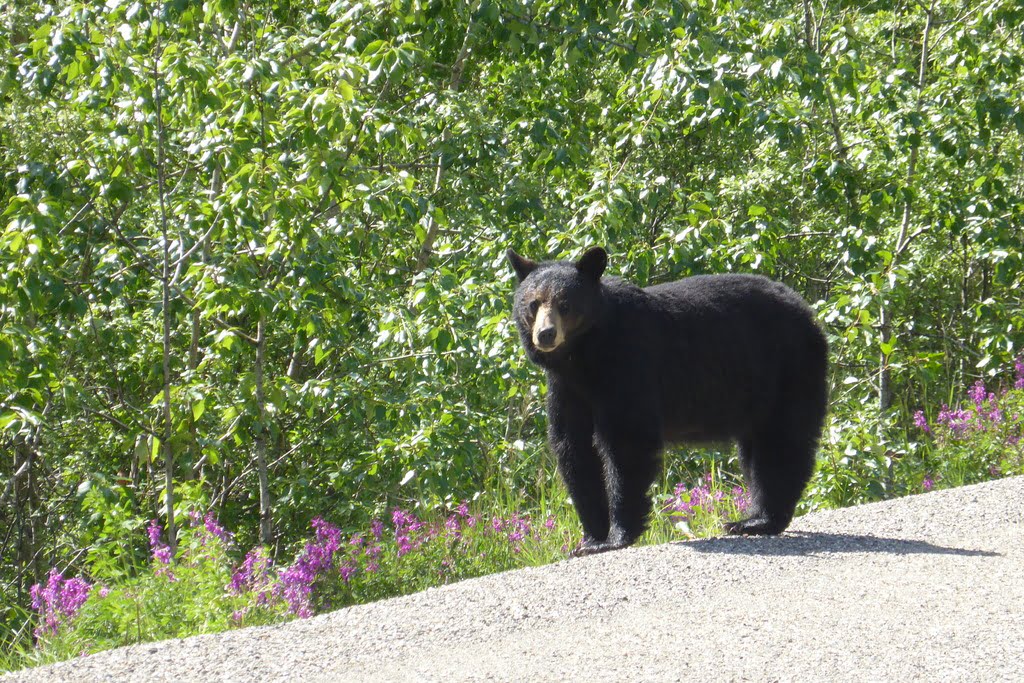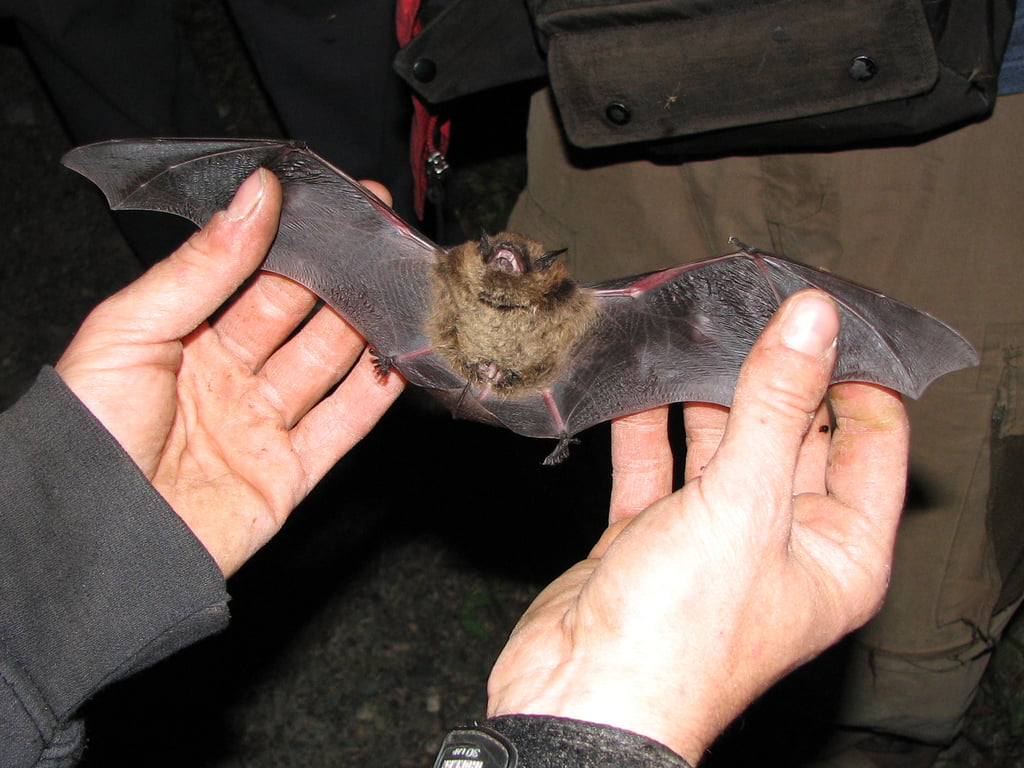
How are Animals Named?

How are Animals Named?

yukon territory

Nov 22, 2023

11 min read -

Throughout history, various languages and cultures have contributed to a wide - and often confusing - vocabulary used to describe animals' genders, the young stages of their lives and what they may be called when they are gathered together in groups.

Mule deer:
Males are called bucks. Females are called does & young are fawns.
A group of deer are often called a herd but more fun versions include a bevy, a bunch, a rangale or a parcel
- though a parcel is often in reference to a group of young deer.

Historically, adjectives were the labels of choice to communicate animal gender identifiers. A broad selection of these labels has resulted - which are not universally applied, even within the same species. For example: in the deer family or Cervidae, males are identified as bucks and females are called does. In moose, and caribou - also members of the Cervidae family - males are called bulls and females are called cows while elk males are referred to as stags.
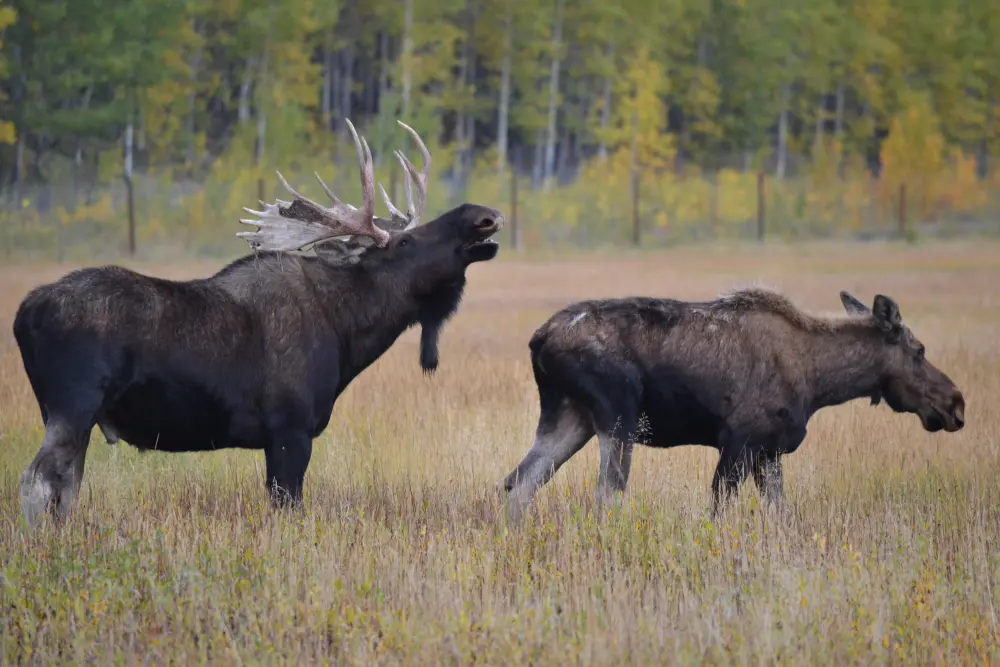
Cervids
From left to right - moose, caribou and Elk.
Males are called bulls (elk are called stags) and females are called cows.

Generally these cervids in groupings would be called herds (though moose are not actually herd animals) while elk can be also called a gang - watch out!

Not limited to just fur-bearing creatures, these titles are applied to other species and there are often departures from the naming conventions used. Rabbits are called bucks and does while steelhead trout males are called bucks, with females being called hens rather than does.

There is also a vast difference in the scientific naming of all creatures. Over the centuries a number of early scientists attempted to establish a format to classify animal groups. Ancient Chinese created the first recorded reference in 2700 BC, but it was quite limited and focused primarily on flora (vegetation) of their geographic region. 

Check out our Facebook post to learn more about Vulpes vulpes; not all red foxes are created equally but all are a red fox!

  1. Remember Fox and the Hound? A male is called a tod (sometimes a reynard or a dog), while females are referred to as vixens.
  2. Young are most commonly called kits but can also go by cubs, or pups.
  3. The collective noun to describe a group of foxes are a skulk, earth or a leash! These names are related to fox behaviour corresponding respectively as a group hunting together, a mama fox with her kits, and a group of domesticated or captive foxes as a leash.

Now, there are other foxes including Arctic fox (Vulpes lagopus), swift fox (Vulpes velox), fennec fox (Vulpes zerda), and others across the world for a total of 12 species that comprise the largest genus, Vulpes.

Smaller classifications exist within the genus Urocyon which include the gray fox. The only extant species of fox belonging to the Otocyon genus is that of the bat-eared fox found in the African savanna.

Ancient Greek philosopher and scientist Aristotle described a large number of natural groups, and although he ranked them from simple to complex, his order was not an evolutionary one. He was far ahead of his time in separating invertebrate animals into different groups and was aware that whales, dolphins, and porpoises had mammalian characters and were not fish. The Aristotelian method dominated classification for many centuries. During this period, it provided a procedure for attempting to define living things through careful analysis, it neglected the variations between living things.

In 1758 Carolus Linnaeus, who is usually regarded as the founder of modern taxonomy and whose books are considered the beginning of modern botanical and zoological nomenclature, drew up rules for assigning names to plants and animals. He was the first to use binomial nomenclature consistently. Although he introduced the standard hierarchy of class, order, family, genus, and species, his main success in his own day was providing workable keys, making it possible to identify plants and animals from his cataloging. Linnaeus was the father of the Field Guide.
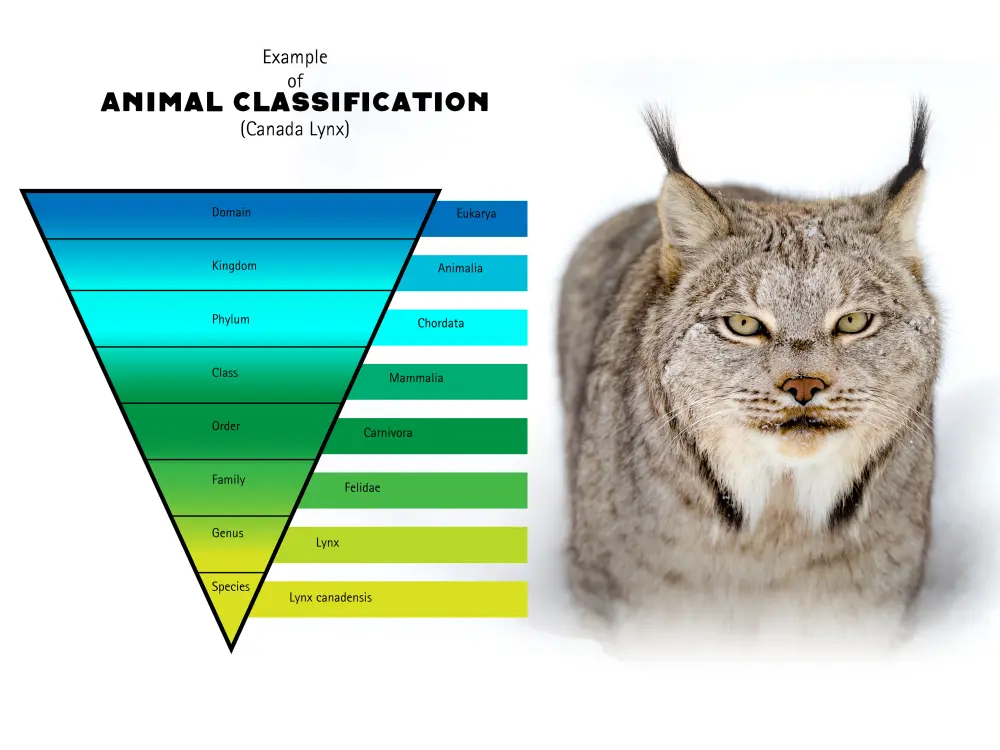
Lynx classification

Over the centuries a number of paleontologists, biologists, and scientists contributed to refining Taxonomy as we know it today. Perhaps the most notable of these was Charles Darwin - who explained his theory of evolution by describing how animals changed over time, yet still remained within specific categories in taxonomy.

Below is a table defining each classification of steppe Bison, the 15,000-year-old ancestor of today’s wood bison. As you can see, their classifications are not much different, other than identifying wood bison as a sub-species.

While their scientific classifications are very similar, the animals themselves were quite different. Steppe bison persisted through the great extinction of the last Ice Age up until about 5,400 years ago. A relatively recent find in Whitehorse city limits proves steppe bison persisted giving rise to the bison seen in the Yukon today but are not the direct descendants of the steppe bison.

Darwin’s famous illustration The Tree of Life displays the evolutionary relationships between species. This idea caused a great deal of controversy when he concluded that mankind evolved from the apes which was contrary to the religious teachings of the day.

Muskox and bison - both species are members of the Bovidea family. In this family, males are called bulls and females are called cows. The young are called calves and groups of both species are referred to as "herds". But that is where the line is drawn for their nomenclatures. The Inuit name for muskox is "omingmak," which means "the animal with the skin like a beard." Geographically, today's populations of muskox and bison do not overlap and their adaptions to winter survival as a result are very different.

We can see from this phylogenetic tree how bovids (horn bearing) and cervids (antler bearing) are related to each other. The animals with icons represent those species at the Yukon Wildlife Preserve. The Yukon has 9 of the 11 ungulates of North America, excluding the bighorn sheep and pronghorn antelope. What's also interesting to note is that mountain goats are their own genus and muskox are more closely related to sheep and goats than they are bison!

When we dive into the scientific name we can see how the classifications carry over. For instance muskox, Ovibos, share genus naming from sheep and cow. Caribou or Rangifer tarandus is reindeer in Latin, from the Greek tárandos, also meaning reindeer. So when someone asks you the difference between caribou and reindeer, you can say, nothing! (Except, reindeer fly!)

Classification tree for ungulates bovid and cervid

(Note: this a general phylogenetic tree; it is not complete and does not represent accurate branch length for amount of genetic change and complexities of sub-taxa).

Beyond the labels used for animal species, their offspring also suffer from a variety of descriptors to classify their young age. There are calves, fawns, foals, pups, cubs, kittens, chicks, hatchlings, fry and owlets to name a few. Yes, there is a lot to remember, but with practice you can master the various names used to identify animal difference.

These descriptor variations also extend to the words used to describe a group of an individual species. There are herds, colonies, congresses, tribes, swarms, flocks, droves, clutches, packs, murders, litters, pods, braces, convocations, gangs, schools, hordes, gaggles, bands, and numerous other words used to describe a group of same-species creatures. There are even names given to groupings of animals that are, in fact, unlikely to group together given their territorial and/or solitary nature - like owls, moose or wolverines.

Even within a class of animals like birds, its a complex web of classification and further to each species' grouping names.

Birds:

  • In general - Flock
  • Eagle - convocation
  • Falcon - cast
  • Owl - parliament, stare or wisdom
  • Swallows - flight, gulp
  • Swans - bevy, wedge
  • Ptarmigans - covey
  • Ravens - unkindness, rave, conspiracy
  • Magpies - tiding, mischief
  • Grouse - pack, covey
  • Crane - sedge
  • Ducks - raft in water and skein when flying
    • mallards on the ground can be called a sord
  • Geese - gaggle
  • Loons - asylum


Other mammals:

  • Squirrel - scurry
  • Wild canids, dogs - pack
  • Goats - tribe
  • Otters - romp
  • Porcupines - prickle
  • Voles - colony
  • Wolverines - mob
  • Martens - richness

Invertebrates:

  • Bees - grist, hive or swarm
  • Caterpillars - army
  • Flies - business

Amphibians (no reptiles in the Yukon):

  • Frogs - army
  • Toads - knot

Fish:

  • Trout - school
  • Salmon - bind, draught or run

It's an interesting read to understand the many different words used to describe an animal’s gender, how they are identified when they are youngsters and in groups together. Of course, the list above is centered on animals that make their home in the Yukon - imagine some of the animals that live in your neck of the woods, or places you've travelled to, and what those animals' naming classifications may be.

What is more, the naming of animal's as described by history must also recognize that many of these species, (beyond the few mentioned like Wapati and Omingnak), also hold Traditional and First Nation naming of animals that are descriptive, communicating the animals' place, use or spiritual significance.

Do you have any interesting or favourite animal classification terms/names? Share them with us in the comment section below!
Doug Caldwell

Doug Caldwell

Wildlife Interpreter

Doug is one of the Interpretive Wildlife Guides here at the Preserve. An avid angler and hunter he has a broad knowledge of Yukon’s wilderness and the creatures that live here. With a focus on the young visitors to the Preserve, Doug takes the extra time to help our guests to better appreciate the many wonders of the animal kingdom here in the Yukon.

Lindsay Caskenette

Lindsay Caskenette

Manager Visitor Services

Lindsay joined the Wildlife Preserve team March 2014. Originally from Ontario, she came to the Yukon in search of new adventures and new career challenges. Lindsay holds a degree in Environmental Studies with honours from Wilfrid Laurier University and brings with her a strong passion for sharing what nature, animals, and the environment can teach us.

867-456-7400
[email protected]

Explore by Category

Explore by Author

Uneasy neighbours: red foxes and arctic foxes in the north

Uneasy neighbours: red foxes and arctic foxes in the north

yukon territory

by Joelle Ingram | Mar 30, 2021

This article was made possible thanks to support from the Environmental Awareness Fund. Engage and educate yourself in this blog series, about Yukon Biodiversity.

15 minute read -

Once upon a time in the distant year of 2015, a Canadian wildlife photographer, Don Gutoski won Wildlife Photograph of the Year with a haunting snapshot of a red fox scarfing down the body of an arctic fox it had just killed. This grisly image titled “The Tale of Two Foxes” was heralded as a stark depiction of climate change in the north where warmer climates lead to red foxes encroaching on the territory of arctic foxes. While climate change is both a real and palpable threat to arctic ecosystems, the reasons behind the expansion of red fox ranges into the arctic and their subsequent relationship with their tiny northern counterparts isn’t that straightforward. When is it ever, am I right? Life is complicated!

Credit: Don Gutoski's photo titled "A Tale of Two Foxes" won Britain's Natural History Museum Wildlife Photographer of the Year 2015. It also sparked some assumptions and conversations about climate change and species competition in the changing Arctic. 

First off, it’s unfair to treat red foxes as an invasive pest freshly arrived on the arctic tundra. Historical fur harvest records from trading outposts in northern Canada show the presence of red foxes in the arctic starting in the early 20th century. In other words, they aren’t new to the neighbourhood. One of the popular hypotheses out there attributes the red fox’s northward expansion to the warmer temperatures caused by climate change. Milder winters definitely help red fox survival in their arctic home as they are nowhere near as well insulated as arctic foxes. But this balmy weather (balmy being a relative term, the arctic is still chilly as heck) is not the only factor behind their northern migration and it’s probably not even the main driving force; people are.

A study that compared the movement of red foxes with historical climate data and the development of sedentary settlements in the Canadian arctic found that it was the settlements, not the temperature, that was most closely linked to fox migration. Why? Well, it’s probably because we’re a great food source. If you live in Whitehorse, you do not need me to tell you that red foxes thrive around human settlements. It’s a fox paradise with all the garbage and unattended dog food that they can eat and a wondrous array of leather goods to steal. The fox that sleeps under my dryer vent probably feels like it has a very plush life. Quick question: It once left a decapitated grouse on my back porch; does that count as paying rent??

In a place like the arctic where resources are scarce, human settlements and by extension, human garbage (or “anthropogenic waste subsidies” if you want to impress your friends) can provide a relatively bountiful food source for red foxes. This isn’t really a good thing though. While both red and arctic foxes like to yummy down on some trash, human-created food sources favour the survival of red foxes over arctic foxes. This in turn could lead to diminished arctic fox populations in the future.

Red foxes are bigger and heavier than arctic foxes so when it comes to direct competition between the two, red foxes are more likely to be the victor. We already have grim photographic evidence of that exact scenario. Both types of foxes also have very similar diets, similar subsistence strategies (scavenging and food caching), and both of their reproductive success depends on having a den to shelter their pups. Leading very similar lifestyles put these two fox species in direct competition for resources. If this is the case, why haven’t red foxes wiped arctic foxes off the map? It’s probably because the relative survival of these two species isn’t contingent on a fox vs. fox death match. Sorry to disappoint. 

If I’m being completely candid with you, dear reader, when I was initially handed this topic, I was kind of hoping to write a shocking and grisly article about fox-on-fox violence. The carnage! The tragedy! Oh the terrible realities of nature! Not because I want bad things to happen to tiny foxes (I don’t), but because I am an absolute ghoul of a human being and that kind of content makes for a gripping article. Either way, this is not the case and I am legitimately relieved to know the arctic tundra isn’t strewn with fuzzy white bodies. Yes, red foxes do prey on arctic foxes but they are by no means out there slaughtering their smaller arctic counterparts into extinction. I mean red foxes also eat other red foxes, it’s the nature of well… Nature.

A group of researchers conducted a forty-year study of fox dens on Herschel Island and the Yukon’s coastal mainland to investigate the relative abundance of red and arctic foxes in the area. In those four decades, both of these fox populations remained relatively unchanged. We (and by “we” I really mean the researchers and biologists who specialize in this kind thing and not myself, a humble turnip and writer) don’t entirely understand all the factors that keep the balance between these two residents of the Yukon arctic. It’s a very complicated relationship and there’s a lot to unravel; here is what we know/can infer from previous studies.

Two major characteristics of the Yukon arctic that limit red fox expansion and increase the arctic fox’s competitive edge are a) limited food resources and b) the cold. As I mentioned before, red foxes are bigger and heavier which helps them bully arctic foxes away from food sources and denning sites but it also means they need to eat more. Both red and arctic foxes are opportunistic carnivores that feed on small to medium sized animals and the carcasses left behind by larger predators. While the arctic fox’s diet is largely reliant on lemmings, the red fox’s diet is more generalized which can help offset their greater need for food. But does it offset it enough? Nope.

During the winter, when food availability is at its lowest, red foxes are burning through a lot more energy than arctic foxes to keep warm. Obviously, they can survive the bitter chill of arctic winters as they’ve been up there for about a century. Red foxes can survive the winter, sure, but arctic foxes were designed for it. Not only do they need less food than red foxes, but they can drop their basal metabolic rate during the winter to conserve more energy and thus need even less food! Arctic foxes also have an incredibly dense winter coat so they need less energy to stay warm and they have a lighter foot-load (meaning they sink down less when they’re scooting around in the snow) so they burn less energy in transit. Arctic foxes are just super energy efficient, folks, I don’t know what to tell ya! While the red fox’s food and energy needs decrease their survival rates in the winter, arctic foxes can coast through it with a lemming and a box of tic tacs. Okay, that’s an exaggeration but you get the picture.

Their dietary requirements can also restrict red foxes spatially. We can see a good example of this if we look at the denning strategies of red and arctic foxes. Denning isn’t easy in the arctic: digging a burrow has a high energy cost and suitable denning sites are limited by the climate, soil type, and that ever-present permafrost. Here’s the real kicker, ideal denning areas and food rich areas don’t occur in the same place! Prime denning real estate is a high, dry area like a ridge, mound, or bank with coarse sediment, lots of sun exposure (i.e.: less frozen dirt to dig through) and low snow accumulation. This setup provides foxes and their pups with protection from the elements, predators and they’re less likely to get snowed in.

Food rich areas, on the other hand, are low, wet places like stream valleys where a higher yield of plant life results in a higher number of delicious rodents. Essentially the complete opposite of the ideal denning area. Great. Foxes then have to make a choice: choose a den with more protection from predators and the weather or choose a den closer to your food? Clearly, the red foxes with their greater need to feed are going to pick the den that’s closer to the buffet. Red foxes often move into dens dug by arctic foxes so they’ll effectively push arctic foxes out of these areas. However, arctic foxes have more flexibility when it comes to denning since they have lower food requirements. When red foxes and arctic foxes are occupying the same area, arctic foxes will prioritise dens with great predator protection and lower food density. When red foxes aren’t around, arctic foxes will favour dens closer to food rich zones instead.

With all this considered, the effects of climate change should have increased the red foxes dominance of the tundra. Warmer winters decrease the arctic fox’s advantage over red foxes and warmer weather increases the amount of plant growth and, in turn, the amount of rodent-based food sources. However, this hasn’t happened. Why? Researchers believe that the answer to that also lies in climate change and the food-related limitations of the red fox. Seal carcasses left behind by polar bears are a really important food source for foxes in the arctic. The warmer temperatures caused by climate change are reducing the ice sheets, increasing the ice-free season, and changing the patterns of seasonal ice flow. All of this is putting stress on polar bear populations and stressed polar bears likely lead to fewer seal kills and thus fewer seal carcasses. Climate change giveth, climate change taketh away, I guess.

It’s also been noted in Sweden and Norway that global warming is actually dampening rodent reproduction rather than increasing it. The resulting drop in the rodent population is having a negative impact on the arctic fox populations in these regions. If the same is true in the Yukon, it would have an even larger negative effect on red foxes due to their greater resource needs. Unfortunately, we’re lacking long term data on rodent populations in the Yukon so we don’t know if this is the case or not.

This complicated web of physical needs, adaptations, and environmental factors have led to this not entirely understood balance between two fox species and who knows which ways the scale will tip in the future. There is one thing I can tell you for sure though: previous studies have shown that an effective way to increase or reduce red fox populations is the addition or removal of human-related waste. This isn’t so much an issue in the mostly-vacant Yukon arctic but in other arctic regions with mining or oil drilling operations, it poses a potential problem. Red foxes aren’t a horrible invasive species laying waste to adorable arctic foxes but a garbage-induced boom in red fox population could negatively impact their little arctic counterparts. So clean up your garbage, don’t feed foxes, and rest a bit easier knowing that while climate change is messing up the arctic, at least it’s not inducing a fox war up on the tundra. It’s really more of a muted territorial scuffle.

Joelle Ingram

Joelle Ingram

Human of Many Talents

Joelle is a former archaeologist, former wildlife interpreter, and a full-time random fact enthusiast. She received her master’s degree in anthropology from McMaster University. One of the four people who read her thesis gave it the glowing review “It’s a paper that would appeal to very specific group of people,” which is probably why only four people have read it. Her favourite land mammal is a muskox, her favourite aquatic mammal is a narwhal. She thinks it’s important that you know that.

867-456-7400
 [email protected]

Explore by Category

Explore by Author

The Dangerous and the Benign: distinguishing between big scary bugs

The Dangerous and the Benign: distinguishing between big scary bugs

yukon territory

by Joelle Ingram | Mar 25, 2021

This article was made possible thanks to support from the Environmental Awareness Fund. Engage and educate yourself in this 10-part blog series, about Yukon Biodiversity.

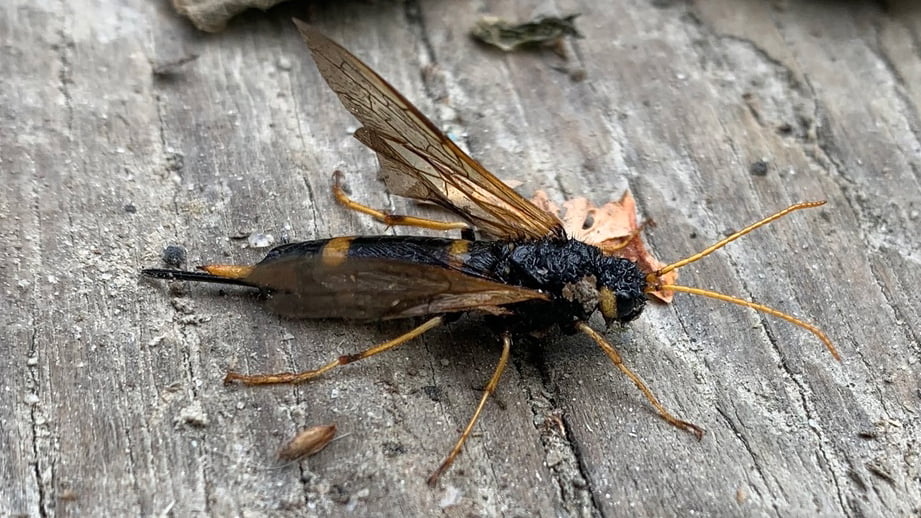
Banner Photo:  Yellow-tailed Horntail.  Photo credit: iNaturalist griffontrail in Dawson YT.

12 minute read - 

I think we can all agree that the past year has been pretty rough with the fires and the pandemic and the political unrest. When you add the appearance of large and intimidating Asian giant hornets on our fair continent, it makes it feel like we’re living through some biblical plagues. For those of you who have not been hysterically following the news, the Asian giant hornet (aka “the murder hornet”) is a massive hornet that earned its ominous nickname from its fun habit of decapitating hundreds of bees at a time and then carrying off the bee babies (the babees) to feed its own young. Also they sometimes kill people. Yikes. In the spring of 2020, they added to the general calamity that was all of last year by popping up in Washington, DC where the U.S. residents were understandably upset to have this horrible serial killer hornet added to their ecosystem.

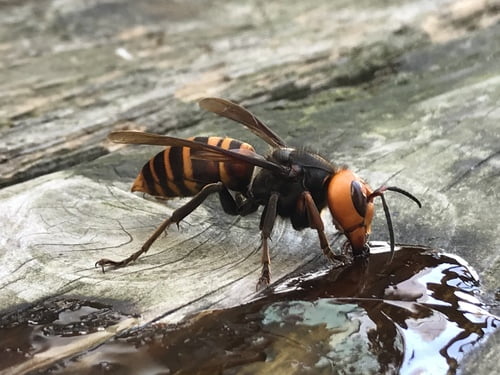
iNaturalist observation of an Asian giant hornet.  No iNaturalist observations are to date recorded in Canada.  Photo Credit (c) Wonwoong Kim, all rights reserved

Obviously, the North American invasion by Asian giant hornets wasn’t kept secret and word traveled all the way to our remote territory. It’s probably because of this news that when a large insect with a prominent “stinger” and suspiciously hornet-like colouring was spotted during the Yukon Wildlife Preserve Bioblitz, some people got very nervous! But fear not, fellow Yukoners! The Yukon is a deeply unappealing habitat for the coast-loving murder hornets. The insect that garnered so much attention at the Bioblitz due to its large, scary appearance and prominent butt-spike is only a threat to felled trees. This benign bug is a horntail also known as a “wood wasp” (of the family Siricidae) and it could not be less like the invasive death machine it was mistaken for.

On the Left:  Yellow-tailed Horntail.  Found in Yukon.  iNaturalist Photo Credit M_Mossop

On the Right:  Asian giant Hornet.  Not found in Yukon.  iNaturalist Photo Credit (c) Alpsdake, some rights reserved (CC BY-SA)

Before we examine these insects in detail, a quick addendum. While scientists and academic types should never let personal bias cloud their research, I am not a scientist nor particularly academic so prepare for some bias. I HATE insects of the wasp/hornet variety. I mean the kind of loathing that would start a centuries long blood feud between families in olden times. Yes, they get props for being pollinators in their spare time but oooooh my god. These stripey menaces ruin every summer outdoor dining experience by completely disregarding your personal space and then rendering your beverage undrinkable after they drown themselves in it. Also, if they sting me, I die and that dynamic would sour any relationship. With that out of the way, let’s meet these bugs!

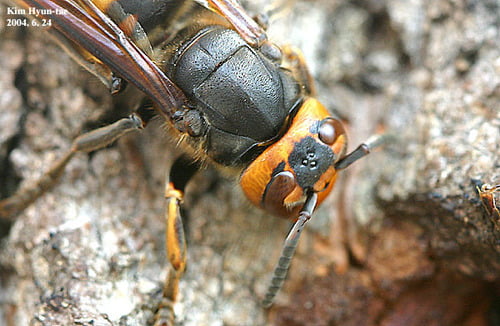
The Asian giant hornet or Vespa mandarinia (which sounds like a particularly elegant moped) is aptly named as it is the world’s largest hornet! Worker hornets are 3.5 cm long while queens get up to 5 cm. Their wingspans range between 4-7 cm which is probably more bug than the average person wants to deal with. If their size isn’t a giveaway, their large orange heads and black eyes make them very recognizable.

iNaturalist observation Asian giant hornet.  Photo credit: (c) Kim, Hyun-tae, some rights reserved (CC BY)

Unlike a lot of other hornets and wasps, these big hornets only nest in the ground. They favour forested areas in coastal environments which is bad news for our west-coast brethren but good news for the Yukon which is notably low on hospitable coastal regions. During the one-year life cycle of a nest, worker hornets usually forage alone and mostly hunt for beetles. The dark and sinister nature of these hornets rears its head in the fall when the colony needs a lot of protein to raise the next generation of queens.

In order to bring in the protein required to beef up their queens, workers abandon solo-foraging missions and band together for group raids. These raids attack high-value targets like the hives of honeybees or even the hives of other hornets. When these raiding parties hit a hive, they decapitate all the adults like they’re doing a re-enactment of the French Revolution then cart off the brood for food. These murder hornets really live up to the moniker as they can kill off thousands of bees in a few hours. Bees are already on a dangerous decline and Asian giant hornets can absolutely devastate local bee populations. This makes their appearance in America and Canada especially concerning.

Although the sudden appearance of murder hornets would be very on-brand for 2020, Asian giant hornets have been in North America before. They were discovered in Nanaimo, BC in August 2019 when beekeepers found a destroyed nest with a whole heap of headless bees outside of it. Their appearance in Washington is just an extension of their coastal conquest. Fortunately, the number of murder hornets in North America is still pretty low. This is good news for humans as people deaths from Asian giant hornets are usually due to disturbing a nest and incurring many stings. Unless you have an allergy (like some people who wrote this article), you have high chances of surviving a murder hornet attack if you have less than fifty stings. Rest easy, I guess? That being said, the Washington State Department of Agriculture had to order special suits to study Asian giant hornets because their massive stingers can pierce through normal beekeeping gear so maybe rest less easily.

It’s time to ease yourself into the warm waters of relief because the horntails that hang out in the Yukon are nothing like this. They’re not invasive, they don’t sting, and unless you’re a dead tree, they pose absolutely zero risk to your health and wellbeing. Yes, wood wasps are also intimidatingly large and similar in size to Asian giant hornets. They range in size between 1-4 cm with females tending to be larger than their male counterparts. Horntails get their name from their cornus: a stinger-shaped plate on the back of their body. Horn. Tail. Geddit? Even though it looks like a stinger, rest assured that it isn’t. Horntails don’t sting or produce venom and don’t really have any defenses other than looking scary. Females in particular look like they have a MASSIVE stinger but it’s actually an ovipositor that helps them lay their eggs into the wood of conifer trees.

iNaturalist image Yellow-tailed Horntail.  Whitehorse YT  Photo credit:  Jake Paleczny

Here’s a fun fact: female horntails have a symbiotic relationship with a fungus! Similar to horntails, basidiomycete wood decay fungi enjoys a nice rotting log. Female horntails help this fungus spread to new locations by carrying bits of it in a specialized pouch on their abdomen. When the female lays her eggs, she also deposits the fungus inside the rotting wood. The horntail also benefits from this arrangement as the larvae get to snack on the fungus after they hatch.

Unlike the newly arrived murder hornet, we’ve probably had horntails in the Yukon as long as we’ve had conifer trees. The reason you might not run into them all the time is that they spend most of their lives inside a tree. After a female lays her hundreds and hundreds of eggs in the wood of a felled or rotting tree, the young hang out in that log for 1-3 years. After they emerge from their timber home as a fully grown adult, they only live for 3-4 weeks! Because they spend so much time in wood, young adults sometimes show up inside people’s homes because the lumber they’ve been tunneling around in has been used as construction material. So they’re not out there murdering bees and giving horrible stings but they can occasionally give you a nasty surprise by exploding out of your new rocking chair.

iNaturalist Yukon.  Yellow-tailed Horntail.  Photo Credit:  Bruce Bennett

I hope your fears are assuaged and you won’t dread painful stings and bee death when you encounter a big scary bug in the Yukon wilds. The horntail might be intimidating in appearance, but it’s a passive insect that just wants to spend most of its life noodling around in a tree. Asian giant hornets are definitely horrible nightmare insects that were probably manifested into existence as punishment for our sins but at least they’re horrible nightmare insects that don’t live up here.

iNaturalist Asian giant hornet resting on human hand.  Photo credit:  (c) elfsama, some rights reserved (CC BY-NC)

Joelle Ingram

Joelle Ingram

Human of Many Talents

Joelle is a former archaeologist, former wildlife interpreter, and a full-time random fact enthusiast. She received her master’s degree in anthropology from McMaster University. One of the four people who read her thesis gave it the glowing review “It’s a paper that would appeal to very specific group of people,” which is probably why only four people have read it. Her favourite land mammal is a muskox, her favourite aquatic mammal is a narwhal. She thinks it’s important that you know that.

867-456-7400
 [email protected]

Explore by Category

Explore by Author

Bear Poo and You: learning about Yukon Bears with the OURS research project

Bear Poo and You: learning about Yukon Bears with the OURS research project

yukon territory

by Joelle Ingram | Mar 19, 2021

This article was made possible thanks to support from the Environmental Awareness Fund. Engage and educate yourself in this 10-part blog series, about Yukon Biodiversity.

Banner Photo:  Grizzly bear scat.  iNaturalist OURS page Photo Credit Lucile Fressigné

15 minute read -

If you, like me, grew up in the Yukon, bear awareness training has been part of your life since you were a wee child. Some combination of videos and booklets have let you know that yes, bears sure are out there and this is what you should do in response to a variety of bear encounters. But here’s the thing, just how aware of bears are you really? The Yukon is renowned for its bears but there are actually some gaps in our bear knowledge, particularly when it comes to just how many bears are actually out there! Population size is important for studying everything from the spatial distribution to the health of a species, but there hasn’t been a bear survey in the Yukon since the 1980s. Unless the Yukon bears are both immortal and not having babies, that information is a touch outdated.

Lucile Fressigné is leading an on-going study that seeks to fill in this gap in bear population knowledge. Starting in 2020, she started a community-based project to survey the Yukon’s bear populations in a creative way that also doesn’t bother the local bears: by collecting their scat! That’s right, Operation Ursus Research using Scat (OURS) is aimed at updating and providing a scientifically reliable estimate of the population size of Yukon bear species using a non-invasive DNA-based method that relies on scat samples. Last year, the study focused on collecting samples in the Mount Lorne, Marsh Lake, Tagish, and Fish Lake areas of the territory. Fressigné offers Yukon residents the opportunity to be part of this project and help build this sample collection by offering free collection kits that can be dropped off at community centres in the study areas. Yes, you too can take part in bear science!

OURS aims to get an estimate on both grizzly (Ursus arctos) and black bear (Ursus americanus) populations. These bears tend to be especially difficult to inventory and monitor as a low number of bears will occur over a large home range and they tend to be avoidant by nature. Grizzlies are the largest of the two and are very distinctive with their dished face profile and defined shoulder hump. They are often referred to as “brown bears” but their colours can range from white to almost black. They most commonly have “grizzled fur”: a deep brown with lighter ends. Apparently, no one told them that frosted tips went out of style in the early 2000s.

Grizzly Bear iNaturalist Photo Credit L to R:  Cameron Eckert, Bdobrowo, and OURS Facebook page.

In 2018, grizzlies in western Canada were designated as a species of special concern. This means that they are a species that does not meet the criteria of an endangered or threatened species but is particularly vulnerable, and could easily become endangered, threatened, or extirpated. This rapid loss of population could happen from a variety of factors such as restricted distribution, low or declining numbers, and/or specialized habitat needs or limits. One of the many benefits of having a population estimation for grizzly bears is that it can help provide a basis for a proactive conservation strategy.

Black bears, as the name would suggest, are most often black but can also be blonde, grey, cinnamon, and brown (in which case, the name is very misleading). They have a straight face profile and lack the shoulder hump present in grizzlies. They also lack the species of special concern status but this doesn’t necessarily mean there are more black bears in the Yukon because, like grizzlies, the last time there was a black bear population estimate was in the 90s. Without an updated population estimate, we really don’t know if we should be concerned about them as well.

Black Bear iNaturalist Photo Credit L to R: Cameron Eckert, YukonAnnie, John Meikle

At first blush, scat analysis might not seem like the most appealing method for studying bear populations but there are a lot of advantages to this method. First of all, it’s incredibly non-invasive when compared with methods like radio collaring. In order to get a collar on a bear, they have to be tranquilized which can result in the injury or even death of the bear (bummer!). The injection site can get infected, the radio collar can get snagged, and there’s a lag between when the dart hits the bear and when the tranquiliser takes effect. During this lag time, bears can run out into a body of water where they can’t be recovered because ursine lifeguards are not a thing.

Hair snags are another non-invasive method for population estimations. This is the most common method of population analysis and it’s done by placing a tantalizing lure near a string of barbed wire. When an animal comes for the lure, they leave a cheeky tuft of hair behind. However, scat analysis doesn’t need a lure/barbed wire setup, you can find it everywhere bears dwell, and it is very easy to identify whereas hair tufts can be tricky to spot. Odds are, if you spend some time in the woods, you’ve come across them before. And believe it or not, there is a ton of information to be gained from analysing bear body waste!

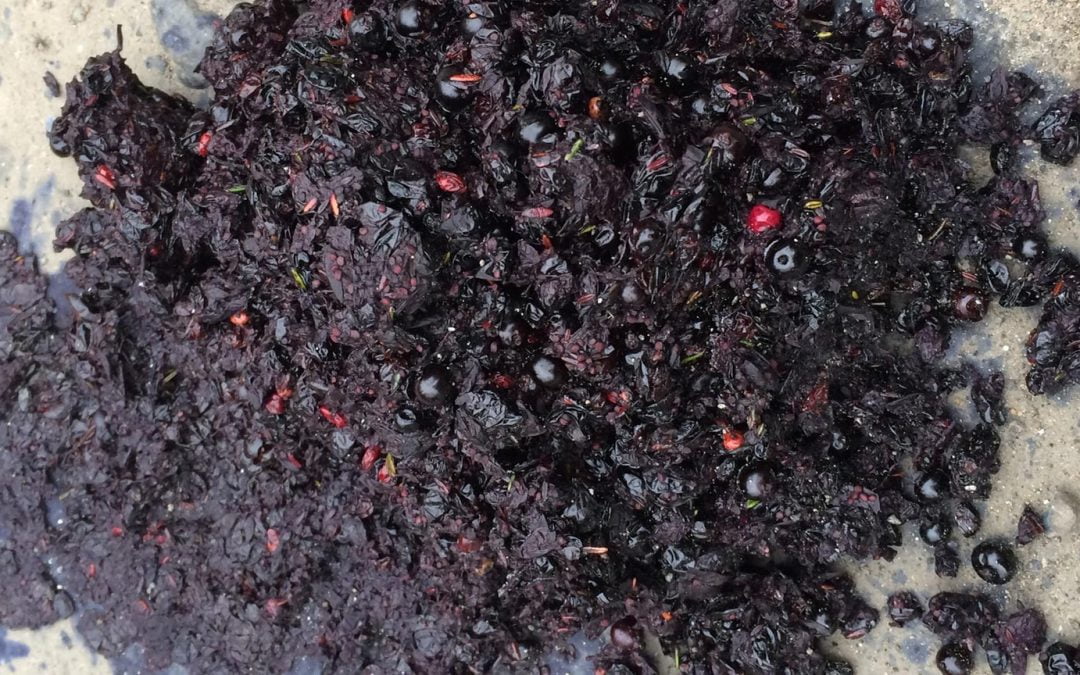
Bear Scat.  iNaturalist Photo Credit L to R:  Grizzlyann, Gerald Haase, Lucile-OURS.

Because scat is found wherever the bear decided to leave it behind, it tells you where and generally when the bear has been so it’s very useful for identifying bear habitats. The DNA analysis technique used on these scat samples is called Genotyping in Thousands by Sequencing (GT-seq). This method can extract information regarding the species, sex, and individual identity of the bear. Knowing this poop-extracted bear information can help scientists track the movement and migration of individual bears as well as trends in bear parentage! Scat also contains cortisol (the stress hormone) which can be used to monitor the relative stress levels of the local bear populations. This can be really important for bear conservation because it can tell us whether bears in certain areas are experiencing more stress than others (are bears living by highways more stressed than those that don’t, for example).

We are generally aware of what bears are eating but scat analysis can give us specific statistics regarding how often and how much bears are consuming of different foods. It also helps chart changes in diet. If one food is present one year and absent the next, this might indicate environmental changes that made this food source inaccessible. OURS can also see how bears are affecting their food sources in turn. As part of this project, Fressigné is partnered with the Kwanlin Dün First Nation who are interested in how or if bear predation is affecting the declining moose population in the Fish Lake area.

The goal of the first season of research was to test the community-based sampling method and generally gauge the public’s interest in the project. It was an opportunity to implement new genetic technology on the collected samples and to test whether the scat collection methodology would yield enough useable DNA. It also aimed to identify the presence and distribution of bears in the sampling areas. Moving into the second season of sampling, OURS is going to adopt a more rigorous sampling method by hiring students to run survey transects in the study area and by partnering with more First Nations and groups that are involved in traveling and exploring through the Yukon wilderness. This includes hunters and trappers, tourism companies, mining companies, summer camps, schools, and very lost tourists. Just kidding on the last one, being a tourist is both dangerous and illegal at the moment.

The OURS project is primarily about providing a population estimate but it’s more than just a bear abacus. Studying the genetic markers in bear scat reveals information about the genetic diversity in bear populations. This work also helps emphasise how important it is to maintain this diversity in order to keep these vulnerable apex species healthy and stable. The groovy analysis from these scat samples will also provide tons of info about bear stress levels, parentage, and the trends and impacts of bear predation. Who knew poo could be so educational?

Bear Scat.  iNaturalist Photo Credit: 1st Alisonp, 2nd and 3rd Grizzlyann

The project is important for future bear conservation efforts and not just because it gives us an approximate bear count. This study can be used to monitor the impact of climate change on bear behavior and population trends. Continued bear scat surveys can also reveal critical/preferential habitats for bears, and lead to the restoration of these habitats or the creation of protected areas that would minimize human/bear conflicts. Which is great because I don’t know about you, but I don’t want to fight a bear. But in all seriousness, these types of conflicts tend to end badly for the bears so it’s best if they can be mitigated or avoided entirely.

As you can see, there are a lot of benefits to the non-invasive, cost effective, kind of smelly, and highly informative research method of scat sampling. This method will hopefully allow the OURS project to collate an estimate of our Yukon bear populations and improve the scope of our bear-related knowledge. If you want to learn more about the project, check out the OURS Facebook and iNaturalist page and consider, come this spring, being part of the bear bowel movement collection crew!

OURS Facebook: https://www.facebook.com/OURS.lf
OURS iNaturalist: https://www.inaturalist.org/projects/operation-ursus-research-using-scat

Joelle Ingram

Joelle Ingram

Human of Many Talents

Joelle is a former archaeologist, former wildlife interpreter, and a full-time random fact enthusiast. She received her master’s degree in anthropology from McMaster University. One of the four people who read her thesis gave it the glowing review “It’s a paper that would appeal to very specific group of people,” which is probably why only four people have read it. Her favourite land mammal is a muskox, her favourite aquatic mammal is a narwhal. She thinks it’s important that you know that.

867-456-7400
 [email protected]

Explore by Category

Explore by Author

Welcome to the Neighbourhood!

Welcome to the Neighbourhood!

yukon territory

by Joelle Ingram | Jan 29, 2021

This article was made possible thanks to support from the Environmental Awareness Fund. Engage and educate yourself in this 10-part blog series, about Yukon Biodiversity.

15 minute Read 

How do you feel about bats? Personally, I love bats: they’re cute and fuzzy and they eat a lot of bugs. What’s not to like? And while a lot of Yukon wildlife can be very illusive and requires patience, luck, and a lot of time in the woods to see, bats are happy to hang out in your neighbourhood so you can view them nightly as they snack on bugs. They’re very courteous like that.

In the Yukon, one bat species in particular prefers life in the city and really likes to roost in buildings. Let me introduce you to Myotis lucifugus or “little brown bat” to its friends. The Yukon’s little brown bats are very interesting: some bat species don’t do well in urban environments because there tend to be fewer insects to eat and a lot of noise and light pollution that make hunting for those bugs difficult. Bats who are used to a more natural setting can also have trouble utilizing urban roosts. Not so the case for the little brown bat. A recent study revealed that Yukon settlements are important roosting habitats for these endangered bats and they actually prefer roosting in town rather than out in the woods. But first, let’s learn more about the bats themselves.

The little brown bat is both little and brown as the name suggests; adults only weigh around 5-14 grams and have a wingspan of 25 cm. These bats have a surprisingly long lifespan for a small mammal. They can live into their 30s as long as disease or an owl doesn’t take them out. Like almost all other bats, the little brown bat is nocturnal and does all its feeding at night. Little brown bats are insectivores (they eat bugs) and they’re opportunistic feeders, meaning they eat whatever insect is available. Typically, their diet includes moths, flies, mayflies, beetles, midges, and mosquitoes and in the Yukon, they’re eating A LOT of mosquitoes. They generally have two or more rounds of feeding per night with one at sunset and the other before sunrise. In between, they’ll park themselves in a night roost to digest and conserve energy. A single bat eats half of its body weight in insects every night which means they’re consuming hundreds and hundred of bugs! They’re a very important part of the boreal forest ecosystem because they help control insect populations.

However, the good name of these little sky mice (they’re not really mice) is often besmirched because they can carry diseases. But if 2020 has taught us anything, it’s that humans do that too so let’s not hold that against bats. It can also occasionally be a bad time if they decide to set up shop in your house. In fact, the only time I did not love bats is when they were roosting in the ceiling of my cabin and a heavy rainstorm caused a waterfall of bat poo to wash down the chimney hole. Fortunately, with a little elbow grease and some strategically placed bat houses, that’s no longer a problem. More on that later (the bat houses, not the guano waterfall).

Female little brown bats usually show up in the territory during the last two weeks of April to form maternity colonies, which are made up of anywhere from a dozen to several hundred females. Just whole bunch of bat gals being bat pals. Late April in the Yukon is pretty chilly and the insects are still waking up, so the females are pretty sluggish and not very active. They’re also waking up from a multi-month hibernation so give them a break. Males show up a bit later, usually in May, and either form their own colonies or just hang out by themselves.

Julie Thomas sets up a detector in the feild. Learn more about bat talk in the Yukon with Joelle's blog: How do you listen to what you can't hear?

Little brown bats mate in the fall but fertilization doesn’t happen until spring once the female wakes up from hibernation. Gestation takes 50 to 60 days and the bat babies, known as “pups” (aw!), are born in June and July. Females only give birth to a single pup so I guess that means that every bat pup has only child syndrome (kidding, kidding).

Since there are no insects around in the winter, the little brown bat needs to build up fat reserves during the summer to carry them through the cold months. In order to conserve winter calories, the little brown bat generally go into hibernation around October or November but can go into hibernation as early as September. These little guys are true hibernators which means their metabolism, heart rate, and breathing slow to a crawl and they go into a very deep sleep. Their winter hibernation sites are usually in caves and are called hibernacula, which sounds like Dracula’s sleepy cousin. Little brown bats usually disappear from the Yukon around mid-October. There are no known hibernacula in the territory and it’s suspected that hibernation happens elsewhere. Bats can migrate hundreds of kilometres between roosting and hibernation sites so the Yukon populations likely winter in known hibernacula in Prince of Wales Island in southeast Alaska (400 km south of the Yukon) or possibly Wood Buffalo National Park, Alberta (500 km east of the Yukon). Strangely enough, the reason bats leave the territory in the winter isn’t because we don’t have caves (we do), or because of the cold (although that would be understandable). It’s likely they don’t stick around because it’s too dry. There is so little moisture in our winter air that bats could die from dehydration while hibernating and that would be a real bummer.

A harp net trap is used capture bats without exposing them to disentagling. This harp net is set up at the base of the Squanga Lake bat house to capture bats exiting at dusk.  Photo credit: Justine Benjamin

Little brown bats are habitat generalists meaning they can live in a variety of different places and this flexibility is why they do so well in urban environments. They form their roosts in tree cavities, under tree bark, in rock crevices, caves, and, of course, man-made structures. Little brown bats tend to forgo the tree option in the Yukon as the trees are too small to host large maternity colonies. Bat home-hunters are looking for dead trees with trunks that are at least 40 cm in diameter that get a lot of sunlight to keep them nice and toasty during their day snooze. As you might imagine, the asparagus-esque trees of Yukon don’t offer many candidates that tick all these boxes, so the little brown bat sets it sights on that sweet suburban life.

Because of their habitat choice, the Yukon’s little brown bats are considered synurbic. The term “synurbic” is fun to say out loud and refers to animals that are more abundant in urban centres than they are in the surrounding forest. The rapid expansion of human settlements is a major conservation issue because it infringes on the natural habitat of many different species of animal. Fortunately, little brown bats are apparently the embodiment of “Improvise. Adapt. Overcome.”, and they are doing quite well in their northern urban environment.

A recent study conducted around Carmacks, Haines Junction, and Teslin noted that the little brown bat colonies in these areas were concentrated around the rural villages. The advantage of small towns over large urban settlements is there is a lot less light and sound pollution. Buildings also make excellent roosts; they give females a cozy place to raise their pups and can actually lead to faster growth rates in their young. Bats can also take advantage of the linear, open corridors created by roads and hydro lines for energy efficient commuting and foraging. Flight is exhausting and bats have very few hours of darkness to eat a lot of bugs so they need all the help they can get.

Where are these little bats flying off to? If towns are for bat apartments, then wetlands and old forests are bat grocery stores so naturally, little brown bats prefer buildings near some form of wet. While people places offer an ideal nap zone, there is a better bug density elsewhere. When bats need a snack, they head for wetlands, swamps, or mature forest. Young forests can be too cluttered but older forests have the open areas these bats crave. Less obstacles, easier travel, baby! Also, if you have ever had the dubious privilege of hanging out around a swamp at any time of day, you will know that if bugs were a large component of your diet, you would be very full.

Despite the people houses and the wetlands, at first blush, the Yukon doesn’t seem like the ideal environment for bats. They have to contend with colder temperatures and limited bug availability at the beginning and end of their foraging season. The extended summer daylight hours in the Land of the Midnight Sun limits their nighttime activity periods. So why does the Yukon have a healthy little brown bat population while their numbers are in decline all across the continent? Well, things are about to get sad.

Habitat destruction definitely has a negative impact on bat populations, but bats are also dealing with a plague of their own. White-nose syndrome (WNS) is a disease caused by the fungus Pseudogymnoascus destructans that grows on bats as they hibernate in caves. The fungus appears as a white fuzz on the nose, wings, and ears of hibernating bats. It damages muscle tissue and blood vessels and causes bats to dehydrate by sapping water and electrolytes from their wings. Bats afflicted with the fungus will become more active and wake up too frequently during hibernation meaning they’ll burn through their fat stores too quickly and will have no way to replenish them. Essentially, WNS causes bats to starve to death.

Since WNS showed up in North America in 2006, it’s killed off millions of bats and caused steep declines in the bat populations of eastern Canada. It’s making its way across to the western half of the country but it hasn’t made it up to the massive boreal forest that makes up northwestern Canada which makes it an important conservation area for this rapidly disappearing species. Especially so as the microclimates of the boreal forest may be unsuitable for the growth and spread of the fungus responsible for WNS.

While we’re in the neighbourhood, let’s keep getting depressing. Bat populations do not recover quickly if they do recover at all. They’re sensitive to environmental change (and face fungus) and with one pup per female per year, it’s slow to rebuild lost numbers. With this in mind, preserving existing bat populations is a more sure-fire method of conservation than trying to rebuild them.

Alright, enough with the sad, onward with the hopeful. There are a bunch of ways that you and I and all Yukon residents can help our bat neighbours. First and foremost, protecting wetlands and ponds, especially those near residential areas, is important not only for keeping bats fed, but also for frogs and aquatic birds. It’s also important to provide them with a safe and accommodating roosting area. There are some great benefits to having bats living in or around your home and many people live comfortably with bats roosting in one of their buildings. They snarf up a lot of the bugs that haunt you during the summer and their guano is fantastic for fertilizing gardens.

However, as I mentioned earlier in the article, sometimes having bats roosting in your roof can sometimes lead to guano geysers hosing out of your ceilings and that’s not great (admittedly, those were some extreme circumstances). If you need to relocate your bat roomies, you need to do so carefully. First, have an alternative roost available. You can purchase a bat house at http://canadianbathouses.com/ or, if you’re feeling crafty, you can find instructions to build your own online (https://yukon.ca/en/building-yukon-bat-nursery-house). You may have to wait until the bats leave in the fall/winter then block the cracks and crannies they use to enter your home. This will encourage them to move to their new roost when they show back up in the spring! It’s important that you don’t block gaps that bats use to enter and exit your home during the summer months when bat pups will get trapped inside. For details on how to comfortably co-exist with your new bat neighbours and report your bat sightings to [email protected] to help with continued bat research!1https://yukon.ca/sites/yukon.ca/files/env-bats-buildings.pdf

The boreal forest is at the northern edge of the little brown bat’s range which means there’s less chance of them interacting with bats that have been affected by white-nose syndrome. Although the trees are too thin and the winters are too dry, human settlements provide essential roosts that the Yukon’s forests can’t deliver and our wetlands are a deluxe buffet for insectivores. Preserving Yukon wetlands and waterbodies and being kind to your little winged neighbours plays an essential role in preserving the endangered little brown bat. Also, it would be super cool of you.

Joelle Ingram

Joelle Ingram

Human of Many Talents

Joelle is a former archaeologist, former wildlife interpreter, and a full-time random fact enthusiast. She received her master’s degree in anthropology from McMaster University. One of the four people who read her thesis gave it the glowing review “It’s a paper that would appeal to very specific group of people,” which is probably why only four people have read it. Her favourite land mammal is a muskox, her favourite aquatic mammal is a narwhal. She thinks it’s important that you know that.

867-456-7400
 [email protected]

Explore by Category

Explore by Author