Feathered Friends in Rehabilitation

Feathered Friends in Rehabilitation

animals of the world

by Lindsay Caskenette | Nov 3, 2023 | 0 comments

1 minute read - 

Generally, this time of year, the Wildlife Rehabilitation Centre is a lot more quiet than in the months leading up to fall. But in the final days of October the Centre got feathered with some new arrivals. 

October 30th, 2023 Conservation Officers from Dawson brought in a mature bald eagle that was observed to be weak, unable to fly and found near a road being harassed by ravens and magpies. The bird was severely underweight. Being on the ground for an unknown amount of time, the birds tail feathers were damaged. Upon its admittance, the bird eagerly ate and some fluids were administered.

mature bald eagle in rehabilitation

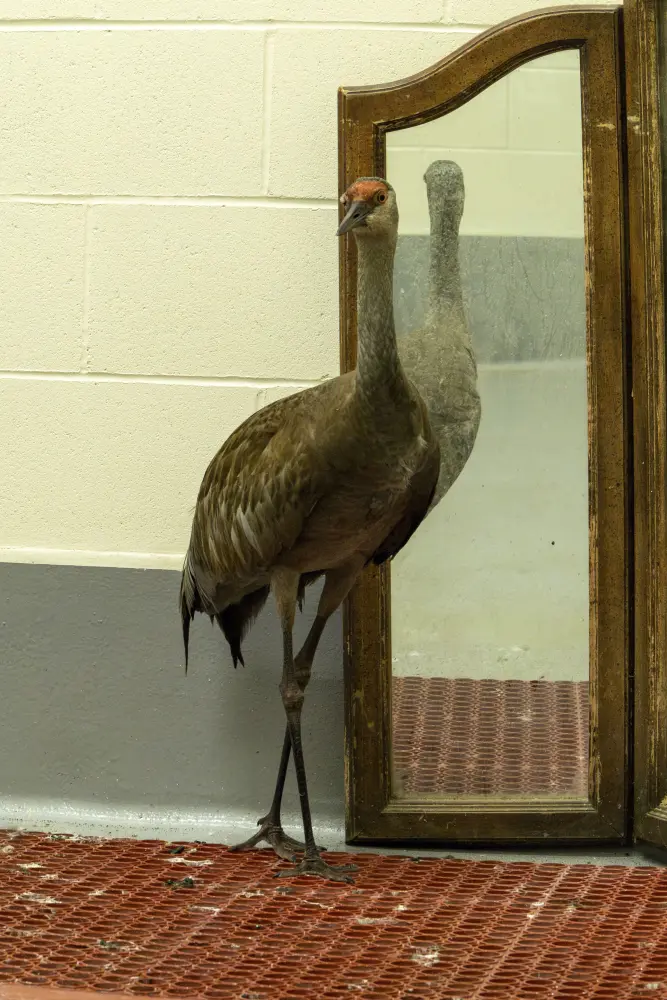
The next day, the Animal Health Unit of the Department of Environment brought a sandhill crane that was unable to fly. Similar to the eagle it was being harassed by scavenging birds. The bird has two lacerations, one of the left eyelid that is not affecting the eye and another on the left tip of the wing. Without much information to these injuries, Dr. Maria Hallock is ensuring they are cleaned and sanitized. The crane is given meloxicam, nonsteroidal anti-inflammatory drug (NSAID), to relieve pain and swelling. 
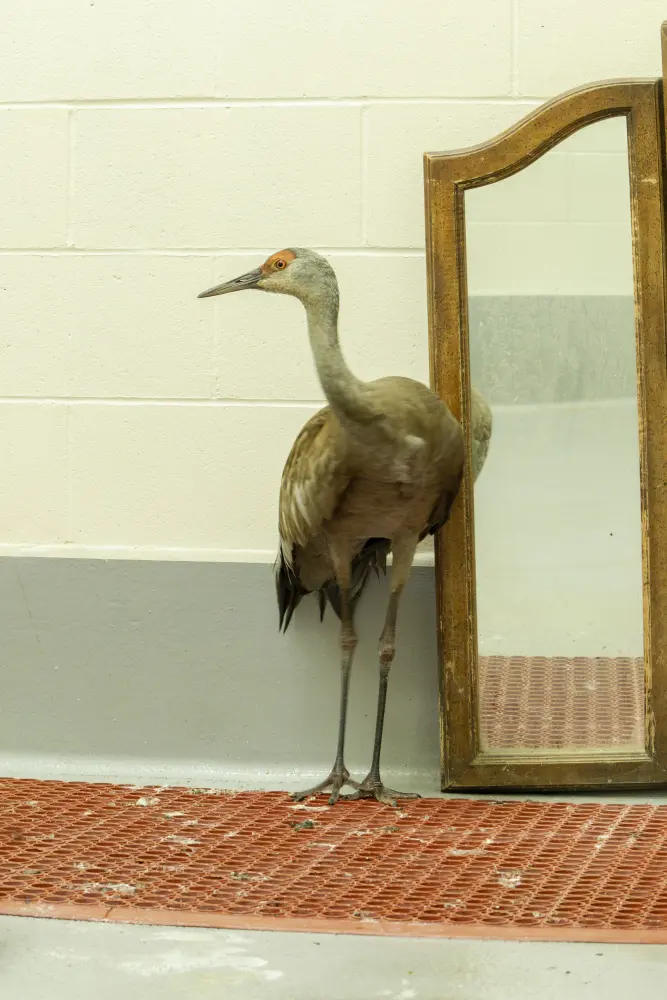
Now both birds just need time to heal, good food to gain weight and protection, while they return to normal health condition. We expect both animals to make a full recovery and be released back into the wild.

Since the crane should be already venturing down-south for Fall migration, the Preserve will look to some rehabilitation centres in B.C. that could admit the animal to provide its final phase of care after we give it a one-way ticket South via Air North!

Help us get them back on their wings. We could use your help. If you are able to support the care of these two animals, please consider donating. Every contribution makes a difference and as a non-profit charitable organization, you can receive a charitable tax receipt for your support. 

Photo credit: B.Forsythe

Lindsay Caskenette

Lindsay Caskenette

Manager Visitor Services

Lindsay joined the Wildlife Preserve team March 2014. Originally from Ontario, she came to the Yukon in search of new adventures and new career challenges. Lindsay holds a degree in Environmental Studies with honours from Wilfrid Laurier University and brings with her a strong passion for sharing what nature, animals, and the environment can teach us.
867-456-7400
Lindsay@yukonwildlife.ca

Explore by Category

Explore by Author

Those Things On Their Heads – Antlers Vs. Horns

Those Things On Their Heads – Antlers Vs. Horns

animals of the world

by Doug Caldwell | Jan 27, 2023 | 3 comments

10 minute read -

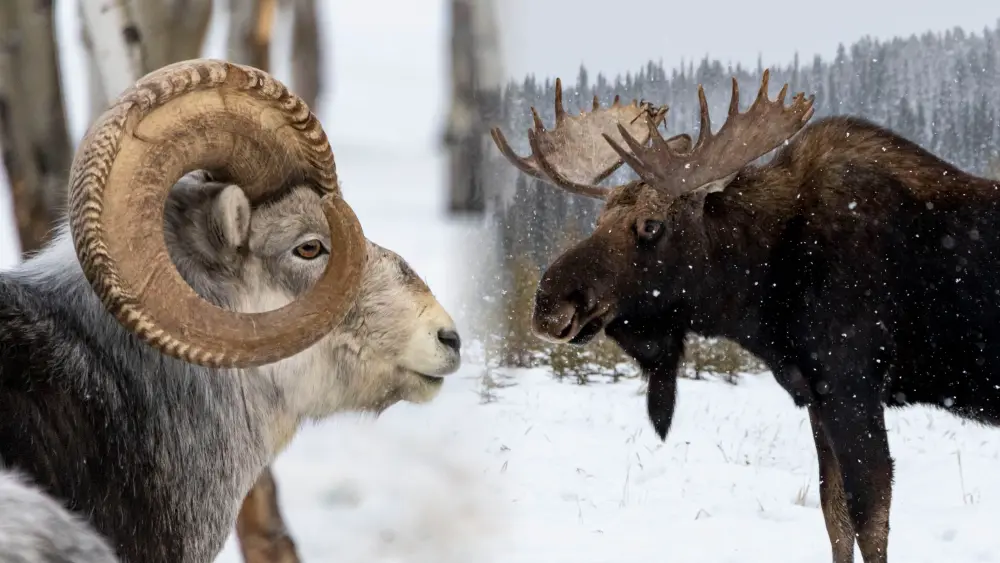
In our modern language usage, some terms or words may be incorrectly applied when describing an item. For example: some people do not always distinguish between horns and antlers where they incorrectly refer to all animal headgear as horns. Antlers and horns are very different in a number of ways and these variations are the result of millions of years of evolution and adaptation for the animal species to live a healthy life in the environment they occupy.

Bovids, or members of the horn-bearing group of animals versus cervids, or members of the deer, antler-bearing group of animals. 
Photo left to right:  Mountain goat, bison, moose, caribou. 
Credit: L.Caskenette & J.Paleczny

Headgear has influenced many aspects of some species and how they conduct themselves through the year; including the obvious breeding cycle but also their comfort in the heat of summer and how they communicate and identify themselves visually.

Let’s begin with construction materials: Horns are made from keratin- the same material as your hair and fingernails- whereas antlers are made from bone. Horns are a two-part structure. An interior portion of bone (an extension of the skull) is covered by an exterior sheath grown by specialized hair follicles called keratin.

Horns grow from the base where it attaches to the animal’s skull, antlers grow from the tips. Antlers are grown only by males of the deer species except for Caribou where females grow lightweight antlers, an adaptation for their grazing in snow for lichen. Horns are present on both male and females of most horned species with the males typically having larger horns than the females. 

Bovid family of animals have horns and both females and males with grow these horns. Typically female horn growth is smaller than males. Sexual selection plays a role here for large displays in both horn and antler bearing animals.

Perhaps the greatest difference between horns and antlers is that antlers are shed and regrow each year, where horns are permanent and remain and grow with the animal for all its life, or until they get broken off. Once they are broken, they do not grow back. The animal will carry a damaged or missing horn for the rest of its life.  Antlers also factor into the breeding cycles of the males who employ them to demonstrate their virility and to impress the females.

Antlers too may become broken or removed completely due to carelessness or fighting. These will grow back, but not right away. The animal must wait for the annual antler shed-regrow cycle for that year to conclude, usually in mid-winter before a new antler will form during the next year’s cycle, this may cause the animal to be without an antler for up to a year. 

Horns appear to form earlier than antlers on younger animals such as goats or bison, where Mountain Goat kids will be displaying small pointed black horns within a few short weeks of its birth, while antler buds appear at several months or so after a calf or fawn is born. But once they are in place and growing, they grow quickly.

Left to right: Mountain goat kids show horn formation, easily seen against the white; Watson the moose shows nubs of antlers developing in his first winter of life in 2019. Bison calves also show horn development early on in life. 

Antler is the fastest growing tissue of any mammal on the planet. With a healthy diet and high caloric intake, a moose can put on as much as a pound of antler in a single day. In the scope of just eight months' growth, moose antler can grow from tiny buds as big as your thumb to gigantic antler racks measuring up to six feet across or 1.8 meters from tip to tip. A large moose’s antlers can weigh up to forty pounds or nearly 20 kilograms on average. Some very large moose antlers may weigh up to 75 pounds or 35 kilograms.

Credit Alaska News Source

Source credit: Alaska News Source

Back to construction for a moment; another key difference between horned and antlered animals is how the physiology of horns and antlers differ.

Horns have a central, conical bony core or cornual process that grows out from the frontal bone of the skull. On close examination of a horn you will see what appears to be layers of horn material (keratin) growing a new layer at the base which will grow longer over time and become thicker with subsequent new layers of keratin forming as the animal ages.

After 6 months of age, the bone becomes hollow and the space within it is continuous with the frontal sinuses. The surface of the bone is rigid and porous and is covered with an internal surface which keratinizes and forms the protective covering of the horn. The new horn produced at the base is soft and often transparent giving the horn a glossy appearance. Horn growth function is similar to how the cuticle on your fingers and toes produce the nails.

Source credit: Talmudology

Antlers however attach to the animal’s skull between the eye and ear at a place called the pedicel where they will grow to full size for that year over about eight to ten months. The antlers separate from the skull at the point of attachment, the pedicel.

Antlers separate from the skull at the pedicel, typically in the winter months.

The antler side is called the corona and forms a bone to bone connection with the pedicel on the skull that is remarkably strong until the its time to shed that year’s antlers. There is a chemical influence when the animal’s hormones change following the rut and seasonal progress that causes the bone between the corona and the pedicel to dissolve where eventually it weakens enough that the skull can no longer support the weight of the antler and it falls off. Both antlers may fall off at the same time, but it is common for both antlers to fall off over a couple of days.

Horns are mostly hollow, white antlers are made up of less dense, sponge-like bone called the trabecular that has been highly vascularized during formation allowing blood to flow to the tips of the antlers to facilitate their growth. Antlers require blood to grow while horns do not.

While antlers are covered in velvet, they are also engorged with blood which provides another important benefit besides growing the antler. As animals do not perspire or sweat in any way, they must expel excessive body heat by panting as many animals do. Antlers perform like radiators where body heat is expelled by the blood-filled antlers.

Ears of most deer species shed the fur and hair off them in the warmer months so they too can dissipate body heat. If they would let you, you could take the pulse of an antlered animal by finding a blood vessel on their fuzzy antler and placing your fingers on it to feel the beat of his heart. Don’t try this at home…or anywhere else.

Both horns and antlers have also been used by people since prehistoric times for tools of various kinds.   The hollow nature of horns has made them desirable for spoons, scoops and hand shovels or scrapers while the strength and hardness of antlers has often found them to be the material of choice for making hunting points for spears and arrow heads. Antler has also been a popular material for handles of tools like knives and axes.

Creativity and need, guided the early peoples to adapt and modify both horns and antlers for a wide variety of tools and other purposes to better their quality of life. They have often been used to make buttons for clothing or ornamentation. Antlers have been carved into needles for sewing of clothes, shelter and similar products, Horns were popular as gun powder containers as they would prevent the powder from getting wet and were easy to carry and measure the appropriate amount of powder into the firearm.

Yukon art Hints of Easter by Faye Chamberlain, 2021. Yukon Permanent Art Collection.

Both antlers and horns provide important functions for the animals that grow them so they may live healthy, secure lives. Their headgear has also influenced many of their social behaviors that have developed and evolved over the centuries. These include mating rituals and protective activities against potential predators.

Most of us have seen sheep rams rearing up on their hind legs and pounding their horns against another ram in courtship competitions, but they may use their horns to communicate in less violent ways. Rams may interlace their horns and gently rub ear to ear as a form of communication that we can only guess what it means.

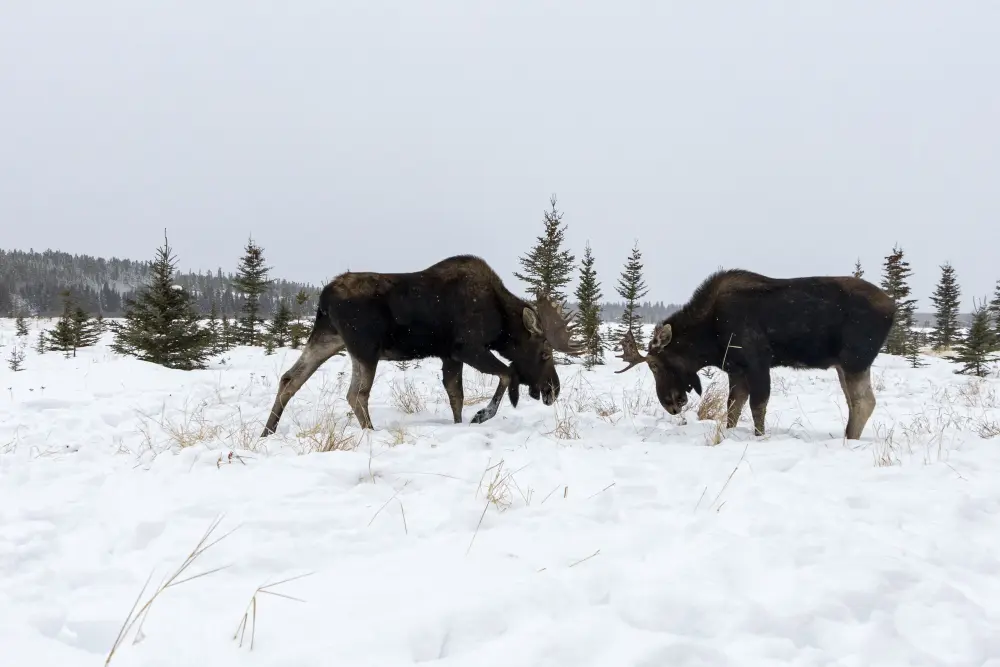
Antlered animals also employ their antlers as a means to communicate for example when two young bulls will use their antlers to joust or push each other around like a game of reverse tug o war.

Antlers are also a means of displaying size and age which will determine their social order of who is dominant and who is subordinate. From a distance the size of the antler rack quickly displays the animal’s placement in the local social order, typically around the breeding season or rut when many male moose may gather in an area for an opportunity to breed with cow moose drawn to the area by pheromones carried in the wind.

Bulls with smaller antlers will size each other up based on their antler racks and determine their chances of winning a fight with a larger bull.

Animal headgear serves a number of important benefits for the creatures that grew them. Humans have also found inventive and beneficial uses for both antlers and horns once the animals are finished using them. Humans often use antlers and horns for tools, but they can also be transformed into wonderful works of art. Nature provides.

Doug Caldwell

Doug Caldwell

Wildlife Interpreter

Doug is one of the Interpretive Wildlife Guides here at the Preserve. An avid angler and hunter he has a broad knowledge of Yukon’s wilderness and the creatures that live here. With a focus on the young visitors to the Preserve, Doug takes the extra time to help our guests to better appreciate the many wonders of the animal kingdom here in the Yukon.

Explore by Category

Explore by Author

Muskox – I’m a Survivor!

Muskox – I’m a Survivor!

animals of the world

by Lindsay Caskenette | May 27, 2022 | 0 comments

4 minute read - 

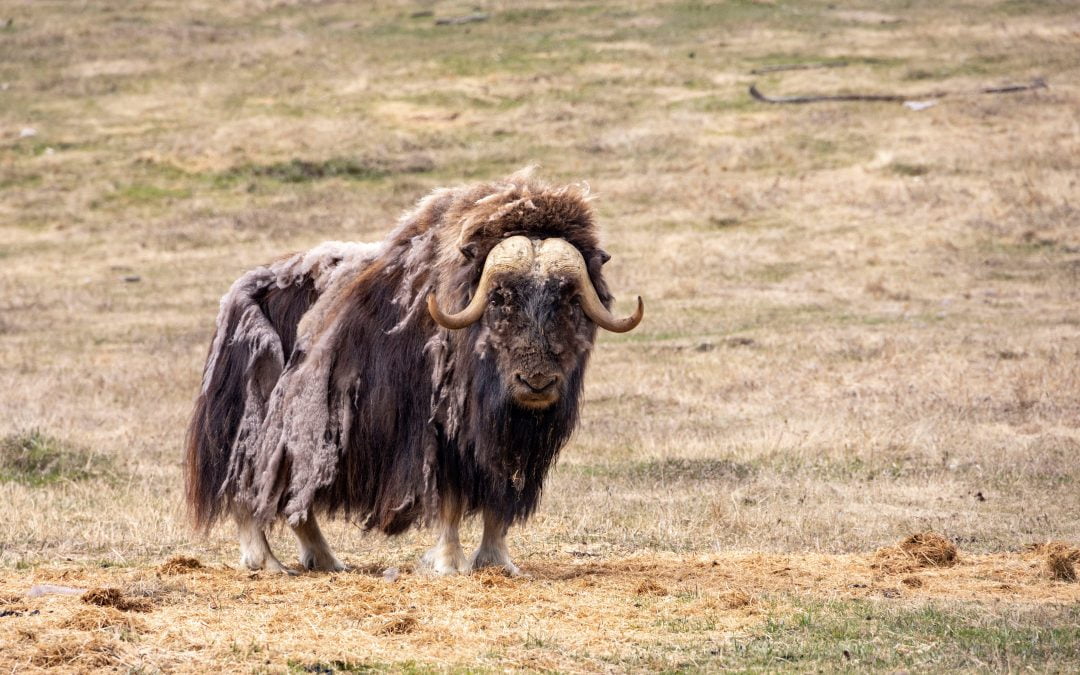
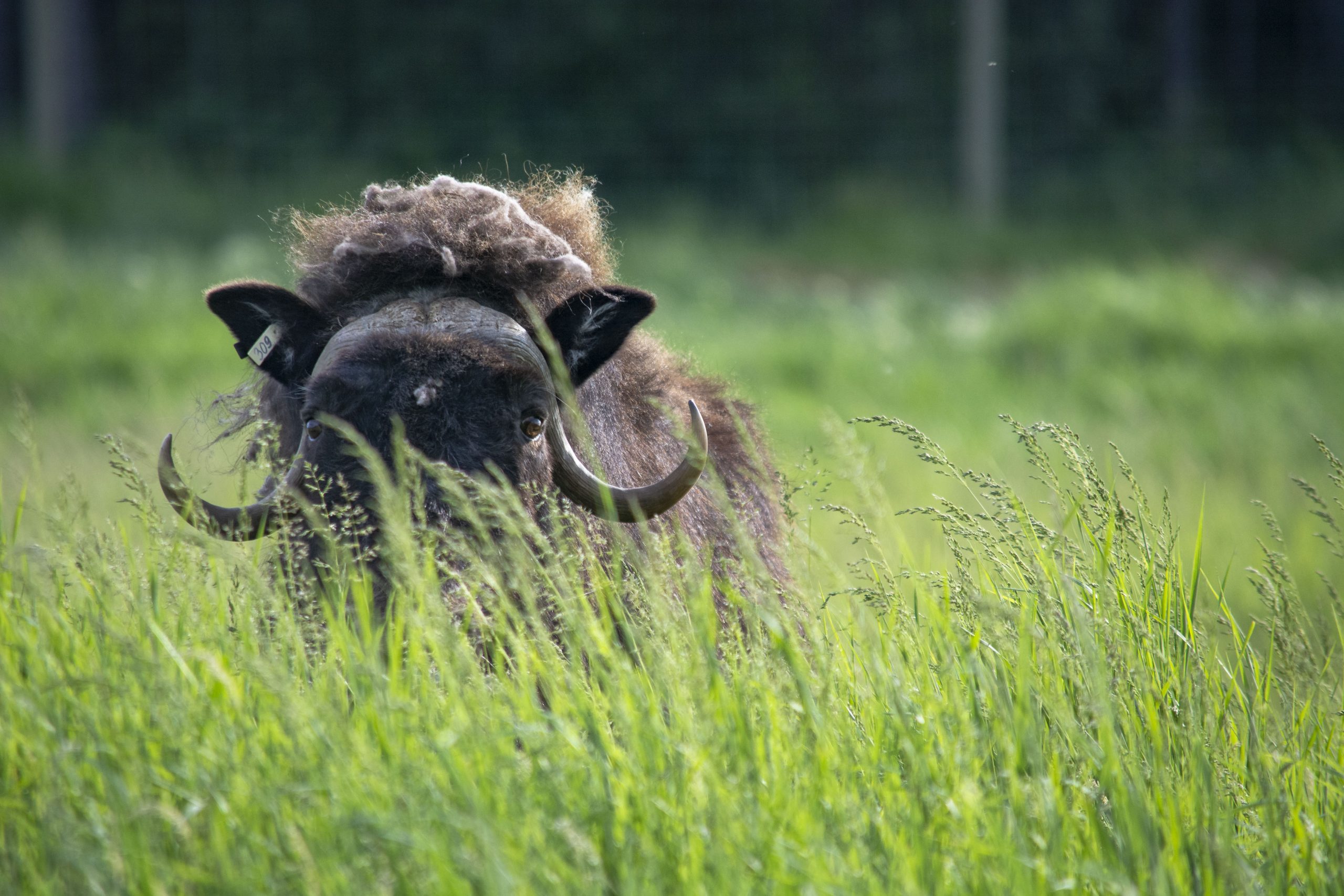
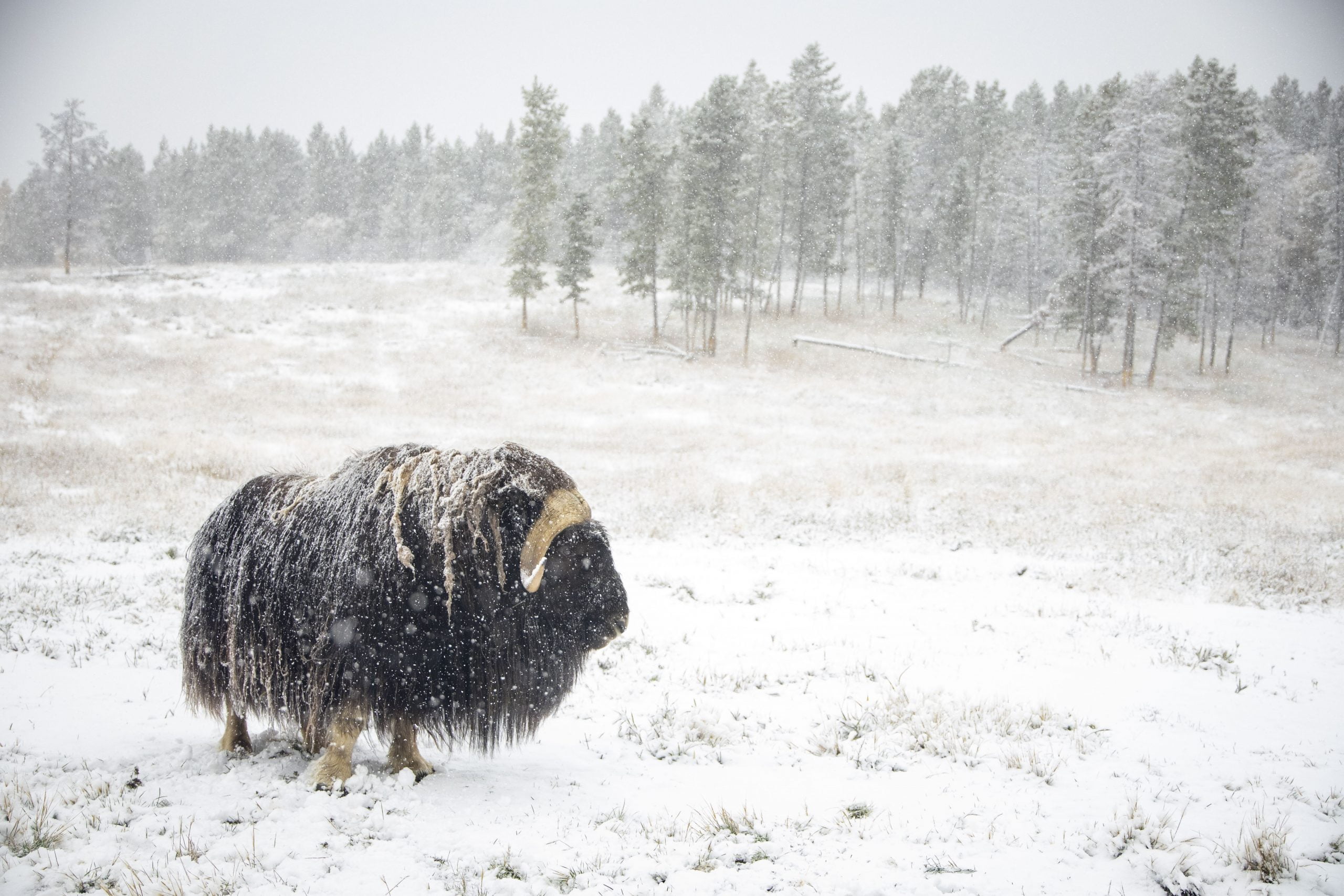
The muskox is an adaptable animal. In the face of climate change a generalist diet with a slow metabolism helped this species survive through the last ice age and to today while other megafauna, like woolly mammoths, went extinct.

During Beringia there were two types of muskox present on the extensive grassland biome - Ovibos moschatus, the tundra muskox that roams today, and Bootherium bombifrons, the helmeted muskox. 

The helmeted muskox did not survive the Pleistocene even though it was endemic to North America and had a wider range than its relative, the tundra muskox. If you could imagine this Beringian muskox was taller and more slender than those of the living tundra muskox and its wider range spanned an area from Texas all the way to Alaska. Like many of the horn and antler bearing animals of this era it was all about BIG, oversized, dramatic displays for sexual selection. The helmeted muskox had longer deeper skulls that supported higher and more flaring horns than the tundra muskox. But, size didn't get selected as most important for survival in this dramatically changing and climatically unstable landscape. It seems not only was smaller horns preferred through evolution but overall body size too - the less compact nature of this muskox might have played a role in its extinction along with many other large herbivorous mammals of its' time.  

The tundra muskox crossed the Bering land bridge from Eurasia into North America about 100,000 years ago. A more focused range and smaller size as well as thicker coat than that of the Bootherium, the Ovibos remains a resident of the Arctic landscape to this day. What's pretty incredible is that these muskox have changed, genetically, very little since their days on the Mammoth Steppe. The muskox of today's Arctic Archipelago are however much less genetically diverse than those that lived during the last Ice Age which suggests they were not completely unscathed during this time of climatic instability. Significant population and geographical range shrinkage restricted the tundra muskox to Greenland and much of the western Northern American Arctic populations are reintroductions from those limited genetics. The two types of muskox of the late Pleistocene did not mix genetically and the reduction of both species, including the extinction of the helmeted muskox, seem to exclude humans as a driving force behind these population dynamics into the Holocene.

Ovibos moschatus, the tundra muskox, was able to ride the waves of climate change over tens of thousands of years. Their adaptability to variability, including climate and thus vegetation quantity and quality, fostered this large Ice Age mammal to survive a formidable narrow niche of the Arctic biome to present day. What might the future hold for the muskox?

Photo credit L. Caskenette

Resources:

Thanks to Dr. Grant Zazula for taking the time share incredible insights into the past, into Beringia with the YWP crew! 

Ancient DNA analyses exclude humans as the driving force behind late Pleistocene musk ox (Ovibos moschatus) population dynamics. Paula F. Camposa, Eske Willersleva, Andrei Sherb, Ludovic Orlandoc, Erik Axelssona, Alexei Tikhonovd, Kim Aaris-Sørensena, Alex D. Greenwoode, Ralf-Dietrich Kahlkef, Pavel Kosintsevg, Tatiana Krakhmalnayah, Tatyana Kuznetsovai, Philippe Lemeyj, Ross MacPheek, Christopher A. Norrisl, Kieran Shepherdm, Marc A. Suchardn, Grant D. Zazulao, Beth Shapirop, and M. Thomas P. Gilberta.

Musk ox (Ovibos moschatus) of the mammoth steppe: tracing palaeodietary and palaeoenvironmental changes over the last 50,000 years using carbon and nitrogen isotopic analysis Maanasa Raghavan,, Gonçalo Espregueira Themudo, Colin I. Smith, Grant Zazula, Paula F. Campos

Tundra Muskox

Helemeted Muskox

Lindsay Caskenette

Lindsay Caskenette

Manager Visitor Services

Lindsay joined the Wildlife Preserve team March 2014. Originally from Ontario, she came to the Yukon in search of new adventures and new career challenges. Lindsay holds a degree in Environmental Studies with honours from Wilfrid Laurier University and brings with her a strong passion for sharing what nature, animals, and the environment can teach us.

867-456-7400
Lindsay@yukonwildlife.ca

Explore by Category

Explore by Author

A Beginner’s Guide to iNaturalist:

A Beginner’s Guide to iNaturalist:

animals of the world

by Joelle Ingram | Jan 22, 2021 | 1 comment

This article was made possible thanks to support from the Environmental Awareness Fund. Engage and educate yourself in this 10-part blog series, about Yukon Biodiversity.

5 minute Read and 8:58 minute Video

How to explore the biodiversity in your own backyard:

Hey there! Are you feeling isolated (and who isn’t in this remote territory, during this plague year, in the cold months)? Would you like to connect to nature? Have you considered iNaturalist? It’s a groovy app available on your phone or computer and it’s essentially an encyclopedia to the wide variety of living organisms in your local area and across the globe.

If you’re new to the app, let me give you the basics. First, go outside. Catch some of the fleeting winter sun, take in some fresh air, and observe your surroundings. Next, spot an interesting organism (plant, animal, bug, algae, etc.) and take a nice, full frame photo of it and upload it to the iNaturalist app. Congratulations! You are now an observer and this thing you have photographed is the first of your (many) observations.

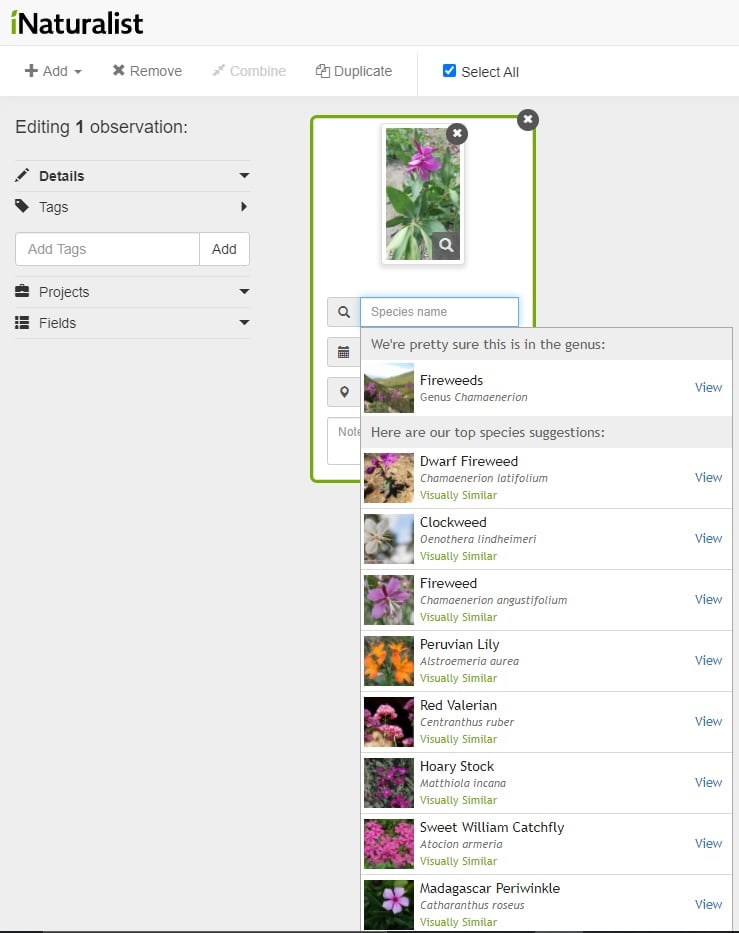
Once you have a photo uploaded, it’s time to build a profile for your observation. Tell us what species you photographed, the date the photo was taken, and where it was located. Not sure what you took a photo of? Not a problem. If you take a peek at the screenshot below, you can see a handy dandy drop-down menu that shows up when you click on the species field and suggests, based on your photo, what species you might have photographed. As you can see, the top suggestion for my photo of dwarf fireweed was… dwarf fireweed! What! WITCHCRAFT (which is code for programming I am both impressed by and don’t understand).

iNaturalist - once you upload your photo you can use the drop down photo suggestion prompt to help identify what in fact you are looking at!

If the dark magic of the iNaturalist app suggested species list doesn’t give you a likely answer, someone else can. This is where the identifiers come into play. The iNaturalist community plays host to specialists and seasoned outdoors enthusiasts whose expertise can put a name to the mystery organisms in your photos.

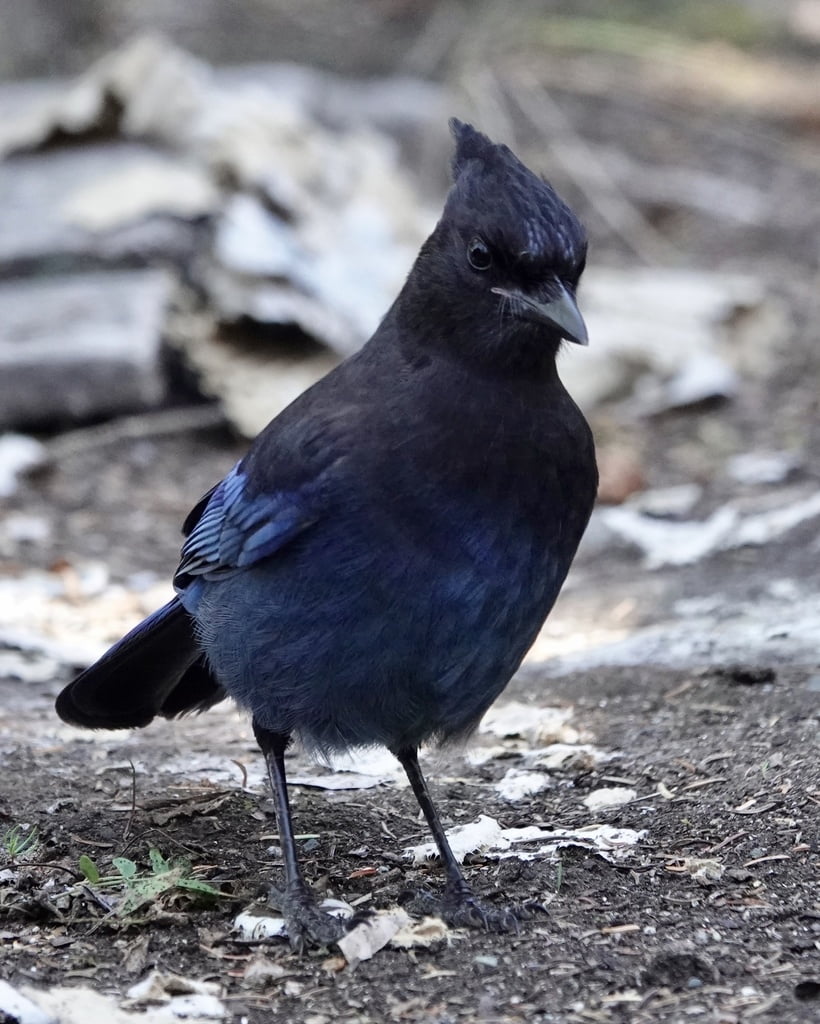
But wait, it’s winter. The insects are dead or dreaming, the fish are under a sizeable roof of ice, and the foliage is exceptionally non-existent. This is all true but that doesn’t mean there aren’t a lot of biodiversity discoveries you can make in the snowy months, far from it in fact. The bird populations in the Yukon change significantly from season to season; the water birds may be gone but the bohemian waxwings are lovely this time of year. We’re also experiencing a rare bird event this winter with the appearance of Steller’s jays. The Steller’s jay is the provincial bird of British Columbia and has only been noted en-masse in the territory twice before this: in 2006 and 1994. This showy blue-black corvid would make a charming addition to your list of iNaturalist observations.

A steller's jay observed in Carcross, Yukon. Photo Credit Cameron Eckert iNaturalist

But wait, there’s more. Act now and you can take advantage of one of the finest animal observing methods gifted to you by winter: animal tracks. Sure, you can spot footprints in mud during the warmer months but the winter offers an endless white canvas for animal feet. Yes, you can also upload photos of animal footprints. Not only do you get to identify the beasties wandering through your neighbourhood but you also learn to identify them even when they aren’t there. That’s some Sherlock level business.

If you don’t feel like meandering outside (and as we move into the colder days, who could blame you), you can check out your local biodiversity from the comfort of your own home. Remember how you enter the location of your observations? That means all observations are placed in a map that lets you check which organisms have been observed in your area or in the destination of your choice.

All the observations in a given region can be seen from a map view. You can then click on each instance to learn more about the obeservation.

Not interested in your home range? No problem, check in on the gibbon observations in Asia, gaze upon the Macaw palm of South America. The iNaturalist map is a wonderful worldwide experience in biodiversity. You can peruse different species in far-ranging areas based on your interests. iNaturalist lets you check out the organisms based on category (frog, insect, flower, etc.), status (wild, threatened, introduced, needs ID, etc.), and date of observation. Mix it up, check it out, and find something new.

Explore iNaturalist through various categories including species, status, and date of observation. 

The iNaturalist app is an approachable means of connecting professionals and the public for the benefit of biodiversity research. The annual Bioblitzes are a great example of this. A Bioblitz is used to determine the health and diversity of an ecosystem by bringing together the local community of both specialists and the enthusiastic public to observe and record as many species as possible in a limited area within an equally limited timeframe to create a “snapshot” of the living things in a specific region. Outside of general curiosity, the data from a Bioblitz can inform decisions about wildlife management and future research.

The 2020 Yukon Bioblitz was held at our very own Yukon Wildlife Preserve in the short span of July 8-10 2020. Not to brag, but the Wildlife Preserve is a great local for a Bioblitz because it’s composed of a diverse array of habitats including forests, meadows, and wetlands which in turn host a variety of plant, animal, and fungi species. Unfortunately, the intentional residents of the Wildlife Preserve were not included in the Bioblitz observations. It would be very impressive to add a muskox or a lynx to your iNaturalist observation repertoire but if they’re full-time residents of the Wildlife Preserve, they’re not necessarily representative of the type or amount of these species that would be present in this area. Alas.

Over the three days of the 2020 Bioblitz, a horde of experts (like Dan Peach - mosquito man) and the public (including me) descended upon the Wildlife Preserve to document every and any species they came across. Even without the residents of the Wildlife Preserve, there were over 400 species recorded during the Bioblitz. That’s a lot! For a little perspective, this count includes:

The Count List
  • 2 species of algae
  • 1 amphibian
  • 22 species of beetle
  • 62 bird species
  • 12 species of moss
  • 1 centipede
  • 18 species of flies
  • 57 species of fungi and lichens
  • 11 species of true bugs
  • 31 species of bees, wasps, ants
  • 18 species of butterflies and moths
  • 8 mammal species
  • 7 species of snails
  • 11 species of dragonflies
  • 1 grasshopper
  • 1 pot worm
  • 8 spider species
  • 182 species of vascular plants
  • And a partridge in a pear tree
  • (Just kidding, partridges aren’t indigenous to the Yukon.)
  • (And neither are pear trees.)

For the full species list and the distribution map, check it out here!

The Bioblitz provides a snapshot of what’s present in the territory but there are 482,443 km² of territory to explore. Imagine what else you could find. Get out there, observe, record, and have a good time!

Video shot and edited by Jake Paleczny.

Joelle Ingram

Joelle Ingram

Human of Many Talents

Joelle is a former archaeologist, former wildlife interpreter, and a full-time random fact enthusiast. She received her master’s degree in anthropology from McMaster University. One of the four people who read her thesis gave it the glowing review “It’s a paper that would appeal to very specific group of people,” which is probably why only four people have read it. Her favourite land mammal is a muskox, her favourite aquatic mammal is a narwhal. She thinks it’s important that you know that.

867-456-7400
 info@yukonwildlife.ca

Explore by Category

Explore by Author

1 Mosquito, 2 Mosquito . . .

1 Mosquito, 2 Mosquito . . .

animals of the world

by Joelle Ingram | Jan 7, 2021 | 4 comments

This article was made possible thanks to support from the Environmental Awareness Fund. Engage and educate yourself in this 10-part blog series, about Yukon Biodiversity.

10 minute Read plus 3:47 minute video. Banner image photo credit: John Borden.

Mosquitoes: the blood-sucking embodiment of tinnitus. Let’s talk about them. If you are a Yukon resident, I’m sure you are painfully aware that our triangle shaped territory plays host to a truly astonishing number of these whining winged menaces. They rise from their slumber in early spring before the ice has even left the lakes to make all your outdoor activities a little bit more annoying. And itchy.
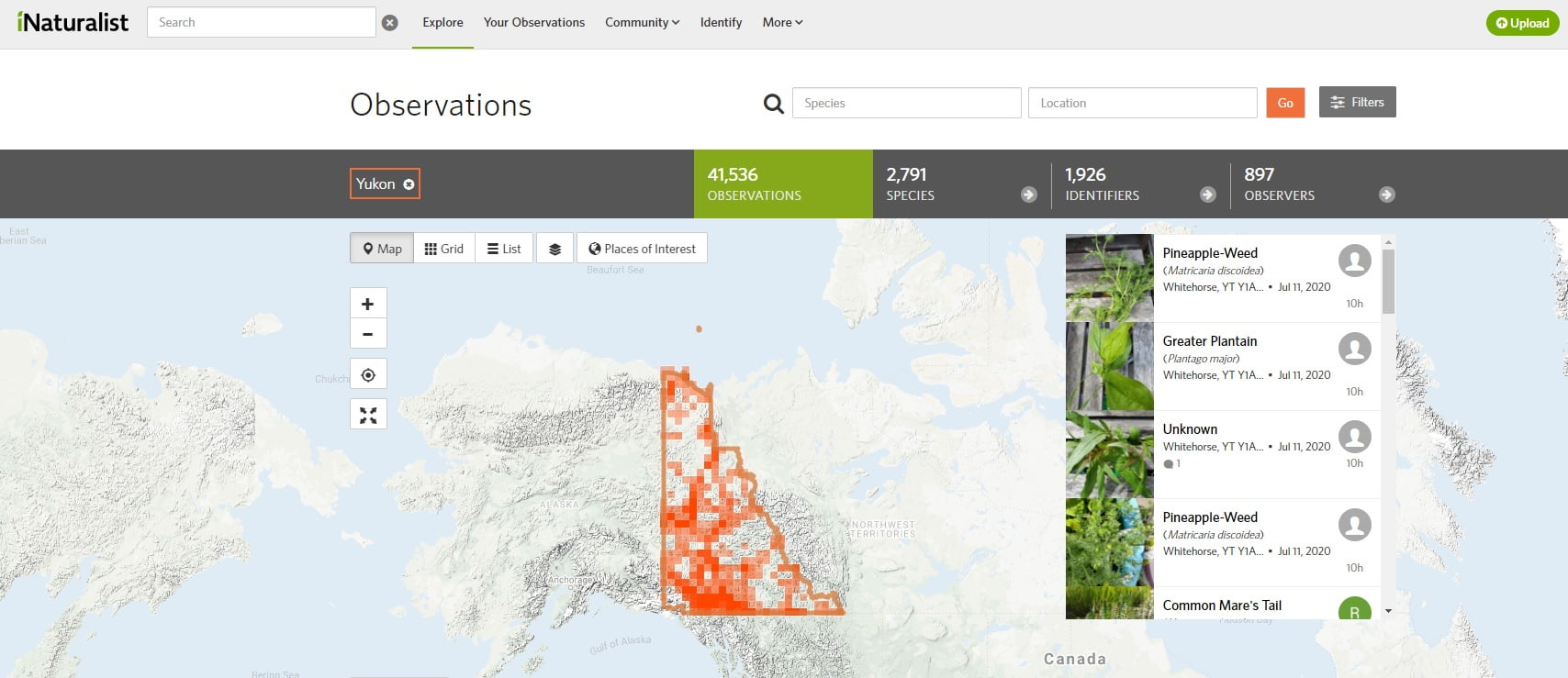
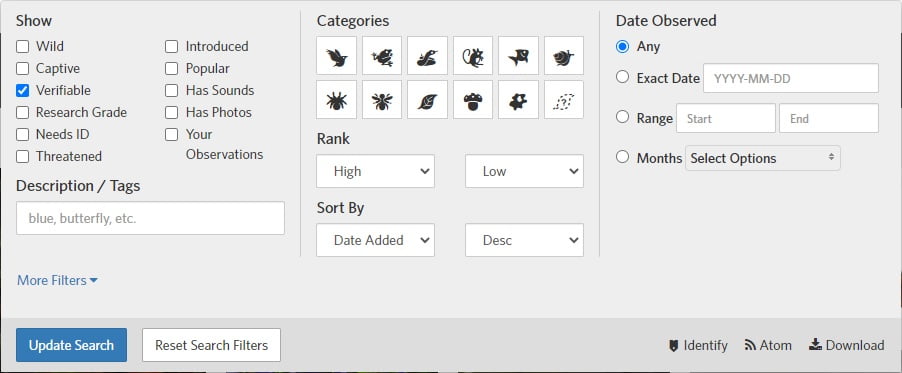
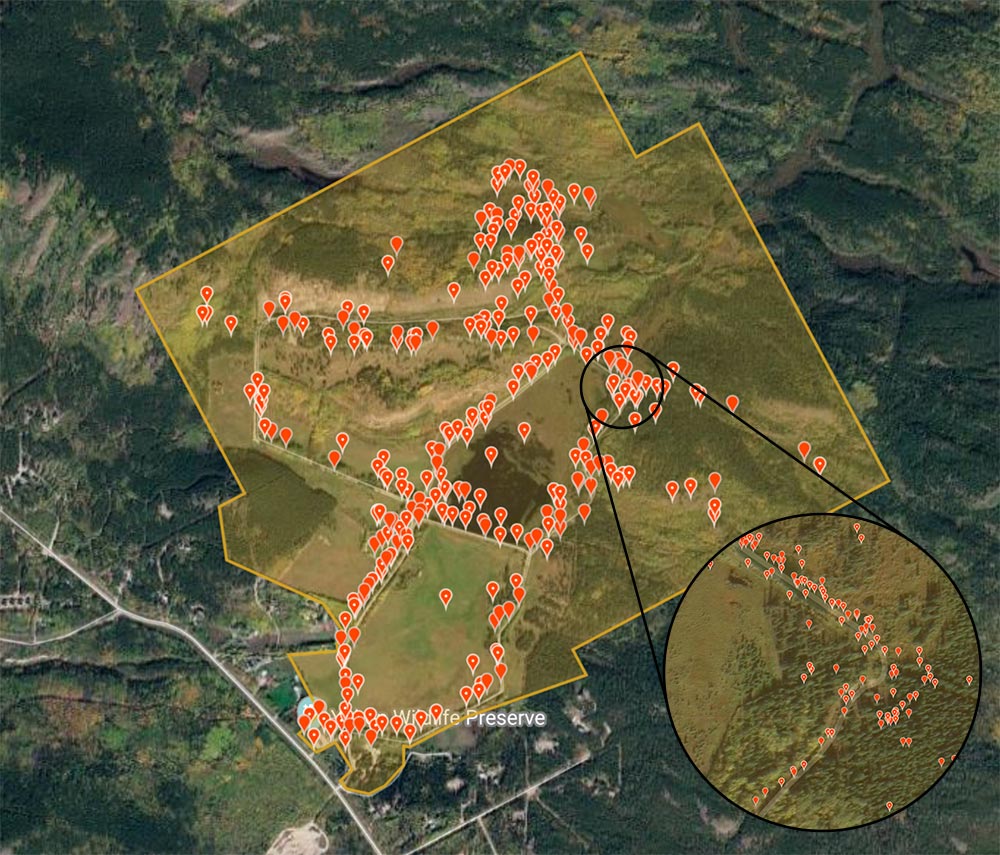
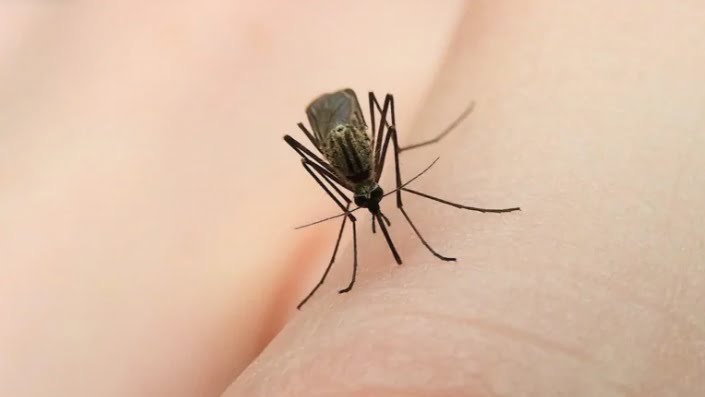
Photo Credit: Dan Peach

Mosquito evasion is a popular summer pastime here in the North so it might seem wild that people would actively seek out mosquitos but that’s the case for many entomologists who go out and willing get bitten by these bugs for science. Dr. Dan Peach from the University of British Columbia recently conducted a mosquito study in the Yukon which identified thirty odd different species of mosquitos including a few that have never been recorded in the territory before!

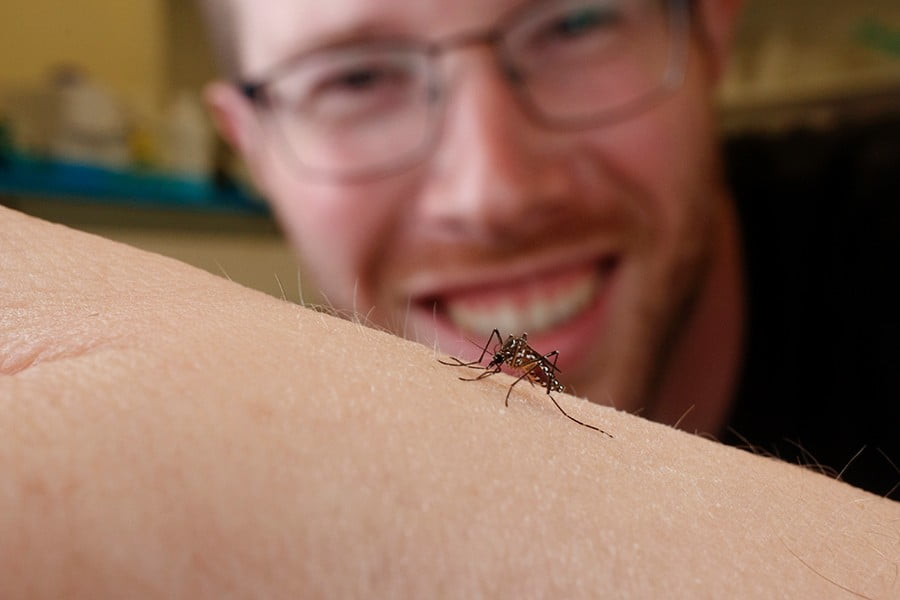
Dan Peach, a PhD candidate in SFU’s Department of Biological Sciences, feeds a mosquito. Photo Credit SFU News.

Researchers use the shape and relative size of a mosquito’s body parts to identify which type it is as well as scale patterns, colour, and hairs. Obviously, identifying these traits on an insect that could comfortably hang out on a dime isn’t easy. Mosquito identification usually requires a microscope, but experienced researchers can identify different species with the naked eye if the mosquito is holding still. It’s a weird party trick but you could get a lot of mileage out of it during a Yukon summer.

In his studies, Peach has had to be bitten by mosquitos more than 100,000 times. In the works for him is a peer-reviewed guide to Yukon mosquitos. This photo was taken during Yukon Wildlife Preserve-hosted Yukon Bioblitz in summer 2020. Photo Credit: Vince Federoff, Whitehorse Star

The Yukon actually has a long a long history of mosquito research; the first formal record of a mosquito collected in the territory was in 1904. That being said, mosquito surveys aren’t frequent. Before Dr. Peach’s survey, the last mosquito collecting spree was conducted in the early ‘70s. Now you may be asking yourself, “why oh why would anyone want to survey mosquitoes?”

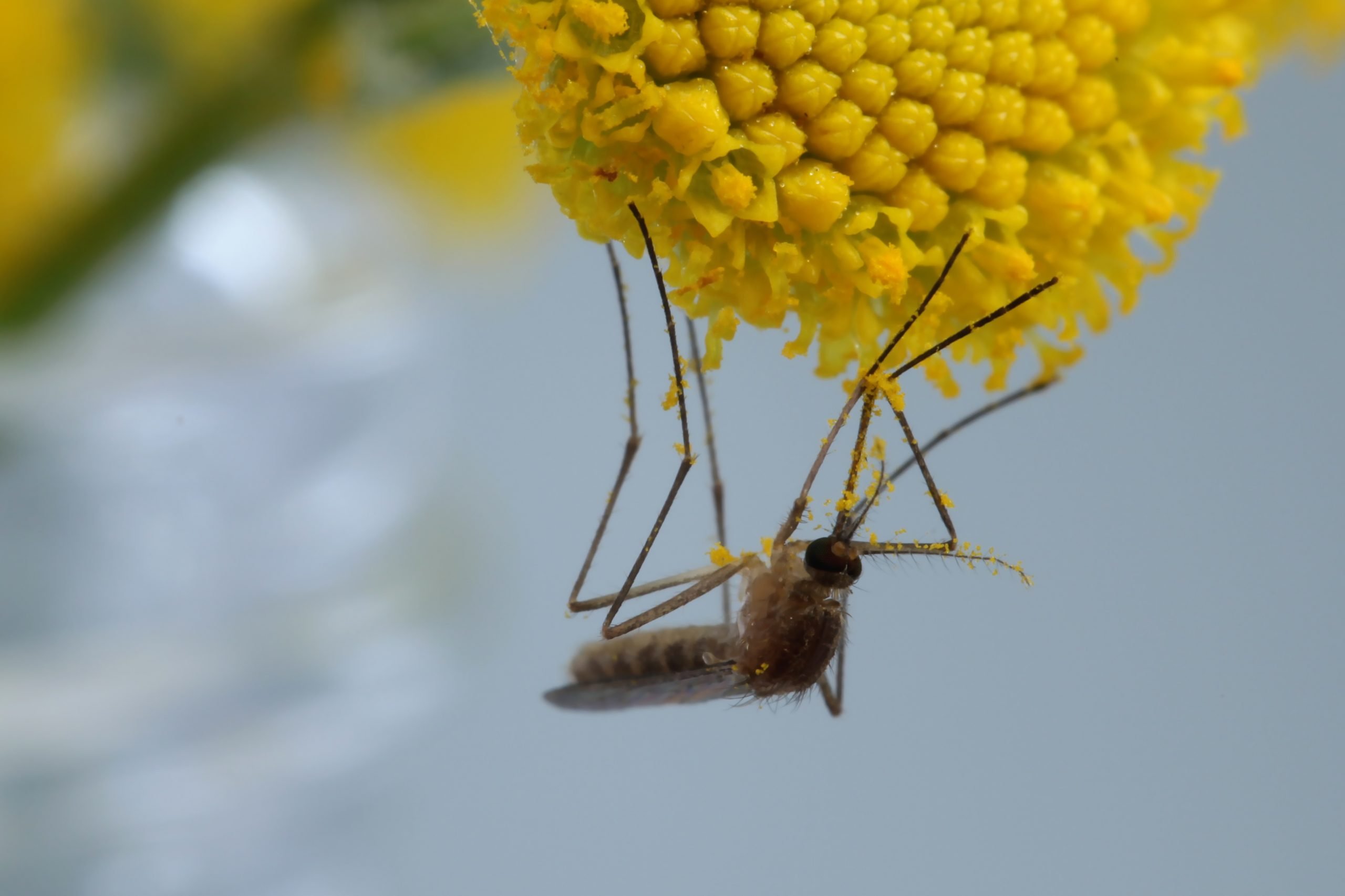
Just like any survey related to biodiversity, it’s important for understanding and monitoring our local ecosystems and improving our understanding of our planet as a whole. Just because something is horrible and bitey doesn’t mean it isn’t ecologically significant and interesting. For example, you may or may not know that only female mosquitoes drink blood while males stick to a diet of plant nectar. That’s right, mosquitoes are pollinators just like bees, bats, butterflies, and… other creatures whose names may or may not start with B. Female mosquitoes also drink plant juice but they do need additional protein to produce eggs and that’s where the blood portion of their diet comes in.

A female Culex pipiens cleans tansy pollen from her proboscis. Photo Credit Mike Hrabar.

Because there is such a diverse array of mosquitoes in the Yukon, I’m not going to get into all of them here (if you want the complete list of every type of mosquito identified in the Yukon, check out Dr. Peach’s mosquito guide for all your mozzie needs coming soon). Instead, I’d like to offer you a sampler pack of what the Yukon mosquito community has to offer starting with my personal favourite, Culex territans. When you’re being eaten alive by clouds of biting bugs during the summer months, I can almost guarantee that none of them are C. territans. See, unlike many other species of mosquito, C. territans rarely if ever feed on warm blooded creatures and instead feed exclusively on amphibians. Amphibians, you know, like frogs. Frogs who are notorious for eating bugs. Bold move, C. territans!

Anopheles earlei is sometimes referred to as “Canada’s national mosquito” and it’s not because it smells of maple syrup and has strong opinions about hockey. During the winter, we are blessedly bug free as they all either die or go into hibernation. Canada’s national mosquito got its title due to its interesting hibernation habits: the females like to hibernate en masse inside beaver lodges! Another fun fact about A. earlei is that before the 2020 Bioblitz (a biodiversity survey conducted in a specific area for a limited amount of time. In this case, our very own Wildlife Preserve!), this particular mosquito hadn’t been reported in the Yukon since 1919, a whole entire century ago.

Footage from Dr. Dan's visit during the 2020 Yukon Bioblitz conducted at the Yukon Wildlife Preserve. Video shot and edited by Jake Paleczny. 

Speaking of gaps in recording, let me introduce our third contestant: Aedes euedes. Up until 2019, A. euedes has never been recorded in the Yukon. This doesn’t mean they haven’t been here, but when there are multiple decades between surveys, some things might slip between the cracks. What else is lurking out there? Only future biodiversity surveys will tell!

While these three species are relatively rare, the most common mosquitoes in the Yukon belong to a group called “snowmelt mosquitoes” which sounds kind of pretty until you remember it’s referring to tiny airborne vampires. Like any species that survives and thrives in the North, snowmelt mosquitoes need to be pretty hearty. Instead of laying their eggs in lakes, ponds, or marshes, they use depressions in the ground that are temporarily filled with water during the early spring melt (hence the name). These pools formed by snow melted on sunny spring days will often freeze over at night, but snowmelt mosquitoes can survive in chilly water and fluctuating temperatures. Their chosen spawning puddles gives these bugs a bit of an advantage: they avoid getting eaten by critters that live in permanent bodies of water like fish or other bugs. Using puddles that thaw while bigger bodies of water are still frozen also gives them a leg up on the relatively brief snow-free seasons.

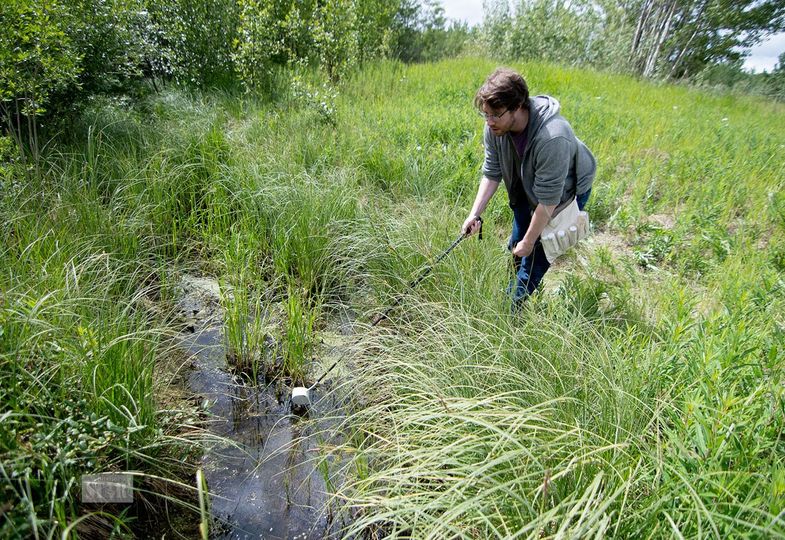
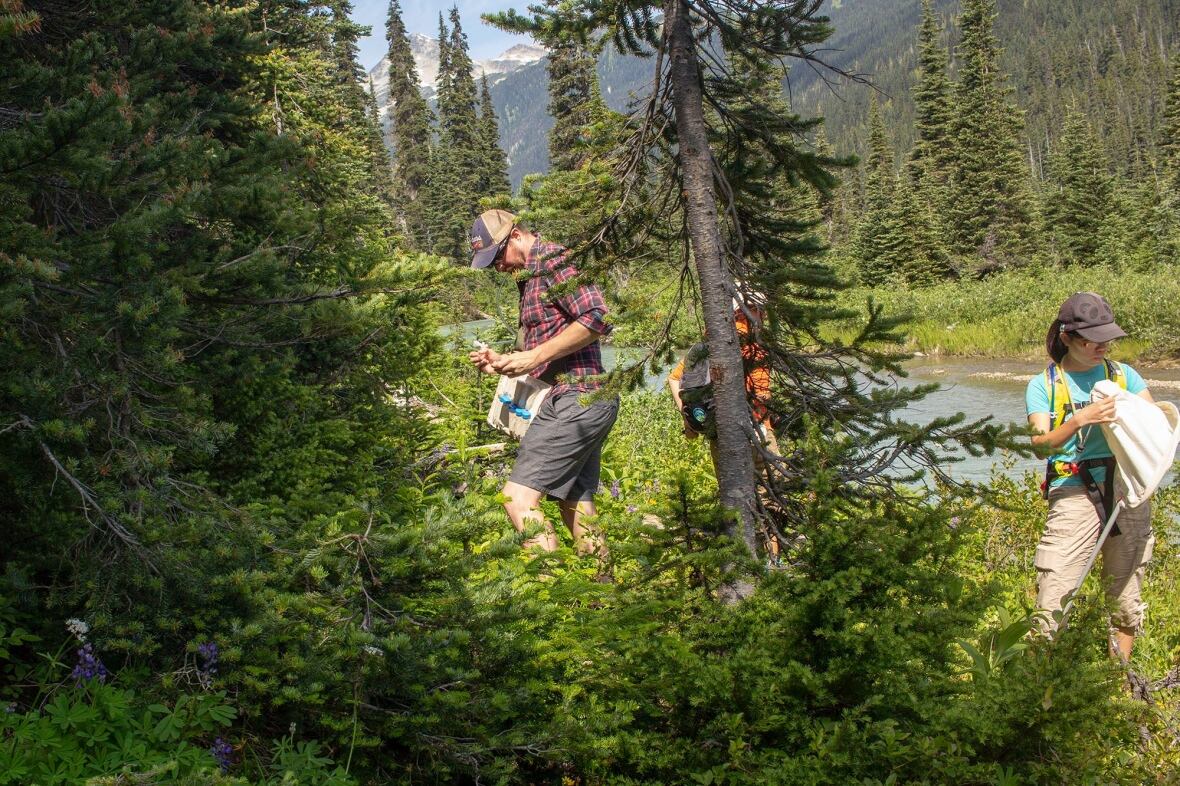
Researchers collect mosquitos in the dense forest of the Yukon. Photo Credit: Dan Peach

One of these snowmelt mosquitoes, Aedes communis, is often found in treed areas and it is a known vector (an agent that carries and transmits a disease) for snowshoe hare virus. While this is a bummer for snowshoe hares, it isn’t a problem for humans unless we get a huge dose of it and even then, it just presents as flu-like symptoms.

Culex tarsalis may be less common in the Yukon than A.communis, but as far as mosquitoes goes, it’s much more intimidating. Known as the “Western Encephalitis Mosquito” and “the mother of all vectors”, it’s a known vector for West Nile virus, several forms of encephalitis, and a long list of other diseases. For those not in the know, encephalitis is a swelling of the brain often caused by a viral infection and has symptoms ranging from aches and fatigue to hallucinations and seizures. It’s not great.

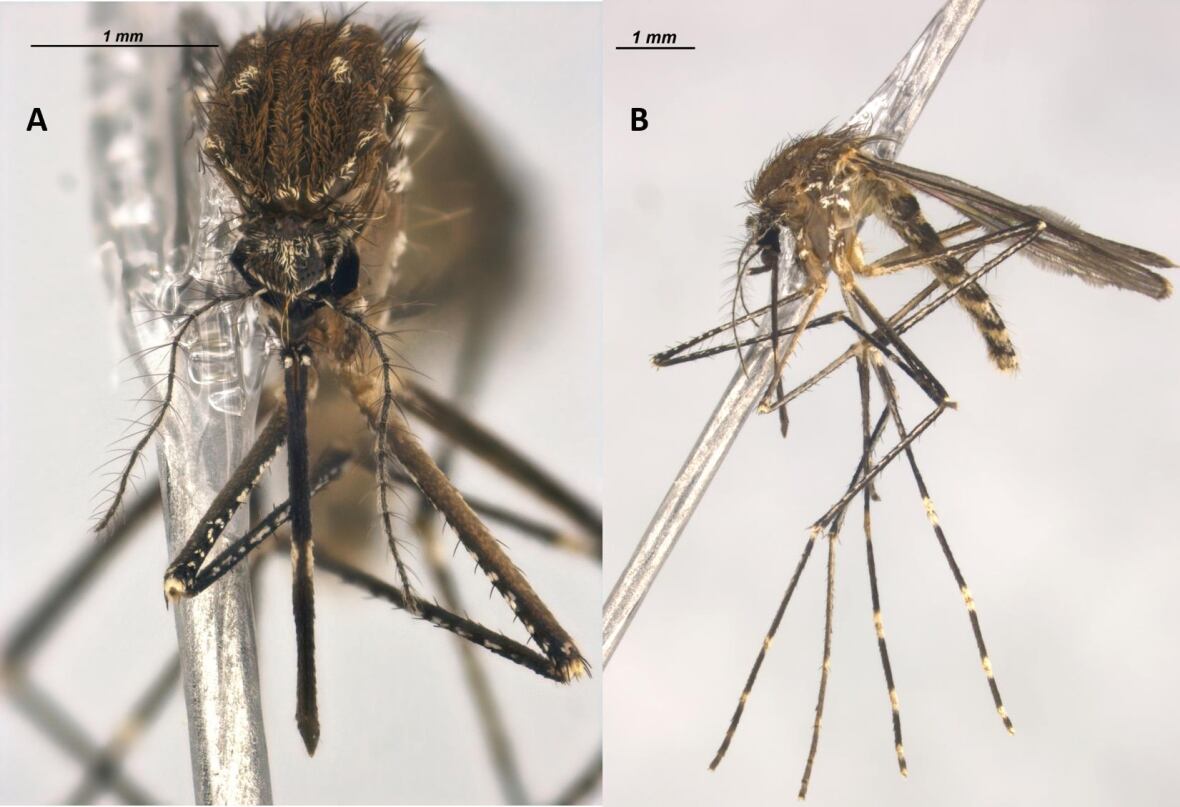
Close up of Culex tarsalis, a species of mosquito that Dr. Dan Peach was the first to confirm is found in Yukon. Photo Credit: Daniel Peach/Journal of the Entomological Society of British Columbia).

But fear not, citizen! While we have mosquitoes in the Yukon that could transmit diseases to people, they don’t and here’s why: In order for mosquito to give you a virus, it needs to be carrying that virus in the first place. Even if the mosquito was carrying a transmittable virus, the virus needs heat to multiply itself enough to the point where it would be too much for the human immune system to deal with. What do we not have in the Yukon? Heat. On the whole, the Yukon is just too chilly for mosquito-born disease to exist let alone thrive. I hope this gives you a feeling of relief as you bask in our -40 C winters.

You see, mosquitoes are diverse in their diets, behaviours, and characteristics, which just helps highlight the fact that the Yukon is wonderfully rich in biodiversity. This is something we should all appreciate even if it applies to insects that sometimes siphon your blood.

Joelle Ingram

Joelle Ingram

Human of Many Talents

Joelle is a former archaeologist, former wildlife interpreter, and a full-time random fact enthusiast. She received her master’s degree in anthropology from McMaster University. One of the four people who read her thesis gave it the glowing review “It’s a paper that would appeal to very specific group of people,” which is probably why only four people have read it. Her favourite land mammal is a muskox, her favourite aquatic mammal is a narwhal. She thinks it’s important that you know that.

867-456-7400
 info@yukonwildlife.ca

Explore by Category

Explore by Author