Why are red foxes so happy among us?

Why are red foxes so happy among us?

animals

by Danette Moule | Jul 16, 2021

5.5 minute read. 

Red foxes are as familiar to any Yukoner as seeing their friend or colleague walking down the street. They are a welcome resident of Whitehorse, and most urban environments in Canada. Though many species numbers have declined since Europeans arrived to the shores of what is now North America, the red fox is the exception to the rule. Red fox populations have only increased since human settlements have grown and expanded. In fact, the red fox is one of the most widely distributed territorial mammals in the world.1even in the Arctic

So why are red fox numbers growing alongside human populations? One reason that the arrival of Europeans coincided with a growth in the red fox population in Canada is that Europeans brought foxes with them. There was already a species of native red fox living here at that time, so both native and non-native red foxes live in North America. Native red foxes are what we typically see in the north; they are the Canadian Boreal Forest species that colonised here shortly after the last glacial period, around 11,000 years ago. Non-native red foxes are found further south, where they were released by European settlers in the mid 1700s, for hunting purposes. However, introduced red foxes are not the only reason fox numbers have increased since colonisation. Though it is commonly thought that people are generally bad for wildlife, there are certain species that benefit greatly from people, and red foxes are one of them!

Despite red foxes having plenty of wildland in which to settle and bear their young, they’ve often chosen human settlements to set up shop. Red foxes are part of the group called ‘synanthropic species.’ These species live near humans and directly benefit from human-altered landscapes. Animals such as mice, rats, pigeons, racoons, skunks, and coyotes are synanthropic species. Red foxes, like these other animals, benefits from our landscape alterations, including gardens, bird feeders, garbage dumps, sheds, porches, and barns, all of which provide either suitable food or shelter, and often both. These species have learned how to exploit human settlements to their advantage, and they thrive in suburbs and cities that are in or near forests or fields. An ‘edge species’ lives at the border of two different habitat types, or ecotones, such as where forest meets grassland. A city like Whitehorse could be an ecotone in and of itself, since its boundaries are rich forest area. But in other cities such as large metropolises, humans have created habitats that very closely mimic an edge species’ natural environment. Gardens and yards that back onto bushy or forested area are perfect for red foxes and other edge species. Because rats, mice, and voles enjoy human suburban environments, red foxes have an abundant food source when living near people, not to mention the garbage that people inevitably leave lying around or in unsecured garbage cans.

Moreover, red foxes require shelter for denning, and the underside of sheds and decks, or your rotting wood pile all offer what a fox needs to rear its young. And because human settlements are typically near a water source, foxes will have access to that as well. Many gardeners also choose to provide bird baths or other water sources on their property, and this makes great habitat for all edge species, including foxes. A bushy yard near a field or forest is a great environment for a red fox, since they benefit from both the human environment and the natural landscape. And suburban environments offer fields where they can hunt, ditches with food and water, and woody parks which offer cover, safety, food, and denning opportunities. A great environment means large litter sizes, and high survival rates among young. The Wilderness City is the perfect environment for a red fox, and the perfect place for fox populations to thrive.

So human environments are great for red foxes, but how are red foxes great for people? As we’ve seen, our environments attract a variety of animals that people find a nuisance. Mice, rats, voles, and pigeons are all things that people don’t enjoy having in or around their house. Fallen fruit such as crab apples and berries attract mice into our yards, and without foxes, these animals can cause problems for people. Luckily, these animals are all great food sources for foxes. And people generally find foxes cute and enjoyable to observe. They aren’t threatening, even to children, and they generally won’t go after a full grown healthy cat. Foxes generally don’t cause problems for people who don’t have chickens or rabbits that they keep outside, and even then, modern fencing is good enough to often keep these animals safe. Foxes can carry rabies, which can cause problems for people, but in the Yukon, rabies is thankfully not a common disease. People have traditionally enjoyed keeping cats to help curb the rodent population, but cats also kill songbirds, and are one of the leading causes of songbird decline in North America. Foxes generally don’t kill songbirds, and subsist mostly on rodents and whatever they can scavenge. In other words, they eat what we don’t like.

Red foxes are the perfect species for urban populations, and because of this mutually beneficial relationship, fox populations will continue to grow and thrive alongside people. Come see our two resident red foxes next time you’re at the Wildlife Preserve!

This interpretetive panel is placed next to our fully fundraised Red Fox exhibit. It shares the story of red fox success across the Northern Hemisphere, from the Arctic to urban enviroments.

Photo credit: Danette Moule

Danette Moulé

Danette Moulé

Wildlife Interpreter

Danette is new to working at the Wildlife Preserve, but not new to appreciating it! Danette currently lives between the Yukon in summers, and BC / Alberta in the winters. She holds a Master's of Natural Resource Management, and has always been a big appreciator of wildlife and our natural world. Danette was raised in the mountains of western Canada, and is enjoying getting to know the north.

Explore by Category

Explore by Author

Vernal Species Migration

Vernal Species Migration

animals

Jul 2, 2021

11 min read -

Part of Nature’s plan involves animals moving to new locations for two primary reasons:.  One is seasonal migration when animals move to a summer location principally to give birth and raise offspring, and the other is permanent migration or colonized range expansion when animals or plants colonize a new range where the critical resources for their continued survival exist in sufficient quantity. Here they will call home and make themselves a part of the local flora and fauna populations.

Migration is a tool used by Nature and benefits many species of animals and the areas where they live. From Monarch Butterflies to Blue Whales, animals migrate back and forth between two primary ranges that support the animal at important stages of every given year. Species temporary absence also provides the area where they live with a break from grazing or predation on a single source of food.  Also, physical disturbances and predation is reduced so that grasses and other vegetation can grow back and prey species can rebuild their populations while the predatory species are away on their seasonal migration. Think of it as shift work, there is a split between where creatures work for almost half the year and where they make their home for the other half.

Let’s begin with spring seasonal migration, more properly called the Vernal (Latin for spring) migration when animals move to alternate locations typically in the north with the changing of the seasons only to return later in the year to the area or range they occupied before they migrated. These are often called winter and summer ranges and in many cases involve moving to a place to birth and raise offspring and when these offspring have adequately grown and become a bit more self-sufficient, they return to the other range with mom and dad to spend the rest of their year.

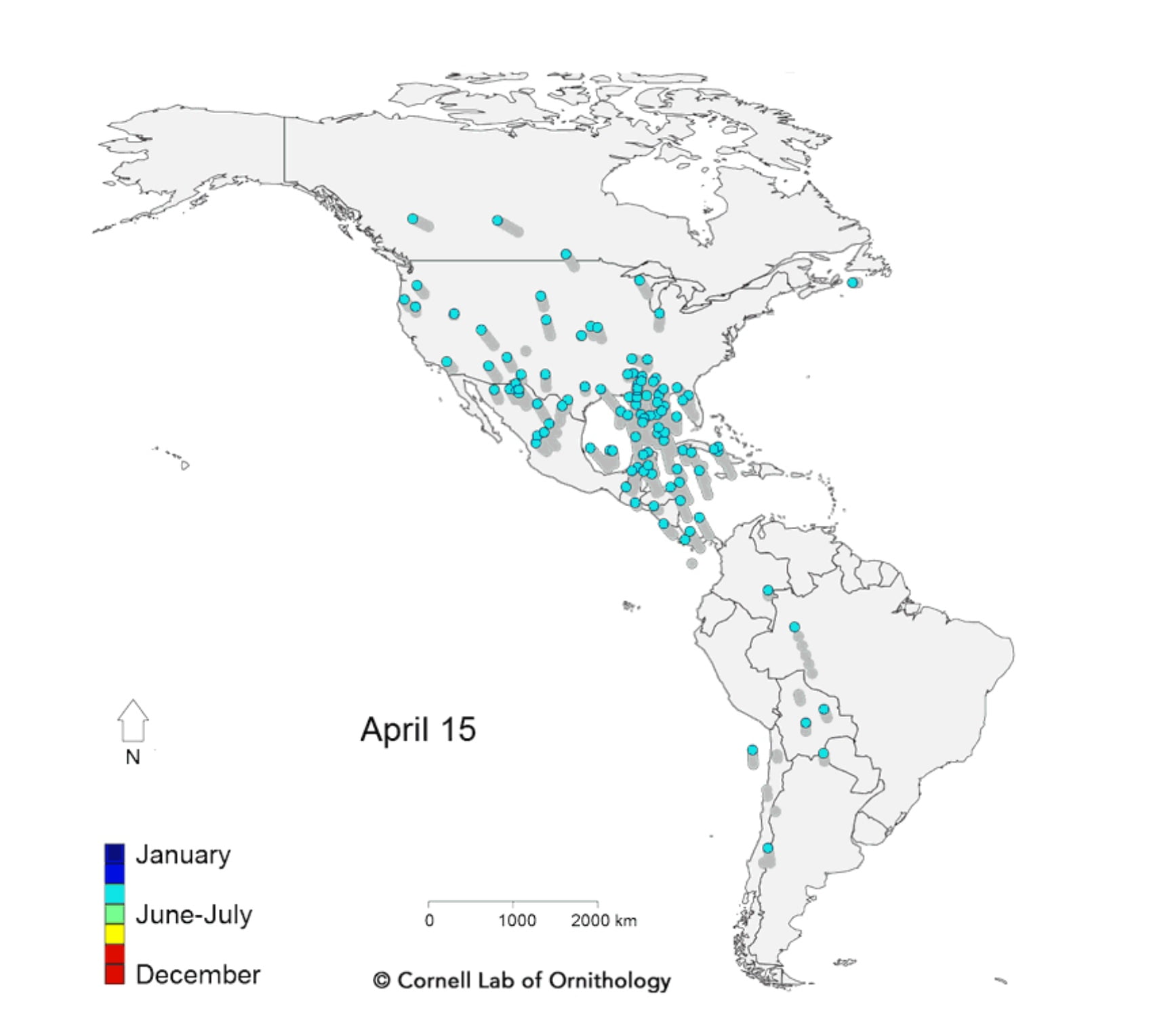
Click here to watch the seasonal movement of birds in North America.
Source Credit: All About Birds

The selection of the spring or winter ranges goes back many hundreds or thousands of generations by species. Some seasonal ranges evolved over time as animals sought out locations that provided the essential basics for them to thrive. Some species migrations have evolved over a tremendous period of time as far back as the Ice Ages, as migration routes are a complex undertaking involving weather conditions and distance to travel while ensuring there is adequate food resources with the right temperatures, humidity and water supply for those species to live comfortably and have the required foods to sustain them on their migration journey. Time is also a very important factor of migration as many other requirements must occur at critical times to ensure the continued health of the animals through all stages of their migrations.

For example, ice in the north must be sufficiently melted to permit arriving waterfowl to eat and remain secure from some predators, similarly, the plants and other vegetation migratory animals depend on should either be grown or growing well enough to sustain the creatures that depend on it when they arrive. These requirements are not just at the destination ranges, but also along the route the animals travel as some migrations may take weeks to complete.

Some species must also learn to endure through varied and sometimes lethal obstacles either created by natural events like landslides, earthquakes and floods, but also by human-made challenges like dams, habitat reduction and new developments and their supportive infrastructure where vital resources needed by the migratory animals have been removed or altered in some way. Ducks and geese must seek out new safe places to stop and reenergize when wetlands they have depended on in previous migrations have been turned into shopping malls and parking lots.

Migratory birds like swans and geese are probably the most visible migratory species as they fly overhead in great flocks honking as they go. Beneath the water’s surface, fish of all kinds like salmon migrate back to their natal streams to lay and fertilize the eggs that will produce their next generation- often within a couple meters of where they were born. Yukon’s rivers connect lakes where our common species of pike, grayling, whitefish and lake trout choose to spend their summers and winters, which may be greatly influenced by the insect hatches and changing water depths resulting from spring melt and freshet flooding. These short seasonal relocations are also considered to be migrations, but are not of the same scope other species like salmon or geese perform.

Photo credit: From Left, Lindsay Caskenette &  Jake Paleczny

Barren ground caribou like the Porcupine herd travel vast distances each year enroute to their calving grounds near the north coast. Their migration helps to distribute the impacts of their grazing so that they do not over-consume the vegetation causing harm to the landscape in any given location. Many thousands of caribou can eat a lot and their migration not only ensures more widespread grazing, but also their waste products (poop) are deposited over a greater area, thereby helping to fertilize more of the tundra they depend on each year.

Woodland Caribou at the Preserve.
While all caribou herd migrate the Barren Ground is know for more expansive journeys, particularly the Porcupine Barren Ground Caribou herd.  
Photo credit: Jake Paleczny

Insects also migrate usually in search of warmer temperatures and liquid water to lay their eggs and ensure there is an adequate food supply for the young to eat and grow healthy on. A queen honey bee will trigger a brief hive migration when she leaves the hive in search of a new location with better food resources nearby.

Migration is closely tied to a number of annual behavior traits as well. Some bird species may molt (shed their feathers) soon after arriving at their spring destination. Energetically expensive as migration itself molting and replacing feathers after a long journey north is important for the return trip. Also, the cast-off feathers can be used to line their nests against the cool winds of the tundra. However, while molting their ability to fly may be diminished which will put them at greater risk from predators. Just like migration and breeding, molting is ones of the vital parts of a bird's life. 

Video explores molt in the migratory species, the Rusty Blackbird in Southern Yukon.
Source Credit: International Rusty Blackbird Working Group.

Predator birds, raptors like falcons, owls, eagles and various hawks also migrate to these ranges to raise their families and they depend on the ducks, hares, lemmings and other ground-nesting birds as a resource for them and their offspring until it’s time to migrate south again.

Climate change is modifying many of the important conditions some species require to live in a region, the timing of the spring melt is one of the major ones. As warmer spring conditions arrive earlier in the year, some species may need to begin their migration northward sooner to ensure they arrive in time to get a good nesting location, or time their arrival to an important food resource like a caddisfly hatch where millions of little flying insects hatch from a river over a few hours. Both fish and birds gather for these short-lived but important high-protein energy feasts.

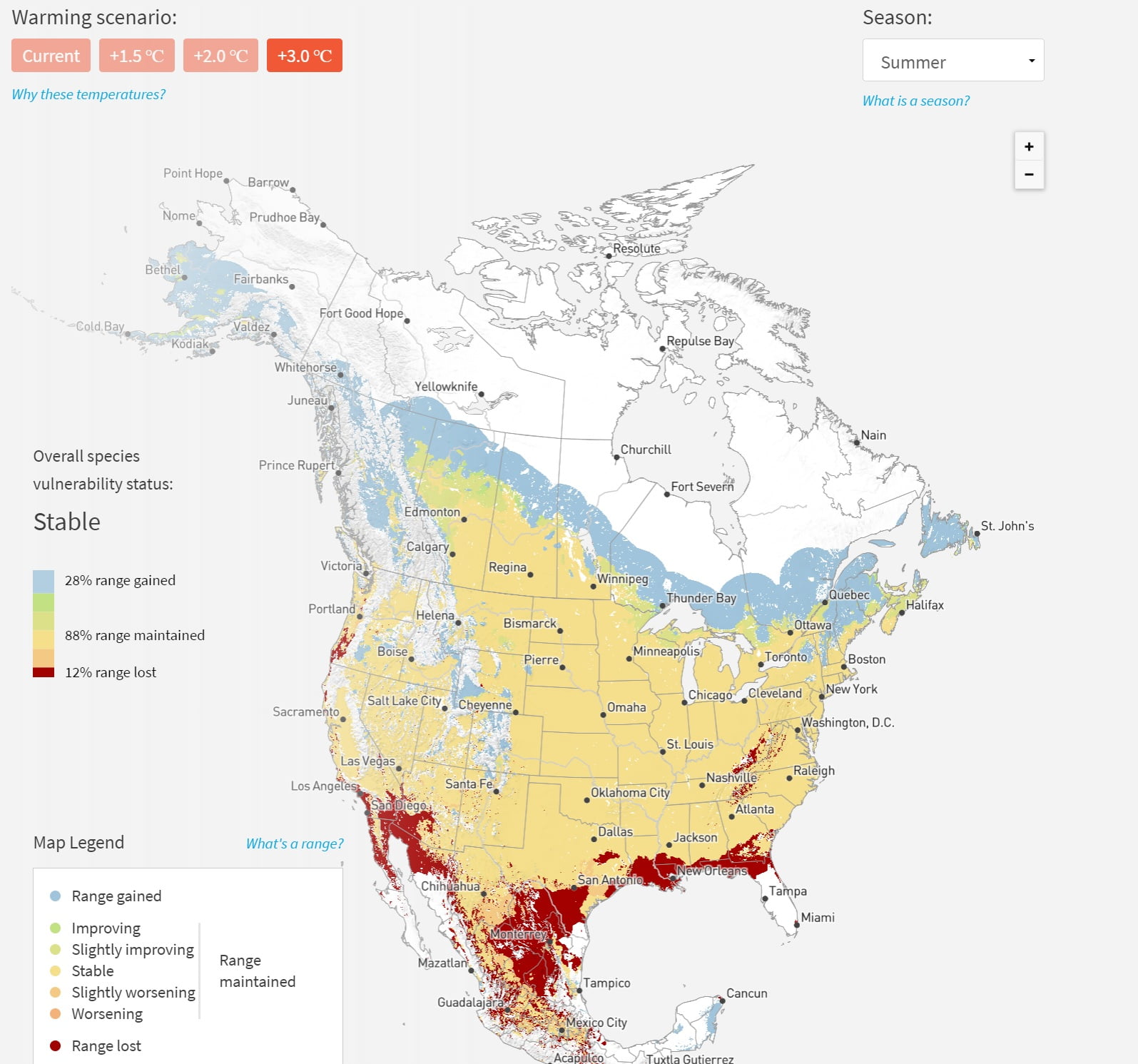
Visit Audonbon.org to learn more about shifting and actaully expanding range for the Barn Swallow in climate change warming scnarios.  Source credit: Audubon

Again time is a critical element that can determine success or failure especially when other elements are out of sync. Like a delayed arrival of the warmer spring weather will slow the growth of some vegetation or delay thawing of the ice from waterways which can also create problems if the spring melt happens too early or too dramatically where it may cause rapid snow melt and flood rivers and creeks along migratory routes and nesting locations that create new hazards for the animals. A long lasting winter will also influence how arriving animals settle into their summer homes and make their arrangements for the warmer days to come. Nesting locations and preferred hunting and fishing and grazing spots may be at a premium and first come-first gets is the rule if they are willing to defend their locations.

Migration can be a life or death test for some animals depending on the conditions of the travel route and their intended destinations. Some destinations may be unusable due to new predators making a home there, physical damages caused by floods, fires and the landslides which may cause the animals to seek a new location that meets their needs. They may have to fight to keep their new location as other groups or another species may compete for the same resources they need to survive.

Bird migration and cities

There are many ways human activity interferes with animal migrations in the Detours and Distractions: How Humans Impact Migration Patterns. Explore the educational PDF by National Geographic.

Some predators take advantage of the migratory creatures when they arrive in great numbers. Bears demonstrate this very well as they gather on the streams and rivers to capture migrating salmon returning to spawn.  Bears also follow the caribou herds in pursuit of newly born calves trying to keep up with the rest of the herd. Fledgling birds are common prey for Sharp-Shinned Hawks, Shrikes and other small raptors that also may have hungry hatchlings in their nests.  Foxes and weasels also prey heavily on eggs and young hatchlings of geese, ducks and other ground-nesting birds.

This photo slide from Yukon photographer, Peter Mather at Ni'iinlii Njik (Fishing Branch) Territorial Park shows the close relationship of predator and prey. Bears will remain active in this region as winter approaches to benefit from the abundance of food in the form of migrating salmon. 
Source Credit: Peter Mather Photography

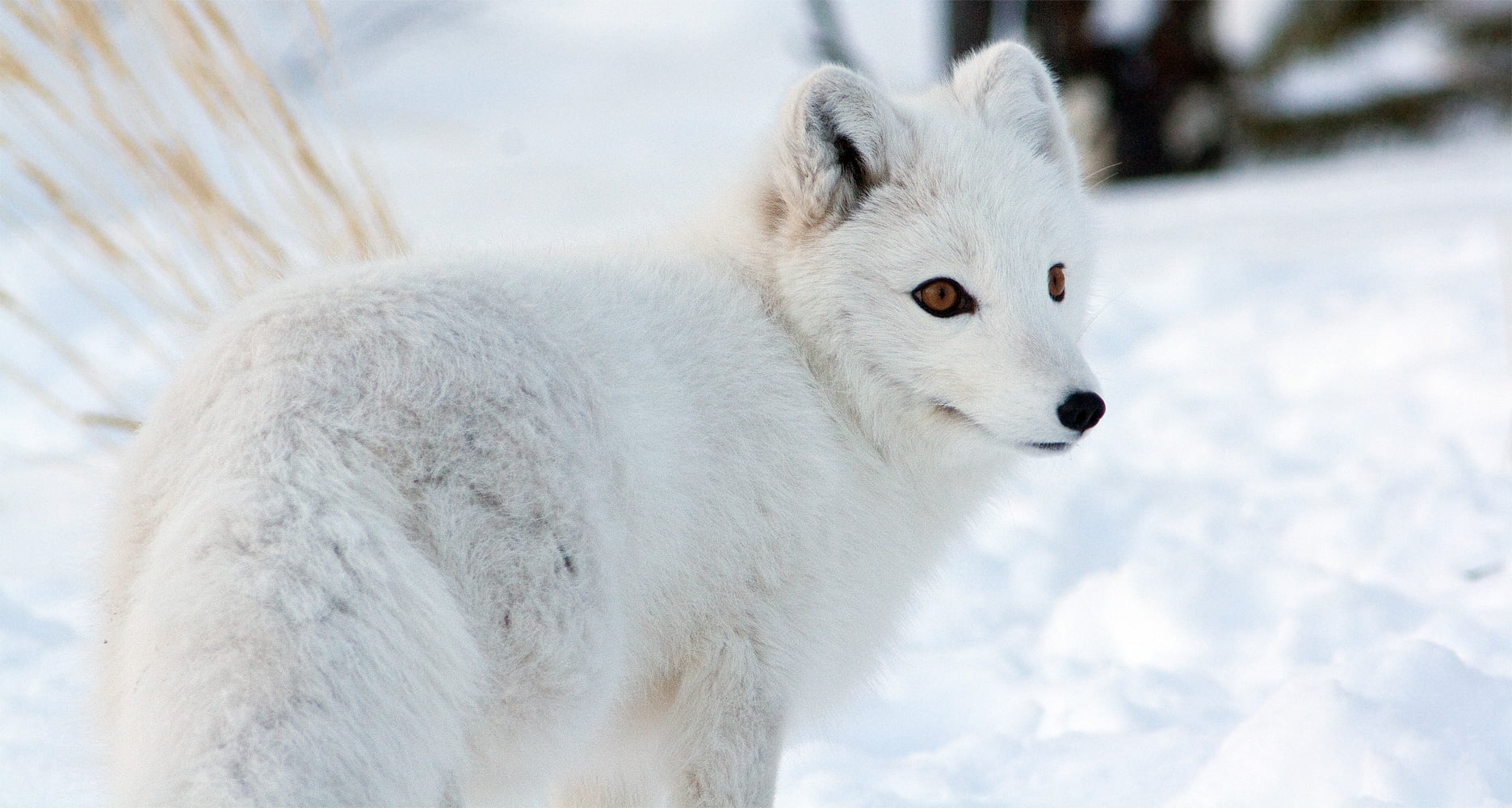
It works the opposite way as well as migratory animals depend on other species to sustain them and in some cases, their choice of destination may depend on resident species and the birthing of their offspring. An example can be found with Peregrine Falcons and other raptors who hunt the lemmings, hares and other rodents born in large numbers on the tundra each spring. Lemmings mature at 5 – 6 weeks of age. They are prolific breeders and may produce 8 litters of up to 6 young each throughout the summer. The gestation period of the female Lemming is 20 days making them one of the primary food resources for carnivorous species, like the Arctic Fox, spending their summer on the tundra.

Arctic Fox at the Yukon Wildlife Preserve.
Photo Credit: J.Paleczny.

Some species like Canada Geese and Tundra Swans mate for life so when they arrive at their springtime destination they can get right to work raising a family, However other species and those just reaching reproductive maturity will need to find a mate, build a nest, breed and raise their new offspring. All of this takes time and each animal is racing the clock and calendar to complete these basic requirements before they have babies which will demand a larger portion of their available time keeping them fed and protected as they grow to adolescence to commence preparations for the migratory trip back to their winter ranges before the winter season arrives, and some years it can come early or later as the present weather trends indicate.

Swan parents and their offspring at the Yukon Wildlife Preserve. In Spring, 2015 a pair built a nest in the moose habitat and had 5 cygnets.
Photo Credit: L.Caskenette

Waterfowl and other creatures that depend on water for their nutrition and safety pay close attention to falling temperatures and the return of ice on the surfaces of ponds and lakes. Other indicators warn of the returning winter conditions, insect populations fall dramatically; leaves change colour and other vegetation stops growing and goes to seed signalling it is time to move south once again.

Some years snow may fall early and in sufficient quantities to make searching for food a greater challenge. Often robins will be seen digging in the snow for insects and berries as they gather together in preparation for their journey south.

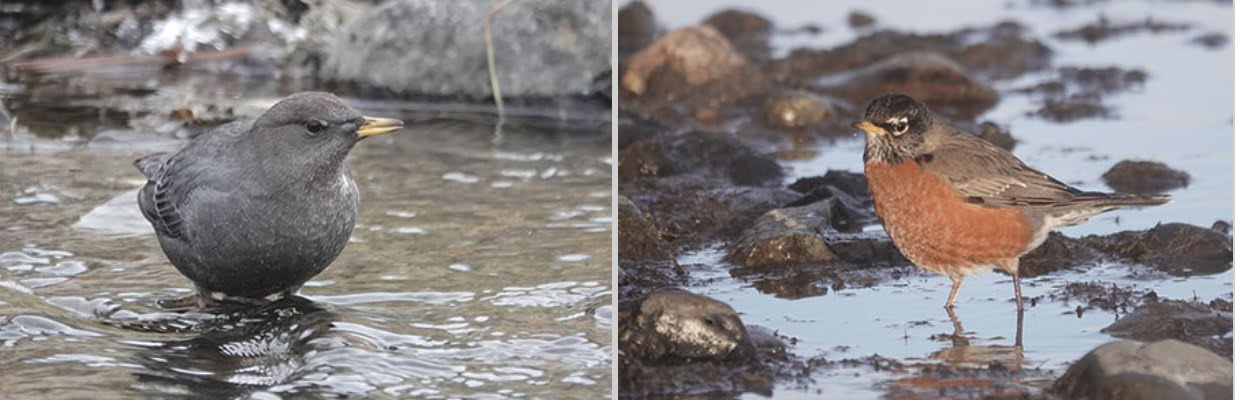
Left Photo: American dippers are a delightful winter sight, swimming and singing from icy or rocky perches in fast-flowing waters, such as the Yukon River below the Whitehorse dam.

Right Photo: Winter wannabes like this American robin find small bugs and animals to eat along the muddy shoreline of the Yukon River below the Rotary Centennial Bridge.

Photo Credit and Caption: Jenny Trapnell
Read more from Jenny - A Chance on Winter in What's Up Yukon.


Migration is an effective tool to ensure the seasonal health of many animal species, but also migration provides habitats some time to regrow while the species are away in their other ranges. Nature’s clock is the movement of the planets and the tilting of the Earth which determine the seasons as winter gives way to spring and new generations are being born. Climate change is also influencing animal species that are well-tuned into these seasonal changes which can be very subtle but are important signs for creatures that need to pay attention to subtle weather changes and the potential impacts on their migration requirements.

Doug Caldwell

Doug Caldwell

Wildlife Interpreter

Doug is one of the Interpretive Wildlife Guides here at the Preserve. An avid angler and hunter he has a broad knowledge of Yukon’s wilderness and the creatures that live here. With a focus on the young visitors to the Preserve, Doug takes the extra time to help our guests to better appreciate the many wonders of the animal kingdom here in the Yukon.

Explore by Category

Explore by Author

Bat Talk: How do you listen to what you can’t hear?

Bat Talk: How do you listen to what you can’t hear?

animals

by Joelle Ingram | Jan 29, 2021

This article was made possible thanks to support from the Environmental Awareness Fund. Engage and educate yourself in this 10-part blog series, about Yukon Biodiversity.

10 minute Read.
Banner image photo credit: Justine Benjamin

If you’re an enthusiast for the sounds that airborne animals make, you can absolutely drown yourself in bird call resources from written guide books to audio recordings on birdwatching apps. But what about bats? These little bug-eating wonders are also screaming around the sky but they are much harder to hear. In fact, they are almost impossible to hear! While some bat calls are audible, a lot of them fall outside of the range of human hearing. So how can we get in on the bat gossip?

Let’s tackle the basics first: how do bats make sound? Bats use echolocation, also referred to as “bio sonar” which essentially lets them “see” using sound. This a very useful technique for creatures that are almost exclusively active in the dark. It’s definitely more effective than my method of locating objects in the dark which is usually by painfully smacking into them with my knees and pinky toes. Echolocating animals emit a calls out into their environment and listen to the echoes of those calls to determine the location of objects or prey in their vicinity. Most bats emit these calls by contracting their voice box (larynx) although a few species click their tongues. The frequency of these calls is mostly in the ultrasonic range i.e. they fall outside the human ear’s audibility limit (around 20,00 hertz or higher). The sound travels out of their mouth (or sometimes nostrils!) and the returning echoes are picked up by their highly specialized ears. The outer shape, size, and wrinkles of a bats ear are thought to help capture and funnel the echoes to their inner ear which has receptors that are tuned to the specific frequencies of the bats call and the corresponding echo. Neat right? I think it’s pretty neat.

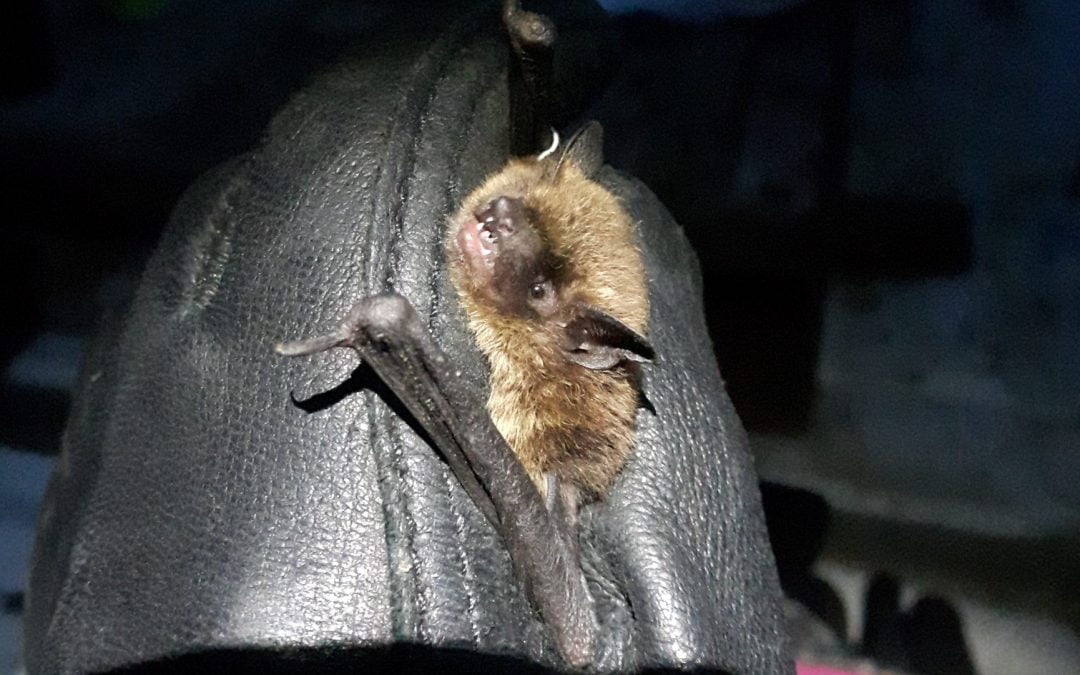
A tail get set up for mark recapture of little brown bat (Myotis lucifugus) in the field. Photo credit: Justine Benjamin

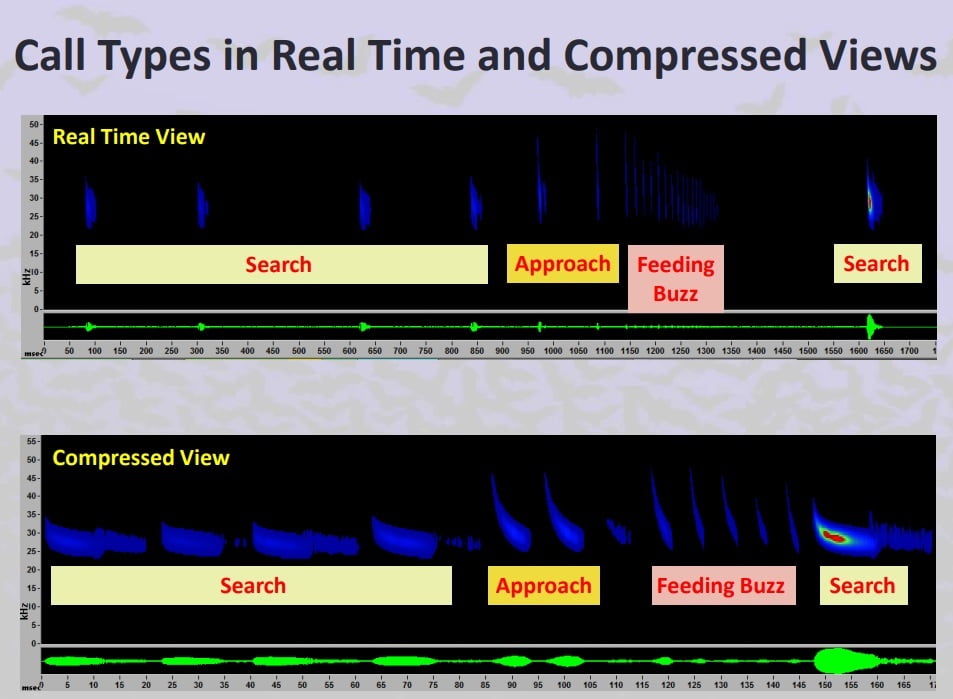
Bats have different calls for different occasions; their “I’m about to eat this bug!” call is different from their general “Where are all the things around me?” call. A smarter way to say this is bat vocalizations include social calls, navigation calls, approach calls, and feeding buzzes. Navigation calls (also known as travel or search calls) are exactly what it says on the label, they’re the call bats use to determine the relative location of objects around them as the bop around in the night sky. Similar to a navigation call is an approach call which bats use when they’re closing in on a bug, heading towards a landing spot, or if they’re flying around in a cluttered environment like somewhere with lots of vegetation. Think of it as a bat proximity warning.

 Social calls are often lower in frequency than navigation calls and they can have complex modulations in frequency that help indicate which genus and species of bat is hollering at its bat buds. We will come back to that in a bit. Finally, a feeding buzz also known as the “terminal phase call” but that sounds a little dire so, I’m just going to keep calling it a feeding buzz. Bats use this buzz to pick up close by objects when they pursue and capture prey. This buzz is made by a lot of rapid-fire calls and by “rapid-fire” I mean up to 100 calls per second! That’s so many! A lot of different species have similar feeding buzzes so unlike social calls, these aren’t useful for telling you what kind of bats are making them.

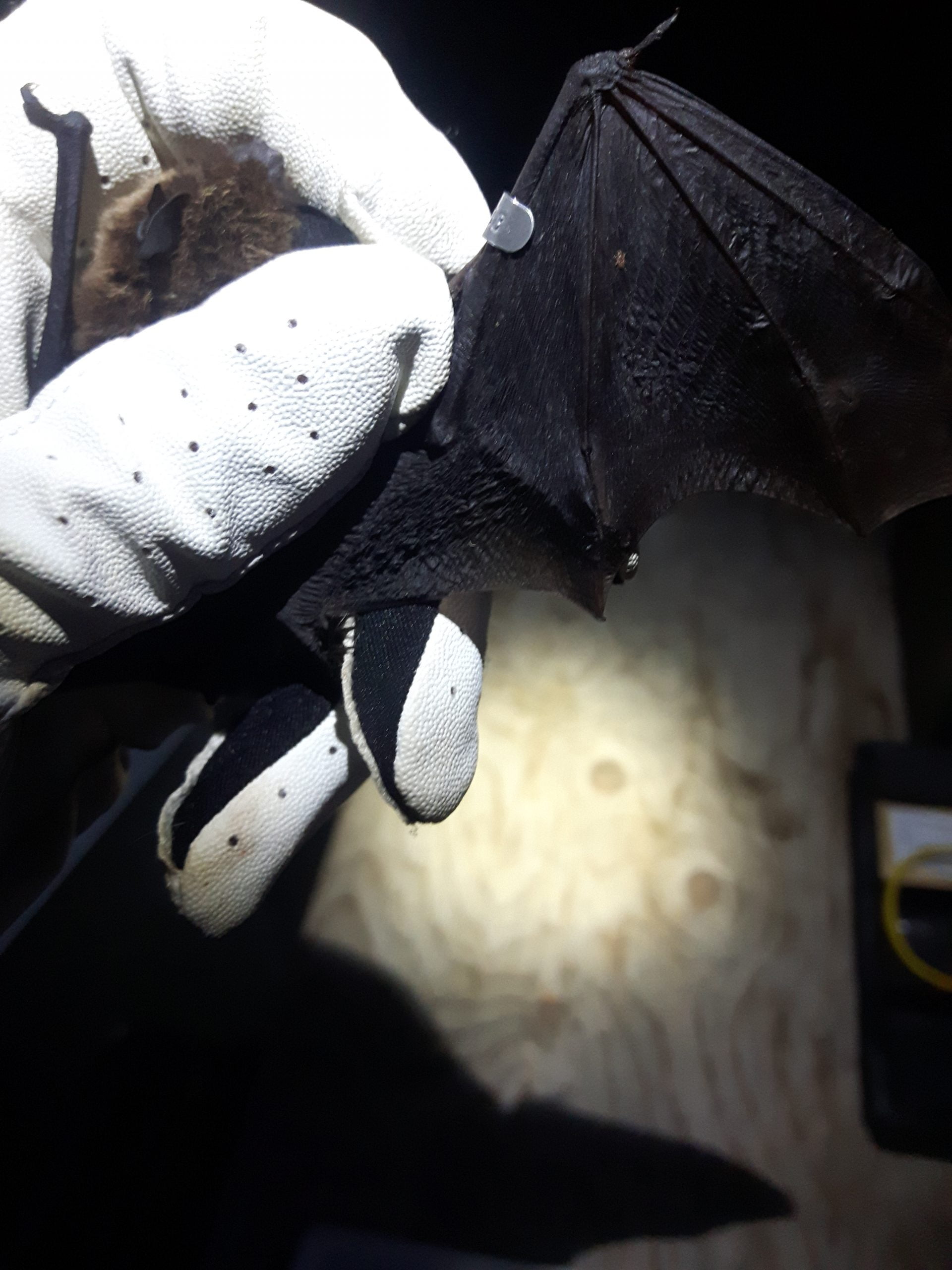
Little brown bat (Myotis lucifugus) with a metal ID band on its forearm. Photo credit: Justine Benjamin

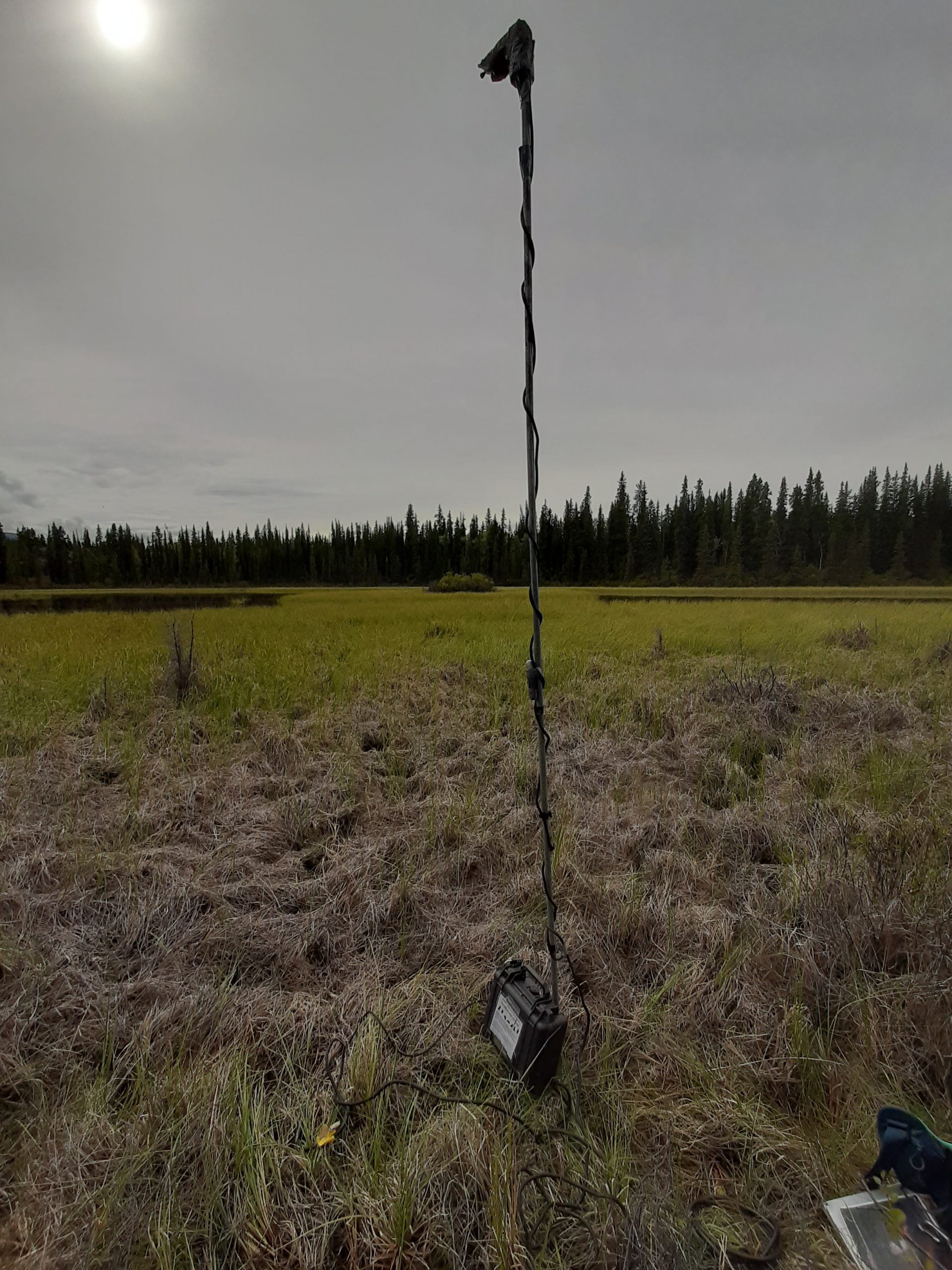
As you might imagine, recording and differentiating between calls you can’t hear might be a little like trying to hit a dartboard with a sewing needle and the dartboard is in a different room. Let me walk you through it using some examples from the 2020 Yukon Wildlife Preserve Bioblitz. During the Bioblitz, four acoustic monitoring stations were spaced out around the preserve to pick up bat calls over the span of four evening. In order to specifically pick up bat calls, the audio detectors were set to high frequencies and only recorded between dusk and dawn when bats are active. They were also set in relatively open areas to avoid noise clutter that would interfere with the recordings.

Once these calls are collected, what do you do with them? Please let me introduce you to SonoBat. While SonoBat may sound like an off-brand superhero, it’s actually software that analyses bat calls. It takes recordings of bat noises and converts them into sonograms (graphs representing sound). Sonobat lets you look at these sonograms in real-time to get an idea of the how the frequency varies across the call sequence and how much time passes between these calls. You can also check them out in “compressed view” which compresses the time interval between calls to show more details of the call at a glance. This gives you a better idea of the shape, frequency, harmonics, and relative strength of the call.

Now you’ve got all the sweet deets from your recorded bat calls, SonoBat can compare these calls to a library of calls from known bat species to help you ID which bats are in your area. However, there are similarities between the call of different bat species and not all recordings will be clear enough to make a definite ID. For example, 10% of the bat calls recorded during the Bioblitz were unidentifiable and hey, it happens. This is where knowing which bat buddies are native to your area can really help you out. Here in the Yukon, our most common tiny sky mammal is the little brown bat (Myotis lucifugus) but they’re not alone. The Northern bat, big brown bat, hoary bat, long-legged bat, and long-eared bat have also been spotted in the territory.

Acoustic bat monitoring set up; a microphone mounted on a 10ft pole attached to a Pettersen audio recorder. Photo credit: Justine Benjamin

The bat calls recorded at the Wildlife Preserve Bioblitz mostly belonged to the ever-popular little brown bat (44%) while 46% was from the other bat species: The Northern bat, the long-legged bat, and the long-eared bat. We apparently have a lot of bats with lengthy body parts up here. Most of these bat calls (536 calls out of 605) were picked up by the audio recorder set up near the preserve’s pond. This makes lots of sense since a pond is essentially a bat cafeteria due the number and density of insects that like to cluster around still water.

SonoBat audio file. Thanks to Justine Benjamin for assisting in this work. 

It may not be as easy as sticking your head out the door to listen to a dawn chorus of birdsong but with audio recorders, specialized programs, and some pre-existing bat knowledge you too can identify bats by their mostly ultrasonic calls! … Okay, eavesdropping on bats might not be an activity for the casual enthusiast but it’s a fascinating process nonetheless.

Joelle Ingram

Joelle Ingram

Human of Many Talents

Joelle is a former archaeologist, former wildlife interpreter, and a full-time random fact enthusiast. She received her master’s degree in anthropology from McMaster University. One of the four people who read her thesis gave it the glowing review “It’s a paper that would appeal to very specific group of people,” which is probably why only four people have read it. Her favourite land mammal is a muskox, her favourite aquatic mammal is a narwhal. She thinks it’s important that you know that.

867-456-7400
 info@yukonwildlife.ca

Explore by Category

Explore by Author

Thinhorn Mountain Sheep

Thinhorn Mountain Sheep

animals

by Doug Caldwell | Dec 4, 2020

10 minute read -

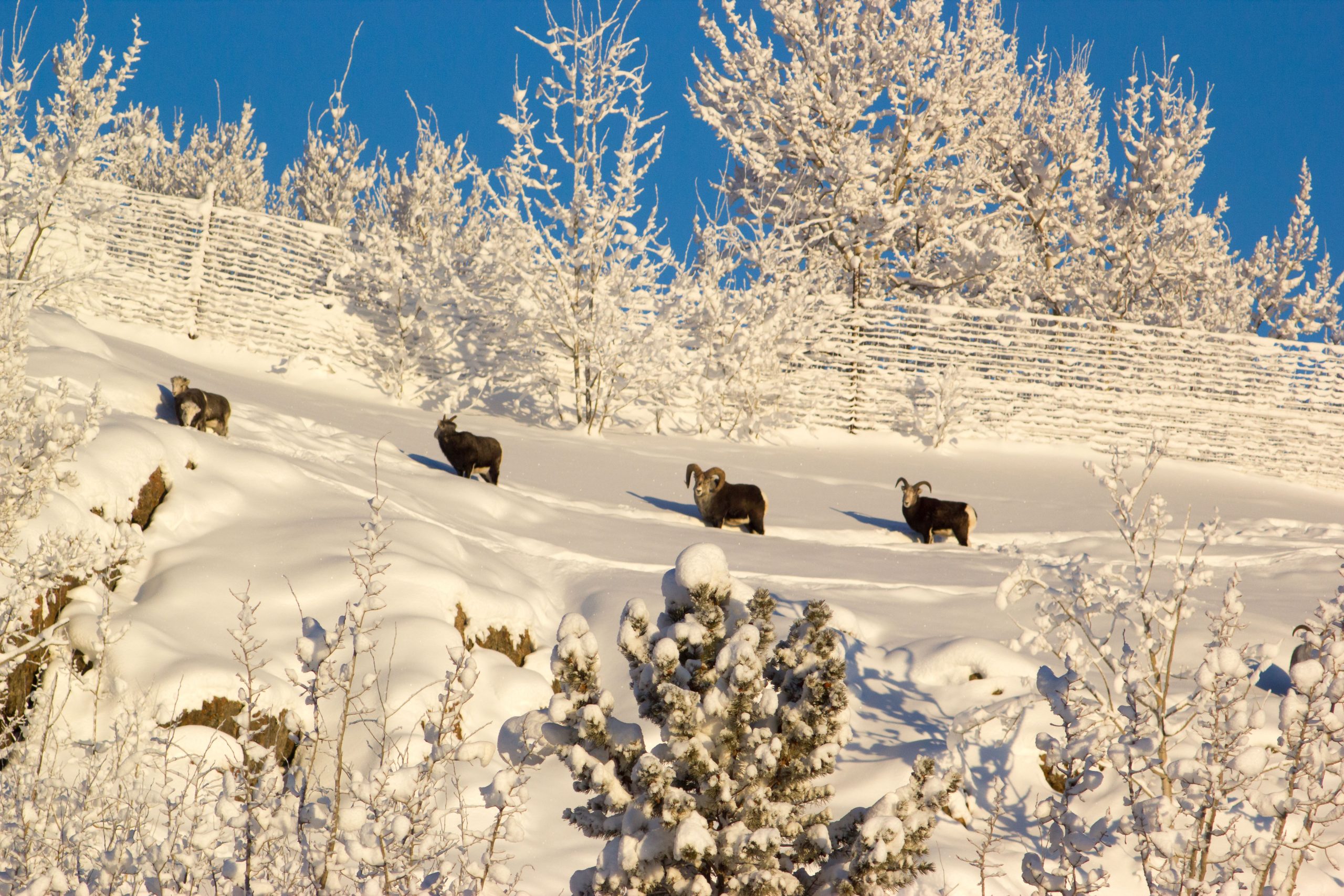
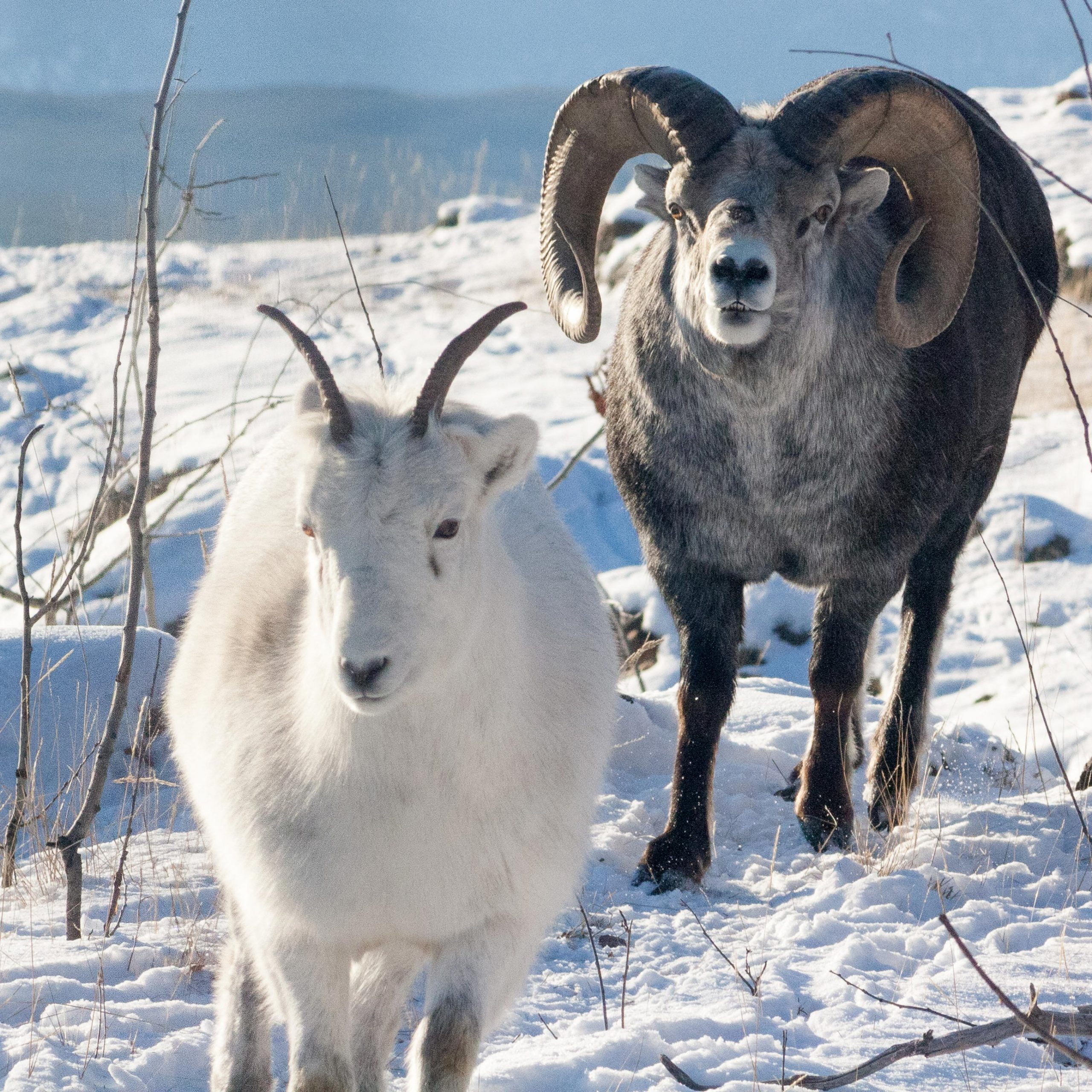
For a long time, it was believed that there are three distinct subspecies of thinhorn Mountain Sheep in North America each of these known as: Dall, Fannin and Stone. Each subspecies displayed different colouring of their coats where Dall would be pure white, Fannin would be white with grey, silver and black highlights and Stone sheep were white with brown and black highlights and sometimes predominantly all dark grey.

Thinhorn Mountain Sheep grow one set of horns from youth to old age.  Pictured are two rams (males).  L to R:  Young ram; mature ram.

Recent DNA gathering and analysis has revealed that all three subspecies are actually very much alike and identification of each subspecies is becoming significantly more difficult to confirm as interbreeding continues and identifiable traits or genetic markers blend together to produce a mongrelized modern day specimen.

Further, evolutionary biologists1https://www.ualberta.ca/science/news/2016/june/dna-analysis-rewrites-the-story-of-thinhorn-sheep-during-the-last-ice-age.html studying the lineages of thinhorn sheep have found evidence suggesting that the species diverged hundreds of thousands of years earlier than previously thought. Greatly influenced by the formation, movement and final melting of the glaciers, thinhorn sheep roamed a vast area in search of ice-free grazing areas known as refugia. The mountainous geography often separated groups of similar or same subspecies sheep where through isolation they accumulated some variances between populations over time, sometimes resulting in the formation of what were originally thought to be new subspecies due to variations of their physical appearance.

Genetic science continues to study these animals and new proofs are foreseen to reveal how the present thinhorn sheep populations of the Yukon, BC and Alaska evolved to be what they are today. As genetic scientists work with data gathered by paleontologists, geologists and other scientific disciplines, there is anticipated to be a more accurate understanding of how northern animals evolved into what they are today.

Despite their uniqueness in genes and variations in colour, thinhorn sheep rams share the same impressive set of horns that are admired in the animal kingdom. It is important to note that horns and antlers are not the same. Members of the deer family grow antlers which are shed and grow back each year, while sheep grow horns which are with the animal for all of its life. Also antlers grow from the tips while horns grow from the base.2https://medium.com/usfws/11-facts-about-antlers-18e689fe9e60#:~:text=Bison%2C%20antelopes%2C%20sheep%2C%20goats%20and%20domestic%20cattle%20%E2%80%94,from%20the%20tip%3B%20horns%20grow%20from%20the%20base  It’s a minor thing, but important because if a young sheep breaks off a tip of their horn, it will remain that way for the rest of its life. Female sheep or ewes also grow horns but these are much more diminutive than the male sheeps’ horns.

​ Female sheep or ewes also grow horns but these are much more diminutive than the male sheeps’ horns.

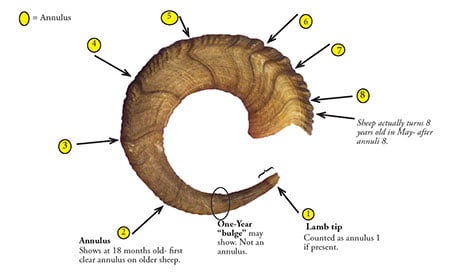
Sheep start to grow their horns shortly after birth and they will continue to grow over their lifespan, sometimes up to 20 years of age.3http://www.env.gov.bc.ca/wld/documents/thinhorn.pdf If you look closely at a ram’s horns you’ll see rings that circle the horn in various locations. These are called growth rings or annuli rings and a new one is formed each year and they are a reliable method to estimate the age of the animal. The horns are made of keratin, which is the same hard material that their hooves are made of and it grows quickly.

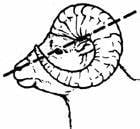
The first few inches of horn that a ram grows is called a lamb tip and represents about the first 6 months of the animal’s life,4https://www.adfg.alaska.gov/static/hunting/dallsheephunting/pdfs/dall_sheep_guide_to_judging_sheep_horns_under_full_curl_regulation.pdf it often gets broken off as the ram’s life of fighting and careless use take their toll.

Credit Alaska Department of Fish and Game

Each year a new annuli ring is formed near the base due to stressors the ram experiences, normally associated with the mating season.  You may notice that the space between the annuli rings is not uniform. This reflects the quality of nutrition that the animal experienced during that year of his life. Large wide spaces between the rings indicate good nutritional intake and low stress. Small thinner spaces may indicate a stressful year or a reduction in nourishment possibly associated with long, hard winters, forest fires and a loss of grazing, avoiding predators and similar stressors found in nature. Once the ram reaches a certain age of maturity, at about eight years,5https://www.coniferousforest.com/dall-sheep.htm the horns will continue filling out in thickness and mass, but stop growing longer as time goes on. A mature ram's horns can weigh up to 15 kilos - more than all the bones in his body combined.

The size and shape of ram’s horns are what distinguish it from others and there is a wide variety of shapes, formations and sizes among sheep horns. Some horns form concise symmetric circles that are located close to the animal’s head, while others grow into a cork-screw-like shape where the tips are splayed out from the ram’s head. Some rams have horns that are thicker and longer than others, this is normally associated to a genetic trait of the animal’s ancestors where the influencing genes get passed to subsequent generations.

Hunting organizations such as Boone & Crockett have devised an elaborate measuring system with which to score the horns of most big game animals. The horns are measured at specific locations including the base, the overall length of the horn on each side, the distance between the horn tips and diameters of the horn in four key places. Once these measurements are collected some math is performed to arrive at the score for that ram’s horns. Records are kept by species so that hunters know how their harvested ram compares to others. This record keeping is also valuable for biologists and others to track the various changes in sheep populations around the world and may indicate declines in health, and their supporting environment and other influences which may be indicated by the changing size or condition of their horns.

Regional governments also utilize hunters to gather important data from the field. This is usually done by making it mandatory that certain parts of the harvested animal are submitted to the Game Branch as a condition of the species harvest tag. In this way biologists get to examine a diversity of a certain species all harvested within a quantified period of time and noted locations. Biologists examining sheep submissions here in the Yukon check for a number of important indicators. Yukon regulations require the complete head of a harvested ram be submitted for inspection.6https://yukon.ca/sites/yukon.ca/files/env/env-yukon-hunting-regulations-summary_en.pdf]]

The first thing they examine is if the horns are indeed a full curl as regulations prohibit harvesting a ram that is less than a full curl.

The biologists then extract a tooth to confirm the exact age of the animal by cutting the top off and counting the rings similar to the dendral or age rings of a tree. They may also take a tissue or blood sample to test for various diseases and infections the animals may suffer from. When all the tests have been completed the biologist bores a small hole in the top side of the horn facing the rear and epoxies a serialized aluminum plug into it. These plugs help to combat the underground trade of animal heads by having each head recorded by hunter, date and location.

Having access to all this data helps biologists to better understand the health of the wild sheep herds and may provide clues on where a disease is developing and which way it may be moving geographically.

Photo Credit: Kevin Pepper

Photo Credit: Kevin Pepper

Rams are famous for bashing their horns together to determine which is dominant for breeding purposes, but that is only for a few days each breeding season typically in late November and December. They also use their horns to communicate among themselves in ways that humans can only guess at. They will sometimes interlace their horns gently and rub their ears together which appears to be a welcoming gesture. Like most creatures, mountain sheep use body language to communicate with others. It may be a twisting of the head or extending their noses while they peel their lips back to reveal their teeth, or something as simple as their stance and how they wiggle their ears as they stare at others from a distance. They often grunt at each other as well.

Rams will often gently head-butt  each other as a form of greeting, similar to how a house cat bumps your leg when seeking attention. They can be quite gentle in their horn touching activities or they will get up on their hind legs and really lean into butting another ram with all the force they can muster.

Photo Credit Mark Newman

Photo Credit: Mark Newman

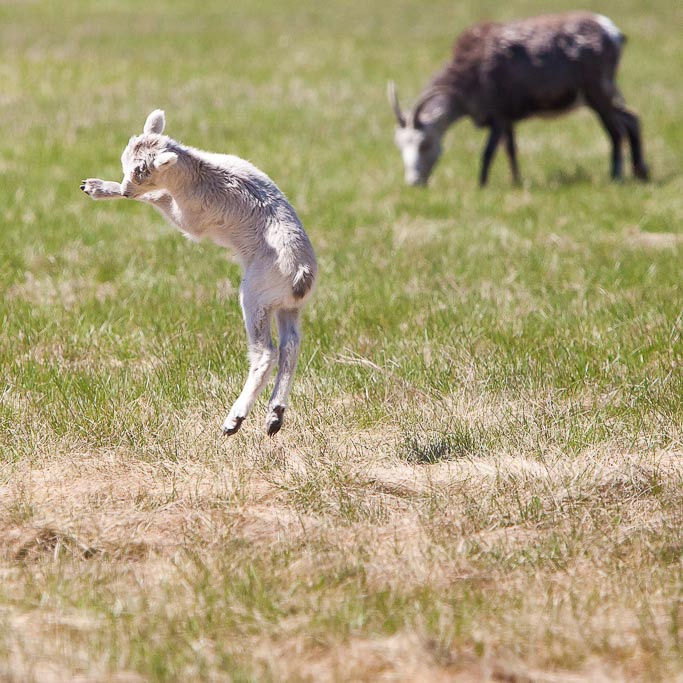
With remarkable muscle tone, balance and coordination mountain sheep demonstrate how well they have adapted to living on rock faces as they frolic and cavort in situations humans try to avoid. Often it will take a human significantly longer to cover a vertical climb it only took a few seconds for the sheep to navigate. Mountain sheep are remarkably strong and have endurance that allows them the energy and stamina to evade predators such as wolves and bears on the uneven and precarious mountain slopes they call home. Young lambs are a popular target for migrating Golden Eagles arriving in the spring season from their over-winter habitats. So sheep must be watching in all directions for potential dangers that could impact on them or their offspring.

Young lambs are a popular target for migrating Golden Eagles.  Ewes must be watching in all directions for potential dangers that could impact them or their offspring.

Mountain sheep have superior eyesight for distance and low-light conditions, they have horizontal pupils that help them to see panoramically to detect predators that could approach from different directions.  They also need to be able to see forward clearly so that they can run over rough terrain. They have excellent peripheral vision and can see behind themselves without turning their heads due to where their eyes are located on their skulls. Remember they need to look around their horns too.

Thinhorn Mountain Sheep are remarkable creatures perfectly adapted to thrive on the mountains of Northwestern Canada and Alaska and will remain a featured megafauna species here at the Yukon Wildlife Preserve.

Ram follows an Ewe closely.

Doug Caldwell

Doug Caldwell

Wildlife Interpreter

Doug is one of the Interpretive Wildlife Guides here at the Preserve. An avid angler and hunter he has a broad knowledge of Yukon’s wilderness and the creatures that live here. With a focus on the young visitors to the Preserve, Doug takes the extra time to help our guests to better appreciate the many wonders of the animal kingdom here in the Yukon.

Explore by Category

Explore by Author

Faces of the Preserve:  Maureen

Faces of the Preserve: Maureen

animals

12 min read -

It takes drive and passion to support a non-profit organization which works to be a living center of Yukon’s wildlife, with informed voices that speak for, and connect others to, the natural world. Who is the team making this happen?

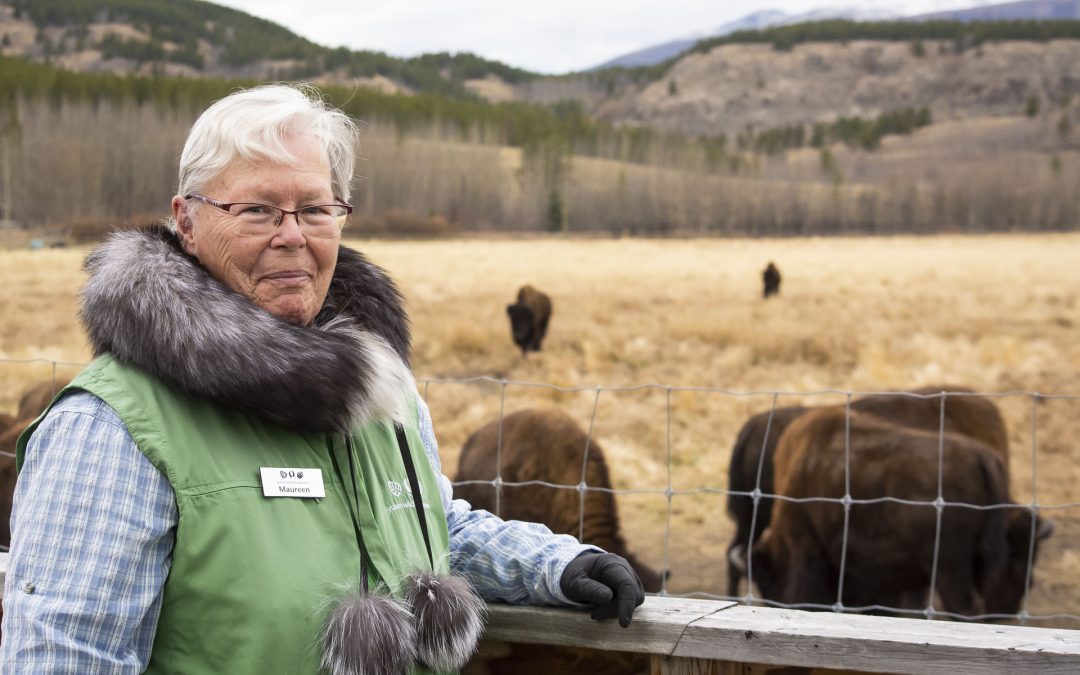
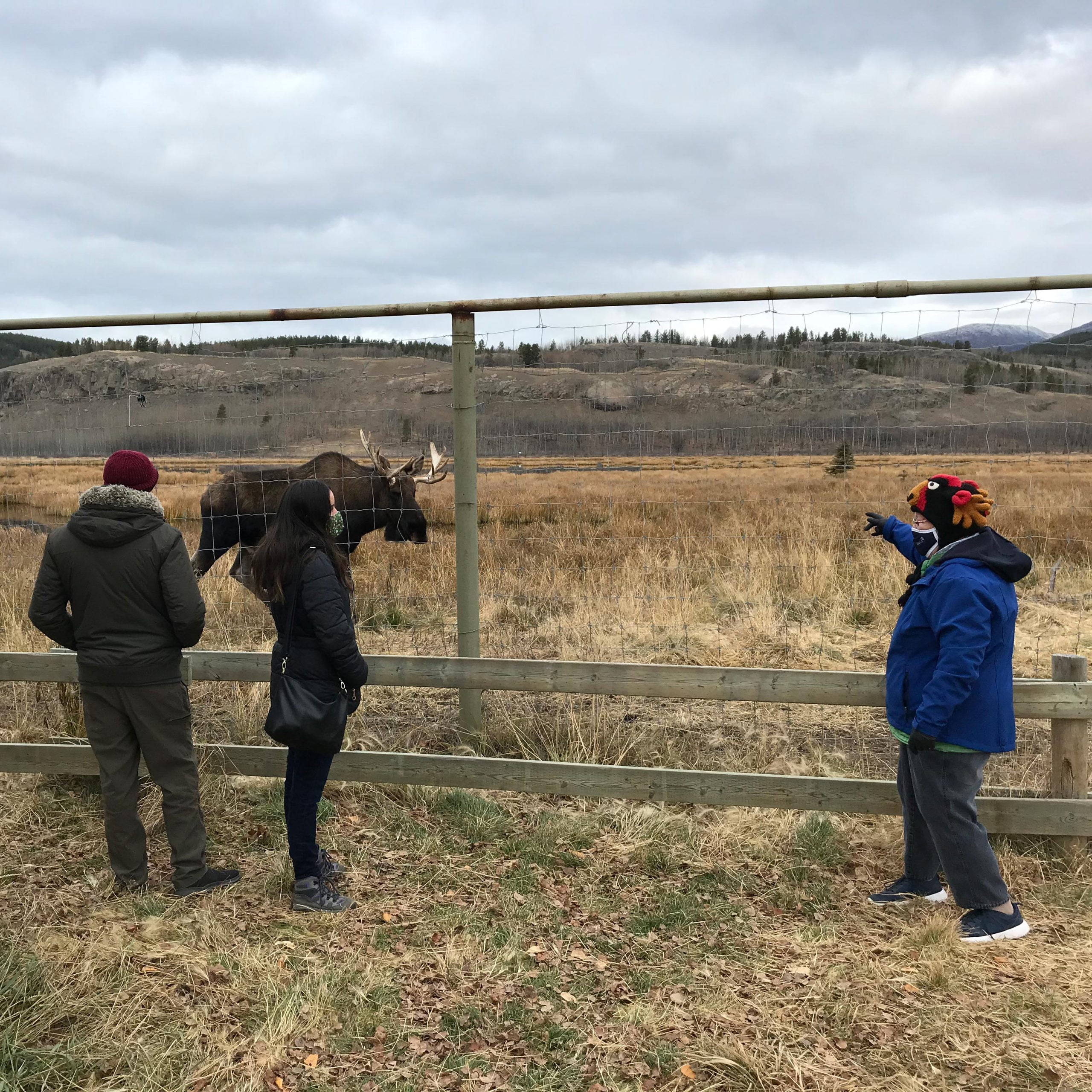
Meet Maureen. She’s a Yukoner with a rich and varied history - just like Yukon Wildlife Preserve. Here she shares what she loves about the Yukon, working as a Wildlife Interpreter, and how that happened in the first place.

“I had always wanted to visit the Yukon. I moved to Whitehorse in 1970 and knew from the start this would be home. In 1973 I moved even further north, to Dawson City, and have spent the next 50 years between the two communities.” As many Yukoners know, successful longevity in the Territory can require versatility; Maureen has this in spades. She joined the team in 2013, drawn to Yukon Wildlife Preserve through a combination of knowledge and understanding of animals, Interpretive experience, and an enjoyment of speaking to people.

Whether in her fox scarf, or her fun moose toque and Covid-19 mask, Maureen helps guests learn about animals.  L to R: Maureen shares knowledge about Wood Bison; Maureen teaches about moose; Guided Bus Tour guest enjoys a close up of Bison while listening to Maureen.

“For 20 years I worked as a commercial fisher(wo)man on Yukon River and Lake Laberge. I spent 30 winters as a trapper, operating from a cabin with no electricity and no running water and 10 years as a placer miner. Finding prehistoric bones while placer mining, that’s very interesting - the most interesting part of placer mining in fact. I have always had an interest in archeology, turns out I had no interest in gold via placer mining! Finding bones:  that's an immediate link to history and the land. Combined, these are years of experience which had me on the land and water, harvesting, observing and getting in tune with nature, the seasons and animals. I learned a lot, during those years, about animal life cycles and respect for animals. I would say I have more appreciation for wild animals because I understand more about how hard life is for them.

I’ve worked for Parks Canada as an Interpreter for 25 summers at sites such as Dredge #4, Bear Creek, Dawson City walking tours and SS Klondike. I’m a Certified Interpretive Guide with the National Association of Interpretation. All those years talking to people, connecting them with history and the Yukon; I bring that to Yukon Wildlife Preserve. My appreciation for and understanding of wildlife, in addition to my skills of observation learned from my years living and harvesting on the land, really assist me in helping to connect our visitors to Yukon species. Specifically, my tracking skills help me observe wild animals in their natural habitats, as well as to understand the story of what I’m watching them do, in that moment. I enjoy sharing those skills and helping visitors learn how to “see” animals that are excellent at camouflage and how to take that beyond their visit to the Preserve, to their lives at home, wherever that is.

Visitors sometimes wonder how my years trapping, hunting and fishing can mean I have a strong appreciation for wild animals. I try to explain that I think I have a greater appreciation because of my experiences, because when you live in the bush, you live closer to the animals. Not only do I think I understand more about how hard life is for wild animals, but I depended on them for sustenance and my livelihood. This has allowed me to acquire a greater appreciation for wildlife. Living this close to nature, while raising a family, allowed me to pass on to my daughter how to observe animals, their natural behaviours and to listen to what their body language and actions are saying, and to then change my behaviour accordingly. We don’t have to speak the same language as animals to hear, and respect, what they are telling us. Humans, we learn that, and I’m pleased to have been able to pass on those teachings to the next generation.

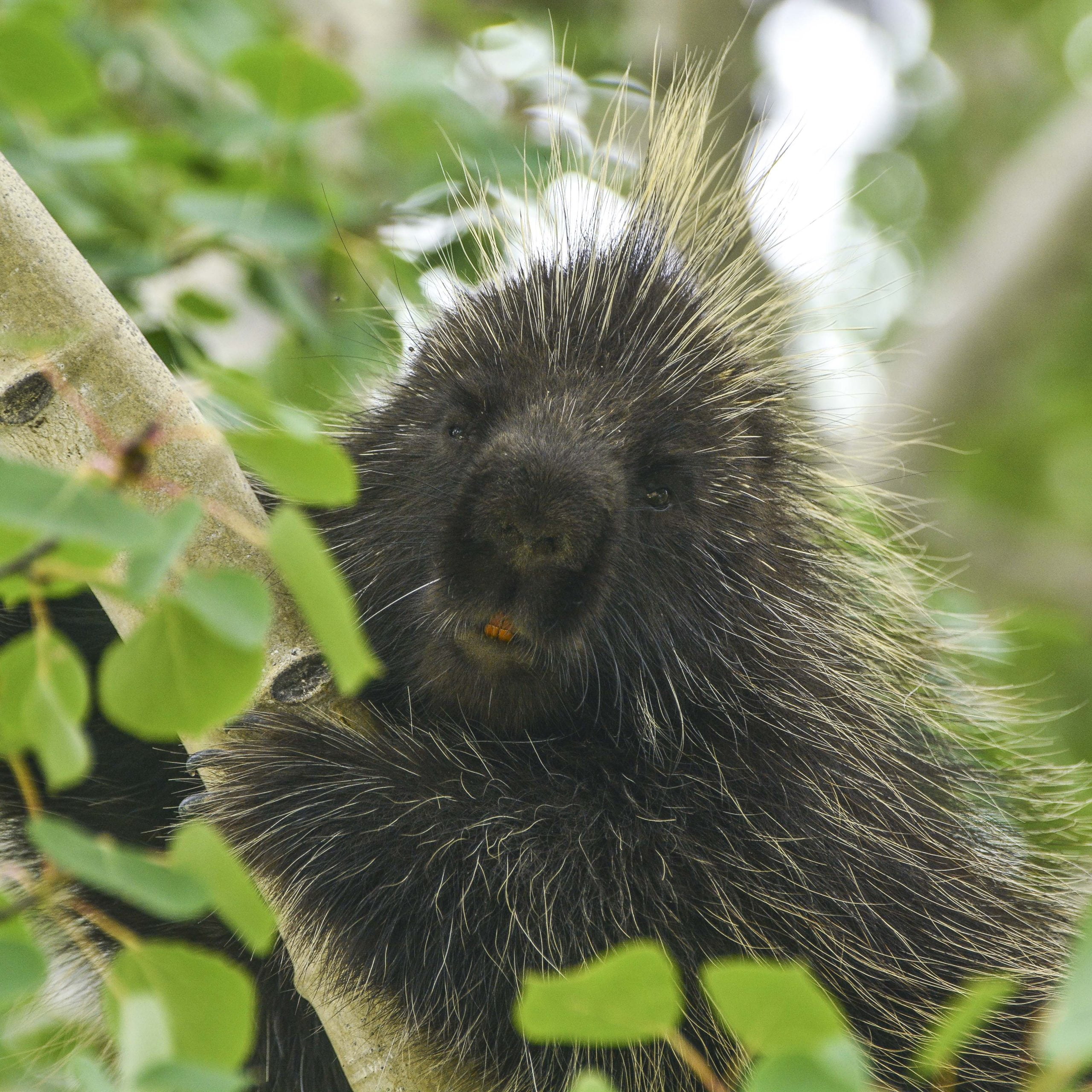
I remember I once had a curious porcupine sit and talk to me, chattering on with its porcupine noises. It was very engaging, although I didn’t understand a word. I finally had to tell the porcupine that I had to leave to do other things that day, and I was the first to leave the conversation.

Trapping and hunting has taught me to pay attention to the animals themselves, and to the signs they leave behind:  tracks, scat. The only way for me to be successful was to observe all these things within a species, and within the area I was harvesting. You have to know your area and the animals on it. You become part of a system when you’re harvesting off the land. You are a predator, and like wild predators, you don’t take all the prey out of your area. As a trapper and subsistence hunter, I participated in a relationship with the land, the animals and the environment; this allowed me to become in tune with the rhythms of life around me. There’s a balance within nature, if we noticed a shift in that balance, then we shifted to accommodate it. Yes, there were parts of this life that were hard and challenging, but it was also rich and rewarding - and very much a lifestyle choice.

I lived 30 years in a cabin in the bush. I stopped trapping and moved back to Whitehorse in 2009, because I like running water and electricity. While I miss the quiet of that life in the bush, well I LOVE the ease of modern life. After so many years without, I don’t take for granted things like lightswitches, kettles, showers or flush toilets. Living without for so long, that’s a hard life. Hauling water, in the winter, by buckets out of a frozen river means chopping holes in the ice with chainsaws or axes, and then doing it again when that hole inevitably refreezes solid. It really puts you in tune with the harsh realities of life and survival; I think it has helped me gain understanding and insight into some of the challenges wild animals face daily. They can’t just flip a switch or push a button and get food or shelter, they have to work hard, and constantly, to be successful in life at acquiring food, territory, shelter and to be successful at breeding and rearing young.

My favourite animal in the wild is the Lynx. They’re cool and simply the most beautiful animal. In the area I lived in the bush, lynx were rare and sightings were very special. Once, I heard a lynx scream. I’ll never forget that sound, or having to keep my dog under control to avoid him going to investigate. Here at the Preserve, my favourite animal is the Muskox. They are survivors and they are stubborn. I respect both those qualities. I’ve been in the Yukon a long time, but I’ve got nothing on the tens of thousands of years of Muskox. They’ve been stubbornly surviving since the last Ice Age.

Visitors to Yukon Wildlife Preserve, they are often curious about more than the animals at the Preserve. I enjoy the opportunity to connect with people of all ages. Some people want to listen, some ask a lot of questions or share their own experiences with me. No matter how or with whom the connection, I enjoy it most when people are interested and open to learning about respectful interactions with wildlife and the land.

Respect, observation, space, quiet, an understanding of the behavioural norms of the different species we can encounter:  this leads to successful interactions with wild animals - safe for us and safe for them. Animals don’t speak human languages, but they don’t need to. Humans can pay attention to the body language of an animal to hear what that animal is saying to us, and if humans don’t know how to do that, we can learn. I try to relate how to do this to visitors to Yukon Wildlife Preserve, and to teach those who are willing to learn.”

Maureen has had guests on her tours ask if she was a schoolteacher. "I was not a teacher.  To me, education sounds like sitting in a classroom. Instead of offering education, I prefer to think that I am helping people learn about the things I know about:  animals."

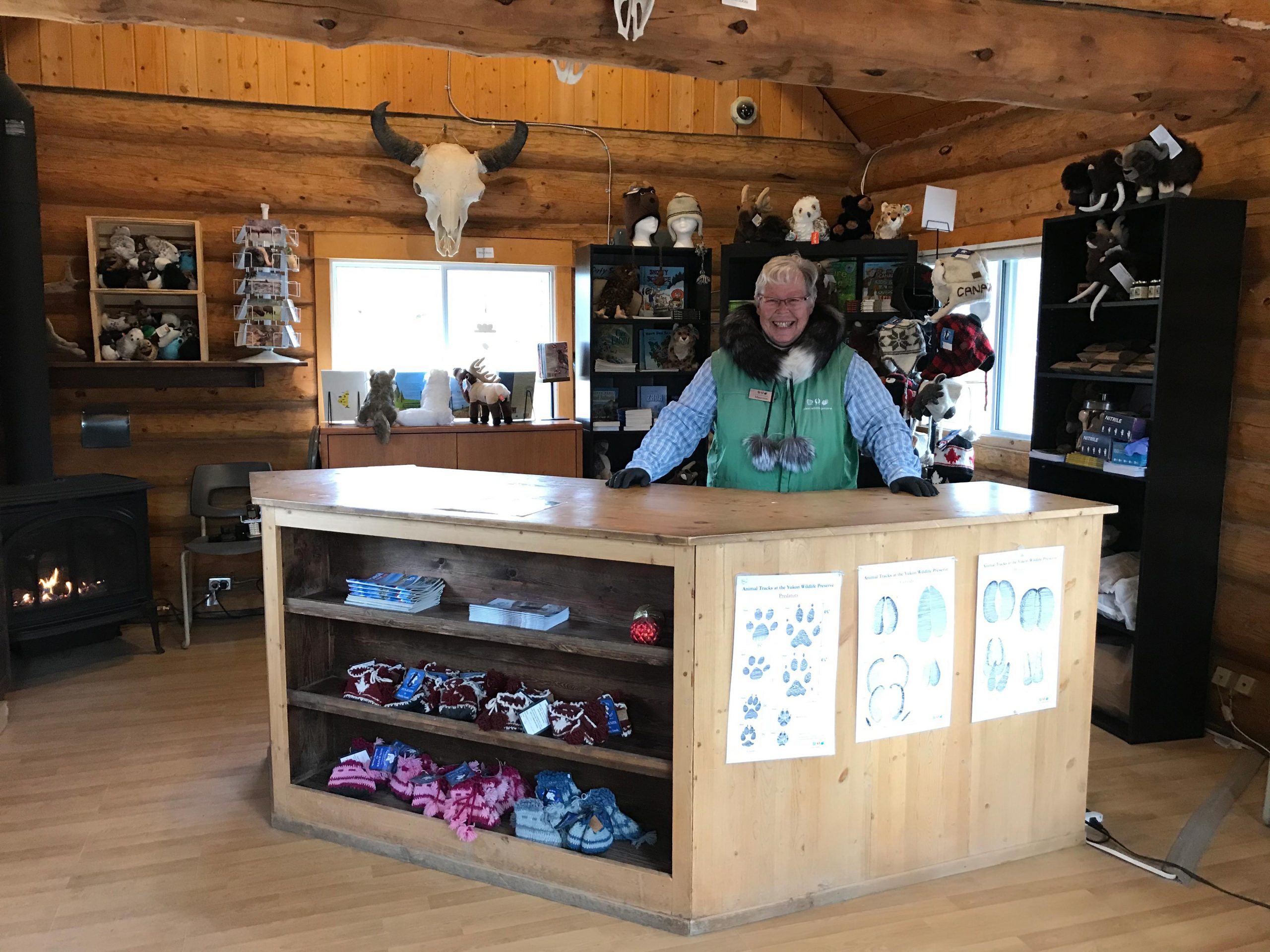
Maureen is one of a strong community at Yukon Wildlife Preserve and part of a thread that weaves us together. The next time you visit, stop at the Reception Cabin and say hello, or share a story:  you might just learn something new from Maureen. “I hope that after I’ve talked to visitors to the Preserve, that they leave with a little more knowledge and understanding of the wildlife they might encounter. Also, a little more respect for those animals.”

Stories by Maureen Peterson.  Compiled and written by Julie Kerr.

Maureen Peterson

Maureen Peterson

Wildlife Interpreter

Maureen is originally from North Vancouver, BC, where she lived for the first 20 years of her  life. In grade 5 she did a project about the Yukon, which is when she decided to go there. It was at age 20, and the day after she was married, that she finally moved North.  The Yukon was everything the 10 year old Maureen thought it would be and she has never had any desire to move anywhere else.
Julie Kerr

Julie Kerr

Visitor Services Coordinator

Julie is a Registered Veterinary Technologist, living and working in Whitehorse since 2012. She joined the team in May 2018. She is passionate about wildlife, nature and living in a conscious manner with both. Her free time is spent outdoors observing wild animals and ecosystems; her connection to the natural world around her brings great joy – joy she loves to share with anyone interested. Honestly? Work and life blend rather seamlessly.
Explore by Category

Explore by Author