Leaps and Bounds “Winter is Here”-Lynx

Leaps and Bounds “Winter is Here”-Lynx

animal adaptations

by Rebecca Carter | Feb 5, 2021 | 0 comments

9 minute read - “Winter Is Here” series continues with the elusive enigma – Lynx!

I, for one, love winter. What a unique time of year it is to be able to get outside in the short but cherished sunlight hours or total darkness for a hike, ski, or skate, then get inside and warm up by a fire. Of course Yukon’s wildlife call the outdoors their home but don’t worry they are just fine outside.

With those view-blocking leaves off the trees and the snow piled high, the Preserve’s most elusive resident - the lynx, becomes ever so slightly easier to spot in their habitat.

The lynx is one of Yukon’s only cat species other than the even more secretive cougar.1Government of Yukon. 2021. Cougar. https://yukon.ca/en/cougar  Lynx can be found in the boreal forest right across Yukon, Alaska, and still occupy roughly 95% of their historic range in Canada.2Poole, K.G. 2003. A review of the Canada lynx, lynx canadensis, in Canada. Canadian Field-Naturalist 117(3): 360-376.  Here in the subarctic boreal forest lynx have adapted to thrive in even the coldest, harshest winters Yukon could throw at them, while also keeping up with their favourite prey: the snowshoe hare.

Lynx almost exclusively prey on snowshoe hares during the winter months, as hares make up anywhere from 75-90% of a lynx’s diet on average.3Ivan, J.S., & Shenk, T.M. 2016. Winter diet and hunting success of Canada lynx in Colorado. The Journal of Wildlife Management 80(6): 1049-1058.In the summer and when hare populations are low, lynx will turn to other small animals like red squirrels, mice, and ptarmigan4Poole, K.G. 2003. A review of the Canada lynx, lynx canadensis, in Canada. Canadian Field-Naturalist 117(3): 360-376., but those hares are by far the preferred ones to catch. So much so that the number of lynx there are in an area depends on the number of hares.5Poole, K.G. 2003. A review of the Canada lynx, lynx canadensis, in Canada. Canadian Field-Naturalist 117(3): 360-376. This is one of the most well recorded examples of a predator-prey interaction dating back to the mid-1800’s.6MacLulich, D.A. 1937. Fluctuations in the numbers of the varying hare (Lepus americanus). University of Toronto Studies Biological Series 43. University of Toronto Press, Toronto

Figure 1. Population cycles of lynx and snowshoe hare over a 90-year period from the fur-trapping records of the Hudson’s Bay Company. Figure based on data from MacLulich (1937) and Elton and Nicholson (1942)

Snowshoe hare populations are cyclic: they peak about every ten years then crash shortly thereafter. Lynx follow this pattern lagging about 1-2 years behind the hares.74. Boutin, S., et al. 1995. Population changes of the vertebrate community during a snowshoe hare cycle in Canada’s boreal forest. Oikox 74: 69-80. 8MacLulich, D.A. 1937. Fluctuations in the numbers of the varying hare (Lepus americanus). University of Toronto Studies Biological Series 43. University of Toronto Press, Toronto  Hares are rich in nutrients providing lynx with the necessary energy and fat reserves needed to survive the long, cold winters. When hare populations are booming, lynx have better survival rates and females can support more kittens to adulthood. An abundance of food and high reproduction rates increases the lynx’s population density to 30-45 lynx/100 km2 , but once the hare numbers decline, that lynx population density drops down to just 2 lynx/100 km2 in the same region.9Poole, K.G. 2003. A review of the Canada lynx, lynx canadensis, in Canada. Canadian Field-Naturalist 117(3): 360-376.

To keep up with the snowshoe hare - a specialist of the subarctic and arctic ecoregions, lynx have to survive and thrive alongside them in these colder lands.

Another great thing about winter is that the snow is a great record keeper of all the different critters that have wandered through an area. Keep an eye out for rounded paw prints indicative of the lynx. Compared to their body size, lynx have huge paws and can spread their fur-covered toes apart making the surface area even larger. Just like a pair of snowshoes on our feet, these giant paws help the lynx walk on top of packed snow. Along with their long legs these cats can wade through soft, deep snow with ease and use their larger back legs to help power big leaps either up trees or when bounding to catch up to a hare.10Murray, D.L., & Boutin, S. 1991. The influence of snow on lynx and coyote movements: does morphology affect behavior? Oecologia 88(4): 463-469.

Lynx can be found across Yukon in the boreal forest, but the slight difference of how open or dense that forest is will change how the lynx behaves while hunting. If lynx are in more open areas with less vegetation on the ground to hide in, their tactic is to chase hares. However, this method is not very successful since lynx cannot keep pace with hares over long distances.11Murray, D.L., Boutin, S., O’Donoghue, M., & Nams, V.O. 1995. Hunting behaviour of a sympatric felid and canid in relation to vegetation cover. Animal Behavior 50: 1203-1210.  More often lynx are ambush hunters, lying in wait in bed-sites along well-used hare trails until the prey comes close.12Poole, K.G. 2003. A review of the Canada lynx, lynx canadensis, in Canada. Canadian Field-Naturalist 117(3): 360-376. To be successful, lynx prefer old growth forests with an abundance of spruce and pine cover along with fallen trees and dense vegetation to hide in.13Murray, D.L., Boutin, S., O’Donoghue, M., & Nams, V.O. 1995. Hunting behaviour of a sympatric felid and canid in relation to vegetation cover. Animal Behavior 50: 1203-1210. This tactic of staying still and ambushing unsuspecting prey not only provides more energy rich food for the lynx, it also allows them to conserve precious energy needed to keep their body temperatures warm during the winter.

When you’re staying still, having a warm coat on also helps you to retain heat against the cold winter air. Lynx have a very thick winter coat made up of a fluffy underfur that traps air against the skin creating an insulating barrier. The soft underfur is covered in coarse guard hairs that function as a waterproofing layer preventing snow and ice from reaching the skin underneath, just like how our waterproof, puffy winter coats function. Lynx’s winter coats are a light grey colour, mottled with those guard hairs that break up the cat’s outline allowing them to blend in to the grey and white forest background. In contrast, the summer coat is shorter with more reddish brown in colour; again allowing the cats to sneak around the forest undetected.14Vaughan, T.A., Ryan, J.M., & Czaplewski, N.J. (2015). Mammalogy. (6th ed.). Burlington, MA: Jones & Bartlett Learning.

Lynx are considered to be almost entirely solitary animals especially in the heart of winter after that year’s kittens have dispersed from the den. Adult lynx usually only pair up for a brief time in late February or March for the breeding season then separate again.15Poole, K.G. 2003. A review of the Canada lynx, lynx canadensis, in Canada. Canadian Field-Naturalist 117(3): 360-376. However, new radio-collar data out of Kluane National Park shows lynx pairing up and eating the same kill together; behaviours that indicate these cats may be more social than previously thought, at least in the Kluane region.16Morin, P. (2020, December 29). Not so solitary: Lynx links surprise scientists. Retrieved from: cbc.ca/news/canada/north/not-solitary-lynx-links-surprise-scientists-1.5854543. This is fascinating new data that right now really leaves us with more questions than answers. Have lynx always been more social than we thought and we just didn’t notice or is this new behaviour in response to change? Currently, we are in a period of low snowshoe hare populations and declining lynx numbers17Krebs., C.J., et al. (2020). The Community Ecological Monitoring Program annual data report 2019. Retrieved from: https://www.zoology.ubc.ca/~krebs/downloads/kluane_annual_report_2019.pdf. so perhaps this is evidence of cooperation either between relatives like parents and offspring or siblings, or between unrelated individuals in order to survive.18Morin, P. (2020, December 29). Not so solitary: Lynx links surprise scientists. Retrieved from: cbc.ca/news/canada/north/not-solitary-lynx-links-surprise-scientists-1.5854543.

 Lynx are a truly remarkable species and being so elusive, we continue to uncover new things about them and their behaviour.

Winter continues on here in the Yukon but it really is the best season to bundle up and get outside for your chance to spot a lynx sneaking through the bare trees or even just their round, furry prints travelling on top of the snow. If you are lucky enough to spot a lynx either out in the wild or right here at the Preserve (there are three of them) take note of their winter adaptations: large paws, long legs, thick fur coat covering their entire body, and stealthy behaviour; all traits that make them such successful felines of the north!

All Lynx photos credit to L. Caskenette

Rebecca Carter

Rebecca Carter

Senior Wildlife Interpreter

Rebecca joined the Wildlife Preserve in the summer of 2020 after moving from Manitoba to the beautiful and wild Yukon. Rebecca earned a degree in Biology with honours from the University of Winnipeg studying behaviour in mule deer (one of her top 20 favourite animals.. it’s hard to choose!). She loves connecting with others through nature and sharing stories and knowledge about the animals at the preserve with visitors.

867-456-7400
rebecca@yukonwildlife.ca

Explore by Category

Explore by Author

Thinhorn Mountain Sheep

Thinhorn Mountain Sheep

animal adaptations

by Doug Caldwell | Dec 4, 2020 | 0 comments

10 minute read -

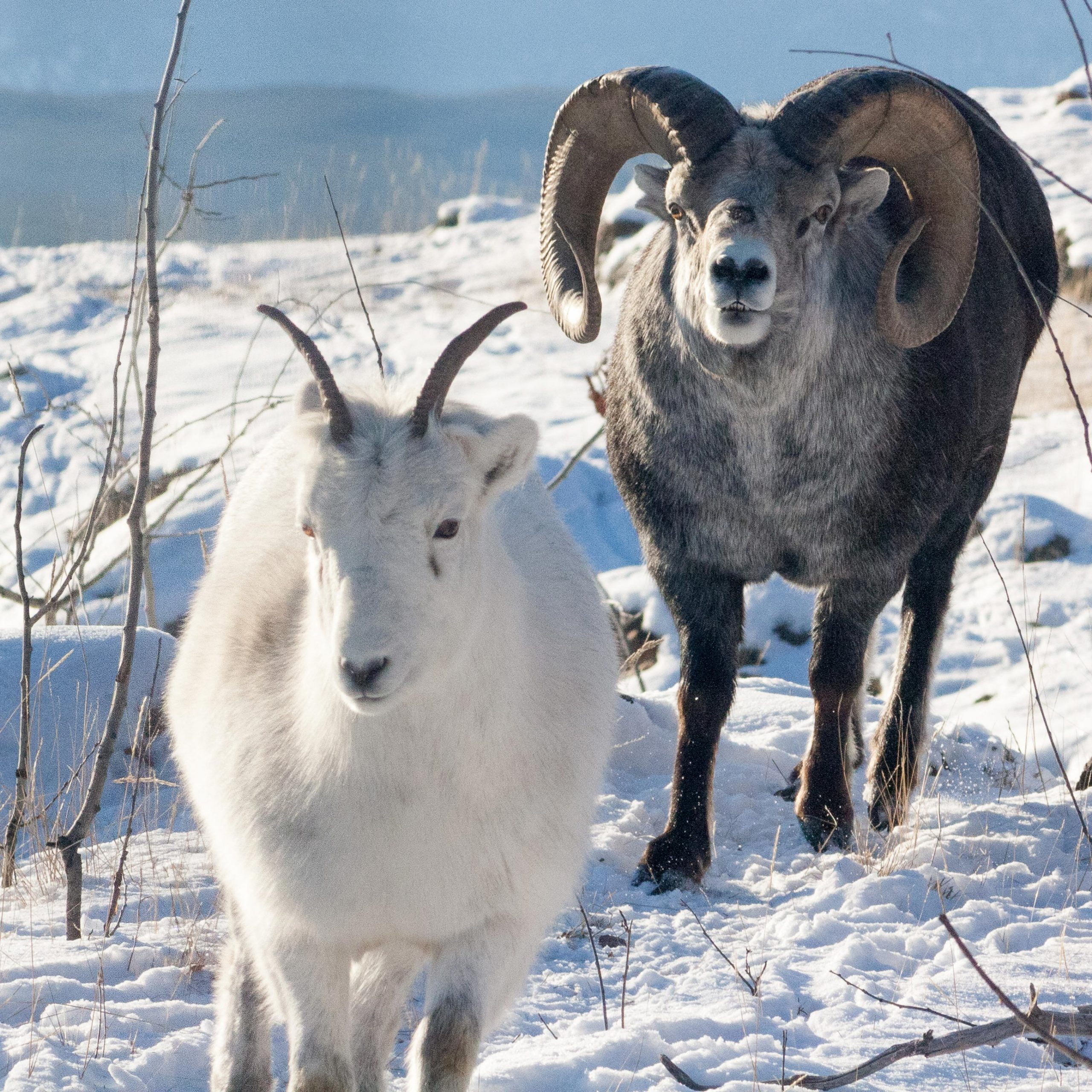
For a long time, it was believed that there are three distinct subspecies of thinhorn Mountain Sheep in North America each of these known as: Dall, Fannin and Stone. Each subspecies displayed different colouring of their coats where Dall would be pure white, Fannin would be white with grey, silver and black highlights and Stone sheep were white with brown and black highlights and sometimes predominantly all dark grey.

Thinhorn Mountain Sheep grow one set of horns from youth to old age.  Pictured are two rams (males).  L to R:  Young ram; mature ram.

Recent DNA gathering and analysis has revealed that all three subspecies are actually very much alike and identification of each subspecies is becoming significantly more difficult to confirm as interbreeding continues and identifiable traits or genetic markers blend together to produce a mongrelized modern day specimen.

Further, evolutionary biologists1https://www.ualberta.ca/science/news/2016/june/dna-analysis-rewrites-the-story-of-thinhorn-sheep-during-the-last-ice-age.html studying the lineages of thinhorn sheep have found evidence suggesting that the species diverged hundreds of thousands of years earlier than previously thought. Greatly influenced by the formation, movement and final melting of the glaciers, thinhorn sheep roamed a vast area in search of ice-free grazing areas known as refugia. The mountainous geography often separated groups of similar or same subspecies sheep where through isolation they accumulated some variances between populations over time, sometimes resulting in the formation of what were originally thought to be new subspecies due to variations of their physical appearance.

Genetic science continues to study these animals and new proofs are foreseen to reveal how the present thinhorn sheep populations of the Yukon, BC and Alaska evolved to be what they are today. As genetic scientists work with data gathered by paleontologists, geologists and other scientific disciplines, there is anticipated to be a more accurate understanding of how northern animals evolved into what they are today.

Despite their uniqueness in genes and variations in colour, thinhorn sheep rams share the same impressive set of horns that are admired in the animal kingdom. It is important to note that horns and antlers are not the same. Members of the deer family grow antlers which are shed and grow back each year, while sheep grow horns which are with the animal for all of its life. Also antlers grow from the tips while horns grow from the base.2https://medium.com/usfws/11-facts-about-antlers-18e689fe9e60#:~:text=Bison%2C%20antelopes%2C%20sheep%2C%20goats%20and%20domestic%20cattle%20%E2%80%94,from%20the%20tip%3B%20horns%20grow%20from%20the%20base  It’s a minor thing, but important because if a young sheep breaks off a tip of their horn, it will remain that way for the rest of its life. Female sheep or ewes also grow horns but these are much more diminutive than the male sheeps’ horns.

​ Female sheep or ewes also grow horns but these are much more diminutive than the male sheeps’ horns.

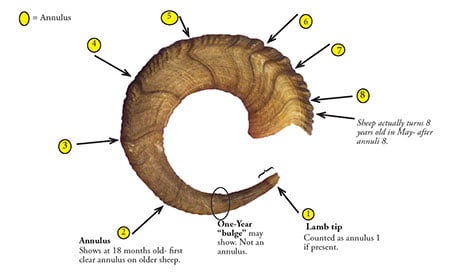
Sheep start to grow their horns shortly after birth and they will continue to grow over their lifespan, sometimes up to 20 years of age.3http://www.env.gov.bc.ca/wld/documents/thinhorn.pdf If you look closely at a ram’s horns you’ll see rings that circle the horn in various locations. These are called growth rings or annuli rings and a new one is formed each year and they are a reliable method to estimate the age of the animal. The horns are made of keratin, which is the same hard material that their hooves are made of and it grows quickly.

The first few inches of horn that a ram grows is called a lamb tip and represents about the first 6 months of the animal’s life,4https://www.adfg.alaska.gov/static/hunting/dallsheephunting/pdfs/dall_sheep_guide_to_judging_sheep_horns_under_full_curl_regulation.pdf it often gets broken off as the ram’s life of fighting and careless use take their toll.

Credit Alaska Department of Fish and Game

Each year a new annuli ring is formed near the base due to stressors the ram experiences, normally associated with the mating season.  You may notice that the space between the annuli rings is not uniform. This reflects the quality of nutrition that the animal experienced during that year of his life. Large wide spaces between the rings indicate good nutritional intake and low stress. Small thinner spaces may indicate a stressful year or a reduction in nourishment possibly associated with long, hard winters, forest fires and a loss of grazing, avoiding predators and similar stressors found in nature. Once the ram reaches a certain age of maturity, at about eight years,5https://www.coniferousforest.com/dall-sheep.htm the horns will continue filling out in thickness and mass, but stop growing longer as time goes on. A mature ram's horns can weigh up to 15 kilos - more than all the bones in his body combined.

The size and shape of ram’s horns are what distinguish it from others and there is a wide variety of shapes, formations and sizes among sheep horns. Some horns form concise symmetric circles that are located close to the animal’s head, while others grow into a cork-screw-like shape where the tips are splayed out from the ram’s head. Some rams have horns that are thicker and longer than others, this is normally associated to a genetic trait of the animal’s ancestors where the influencing genes get passed to subsequent generations.

Hunting organizations such as Boone & Crockett have devised an elaborate measuring system with which to score the horns of most big game animals. The horns are measured at specific locations including the base, the overall length of the horn on each side, the distance between the horn tips and diameters of the horn in four key places. Once these measurements are collected some math is performed to arrive at the score for that ram’s horns. Records are kept by species so that hunters know how their harvested ram compares to others. This record keeping is also valuable for biologists and others to track the various changes in sheep populations around the world and may indicate declines in health, and their supporting environment and other influences which may be indicated by the changing size or condition of their horns.

Regional governments also utilize hunters to gather important data from the field. This is usually done by making it mandatory that certain parts of the harvested animal are submitted to the Game Branch as a condition of the species harvest tag. In this way biologists get to examine a diversity of a certain species all harvested within a quantified period of time and noted locations. Biologists examining sheep submissions here in the Yukon check for a number of important indicators. Yukon regulations require the complete head of a harvested ram be submitted for inspection.6https://yukon.ca/sites/yukon.ca/files/env/env-yukon-hunting-regulations-summary_en.pdf]]

The first thing they examine is if the horns are indeed a full curl as regulations prohibit harvesting a ram that is less than a full curl.

The biologists then extract a tooth to confirm the exact age of the animal by cutting the top off and counting the rings similar to the dendral or age rings of a tree. They may also take a tissue or blood sample to test for various diseases and infections the animals may suffer from. When all the tests have been completed the biologist bores a small hole in the top side of the horn facing the rear and epoxies a serialized aluminum plug into it. These plugs help to combat the underground trade of animal heads by having each head recorded by hunter, date and location.

Having access to all this data helps biologists to better understand the health of the wild sheep herds and may provide clues on where a disease is developing and which way it may be moving geographically.

Photo Credit: Kevin Pepper

Photo Credit: Kevin Pepper

Rams are famous for bashing their horns together to determine which is dominant for breeding purposes, but that is only for a few days each breeding season typically in late November and December. They also use their horns to communicate among themselves in ways that humans can only guess at. They will sometimes interlace their horns gently and rub their ears together which appears to be a welcoming gesture. Like most creatures, mountain sheep use body language to communicate with others. It may be a twisting of the head or extending their noses while they peel their lips back to reveal their teeth, or something as simple as their stance and how they wiggle their ears as they stare at others from a distance. They often grunt at each other as well.

Rams will often gently head-butt  each other as a form of greeting, similar to how a house cat bumps your leg when seeking attention. They can be quite gentle in their horn touching activities or they will get up on their hind legs and really lean into butting another ram with all the force they can muster.

Photo Credit Mark Newman

Photo Credit: Mark Newman

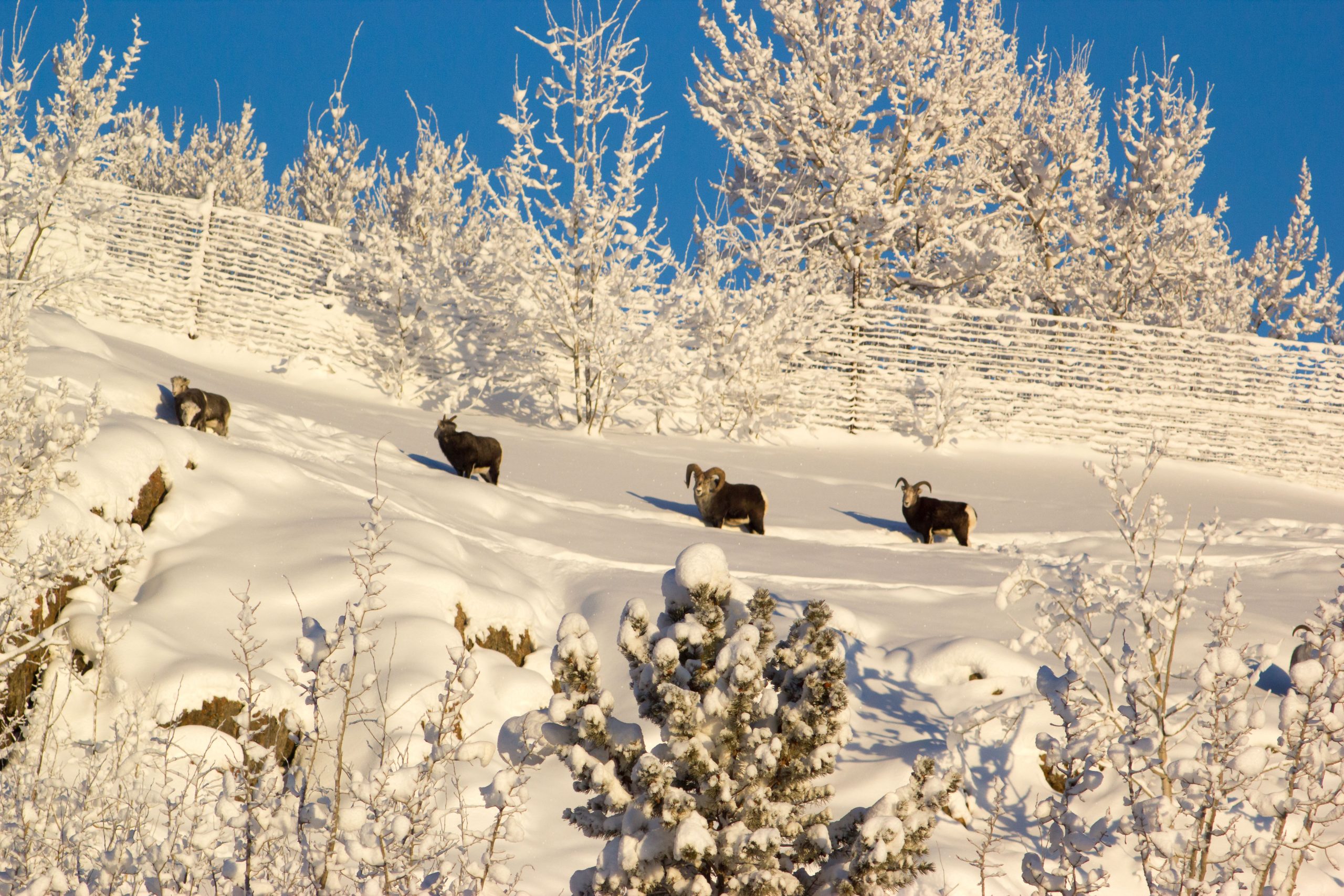
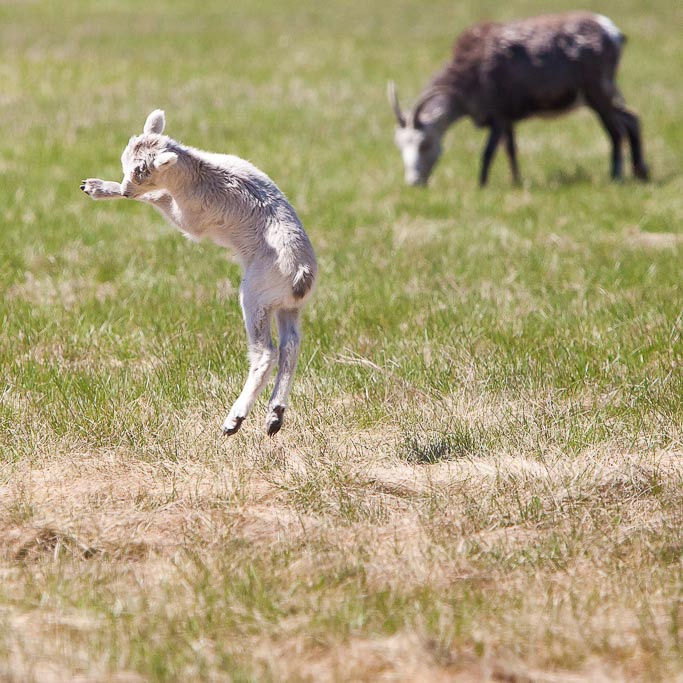
With remarkable muscle tone, balance and coordination mountain sheep demonstrate how well they have adapted to living on rock faces as they frolic and cavort in situations humans try to avoid. Often it will take a human significantly longer to cover a vertical climb it only took a few seconds for the sheep to navigate. Mountain sheep are remarkably strong and have endurance that allows them the energy and stamina to evade predators such as wolves and bears on the uneven and precarious mountain slopes they call home. Young lambs are a popular target for migrating Golden Eagles arriving in the spring season from their over-winter habitats. So sheep must be watching in all directions for potential dangers that could impact on them or their offspring.

Young lambs are a popular target for migrating Golden Eagles.  Ewes must be watching in all directions for potential dangers that could impact them or their offspring.

Mountain sheep have superior eyesight for distance and low-light conditions, they have horizontal pupils that help them to see panoramically to detect predators that could approach from different directions.  They also need to be able to see forward clearly so that they can run over rough terrain. They have excellent peripheral vision and can see behind themselves without turning their heads due to where their eyes are located on their skulls. Remember they need to look around their horns too.

Thinhorn Mountain Sheep are remarkable creatures perfectly adapted to thrive on the mountains of Northwestern Canada and Alaska and will remain a featured megafauna species here at the Yukon Wildlife Preserve.

Ram follows an Ewe closely.

Doug Caldwell

Doug Caldwell

Wildlife Interpreter

Doug is one of the Interpretive Wildlife Guides here at the Preserve. An avid angler and hunter he has a broad knowledge of Yukon’s wilderness and the creatures that live here. With a focus on the young visitors to the Preserve, Doug takes the extra time to help our guests to better appreciate the many wonders of the animal kingdom here in the Yukon.

Explore by Category

Explore by Author

The Animals are Quite Fine Outside

The Animals are Quite Fine Outside

animal adaptations

by Jake Paleczny | Nov 6, 2020 | 0 comments

5 minute read -

After a beautiful, drawn out fall (by Yukon standards), winter arrived in force at the end of October 2020. Record setting snowfall on November 2nd 2020 kicked winter into full gear. Shutdowns were widespread (including here at the Preserve). It was snow joke!

Now that we've dug ourselves out, we can offer winter wildlife viewing at its finest! Without leaves on the trees and a beautiful white backdrop, its easier to spot the animals (although the Arctic Foxes can be a bit tricky with their white winter coat). It is especially satisfying to watch animals in their element.

We sometimes get asked if we bring them inside when it gets cold. Apart from the obvious challenges of convincing the Mountain Goats to come down off their cliff, I think they all might get a little hot if they had to be inside. I don't even want to think about "musk"ox in an enclosed space. And the Bison probably wouldn't listen to us, even if we asked nicely. Anyway.

They are quite fine outdoors. If you're not convinced, I give you:


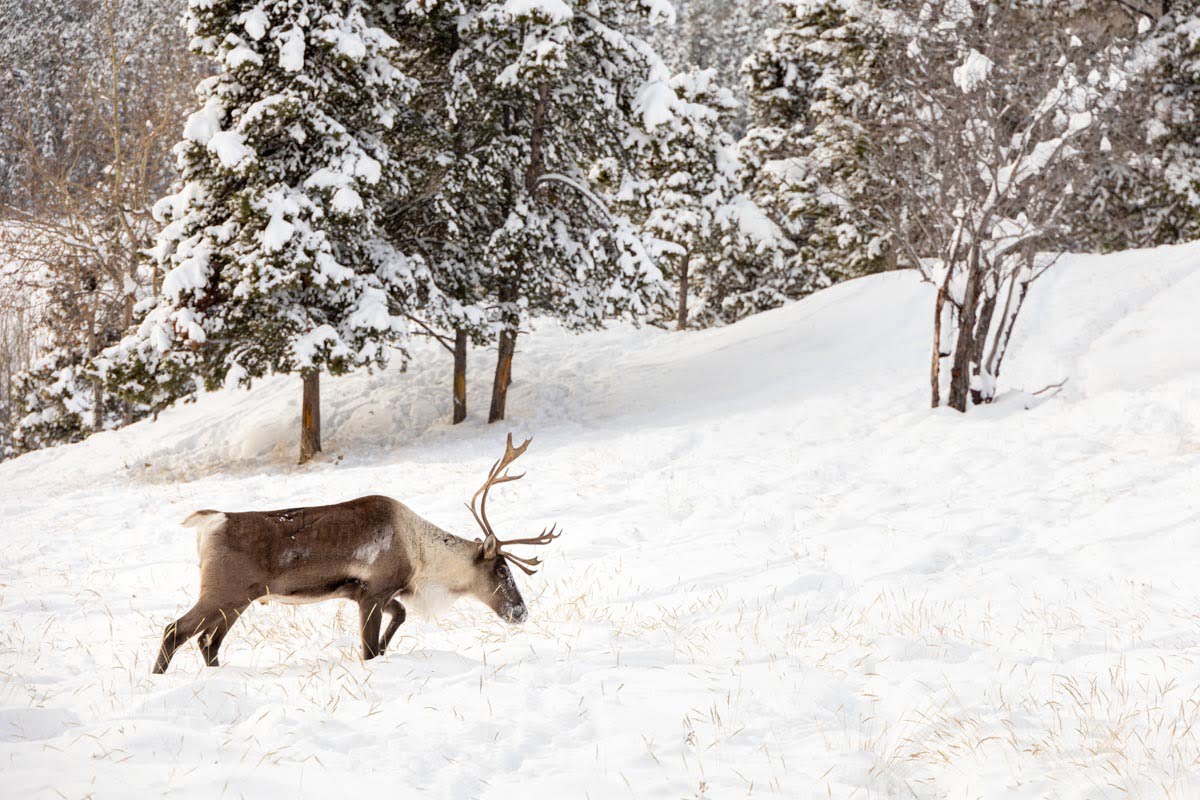
Exhibit A: Muskox and Caribou

Muskox and Caribou were wandering around with mammoths on the Beringian steppes during the last ice age. (For better or for worse, the giant beavers didn't make it). The Preserve's other ice age animal (and unofficial 13th species) the ground squirrel is much more sensible. They are currently napping right now instead trying to eat each other. While there's been a lot of snow so far, it's probably not as much as they had last ice age.

Rebecca spotting deer, in layered clothing to blend into the vegetation - Cora Romanow

Exhibit B: Arctic Foxes.

They also get around the north (quite fine, thank you very much). Incidentally, they may be illegally immigrating into Canada from Norway. This is probably because they are the bomb. By which I mean "Among mammals, the arctic fox has the best insulative fur of all." In the same paper, they also note that Arctic Foxes don't start shivering until somewhere below -40c. They're not quite sure how cold it needs to get, because the scientists that tried, "...did not succeed, because they did not have the necessary equipment available to reach sufficiently low ambient temperatures."

This Arctic Fox is not only warm, but also enjoying a pumpkin filled with meat treat. No tricks here.

Exhibit C: Mule Deer.

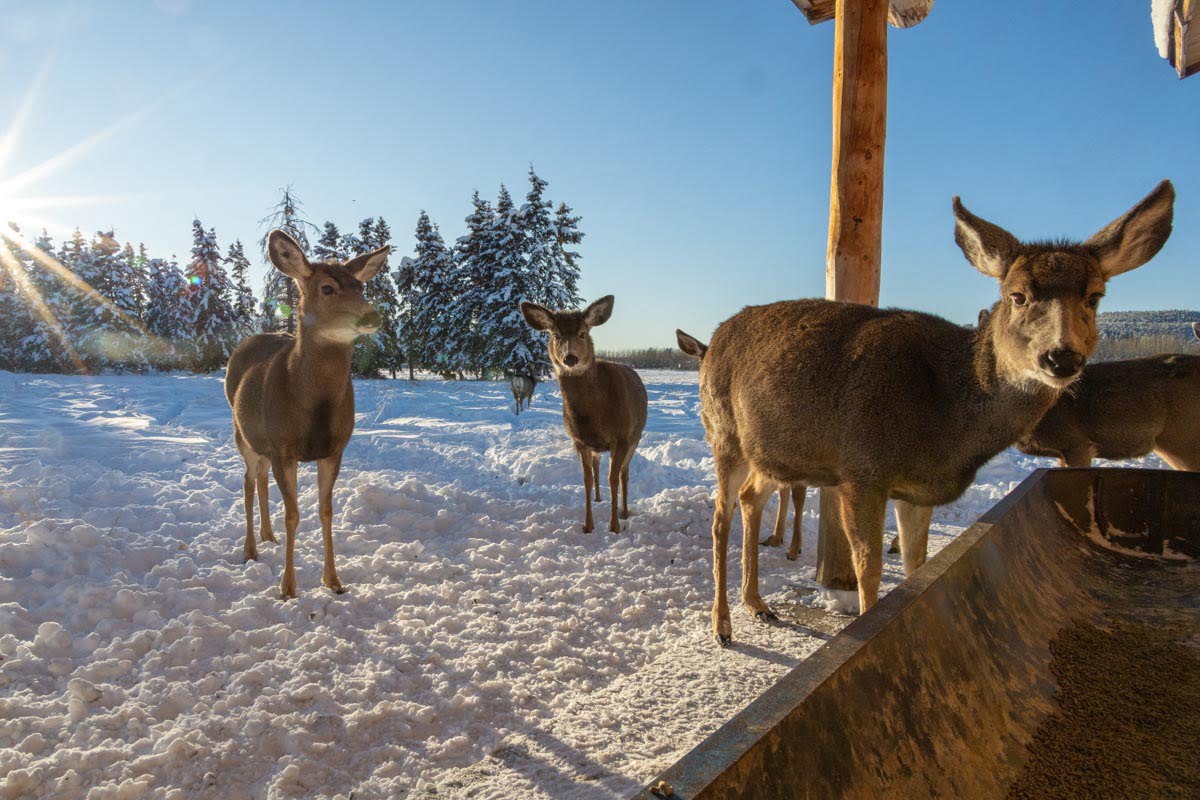
Now stay with me. I realize I'm skipping past a few animals to get to what is arguably the least "winterized" animal at the Preserve. Their large ears and delicate hooves say "I'm new here". And that's true - they were first sighted in the Yukon in the 1930s and 40s.

What's so remarkable about Mule Deer is just how wide a range they now have. Several years ago I was camping in the dessert outside Phoenix, Arizona. And believe it or not, there were Mule Deer wandering around between the prickly pear cactuses! Meanwhile they are now seen as far North as Dawson City, Yukon!! They are simply remarkable animals (Rebecca will back me up on this) that deserve a lot more credit than they get.

And finally,

Exhibit D: Humans

It's really just us that get hung up about the cold. Last January I had an excellent opportunity to  to make a questionable life choice and strip down to a thin long-sleeve shirt while standing beside a caribou at -35c. I decided to leave my pants on as well as my long underwear not to mention my wool snow pants. Even so, it was quite cold. Painfully cold. Luckily Josh Robertson, a PHD student studying animals with thermal cameras had his camera handy:

The bright yellow bits in the second image are all my heat escaping out into the atmosphere. The caribou is busy eating and clearly doesn't care. (If you found this foray into thermal imaging unsatisfyingly brief, you're in luck, we've got more on this in the works)!

The animals have got this.

If you haven't experienced these Yukon species in their element, I highly recommend a trip to the Preserve. If you're worried about the cold I recommend:

  • Walking (shivering is a metabolic way of warming your core temperature, but walking is a way more effective).
  • Bring some snacks (to fuel your internal furnace).
  • Wear warm clothes (and you know... maybe don't strip down to pose with animals). Soft soled boots keep your feet flexing and therefore warm. A warm hat keeps the heat from leaking out the top.

I got around a couple days ago and took a few photos to give you a taste of what you're missing out on! Click for bigger versions - and see if you can find any of the Preserve's bigger "cats".

Jake Paleczny

Jake Paleczny

He/Him - Executive Director/ CEO

Jake Paleczny is passionate about interpretation and education. He gained his interpretative expertise from a decade of work in Ontario’s provincial parks in addition to a Masters in Museum Studies from the University of Toronto. His interests also extend into the artistic realm, with a Bachelor of Music from the University of Western Ontario and extensive experience in galleries and museums.

867-456-7313
jake@yukonwildlife.ca

Explore by Category

Explore by Author

Misunderstood Moose

Misunderstood Moose

animal adaptations

Sep 25, 2020 | 0 comments

5 min read -

You have most likely heard the phrase “Don’t judge a book by it’s cover”, implying that captivating stories can be hidden behind bland book covers. Similarly, at one time or another many of us have been judged or have judged others based on their outward appearance. Judging others based on their appearance can lead to us underestimating other people's abilities. Have you ever been underestimated? How did it feel? Due to their funny-looking, long snouts, and gangly, plodding bodies, moose are often underestimated. People tend to view moose as gentle, slow-moving animals, and often don’t associate moose with characteristics such as agile and fierce. Cartoons1Like Bullwinkle the Moose can perpetuate this impression by displaying moose as slow, friendly Canadians. But don’t be deceived by this common misperception. Though moose may look unassuming, they are capable of performing impressive athletic feats in order to find food and avoid predators.

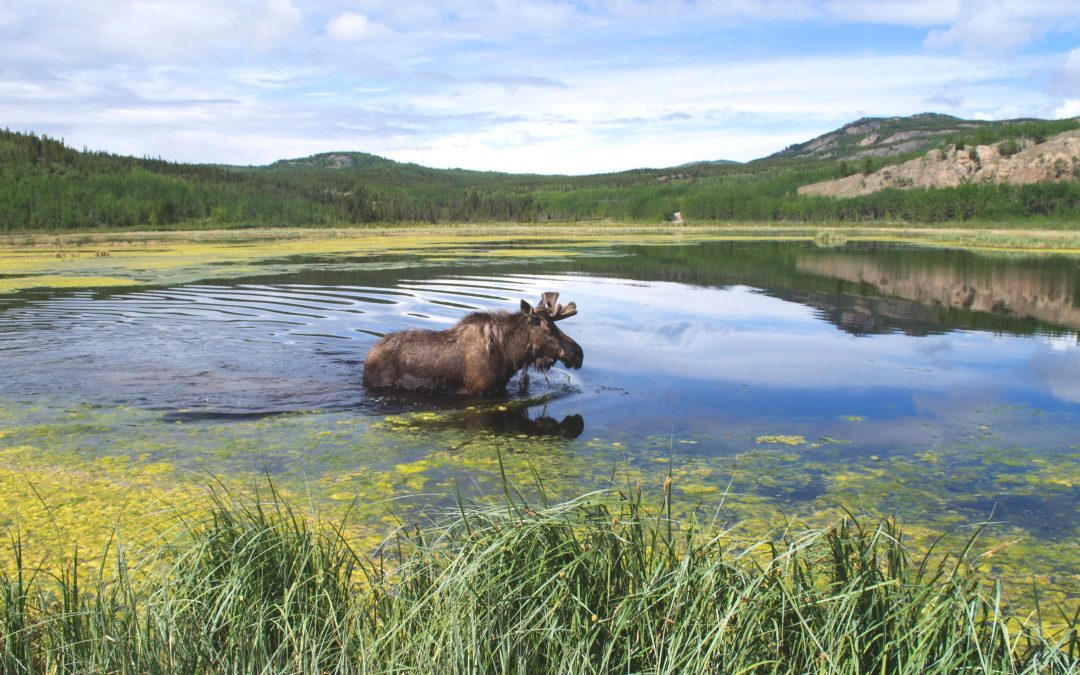
Despite their appearance, moose can easily propel themselves through water in order to find food. While otters, beavers, and other mammals that are known for their swimming ability have lean bodies and webbed feet which allow them to easily glide through the water, moose are heavy-set and have hoofed feet. Despite their size and hooved feet, moose have the advantage of being tall, and their long legs help propel their large bodies through the water. Moose also have hollow hairs, which help them stay buoyant while swimming.2National Park Service With these advantages, moose can swim as fast as 9.5 km per hour. By comparison, most humans only swim at the pace of 3 km per hour. Moose’s ability to swim quickly allows them to travel in search of food while reducing stress on their joints. Water also helps protect moose from predators because it is more difficult for predators to sneak up on them when they are in the water.3Moose Facts 

Moose swimming across Lake Laberge.  Photo credit D. Caldwell.

Photo Credit Johanna Marglowski

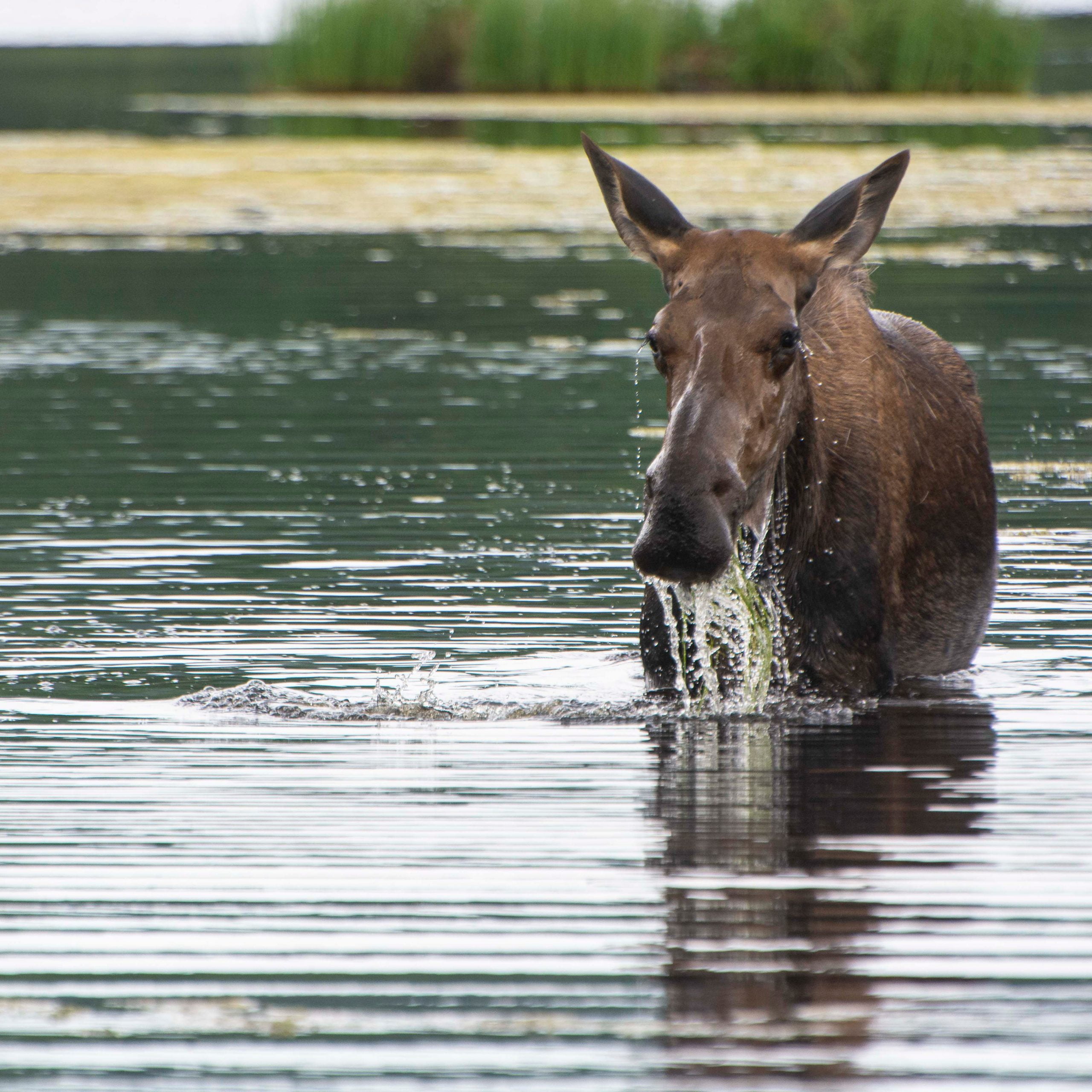
Moose also have adaptations that allow them to dive underwater to eat nutrient rich aquatic plants.4National Geographic To prevent water from rushing up their noses, moose have flaps that close in their nostrils. These flaps allow them to hold their breath underwater for up to 50 seconds5Holding breath Ecology and Management of the North American Moose and help them to dive up to 6 m (20 ft) underneath the water surface!6Hinterland Who's Who After a winter of sparse food resources, aquatic plants provide essential energy to both pregnant cows (female moose), and to bulls (male moose) as they regrow their antlers.

In addition to swimming, moose are also capable of running at high speeds. Being the tallest member of the deer family, a moose can stand around 6 feet tall at the shoulder, which is as tall as some professional basketball players.7National Geographic Even though moose might be too gangly to make great basketball players, their height and long legs allow them to run very fast. A moose calf can outrun the average human after only 5 days of life,8National Geographic while an adult moose can charge at a pace of 56 km per hour, and maintain a pace of 32 km per hour over longer periods. For perspective, during his world record 100 metre dash Usain Bolt ran at an average pace of 44 km per hour. However, moose do not run fast to set world records, their speed provides them protection by enabling them to run away from wolves and other quick-moving predators.

Furthermore, despite the perception of being friendly, moose are actually effective fighters. Though they sometimes use their speed to outrun predators, an experienced and healthy moose is capable of defending itself against wolves by standing its ground and fighting.9Wolves of the Yukon by Bob Hayes Moose will protect their sides by standing next to trees and high shrubs, and then use their powerful legs to stomp or kick attacking wolves, hitting them with their deadly hooves. A powerful strike from a moose’s sharp hooves can result in injury to or even kill a wolf. 

Even young moose are large animals.  The photos show 2 moose bulls; on the left a young 1 year old and on the right a more mature bull of many years of age.

So, are moose really the plodding, polite animals that cartoons depict them as? Have you ever underestimated moose based on their goofy-looking appearance? As we have seen, instead of being slow, and plodding, moose are impressive athletes. Moose are capable of swimming through and under water, which allows them to more easily travel in search of food and access the nutrients they need during pregnancy and to grow antlers. Moose are also capable of running at high speeds and of fighting off other animals, which helps them survive attacks from wolves and other predators. Each of these athletic capabilities are important survival mechanisms that help moose thrive in the wild.

Tasha Mazurkewich

Tasha Mazurkewich

Wildlife Interpreter

Tasha is a self-proclaimed animal enthusiast and adventurer. Originally from British Columbia, she enjoys skiing, hiking, and all things outdoors. She is happiest when she is climbing a mountain with her pup. Having recently moved up north, she has enjoyed learning about Yukon’s wildlife and landscape and is excited to share the new knowledge she has learned with visitors to the wildlife preserve

Explore by Category

Explore by Author

The Life of a Mule Deer

The Life of a Mule Deer

animal adaptations

by Rebecca Carter | Aug 8, 2020 | 0 comments

7 minute read - 

Watching how an animal behaves in its natural environment and towards other individuals has always been fascinating to me, but I could never have predicted that I would find myself crawling around the open prairie grassland to sneak up on mule deer.  

Mule deer are an indigenous deer species to North America, ranging from as far south as central Mexico up all the way up to Dawson City, Yukon along the western half of the continent. Across their range, mule deer tend to be found in more open habitats along forest edges, in grasslands, and even deserts.  1Sanchez Rojas, G., & Gallina Tessaro, S. (2016). Odocoileus hemionus. The IUCN Red List of Threatened Species: e.T42393A22162113. https://dx.doi.org/10.2305/IUCN.UK.2016-1.RLTS.T42393A22162113.en.

Rebecca spotting deer, in layered clothing to blend into the vegetation - Cora Romanow

A good friend and colleague of mine spent our summer days searching for mule deer fawns to watch how these little animals played and how much of their days consisted of playing.

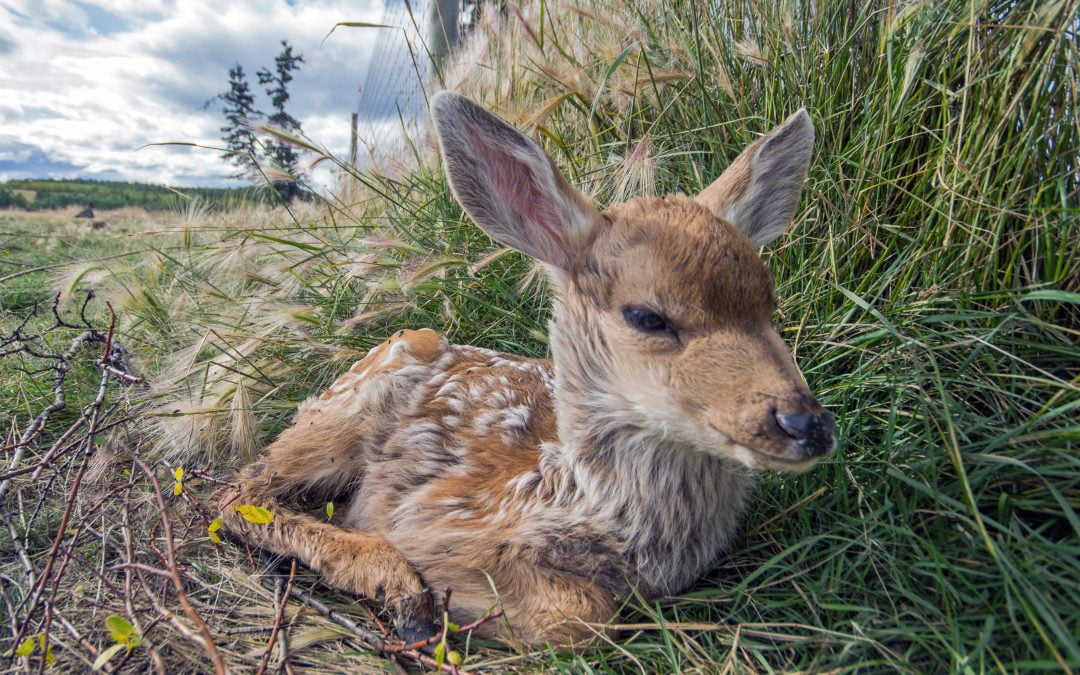
A mule deer fawn’s life begins around late-May to mid-June, born to a female who is at least two years old. The fawn may be the only off-spring or may have a twin depending on the mom’s health and the amount of food that was available the previous summer.  A newborn fawn has spots on their fur which helps to break up their outline allowing them to hide in long grass. The little fawn will remain close to mom for their first summer, relying on mom’s milk for the first five months before they start to graze on vegetation, then becoming fully independent after a year2 Geist, V. (1981). Behavior: adaptive strategies in mule deer. In O.C. Wallmo (Ed.), Mule and black-tailed deer of North America (pp. 157-224). Lincoln, NE: University of Nebraska. .

For us to watch the deer’s behaviour without influencing them, we needed to be extremely stealthy.

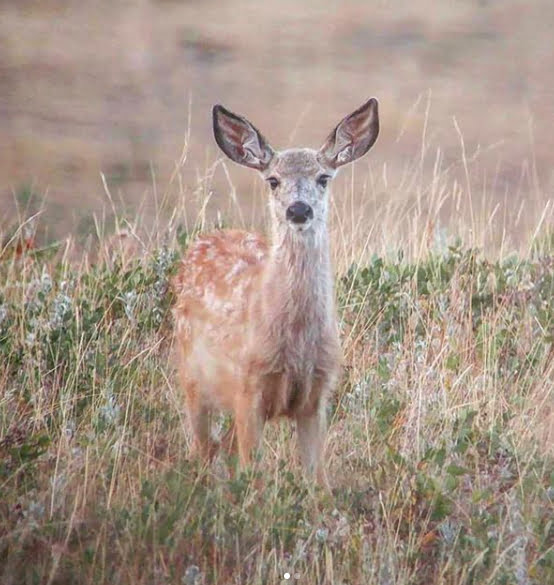
Named for their large ears, mule deer are well suited for living on open and rugged terrain. When detecting a sound, their ears can move independently of one another to allow the deer to hone in on a sound. Their eyes placed on the side of their head allow them to have up to a 310 degree view around themselves.  3Wishart, W. D. (1986). White-tailed deer and mule deer. In Alberta Fish and Game Association (Ed.), Alberta wildlife trophies (pp. 134-143). Edmonton, AB: Alberta Fish and Game Association.

Both of these senses give mule deer an advantage in detecting predators (and us) from far distances, even up to 1km away!   4Lingle, S. (2001). Detection and avoidance of predators in white-tailed deer (Odocoileus virginianus) and mule deer (O. hemionus). Ethology, 107, 125-147.   This is especially important in a wide open space where the predators are also able to spot their prey from afar.

We would hike into the prairie with all of the gear we needed – spotting scopes, tripods, a video camera and plenty of paper to document what we saw. We would wear clothing that matched the seasonal grasses (vibrant green in the spring transitioning to browns in the late summer), and layered different colours and patterns to break up our outline, just like the fawns do with their fur patterns.

At times we would make the deer alert to our presence. When alarmed, and especially when they were trying to figure out what type of animal we were, mule deer would stomp one of their front hooves on the ground, move around us to try to get a better view, and make repeated snort vocalizations. The sound of the snort and the stomp, along with releasing an alarm scent from a gland on their hind limbs, functions to alert other deer in the area to potential danger. Females were especially persistent with getting us to show ourselves, which at times we had to scare her away to prevent her from alerting every deer in an area.

Mule deer are generally more stocky and unable to run as fast as say a coyote. Typically, mule deer can reach speeds of 50km/h, but a coyote can run upwards of 70km/h, making it difficult for mule deer to outdistance them. Instead when threatened, mule deer will move on to steeper terrain if available nearby, bunch up together, and confront the predator.  5Lingle, S., Pellis, S., & Wilson, F.W. (2005)  Interspecific variation in antipredator behaviour leads to differential vulnerability of mule deer and white-tailed deer fawns early in life. 6Journal of Animal Ecology, 74(6), 1140-1149.  When a fawn is in danger of being attacked, they will let out a high-pitched distress cry that causes mom to become alert and quickly find her fawn and whoever is attempting to grab them. What’s interesting is that this call will attract all mule deer moms in the area to the fawn regardless of whether the fawn is their own or the fawn of another individual. The females will then group together and perform a coordinated attack using their hooves to kick and stomp at the predator.

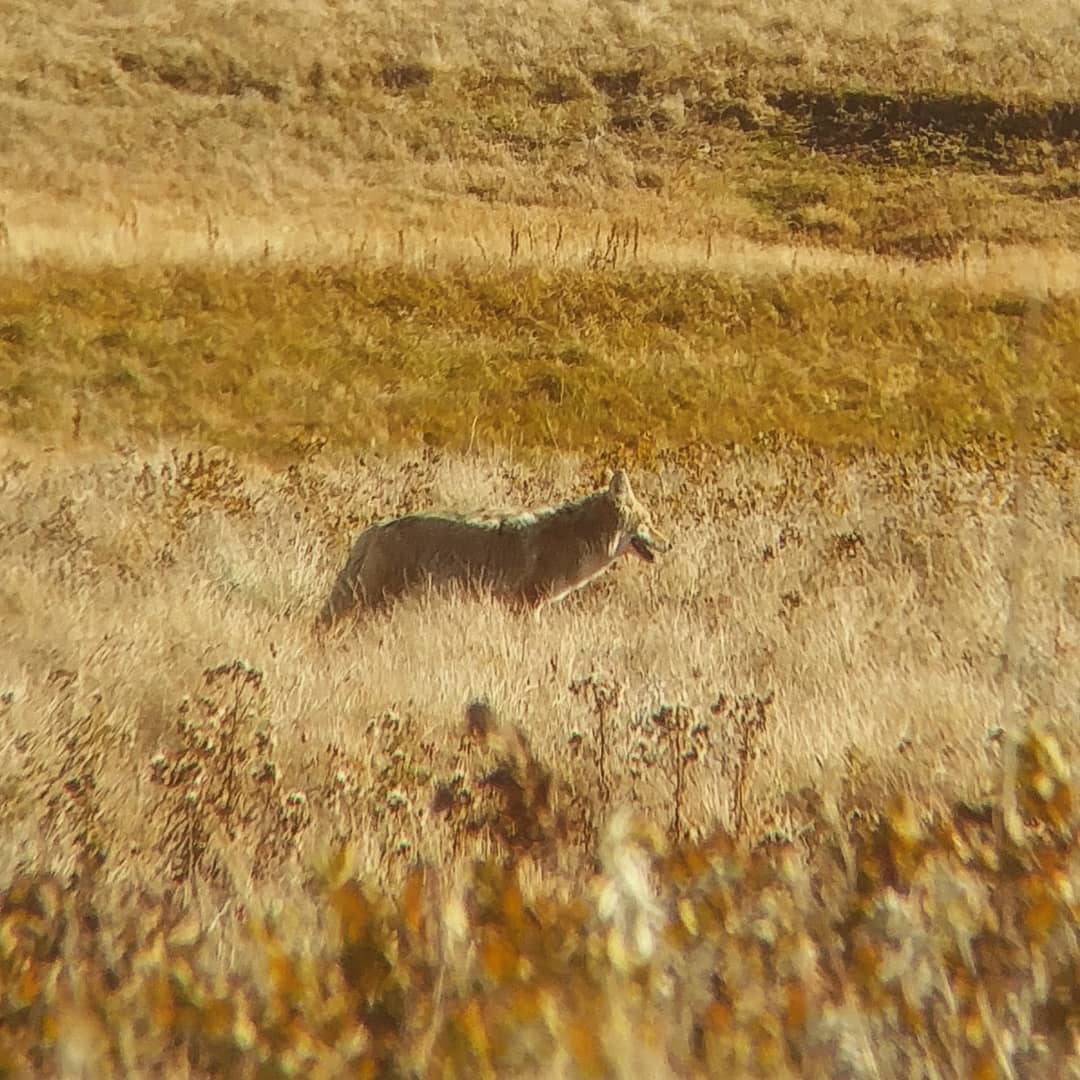
Coyote seen looking for preferred prey like deer. A coyote can also camoflauge well into their landscape. 

We never got close enough to elicit this level of antipredator reaction, nor did we want to. We aimed to be quiet and unknown so we could slip in and out of an area without causing undue stress to the animals.

We watched the fawns from when they were born in May, to when they were becoming independent and lanky teens in the late-summer. During this time, we could also see the adult mule deer groups shifting as the seasons changed.

In early spring, pregnant females will stay separate from other deer to give birth in their home range area. Our team can reliably identify deer based on their features, such as markings or scars on the face and/or body, size and shape of the white rump patch, tail length and colouration, and antler size and shape if they are males. Using their distinct features, we could go back into an area year after year and find the same females and her fawns in their homes. The only presence that would really move the deer out of an area would be the grizzly bears and to a lesser extent, coyotes. It seemed to be a dance to figure out week by week where the deer had shifted to if the grizzlies had moved through. After the predators moved on, those same reliable females would take back their homes once more.

As the summer wore on, females and fawns began to come together and spend their time in small groups. There were areas we named “nurseries” where it seemed that the females dropped their fawns together before moving on to graze, apparently taking advantage of the collective antipredator strategy females use.

At the same time, the males were in the bachelor groups or the “dude crews” as we referred to them. They too would be in a consistent area, forming groups of usually 5-10 males of various ages and generally be pretty relaxed looking, staying bedded for the majority of the day. But while they may look lazy, they were really investing a lot of energy into growing their antlers and prepping for the rut (their breeding season).

During the rut, males and females will form larger groups together along with the fawns of that summer and the previous summer’s juveniles. Males fight for access to females who become receptive around the same time in mid-November (although there are some females who are earlier in October and some later into December)2. Into the winter, mule deer of all ages and both sexes stay together in large groups of up to 100 individuals. This is a safety in numbers game to protect them from predators, especially from coyotes whose only available prey are deer since the small rodents such as ground squirrels are hibernating. When spring comes around, the cycle of behaviour patterns continues.

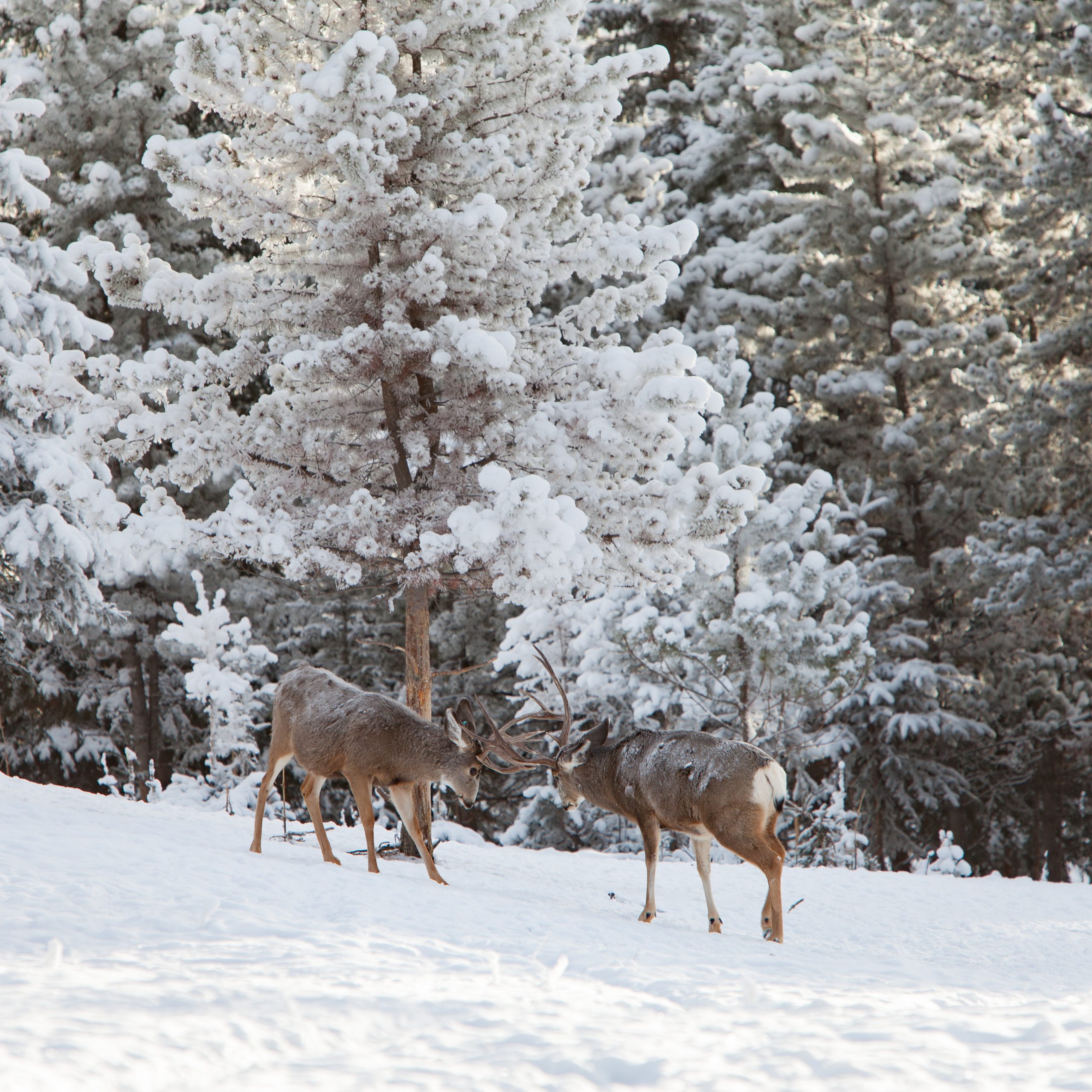
mule deer bucks sparring, rut fall season animal behaviour

Mule deer seem to have an intricate life balancing the ongoing risk of predators, to solving dominance disputes with one another, to looking out for their babies, all influenced by their own individual personalities and the areas they call their homes. Watching animals can give us a new perspective on the animals that live amongst us, and let us know that they are just as complex as us and deserve to have wild spaces left for them to live.

Rebecca Carter

Rebecca Carter

Senior Wildlife Interpreter

Rebecca joined the Wildlife Preserve in the summer of 2020 after moving from Manitoba to the beautiful and wild Yukon. Rebecca earned a degree in Biology with honours from the University of Winnipeg studying behaviour in mule deer (one of her top 20 favourite animals.. it’s hard to choose!). She loves connecting with others through nature and sharing stories and knowledge about the animals at the preserve with visitors.

867-456-7400
rebecca@yukonwildlife.ca

Explore by Category

Explore by Author