The Dangerous and the Benign: distinguishing between big scary bugs

The Dangerous and the Benign: distinguishing between big scary bugs

nature

by Joelle Ingram | Mar 25, 2021

This article was made possible thanks to support from the Environmental Awareness Fund. Engage and educate yourself in this 10-part blog series, about Yukon Biodiversity.

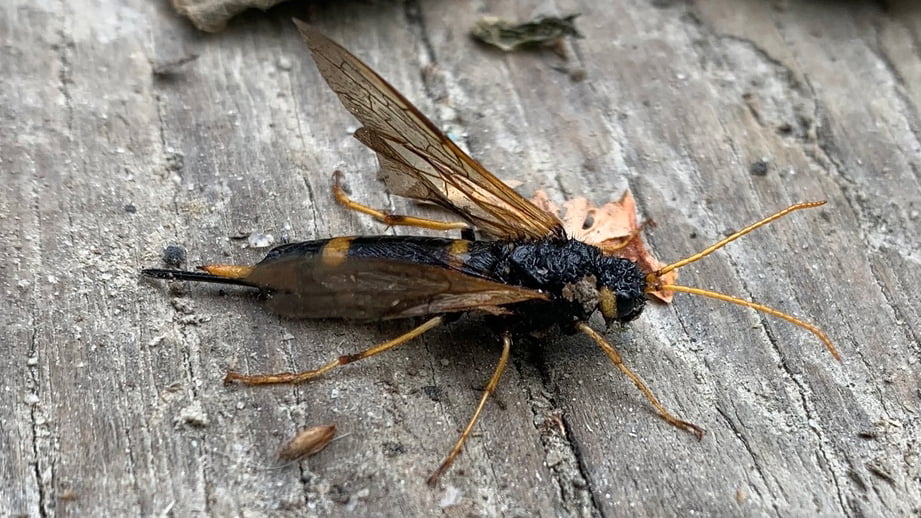
Banner Photo:  Yellow-tailed Horntail.  Photo credit: iNaturalist griffontrail in Dawson YT.

12 minute read - 

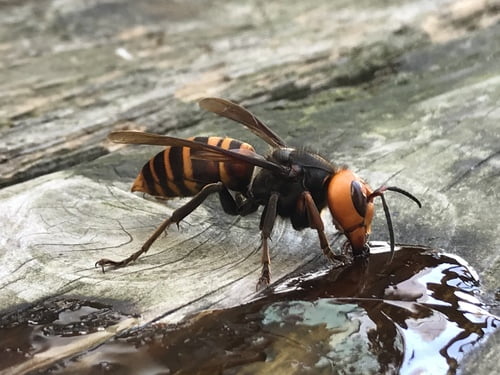
I think we can all agree that the past year has been pretty rough with the fires and the pandemic and the political unrest. When you add the appearance of large and intimidating Asian giant hornets on our fair continent, it makes it feel like we’re living through some biblical plagues. For those of you who have not been hysterically following the news, the Asian giant hornet (aka “the murder hornet”) is a massive hornet that earned its ominous nickname from its fun habit of decapitating hundreds of bees at a time and then carrying off the bee babies (the babees) to feed its own young. Also they sometimes kill people. Yikes. In the spring of 2020, they added to the general calamity that was all of last year by popping up in Washington, DC where the U.S. residents were understandably upset to have this horrible serial killer hornet added to their ecosystem.

iNaturalist observation of an Asian giant hornet.  No iNaturalist observations are to date recorded in Canada.  Photo Credit (c) Wonwoong Kim, all rights reserved

Obviously, the North American invasion by Asian giant hornets wasn’t kept secret and word traveled all the way to our remote territory. It’s probably because of this news that when a large insect with a prominent “stinger” and suspiciously hornet-like colouring was spotted during the Yukon Wildlife Preserve Bioblitz, some people got very nervous! But fear not, fellow Yukoners! The Yukon is a deeply unappealing habitat for the coast-loving murder hornets. The insect that garnered so much attention at the Bioblitz due to its large, scary appearance and prominent butt-spike is only a threat to felled trees. This benign bug is a horntail also known as a “wood wasp” (of the family Siricidae) and it could not be less like the invasive death machine it was mistaken for.

On the Left:  Yellow-tailed Horntail.  Found in Yukon.  iNaturalist Photo Credit M_Mossop

On the Right:  Asian giant Hornet.  Not found in Yukon.  iNaturalist Photo Credit (c) Alpsdake, some rights reserved (CC BY-SA)

Before we examine these insects in detail, a quick addendum. While scientists and academic types should never let personal bias cloud their research, I am not a scientist nor particularly academic so prepare for some bias. I HATE insects of the wasp/hornet variety. I mean the kind of loathing that would start a centuries long blood feud between families in olden times. Yes, they get props for being pollinators in their spare time but oooooh my god. These stripey menaces ruin every summer outdoor dining experience by completely disregarding your personal space and then rendering your beverage undrinkable after they drown themselves in it. Also, if they sting me, I die and that dynamic would sour any relationship. With that out of the way, let’s meet these bugs!

The Asian giant hornet or Vespa mandarinia (which sounds like a particularly elegant moped) is aptly named as it is the world’s largest hornet! Worker hornets are 3.5 cm long while queens get up to 5 cm. Their wingspans range between 4-7 cm which is probably more bug than the average person wants to deal with. If their size isn’t a giveaway, their large orange heads and black eyes make them very recognizable.
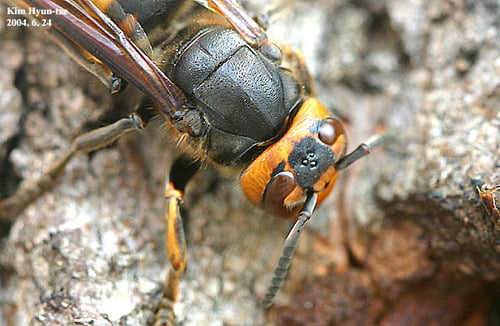
iNaturalist observation Asian giant hornet.  Photo credit: (c) Kim, Hyun-tae, some rights reserved (CC BY)

Unlike a lot of other hornets and wasps, these big hornets only nest in the ground. They favour forested areas in coastal environments which is bad news for our west-coast brethren but good news for the Yukon which is notably low on hospitable coastal regions. During the one-year life cycle of a nest, worker hornets usually forage alone and mostly hunt for beetles. The dark and sinister nature of these hornets rears its head in the fall when the colony needs a lot of protein to raise the next generation of queens.

In order to bring in the protein required to beef up their queens, workers abandon solo-foraging missions and band together for group raids. These raids attack high-value targets like the hives of honeybees or even the hives of other hornets. When these raiding parties hit a hive, they decapitate all the adults like they’re doing a re-enactment of the French Revolution then cart off the brood for food. These murder hornets really live up to the moniker as they can kill off thousands of bees in a few hours. Bees are already on a dangerous decline and Asian giant hornets can absolutely devastate local bee populations. This makes their appearance in America and Canada especially concerning.

Although the sudden appearance of murder hornets would be very on-brand for 2020, Asian giant hornets have been in North America before. They were discovered in Nanaimo, BC in August 2019 when beekeepers found a destroyed nest with a whole heap of headless bees outside of it. Their appearance in Washington is just an extension of their coastal conquest. Fortunately, the number of murder hornets in North America is still pretty low. This is good news for humans as people deaths from Asian giant hornets are usually due to disturbing a nest and incurring many stings. Unless you have an allergy (like some people who wrote this article), you have high chances of surviving a murder hornet attack if you have less than fifty stings. Rest easy, I guess? That being said, the Washington State Department of Agriculture had to order special suits to study Asian giant hornets because their massive stingers can pierce through normal beekeeping gear so maybe rest less easily.
It’s time to ease yourself into the warm waters of relief because the horntails that hang out in the Yukon are nothing like this. They’re not invasive, they don’t sting, and unless you’re a dead tree, they pose absolutely zero risk to your health and wellbeing. Yes, wood wasps are also intimidatingly large and similar in size to Asian giant hornets. They range in size between 1-4 cm with females tending to be larger than their male counterparts. Horntails get their name from their cornus: a stinger-shaped plate on the back of their body. Horn. Tail. Geddit? Even though it looks like a stinger, rest assured that it isn’t. Horntails don’t sting or produce venom and don’t really have any defenses other than looking scary. Females in particular look like they have a MASSIVE stinger but it’s actually an ovipositor that helps them lay their eggs into the wood of conifer trees.

iNaturalist image Yellow-tailed Horntail.  Whitehorse YT  Photo credit:  Jake Paleczny

Here’s a fun fact: female horntails have a symbiotic relationship with a fungus! Similar to horntails, basidiomycete wood decay fungi enjoys a nice rotting log. Female horntails help this fungus spread to new locations by carrying bits of it in a specialized pouch on their abdomen. When the female lays her eggs, she also deposits the fungus inside the rotting wood. The horntail also benefits from this arrangement as the larvae get to snack on the fungus after they hatch.

Unlike the newly arrived murder hornet, we’ve probably had horntails in the Yukon as long as we’ve had conifer trees. The reason you might not run into them all the time is that they spend most of their lives inside a tree. After a female lays her hundreds and hundreds of eggs in the wood of a felled or rotting tree, the young hang out in that log for 1-3 years. After they emerge from their timber home as a fully grown adult, they only live for 3-4 weeks! Because they spend so much time in wood, young adults sometimes show up inside people’s homes because the lumber they’ve been tunneling around in has been used as construction material. So they’re not out there murdering bees and giving horrible stings but they can occasionally give you a nasty surprise by exploding out of your new rocking chair.

iNaturalist Yukon.  Yellow-tailed Horntail.  Photo Credit:  Bruce Bennett

I hope your fears are assuaged and you won’t dread painful stings and bee death when you encounter a big scary bug in the Yukon wilds. The horntail might be intimidating in appearance, but it’s a passive insect that just wants to spend most of its life noodling around in a tree. Asian giant hornets are definitely horrible nightmare insects that were probably manifested into existence as punishment for our sins but at least they’re horrible nightmare insects that don’t live up here.

iNaturalist Asian giant hornet resting on human hand.  Photo credit:  (c) elfsama, some rights reserved (CC BY-NC)

Joelle Ingram

Joelle Ingram

Human of Many Talents

Joelle is a former archaeologist, former wildlife interpreter, and a full-time random fact enthusiast. She received her master’s degree in anthropology from McMaster University. One of the four people who read her thesis gave it the glowing review “It’s a paper that would appeal to very specific group of people,” which is probably why only four people have read it. Her favourite land mammal is a muskox, her favourite aquatic mammal is a narwhal. She thinks it’s important that you know that.

867-456-7400
 info@yukonwildlife.ca

Explore by Category

Explore by Author

Love for the Lynx

Love for the Lynx

nature

by Lindsay Caskenette | Feb 13, 2021

This story was originally published February 13, 2021 in the e-blast newsletter to Yukon Wildlife Preserve's membership.

Are you a member but don't receive these email Newsletters?  Contact us at info@yukonwildlife.ca to update your email preferences.

While the ungulates have already gone through their languages of love the carnivores are just getting started!

It's a great time to hear the courtship calls from the lynx, arctic fox and red foxes. While the two species of foxes are the same gender (red foxes - males, arctic foxes - females), our lynx group consists of a male and two females and all three lynx will remain in the habitat together this season.

In past years we have separated the male to eliminate breeding potential - an important practice to manage our animal collection and animal numbers. This year however the lynx will be left together to let nature take its course!

Our 3-legged male has never bred before nor has our younger female, who turns 7 this spring, so we do not have any history to give indication of sexual success. Our other female, who is now 13 years old, has successfully reared offspring in her younger days - most recently in 2014. If breeding is successful we could expect kittens in mid - late May. YWP collection growth and stability is a consideration for breeding given the age of our male, also 13 years. Further to that, BC Wildlife Park in Kamloops, a CAZA accredited facility, will also look to add to their population by accepting a litter of siblings. This potential breeding will be an important contribution to lynx genetics and the Species Survival Plan given how unique (completely unrepresented actually), his genetics are among captive populations.

It's all up to the animals and only time will tell if these individuals are successful.

Lynx at Yukon Wildlife Preserve L to R:  3-legged male circa 2018 and kitten circa 2014.

All Photos credit:  Jake Paleczny

Lindsay Caskenette

Lindsay Caskenette

Manager Visitor Services

Lindsay joined the Wildlife Preserve team March 2014. Originally from Ontario, she came to the Yukon in search of new adventures and new career challenges. Lindsay holds a degree in Environmental Studies with honours from Wilfrid Laurier University and brings with her a strong passion for sharing what nature, animals, and the environment can teach us.

867-456-7400
Lindsay@yukonwildlife.ca

Explore by Category

Explore by Author

Leaps and Bounds “Winter is Here”-Lynx

Leaps and Bounds “Winter is Here”-Lynx

nature

by Rebecca Carter | Feb 5, 2021

9 minute read - “Winter Is Here” series continues with the elusive enigma – Lynx!

I, for one, love winter. What a unique time of year it is to be able to get outside in the short but cherished sunlight hours or total darkness for a hike, ski, or skate, then get inside and warm up by a fire. Of course Yukon’s wildlife call the outdoors their home but don’t worry they are just fine outside.

With those view-blocking leaves off the trees and the snow piled high, the Preserve’s most elusive resident - the lynx, becomes ever so slightly easier to spot in their habitat.

The lynx is one of Yukon’s only cat species other than the even more secretive cougar.1Government of Yukon. 2021. Cougar. https://yukon.ca/en/cougar  Lynx can be found in the boreal forest right across Yukon, Alaska, and still occupy roughly 95% of their historic range in Canada.2Poole, K.G. 2003. A review of the Canada lynx, lynx canadensis, in Canada. Canadian Field-Naturalist 117(3): 360-376.  Here in the subarctic boreal forest lynx have adapted to thrive in even the coldest, harshest winters Yukon could throw at them, while also keeping up with their favourite prey: the snowshoe hare.

Lynx almost exclusively prey on snowshoe hares during the winter months, as hares make up anywhere from 75-90% of a lynx’s diet on average.3Ivan, J.S., & Shenk, T.M. 2016. Winter diet and hunting success of Canada lynx in Colorado. The Journal of Wildlife Management 80(6): 1049-1058.In the summer and when hare populations are low, lynx will turn to other small animals like red squirrels, mice, and ptarmigan4Poole, K.G. 2003. A review of the Canada lynx, lynx canadensis, in Canada. Canadian Field-Naturalist 117(3): 360-376., but those hares are by far the preferred ones to catch. So much so that the number of lynx there are in an area depends on the number of hares.5Poole, K.G. 2003. A review of the Canada lynx, lynx canadensis, in Canada. Canadian Field-Naturalist 117(3): 360-376. This is one of the most well recorded examples of a predator-prey interaction dating back to the mid-1800’s.6MacLulich, D.A. 1937. Fluctuations in the numbers of the varying hare (Lepus americanus). University of Toronto Studies Biological Series 43. University of Toronto Press, Toronto

Figure 1. Population cycles of lynx and snowshoe hare over a 90-year period from the fur-trapping records of the Hudson’s Bay Company. Figure based on data from MacLulich (1937) and Elton and Nicholson (1942)

Snowshoe hare populations are cyclic: they peak about every ten years then crash shortly thereafter. Lynx follow this pattern lagging about 1-2 years behind the hares.74. Boutin, S., et al. 1995. Population changes of the vertebrate community during a snowshoe hare cycle in Canada’s boreal forest. Oikox 74: 69-80. 8MacLulich, D.A. 1937. Fluctuations in the numbers of the varying hare (Lepus americanus). University of Toronto Studies Biological Series 43. University of Toronto Press, Toronto  Hares are rich in nutrients providing lynx with the necessary energy and fat reserves needed to survive the long, cold winters. When hare populations are booming, lynx have better survival rates and females can support more kittens to adulthood. An abundance of food and high reproduction rates increases the lynx’s population density to 30-45 lynx/100 km2 , but once the hare numbers decline, that lynx population density drops down to just 2 lynx/100 km2 in the same region.9Poole, K.G. 2003. A review of the Canada lynx, lynx canadensis, in Canada. Canadian Field-Naturalist 117(3): 360-376.

To keep up with the snowshoe hare - a specialist of the subarctic and arctic ecoregions, lynx have to survive and thrive alongside them in these colder lands.

Another great thing about winter is that the snow is a great record keeper of all the different critters that have wandered through an area. Keep an eye out for rounded paw prints indicative of the lynx. Compared to their body size, lynx have huge paws and can spread their fur-covered toes apart making the surface area even larger. Just like a pair of snowshoes on our feet, these giant paws help the lynx walk on top of packed snow. Along with their long legs these cats can wade through soft, deep snow with ease and use their larger back legs to help power big leaps either up trees or when bounding to catch up to a hare.10Murray, D.L., & Boutin, S. 1991. The influence of snow on lynx and coyote movements: does morphology affect behavior? Oecologia 88(4): 463-469.

Lynx can be found across Yukon in the boreal forest, but the slight difference of how open or dense that forest is will change how the lynx behaves while hunting. If lynx are in more open areas with less vegetation on the ground to hide in, their tactic is to chase hares. However, this method is not very successful since lynx cannot keep pace with hares over long distances.11Murray, D.L., Boutin, S., O’Donoghue, M., & Nams, V.O. 1995. Hunting behaviour of a sympatric felid and canid in relation to vegetation cover. Animal Behavior 50: 1203-1210.  More often lynx are ambush hunters, lying in wait in bed-sites along well-used hare trails until the prey comes close.12Poole, K.G. 2003. A review of the Canada lynx, lynx canadensis, in Canada. Canadian Field-Naturalist 117(3): 360-376. To be successful, lynx prefer old growth forests with an abundance of spruce and pine cover along with fallen trees and dense vegetation to hide in.13Murray, D.L., Boutin, S., O’Donoghue, M., & Nams, V.O. 1995. Hunting behaviour of a sympatric felid and canid in relation to vegetation cover. Animal Behavior 50: 1203-1210. This tactic of staying still and ambushing unsuspecting prey not only provides more energy rich food for the lynx, it also allows them to conserve precious energy needed to keep their body temperatures warm during the winter.

When you’re staying still, having a warm coat on also helps you to retain heat against the cold winter air. Lynx have a very thick winter coat made up of a fluffy underfur that traps air against the skin creating an insulating barrier. The soft underfur is covered in coarse guard hairs that function as a waterproofing layer preventing snow and ice from reaching the skin underneath, just like how our waterproof, puffy winter coats function. Lynx’s winter coats are a light grey colour, mottled with those guard hairs that break up the cat’s outline allowing them to blend in to the grey and white forest background. In contrast, the summer coat is shorter with more reddish brown in colour; again allowing the cats to sneak around the forest undetected.14Vaughan, T.A., Ryan, J.M., & Czaplewski, N.J. (2015). Mammalogy. (6th ed.). Burlington, MA: Jones & Bartlett Learning.

Lynx are considered to be almost entirely solitary animals especially in the heart of winter after that year’s kittens have dispersed from the den. Adult lynx usually only pair up for a brief time in late February or March for the breeding season then separate again.15Poole, K.G. 2003. A review of the Canada lynx, lynx canadensis, in Canada. Canadian Field-Naturalist 117(3): 360-376. However, new radio-collar data out of Kluane National Park shows lynx pairing up and eating the same kill together; behaviours that indicate these cats may be more social than previously thought, at least in the Kluane region.16Morin, P. (2020, December 29). Not so solitary: Lynx links surprise scientists. Retrieved from: cbc.ca/news/canada/north/not-solitary-lynx-links-surprise-scientists-1.5854543. This is fascinating new data that right now really leaves us with more questions than answers. Have lynx always been more social than we thought and we just didn’t notice or is this new behaviour in response to change? Currently, we are in a period of low snowshoe hare populations and declining lynx numbers17Krebs., C.J., et al. (2020). The Community Ecological Monitoring Program annual data report 2019. Retrieved from: https://www.zoology.ubc.ca/~krebs/downloads/kluane_annual_report_2019.pdf. so perhaps this is evidence of cooperation either between relatives like parents and offspring or siblings, or between unrelated individuals in order to survive.18Morin, P. (2020, December 29). Not so solitary: Lynx links surprise scientists. Retrieved from: cbc.ca/news/canada/north/not-solitary-lynx-links-surprise-scientists-1.5854543.

 Lynx are a truly remarkable species and being so elusive, we continue to uncover new things about them and their behaviour.

Winter continues on here in the Yukon but it really is the best season to bundle up and get outside for your chance to spot a lynx sneaking through the bare trees or even just their round, furry prints travelling on top of the snow. If you are lucky enough to spot a lynx either out in the wild or right here at the Preserve (there are three of them) take note of their winter adaptations: large paws, long legs, thick fur coat covering their entire body, and stealthy behaviour; all traits that make them such successful felines of the north!

All Lynx photos credit to L. Caskenette

Rebecca Carter

Rebecca Carter

Senior Wildlife Interpreter

Rebecca joined the Wildlife Preserve in the summer of 2020 after moving from Manitoba to the beautiful and wild Yukon. Rebecca earned a degree in Biology with honours from the University of Winnipeg studying behaviour in mule deer (one of her top 20 favourite animals.. it’s hard to choose!). She loves connecting with others through nature and sharing stories and knowledge about the animals at the preserve with visitors.

867-456-7400
rebecca@yukonwildlife.ca

Explore by Category

Explore by Author

A Convocation of Eagles

A Convocation of Eagles

nature

by Lindsay Caskenette | Jan 22, 2021

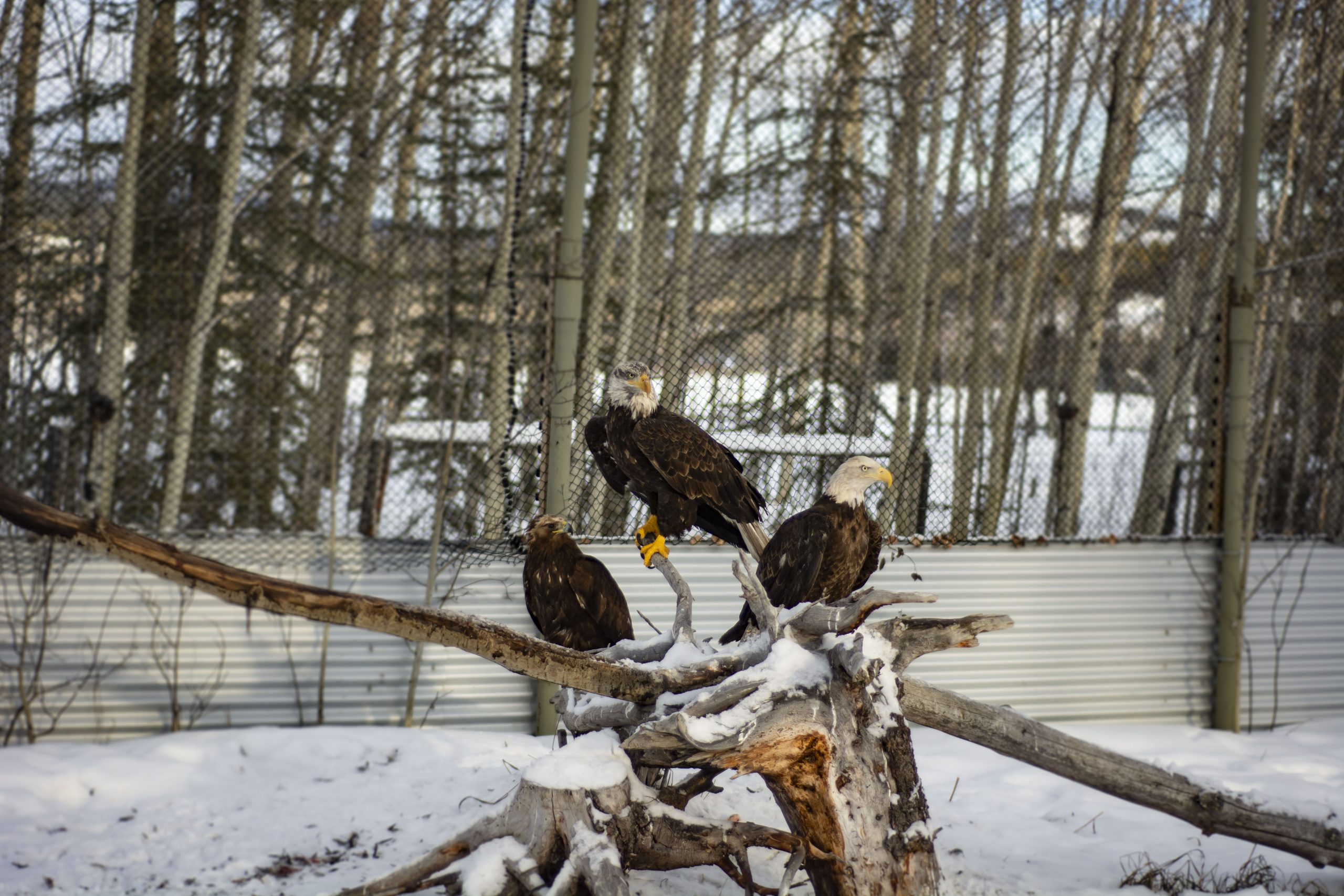
What do the dates; August 7th, September 21st, and October 20th have in common?  Well, each of these days the Yukon Wildlife Preserve's Wildlife Rehabilitation Centre received a new patient, with each those being an eagle. It started with the Golden Eagles arrival from Watson Lake, followed by a Bald Eagle from Jake's Corner, and another Bald Eagle from Mayo.  While an arrival of an animal, into the centre for care by the team at the Preserve, isn't distinctive; it is unusual to receive an influx of eagles in the fall.

Seen from left to right is the Golden Eagle, the younger Bald Eagle with scapular injury from Jake's Corner, and the older Bald Eagle with carpal infection from Mayo.

Over the years, the Rehabilitation Centre has admitted many eagles - both golden and bald. Some of these occasions have occurred to eaglets, some adults. Some of these have been due to injury to the individual - like from a nest blowing over in strong winds (they're nests are built over years and with time can weigh hundreds of pounds, which for our small northern trees can sometimes be just too much to support).1https://www.nationaleaglecenter.org/eagle-nesting-young/ Often times, we do not know the circumstances around an animals ailment but can gain insight from x-rays as to why an animal might be behaving differently than we might expect - like the successful juvenile bald eagle rehabilitation from summer 2020. A common thread for many of these eagles is admittance timing - usually in the Spring and Summer. 

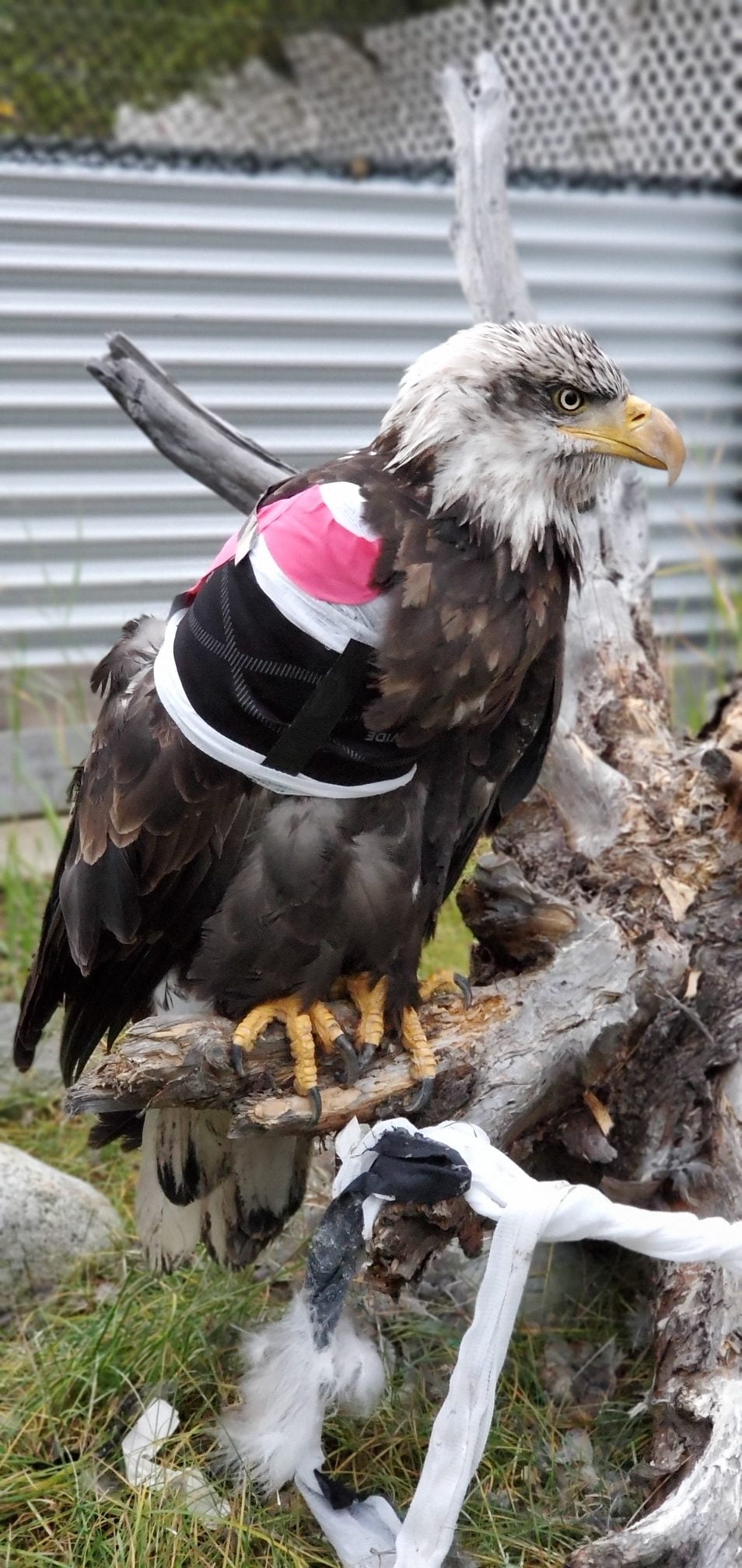
Several months have passed since the three birds Fall time admittance. This time has allowed each eagle recovery, to some degree but there's much road ahead still for them each. We'll start first with the younger, (white with brown head) Bald Eagle from Jake's Corner.  A fracture to the scapular caused the animal to be flightless in the wild. The injury has healed. The wing was wrapped for 2 months to immobilize the wing but this does cause muscle atrophy - just like in humans who are casted following a bone break. The eagle was contained in a small aviary to help reduce its movements to maintain fracture alignment and eventual bone fusion.

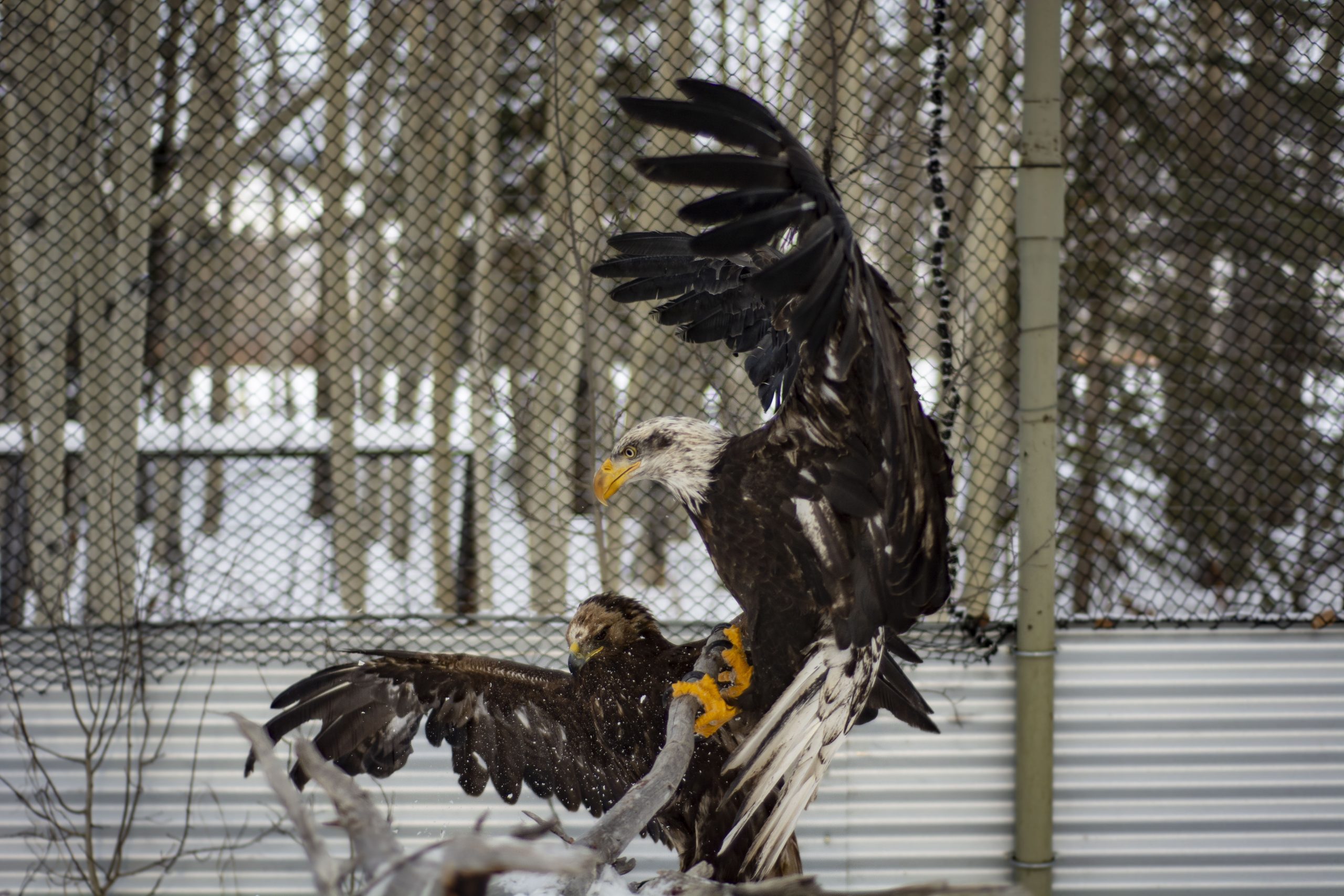
Once this stage of recovery was met, the eagle was moved into the large aviary. This is an important phase of the recovery process for the bird -  movement and flight tests. This individual can fly, and will spend the rest of the winter building up flight muscles in the aviary to support its probable return to the wild in the spring!

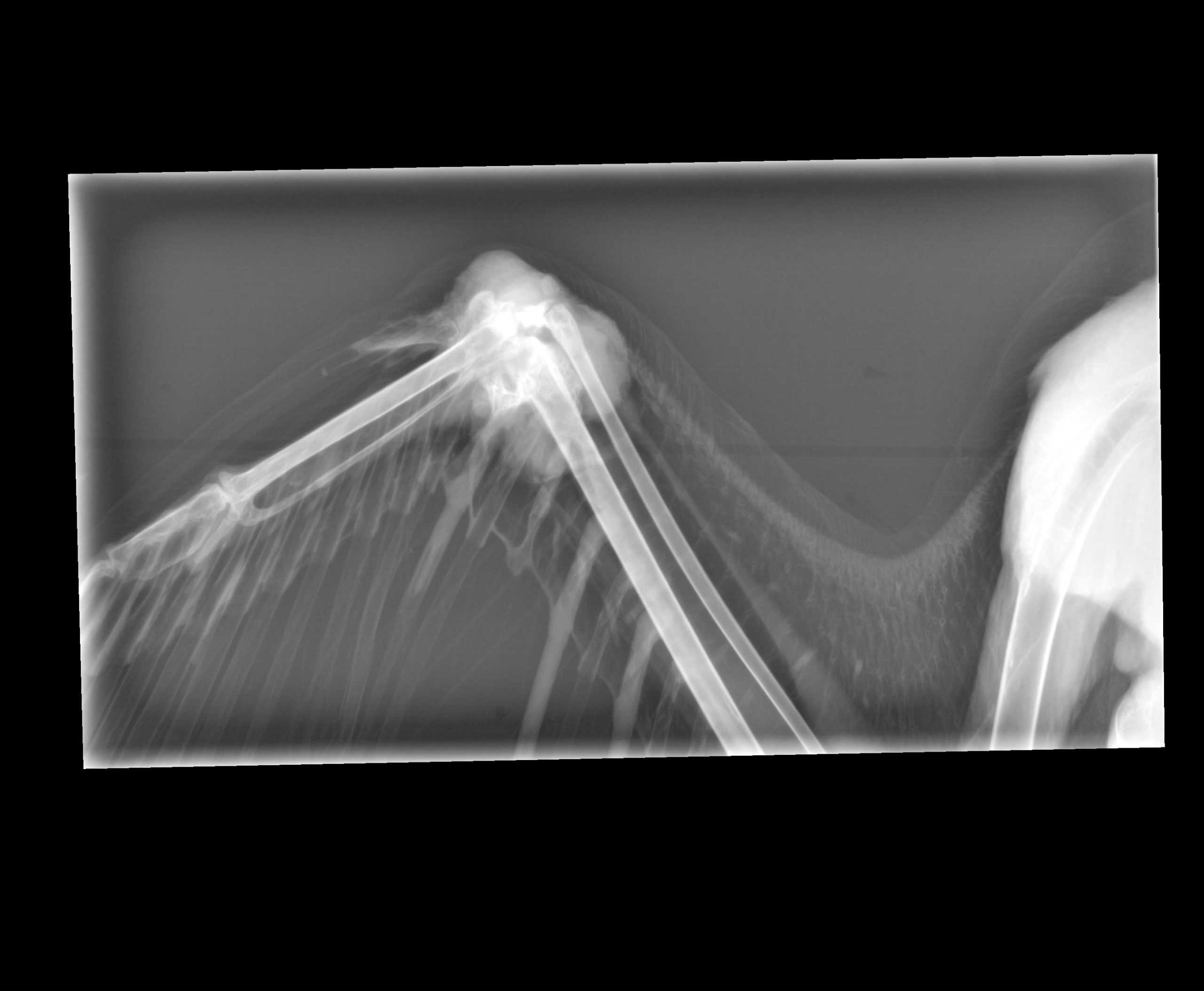
The older (full white head) Bald Eagle who suffered from severe chronic infection of the right carpal joint was initially treated with a small hope that even though the integrity of the joint was compromised the eagle might still be able to fly well enough and survive in the wild after the infection was controlled and the wing healed. However, based on most current radiographic imaging and physical exam, done by Dr. Maria Hallock and the Animal Care team, the prognosis is poor. While the infection is cleared and the joint has healed, its integrity is compromised - this will prevent the eagle from being able to fly uninhibited. Observations of the animal in the large aviary has seen it able to gain lift up to 6 feet and fly off the perch within the aviary but unable to maintain latitude for more than 20 feet. 

The Preserve will continue to care for this individaul through the remainder of the winter. We will continue to monitor and observe its behaviour.

Finally, the Golden Eagle has had the longest and most challenging recovery of the three. While we are happy to report that the left foot has recovered from the infection due to porcupine quills; the right foot is severely compromised due to the infection. This has resulted in multiple bone dissolution and loss of the skeletal and ligamentous integrity of the foot and consequently loss of its function. The bird can perch but cannot grasp effectively with the right foot. The bird still has a long way to its full recovery. At this time it does not look probable for the bird to be released back into the wild sucessfully due to this loss of functionality in the foot - an important tool for a bird of bird such as this to capture its food to survive.

The x-ray image of the Golden Eagle's feet shows significantly compromised structure between the right and the left. The left foot was imaged with the banadaging on his feet still. The Golden Eagle is observed to be perching, and with the other birds, more and more. This is a postive progression from when he was often observed resting on stomache and on the ground, rathern than higher perch.

Each of these birds are on their own path to recovery. The Preserve continues to provide care through, mostly now, feeding and observation. These birds eat a lot! If you are able to support the ongoing care of these animals please consider donating to the Wildlife Rehabiliation and Resaearch Centre Fund.

While we progress through winter and meet spring the Preserve's Animal Care team will reevaluate each individual and their release back to the wild or the alternative. The alternatives could include remaining at the Yukon Wildlife Preserve to live out their life and offer education and an opportunity to personally connect with such a magnificent creature. This will be a significant investment, up to a 25 year commitment, given the birds average lifespan and food requirements, however that the Preserve may not be able to provide this given the expenses. Another alternative may be to place them in another animal care facility or CAZA accredited institution.  Time will tell, to be continued . . .

Photo credits:  L. Caskenette

Lindsay Caskenette

Lindsay Caskenette

Manager Visitor Services

Lindsay joined the Wildlife Preserve team March 2014. Originally from Ontario, she came to the Yukon in search of new adventures and new career challenges. Lindsay holds a degree in Environmental Studies with honours from Wilfrid Laurier University and brings with her a strong passion for sharing what nature, animals, and the environment can teach us.

867-456-7400
Lindsay@yukonwildlife.ca

Explore by Category

Explore by Author

A Beginner’s Guide to iNaturalist:

A Beginner’s Guide to iNaturalist:

nature

by Joelle Ingram | Jan 22, 2021

This article was made possible thanks to support from the Environmental Awareness Fund. Engage and educate yourself in this 10-part blog series, about Yukon Biodiversity.

5 minute Read and 8:58 minute Video

How to explore the biodiversity in your own backyard:

Hey there! Are you feeling isolated (and who isn’t in this remote territory, during this plague year, in the cold months)? Would you like to connect to nature? Have you considered iNaturalist? It’s a groovy app available on your phone or computer and it’s essentially an encyclopedia to the wide variety of living organisms in your local area and across the globe.

If you’re new to the app, let me give you the basics. First, go outside. Catch some of the fleeting winter sun, take in some fresh air, and observe your surroundings. Next, spot an interesting organism (plant, animal, bug, algae, etc.) and take a nice, full frame photo of it and upload it to the iNaturalist app. Congratulations! You are now an observer and this thing you have photographed is the first of your (many) observations.

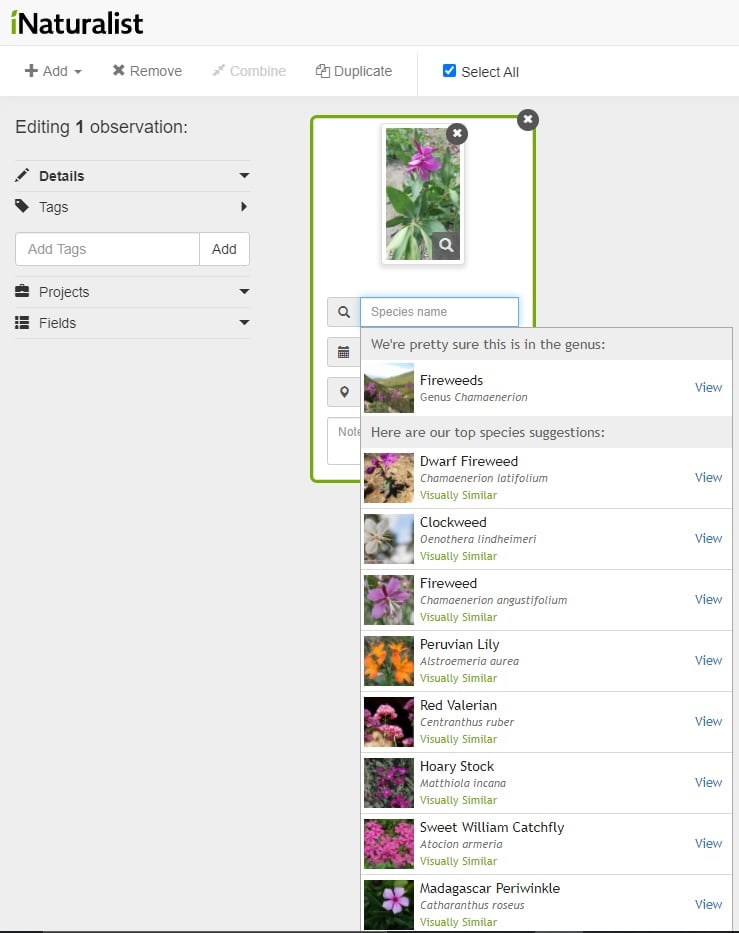
Once you have a photo uploaded, it’s time to build a profile for your observation. Tell us what species you photographed, the date the photo was taken, and where it was located. Not sure what you took a photo of? Not a problem. If you take a peek at the screenshot below, you can see a handy dandy drop-down menu that shows up when you click on the species field and suggests, based on your photo, what species you might have photographed. As you can see, the top suggestion for my photo of dwarf fireweed was… dwarf fireweed! What! WITCHCRAFT (which is code for programming I am both impressed by and don’t understand).

iNaturalist - once you upload your photo you can use the drop down photo suggestion prompt to help identify what in fact you are looking at!

If the dark magic of the iNaturalist app suggested species list doesn’t give you a likely answer, someone else can. This is where the identifiers come into play. The iNaturalist community plays host to specialists and seasoned outdoors enthusiasts whose expertise can put a name to the mystery organisms in your photos.

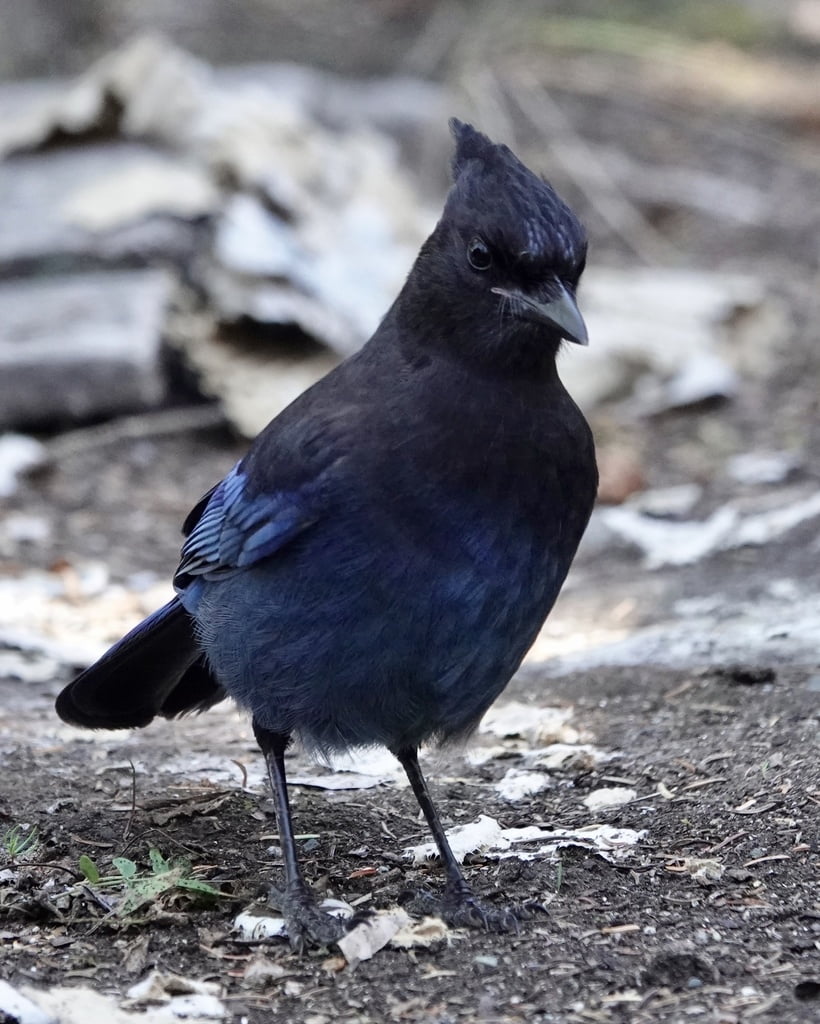
But wait, it’s winter. The insects are dead or dreaming, the fish are under a sizeable roof of ice, and the foliage is exceptionally non-existent. This is all true but that doesn’t mean there aren’t a lot of biodiversity discoveries you can make in the snowy months, far from it in fact. The bird populations in the Yukon change significantly from season to season; the water birds may be gone but the bohemian waxwings are lovely this time of year. We’re also experiencing a rare bird event this winter with the appearance of Steller’s jays. The Steller’s jay is the provincial bird of British Columbia and has only been noted en-masse in the territory twice before this: in 2006 and 1994. This showy blue-black corvid would make a charming addition to your list of iNaturalist observations.

A steller's jay observed in Carcross, Yukon. Photo Credit Cameron Eckert iNaturalist

But wait, there’s more. Act now and you can take advantage of one of the finest animal observing methods gifted to you by winter: animal tracks. Sure, you can spot footprints in mud during the warmer months but the winter offers an endless white canvas for animal feet. Yes, you can also upload photos of animal footprints. Not only do you get to identify the beasties wandering through your neighbourhood but you also learn to identify them even when they aren’t there. That’s some Sherlock level business.

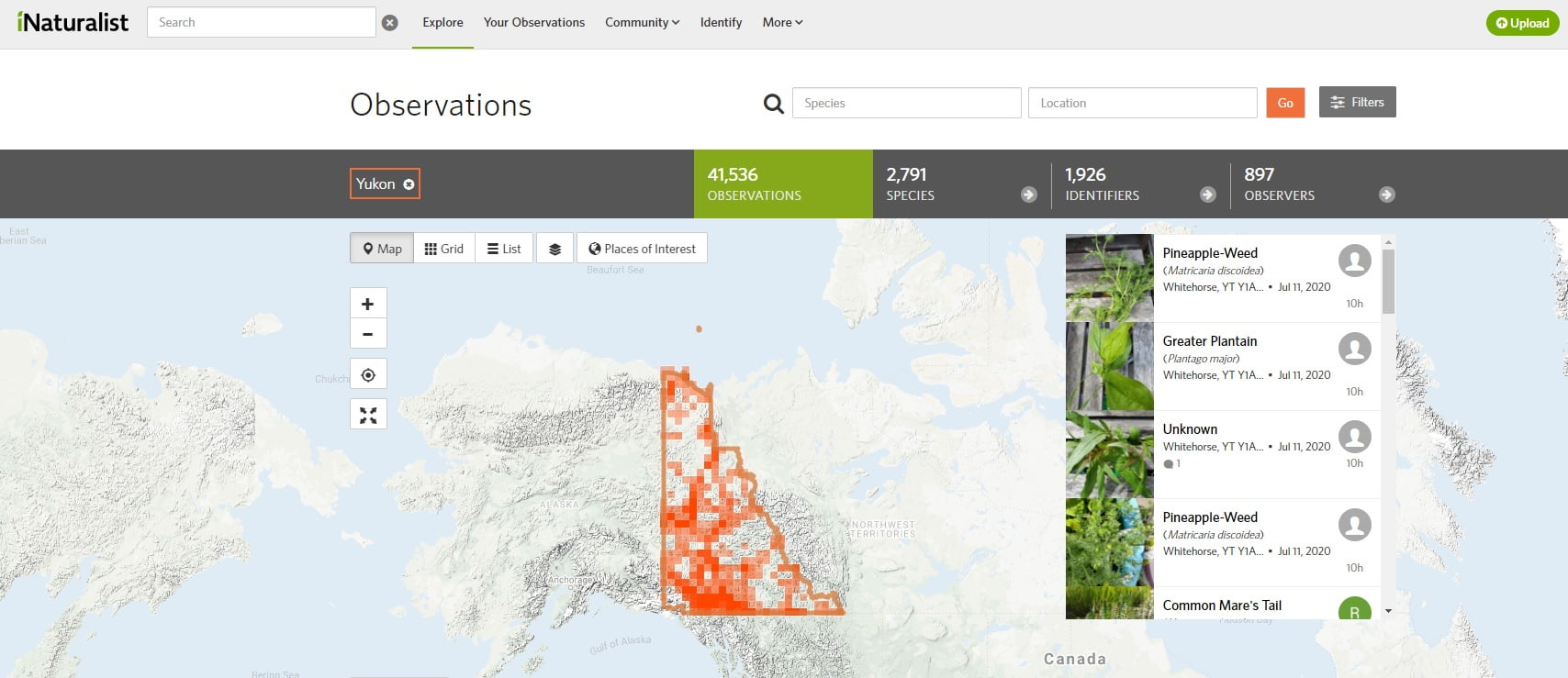
If you don’t feel like meandering outside (and as we move into the colder days, who could blame you), you can check out your local biodiversity from the comfort of your own home. Remember how you enter the location of your observations? That means all observations are placed in a map that lets you check which organisms have been observed in your area or in the destination of your choice.

All the observations in a given region can be seen from a map view. You can then click on each instance to learn more about the obeservation.

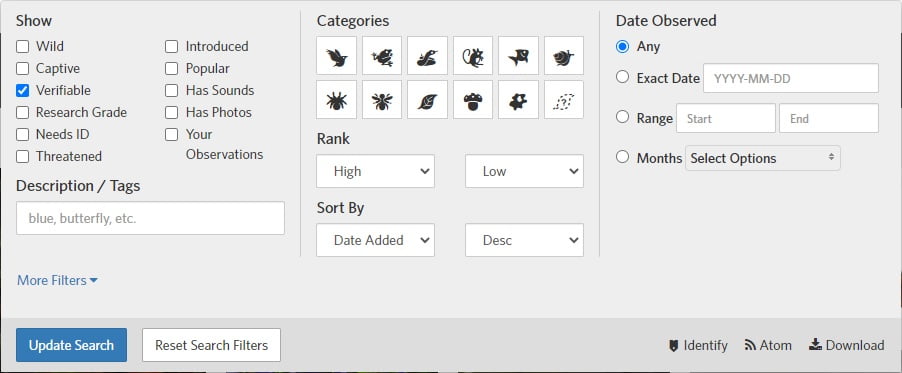
Not interested in your home range? No problem, check in on the gibbon observations in Asia, gaze upon the Macaw palm of South America. The iNaturalist map is a wonderful worldwide experience in biodiversity. You can peruse different species in far-ranging areas based on your interests. iNaturalist lets you check out the organisms based on category (frog, insect, flower, etc.), status (wild, threatened, introduced, needs ID, etc.), and date of observation. Mix it up, check it out, and find something new.

Explore iNaturalist through various categories including species, status, and date of observation. 

The iNaturalist app is an approachable means of connecting professionals and the public for the benefit of biodiversity research. The annual Bioblitzes are a great example of this. A Bioblitz is used to determine the health and diversity of an ecosystem by bringing together the local community of both specialists and the enthusiastic public to observe and record as many species as possible in a limited area within an equally limited timeframe to create a “snapshot” of the living things in a specific region. Outside of general curiosity, the data from a Bioblitz can inform decisions about wildlife management and future research.

The 2020 Yukon Bioblitz was held at our very own Yukon Wildlife Preserve in the short span of July 8-10 2020. Not to brag, but the Wildlife Preserve is a great local for a Bioblitz because it’s composed of a diverse array of habitats including forests, meadows, and wetlands which in turn host a variety of plant, animal, and fungi species. Unfortunately, the intentional residents of the Wildlife Preserve were not included in the Bioblitz observations. It would be very impressive to add a muskox or a lynx to your iNaturalist observation repertoire but if they’re full-time residents of the Wildlife Preserve, they’re not necessarily representative of the type or amount of these species that would be present in this area. Alas.

Over the three days of the 2020 Bioblitz, a horde of experts (like Dan Peach - mosquito man) and the public (including me) descended upon the Wildlife Preserve to document every and any species they came across. Even without the residents of the Wildlife Preserve, there were over 400 species recorded during the Bioblitz. That’s a lot! For a little perspective, this count includes:

The Count List
  • 2 species of algae
  • 1 amphibian
  • 22 species of beetle
  • 62 bird species
  • 12 species of moss
  • 1 centipede
  • 18 species of flies
  • 57 species of fungi and lichens
  • 11 species of true bugs
  • 31 species of bees, wasps, ants
  • 18 species of butterflies and moths
  • 8 mammal species
  • 7 species of snails
  • 11 species of dragonflies
  • 1 grasshopper
  • 1 pot worm
  • 8 spider species
  • 182 species of vascular plants
  • And a partridge in a pear tree
  • (Just kidding, partridges aren’t indigenous to the Yukon.)
  • (And neither are pear trees.)

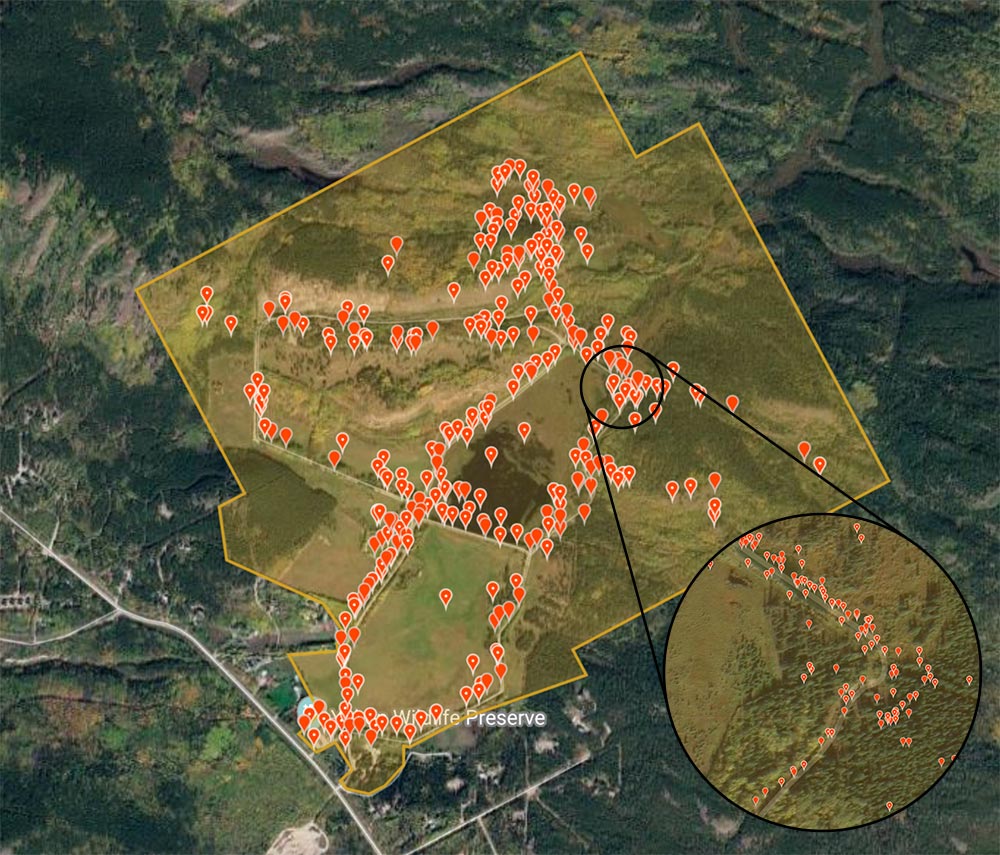
For the full species list and the distribution map, check it out here!

The Bioblitz provides a snapshot of what’s present in the territory but there are 482,443 km² of territory to explore. Imagine what else you could find. Get out there, observe, record, and have a good time!

Video shot and edited by Jake Paleczny.

Joelle Ingram

Joelle Ingram

Human of Many Talents

Joelle is a former archaeologist, former wildlife interpreter, and a full-time random fact enthusiast. She received her master’s degree in anthropology from McMaster University. One of the four people who read her thesis gave it the glowing review “It’s a paper that would appeal to very specific group of people,” which is probably why only four people have read it. Her favourite land mammal is a muskox, her favourite aquatic mammal is a narwhal. She thinks it’s important that you know that.

867-456-7400
 info@yukonwildlife.ca

Explore by Category

Explore by Author